
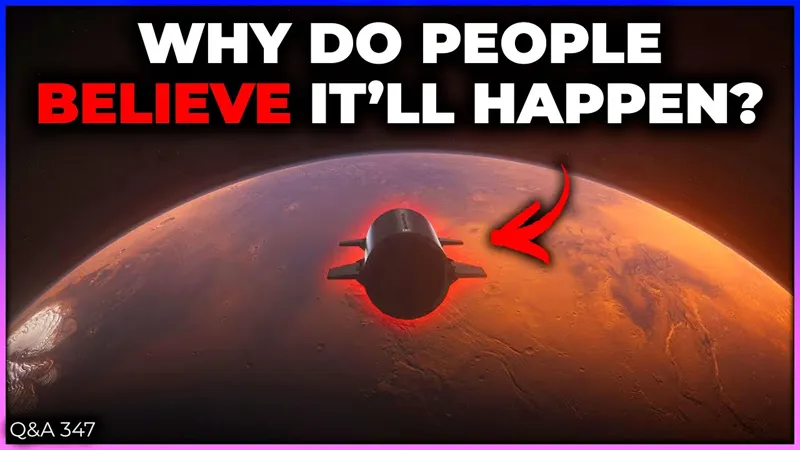

[Q&A+] Starships on Mars, Molten Salt Moon Batteries, Observable Universe | Q&A 347
Why do people believe Starships will go to Mars? Can we use molten salt batteries on the Moon? What's the difference between the Universe and the Observable Universe? And in Q&A+, what's the chance of hitting an stone during an interstellar voyage?
Watch the video here (with no ads) or on YouTube: https://youtu.be/pbAZmQ2Sh80
Comments (8)
Fraser, we all know the odds of successfully navigating an asteroid field are approximately 3,720 to 1! In all seriousness, though, I could see an interstellar spaceship keeping a giant water tank at the very front of the ship that was at least 2 meters deep, and large enough to keep all of its rotating crewed sections in the shield-tank's shadow. That would be a LOT of water, but there are a lot of icy bodies in the solar system.
Finally came over her to listen but i can't turn my screen off while the episode plays. I'll have a bit of a play around while I'm listening to this one but might have go back to youtube, sorry. Love the show etc
The limiting factor for how big a mirror of a telescope can be is how many superlatives you can muster : large, giant, very large, extremely large, overwhelmingly large... ;-)
Humongously mahoosive telescope.
Regarding Scott Manley’s announcement… Hear! Hear! Support Scott on Patreon and enjoy his videos advert-free on Odysee.
Although he made a lot of different and wild predictions, I would say Philip K Dick was the one who came closest to understanding how computers would weird out our world and our consciousness. I remember reading a story in which a guy talks to a computer and asks it to give him ideas for how to write a speech. The way he interacted with it was almost exactly the way you would interact with chat gpt. This was in the 60s when computers were still the size of a small building and you interacted with them through punch cards.
William Gibson predicted virtual reality and computer among other things.
I agree he was a visionnary, but he is not really from what is generally called the "classics" who are a generation earlier.