

[Space Bites+] Weakening Dark Energy // Lunar Radio Telescope // Fuel Depots for Space
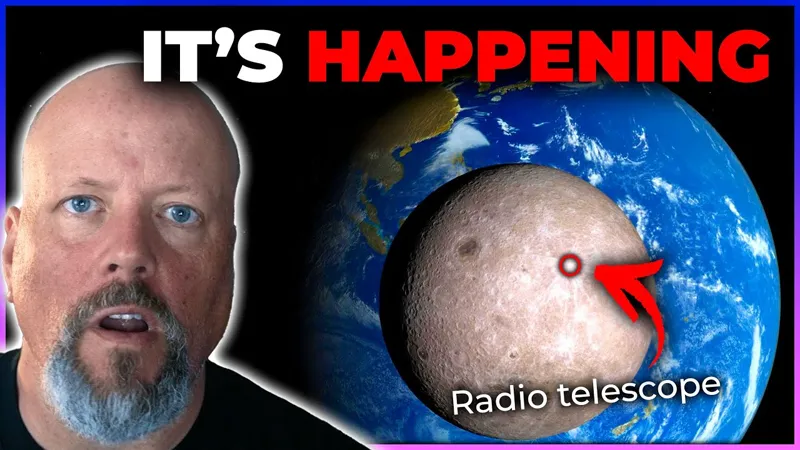
More evidence that dark energy is weakening, cosmic rays could keep life alive under the ice, NASA is building fuel depots in space, and a radio telescope is going to the far side of the Moon. On Space Bites+, how brines could form on the surface of Mars, providing a habitat for life.
Watch the video here (with no ads) or on YouTube: https://youtu.be/04AJW2jVsW0
Comments (19)
On the topic of keeping our fuel depots cold, why don’t we just place a bunch of them behind earth’s or the moon’s shadow? What would be the orbital bechanics to make something like that work?
Currently obsessed with the Expanse novels and thinking about all the possibilities of near-Earth space habitation. 😃
Current obsession: the route to robotic autonomy in space, aka von Neumann probes. The ability of such systems to protect their parent planet as well as explore.
How will the Radio Telescope on the moon far side communicate data back to earth? Are there comm satellites around the moon already? That is my observation better communication processes for far flung objects through out the system. How can higher data rates be sustained?
Am definitely obsessed with sending extra-solar probes to nearby solar systems. Ever since I've heard of Parker's solar probe maximum achieved speeds I realized you can basically quantify that as a percentage of c (0.064%, but still). Yes, it'd still take well over 6000 years to reach the nearest systems, but imagine we made our probes ("only") about 100x faster through various technological advancements? Suddenly we're down to 60 years, an actually (somewhat) feasible proposition. And Parker Solar Probe is a bit of an unwieldy and large object, ever since I've read about sophons I've been enchanted by this concept of smaller stuff being easier to send across vast distances. Between continuous miniaturization of electronics, improving material sciences and steadily progressing practical space-faring engineering advancements, the probes we eventually actually send to shoot through the neighboring systems will presumably be small, perhaps 10x10cm or even smaller. On the other hand propulsion systems advanced enough to give tiny things a massive push are being developed as we speak (solar sails -> for example the variant p. David Kipping came up with recently - definitely liked the initial 'pre-launch' system, 'charging' it up with kinetic energy through spinning before shooting it off is a great engineering idea - and I'm sure we'll come up with plenty more). Relatively basic reasons that exist for our current 2nd quasi 'space-race' aside, the colonization of moon, humans on Mars grandstanding, extra-solar chunks of rock - this all adds up to a substantial media hype which theoreticaly shouldn't hurt general funding (well, in most countries that aren't in a state of global decline at the moment anyway). It is definitely a golden age for astronomy in general and hopefully we can capitalize on it as much as possible - and one day, perhaps before I die of old age, reach a level of technological advancement where such probes turn from dream into something resembling a viable possibility.
I am obsessed with planets, especially terrestrial and Earth-like planets. I try to check new papers that come out on Arxiv about their atmospheres/outgassing, possible hydrospheres, volcanic activity, water-mass fractions. I like imagining what they might be like, whether they might have tectonics. I also keep wondering how accurate radial velocity measurements are. For instance, Barnard's star has planets that are roughly 0.3 Earth Masses (at minimum). I am wondering if there are any ways to know the maximum, whether they could be even Earth-mass or higher. Whenever I read about planetary systems discovered by RV, I am not sure how much I can trust the numbers
Im obsessed with stellar occultations. I'd love to hear in interview with someone who studies these, whether to map the shapes of asteroids or study planetary atmospheres/rings
Currently into plasma nitrogen fixation, basically the precursor to the Haber-Bosch process that fixed the majority of the nitrogen that is in our bodies. It isn't exactly a promising replacement to Haber since the efficiency only gets close in the lab and probably couldn't get better at scale, but it is very simple and you can do it anywhere since the tech is basic and it just needs air and water, whereas Haber-Bosch is seriously industrial. I'm currently putting together a small gliding-arc plasma-water reactor, I might see if I can simplify it down to a cheap bit of kit that someone out in the middle of nowhere with some solar panels could use to make a little nitrogen fertiliser. As for space stuff, I was recently curious about whether neutron star charge can oscillate when they are accreting matter, due to the magnetic field setting up an electric field over the accretion disc and separating charges in the accreting matter to some degree, and then those charges end up on the spinning neutron star and change its magnetic field a little bit, so maybe there is a feedback loop there that could result in some oscillation, maybe even putting out some radio emissions? The base effects are well known but I couldn't find anyone talking about the system oscillating, maybe it's always self-damping or just too small of an effect to care about, but it was an interesting thought.
I am obsessed with the habitable worlds observatory!! The reason I get so excited about every space telescope is that we get a little closer at finding other earth like planets, or perhaps finding out that there are none, which would be equally if not more shocking! I am all about advancing SETI!
I am obsessed with what I could share in a message to the US congress about the importance of NASA. A summary in a way of all the technological advances we are yet to discover. All of the scientific discoveries that are critical to humanity and our future. This could be a group effort of your staff, your listeners,and your expert guests. I’d love to see something like this created and published in international newspapers. What do you think?
In the Big Beautiful Bill. $10 Billion allocated to NASA
As for what I am obsessed with: AI development and its impact. AIs are getting much better... not just LLMs, but all the other things that aren't ChatGPT. People think that AI is only chatbots and deepfake image generators, but that's just a small part of the overall picture. Six-fingered images aside, AI is getting super-humanly capable very quickly, especially in functions in which it's about objective accuracy rather than subjective quality. The ability of LLMs to mirror human conversations is also becoming downright uncanny. I'm rereading Frederick Pohl's "Gateway" with a particular focus on "Sigfrid" for that reason, and not eager to reread Harlan Ellison for that same reason. I'm very worried about where this is leading. I don't see a Roddenberry-esque season 1 ST:TNG utopia in which we drink tea (Earl Grey, hot), hang out in the holodeck with spicy simulations, and "better ourselves by listening to music no newer than 400 years old". What I see are elites whose lives and positions are managed/supported by AI, and billions of unemployed "nonproductive/surplus" people who can't afford the benefits of AI because they don't produce anything the elites want. It won't end well. This is ironic, because I have seven patents pending in AI-enabled cybersecurity. I guess I'm part of the problem.
I'm obsessed with the origin of time, as in the book by Hertog. There are some really deep questions here, raised by Stephen Hawking when he was still alive. And no, not related; mine ends in s not g!
at 9:58 it's about 4.5 Billion, not 4.5 Million years ago, when the Mars sized object hit the Earth to form the Moon. I think you should correct that somehow. Probably a slip of the tongue, but anyway...
And, in another "speako" (akin to a typo, but for spoken words), at 23:40, Fraser says that the Moon doesn't have to have the Moon to stabilise its axial tilt. Should have been "Mars doesn't have..." Oh well...
So here's a question. Why not deliver solid fuel modules instead of liquid? Solid rocket motors will be much easier to move around, decouple/attach, store in orbit etc. than the complexity of liquid fuel transfer and storage. Sure, liquid is nicely throttleable, good for turning engines on and off and all that, but the bulk of specific impulse is in continuous-burn high output... the . Save your liquid fuel for steering and fine adjustments; use solid fuel for deorbit burns, ascent and escape.
Solids are generally heavy, or in other words, provide less efficiency (lower Isp). plus the fact that once they go.. they go.. you aren't stopping them. One way to solve the problem with storing propellants is to go with liquid propellants which are stable at higher temperatures as opposed to cryogenic propellants. Still, that would only solve the storage, not the fuel transfer. Moving fluids is generally easier than moving solids. If you have gravity, it becomes much easier. If you are in microgravity you can still achieve the same effect with artificial gravity generation (by putting two spacecraft into rotation relative to one another. It doesn't even need to be very fast rotation). Then you "only" need your transfer tubes to be in a correct configuration for the fluids to flow where you want them to and an active system to control it all. Easier said than done, but it should still be easier than using solids. Also, keep in mind that solid fuel needs to be cast into the SRB (which is essentially a metal tube with a nozzle and some controls) and then needs to sit for a few months for it to settle down. Only then it can be actually used. It's not as if you could just throw solid pellets into and SRB and use it immediately. You would have to replace the whole SRB each time. But of course, you could use solid fuel. It's just that the main benefit of solids is that they provide high thrust. This is much more useful as a first stage on a rocket than in the space or on the moon (where you can easily get away with low thrust). Unless you have some niche reason for why to do that.
I'm self hosting a bunch if services on my own kubernetes cluster. I'm also working on some iot things with esphome and home assistant. My garden has also been keeping me busy, I just made 6 jars of pickles lol.
Obsession: how can I use AI to help me progress in learning new skills and in being more productive in my personal and professional life.