

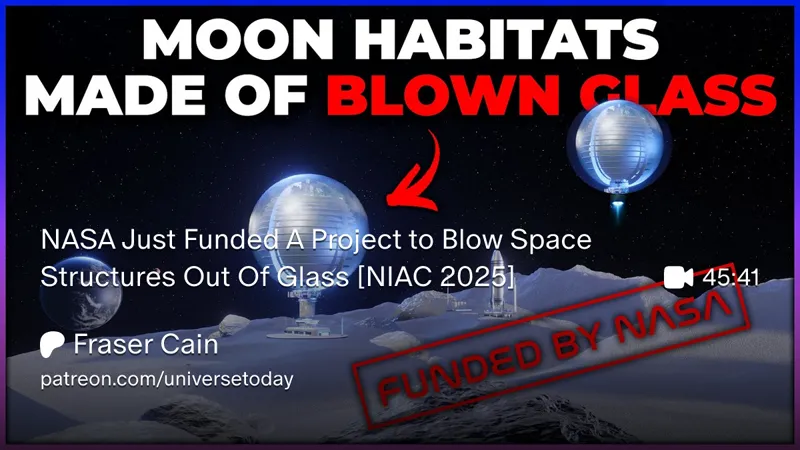
NASA Just Funded A Project to Blow Space Structures Out Of Glass [NIAC 2025]
NASA just funded a NIAC project to study the possibility of building large structures on the Moon, on Mars and in space out of glass. Blowing glass bubbles similarly to how it's done on Earth.
Watch the video here (with no ads) or on YouTube: https://youtu.be/p-eGu_RGCOI
Comments (8)
Interesting idea, but (one of) my question: what holds the weight of the whole structure, with lot of "bubbles"? Can the furnace do it?
That's what their tests will hope to find out.
I have so many questions after watching this video. Although the video clip showing the nested bubbles expanding from the lunar surface is extremely cool, it triggered my engineering background. On earth we can blow bubbles (balloons) because there is an outside atmosphere that offers bouyancy (lift) when we need it to overcome gravity. We simply inflate the bubble using a lighter gas than the heavier atmospheric gas surrounding the bubble. If anyone tries to build one of these glass spheres on any body with significant gravity but no atmosphere, however, then how is gravity's downward pull offset? Glass is VERY heavy. Even at 1/6 earth's gravity, a bubble of borosilicate glass 4" thick and 20 meters wide will weigh a lot: 550 metric tons on earth and 90 metric tons on the moon. What upward force is keeping 90 metric tons of glass suspended high above the base while it is being blown and deformable? Internal gas pressure would indeed try to make it spherical, but in my mind's eye that much weight would flatten the sphere and pull the heavy molten bubble to the ground all around the base. The glass will simply flow down and not up into the sky. Since gravity is the problem (at least to me), I see no problem building the perfectly round, and nested glass spheres in orbit where this all makes sense. But then getting this beautifully constructed glass orb onto any surface would be a nightmare. Leave it in space!
This sounds absolutely insane - but I love it!
Yeah, it really shows how "out there" NIAC projects can be.
I wonder what is happening with the crystalline structure, is there any similarities to a prince ruperts drop than can be applied? Or is it possible to blow some type of polymer layer internally, similar to safety glass? What is the failure modes of the glass, large sharp shards or many tiny pieces? What about filling the space between layers with water? Would there be any issues with a lensing effect, are you the ant under the magnifying glass? What about bringing dopants for the melt, such as lead (for radiation protection) or boron (for C.O.E properties), or something to filter the solar visible spectrum to be closer to earths surface? Also thanks for the interview!
Silver Oxide is used in "Recto-light" sunglasses.
People who live in glass houses shouldn't throw stones. But it sounds like they thought of that. Lol Love these ideas that utilize the natural resources of the moon/planet we want to set up on. Who knew that a glass blower and a 3D printer is almost all you need! And with the glass blower you can also make your terrarium for the garden 😁