
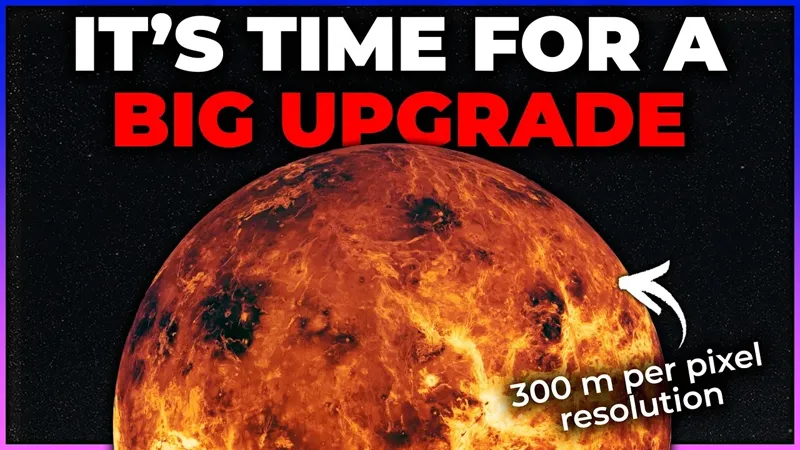

Our Best Venus Map Is 36 Years Old. NASA Wants to Fix it With Balloons [NIAC 2025]
Venus has a thick layer of clouds that obscures our view of the surface. To tackle that, this NIAC project suggests launching a balloon with a tether that will go below the cloud layer and help us image Venus's surface.
Watch the video here (with no ads) or on YouTube: https://youtu.be/BePPHPj6uo8
Comments (6)
Maybe it's time for Canada to leave the US sphere a little further and upgrade to 220/415 voltages so cables don't need to be so thick going to your houses.
Why not use nuclear to power the payload carried by the balloon? The mars rovers are doing great
A nuclear power plant will be too heavy for the 1mm thin wire to support. If the wire gets any thicker it will cause too much drag.
Great interview. Could people ride in this balloon? What would it take to shuttle people to and from a craft circling Venus in the clouds?
Can the balloon navigate to higher or lower latitudes to attempt a helical path around Venus? I envision the balloon would be stuck in a path within only a few degrees north or south of the equator.
Another great interview Fraser. Thanks for the update with Dr Benjamin Hockman. I'm kinda jealous, what a great job he has! Interesting conversation re the idea of a tethered tow-body doing science, getting visual and possibly, even a surface sample! Great Interview. I'm surprised though that you didn't bring up other potential data gathering methods besides the tethered tow-body albeit that's Dr Hockman's current focus). I also get the difficulty of supplying power where needed though too. Perhaps you could have added questions like: how about deploying lots of smaller gliding, drifting probes dropped from the gondola to the surface like "ceramic" paper darts or parachutes with different instruments at intervals (maybe even these could be recoverable) - or buoy type transmitters that drift at different altitudes sensing until they die. Does the chemical makeup of the Venusian atmosphere pose particular problems for wireless signal transmissions or magnetism - presumably, heat near the surface will make the use of magnets, say to pick up landed surface sample darts, impossible? Conversations for another day perhaps.