

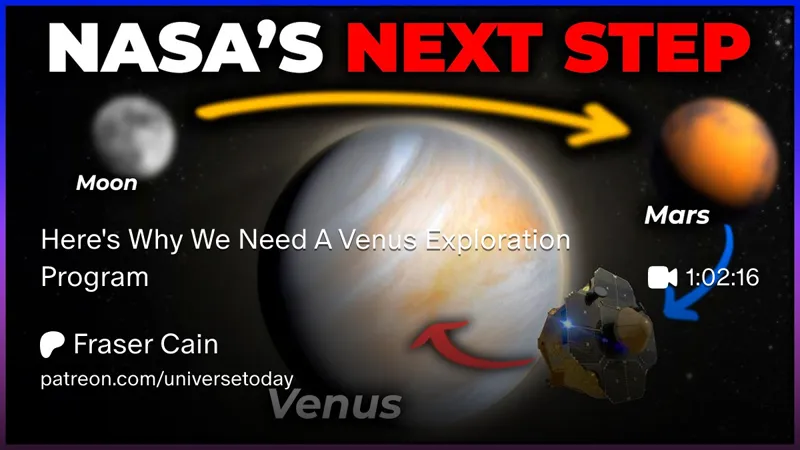
Here's Why We Need A Venus Exploration Program
Venus is closer than Mars. It's more Earth-like. We can bring back samples from it. But it's chronically underexlored. This is why we need a Venus Exploration Program!
🟣 Guest: Dr Paul Byrne https://arxiv.org/pdf/2412.06830
Watch the video here (with no ads) or on YouTube: https://www.youtube.com/watch?v=qshaDSStFPY
Comments (7)
To address your initial comments, a mothership probe with multiple small sats could use gravity assist to get into orbit around Venus and then deploy rideshare small sats to orbit Venus or even descend to the clouds and or surface. There are some great materials that can help withstand the great heat and pressure of a Venusian surface. And I'm sure lots of good research being done to advance the technology required for such missions - obviously, this will be key to realising such missions.
Very true if the mothership was going to Venus and not just passing by to get a change of velocity out of the encounter. My point was just for the gravity assist maneuver, where essentially the vehicle getting the assist is hyperbolic to Venus, any small sats would need independent propulsion to get into orbit, enter the atmosphere, or whatever. Cassini at Titan and the Vega probes at Venus aimed at the target, released probes, and then did burns to change their own velocity afterwards, so at least for the Vegas, that's sort of a gravity assist, but that wouldn't work for an orbital small sat unless it could aerobrake. (And I'll figure out how to properly do a carriage return in Patreon one of these days)
A fascinating interview Fraser. Thanks. Given the challenges we are experiencing with Earth's climate change, I suggest that we could/ should, have a Venus mission to send a large solar shield to be positioned between Venus and the Sun to cut a known amount of radiation from the Sun so that we can see the effect it has on Venus (before we experiment doing this to Earth). Venus would be an ideal subject to study this as all the components of the experiment are extremes. Such a mission would also provide a mechanism for other interesting studies of Venus too.
Great speaker and veery interesting interview, thank you again Fraser for bringing these very interesting people into our lives.
I like the idea of adding small payloads to missions that use Venus for gravity assist, but since the whole point of a Venus gravity assist is to go faster, I would think that any ride-alone payload would need to either aerobrake or have enough propellant to slow to orbital velocity. Or else it would just be flyby smallsat which, I suppose could also, if cleverly pointed, help with the gravity assist, but that's just fly-bys. Orbital small stats need a way to slow down.
Correct me if I'm wrong but a "gravity assist" manoeuvre can speed up or slow down a passing spacecraft - it just depends on the trajectory of the spacecraft being with or against the rotation of the planet giving the assistance. In both cases, energy is transferred from one body to the other.
The audio from your guest is much poorer quality than the audio from you, our host. Could you possibly improve that for those of us who are hearing impaired? Thanks!