
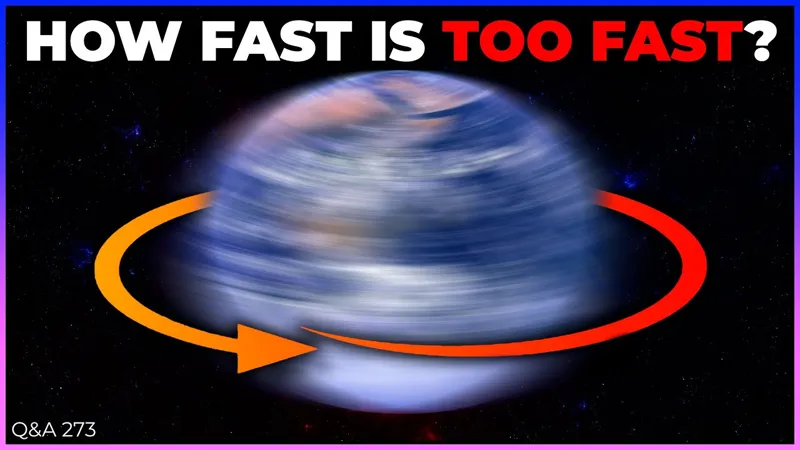

Spin Limit of Earth, True Colours of Exoplanets, Danger from Space Samples | Q&A 273
How fast can the Earth spin before it starts tearing itself apart? Should we be worried about samples from Mars contaminating Earth? Why don't space agencies use standardized platforms for their missions to save costs?
Watch the video here (with no ads) or on YouTube: https://www.youtube.com/watch?v=uibgztL2wEA
Here's a link to the full, unedited live stream: https://youtube.com/live/fYlp37PzqxA
Comments (2)
Thanks for great channel, Fraser! But I must correct a major physics error. A viewer asked you about how satellites stay in orbit. You said that the inward force of gravity is balanced by the outward centrifugal force. This is incorrect. If the forces on the satellite were balanced, so that there was no net force, the satellite would experience no acceleration and so would fly off in a straight line (Newton's first law of motion). In reality, there is just a single force, that of gravity acting inward, whose acceleration = G M / r^2 (where M is the planet's mass and r is the distance to the planet's center from the satellite) must provide exactly the acceleration needed to keep an object on (say) a circular orbit = v^2 / r, where v is the satellite's velocity. A force F applied at right angles to an object's motion v does no work upon it (because that's equal to F x v x cos (a), [aka the "dot product" of the force vector with the velocity vector], where "a" is the angle between them, and cos(a) = 0 when a=90 degrees lol). Thus, no energy is expended to keep an object in orbit. It stays in orbit because the satellite has no way of shedding angular momentum. Thanks! - Alynndarris
Hmm... negative energy; as the red Queen said to Alice "It's very difficult to take less than nothing".