
Try Too Hard, End up Disappointed? New Study
Hey patrons! You've probably already guessed that I'm WAY behind this month thanks to the big SF to LA ride followed by a week of being sickly and pathetic. So this is going live immediately but I'll have another early, ad-free video for you later today!
Transcript:
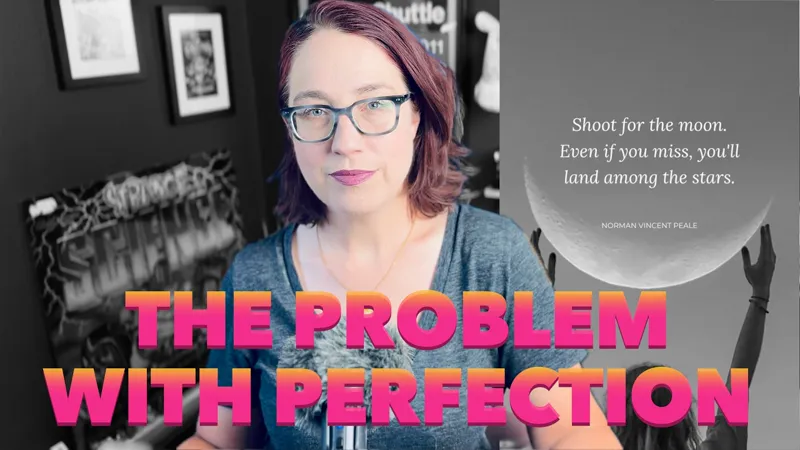
If you’ve ever seen a motivational poster, you’ve probably seen this quote, often attributed to the “positive thinking” preacher Norman Vincent Peale: “Shoot for the moon. Even if you miss, you’ll land among the stars.”
Now, personally, I prefer the bon mot coined by Adlai Stevenson, whose bid for the US presidency was opposed by Peale because he was divorced: “Speaking as a Christian, I find the Apostle Paul appealing and the Apostle Peale appalling,” which is just a truly inspired turn of phrase. “Shoot for the moon; even if you miss, you’ll land among the stars,” meanwhile, falls apart completely under the briefest investigation. Surely you’re aiming for the moon because you’ve made a plan to get there and survive, and even now but much more so back in the mid-20th century if you managed to miss the god damn moon you would end up drifting alone in the cold vacuum of space, left to painfully starve to death while contemplating your fuck-up of epic proportions.
Anyway, a new study supports this more accurate view of the moon/stars platitude: in “Optimal ambition in business, politics and life,” published just last month in Physical Review E, a team of researchers found that when a person is in search of uncertain rewards, like when dating or applying to colleges or finding a job with the right salary, being too ambitious can have a negative effect: if you demand too much, you’ll end up with less than what you would have got had you set your sights lower.
How did they prove this across such a variety of complicated situations? Simple: they didn’t. It wasn’t a real world study–it was a mathematical model applied to more simplistic situations with a variety of hypothetical reward distributions. That’s right, it’s just math. Everybody move along, the nerds got themselves all fired up about numbers and “discovered” that “perfect is the enemy of good.” Another god damn aphorism that’s been around since the stone age.
Okay, so let me lay my cards on the table. I first saw this study a few weeks ago, and it caught my interest because I was just about to embark on the biggest physical challenge of my life, which I mentioned in a few videos prior to this: riding my little bicycle from San Francisco to Los Angeles over six days to raise money for climate action as part of Climate Ride. And to be honest I was a bit annoyed when I saw this headline in the Guardian, which reads “Don’t shoot for the moon: aiming for ‘above average’ is key to success, maths suggests
“Model created by researchers shows better outcomes are often more likely when people are not too ambitious.”
I read that and thought, “Fuck you, I aimed extremely ambitiously high and I’m going to nail it. Stop telling people to aim lower.”
But I actually only had time to read the headline before I embarked on the ride, and we were camping the entire way, so I didn’t have great internet, so all I could really do was stew on that headline and use my annoyance at it to motivate me to pedal every mile.
And it really was ambitious. At the end of 2025, I was in the worst shape of my life. My anxiety was through the roof, my depression was through the floor, I was eating and drinking all my feelings and not exactly keeping up with my cardio. And so I decided that I needed a seemingly insurmountable goal to motivate me to get my shit together. Two years ago when I was in slightly better shape, I just barely limped through a 100-mile bike ride. THIS ride had a 100-mile ride in the middle of a week of 70 to 80-mile rides. If I had had to start riding the day after I signed up for the trip, I would have died. Not metaphorically died, I mean I actually would have passed out on Highway 1 and been pancaked by a dump truck, like Tiny Dinky Daffy. RIP.
But I had about six months, and so I set a ridiculous goal: train on the bike at least four times per week with gradually increasing long rides of up to six hours; continue weight training on days I wasn’t biking; stop drinking alcohol; stop snacking on garbage; and count every calorie I eat and track my protein so that I can lose weight while building or maintaining muscle, because a lot of this ride was heading straight up some mountains and every pound of fat I dropped was one less pound I had to drag up to the top. If I stuck to those rules, in six months I figured I could lose 30 pounds of mostly fat and build enough fitness to ride almost 500 miles to LA.
Ambitious? Absolutely. But did I do it?
No. No, I did not. I did not do that.
Uh, it was hard. Making the choice to sign up for the ride didn’t immediately delete the anxiety and depression at the heart of my bad diet, so it took me months to gradually cut back on my snacking and alcohol drinking. And then in the two weeks before the ride, my anxiety shot to the moon, missed, and continued flying through the inky void of space as my brain started telling me that I had truly fucked up.
On ride day, I was a nervous wreck because I had NOT hit all those intermediary goals that I knew would set me up for success on my “moonshot” goal. I honestly didn’t know whether or not I was going to make it.
But here’s the thing: despite “failing” those goals, I DID make it. I did every inch of that route and glided into Santa Monica triumphant and proud. Take THAT, math nerds who said I shouldn’t have set such an audacious goal! In your faces!
Once I got back to the Bay Area, I finally had the time to crack open the study and read beyond the headline. And I’m sad to report that my singular achievement did not, in fact, negate this mathematical model.
I mean, obviously, a single contrary anecdote is never enough to throw away a population-level model, and in this case they make it pretty clear that they’re only saying that a person is MORE likely to end up disappointed when they are “too unsatisfiable” compared to when they are “too easily satisfied.” That doesn’t mean that every person who refuses to accept less than they think they deserve will end up disappointed…just that “being too unsatisfiable is costlier than being too easily satisfied, on average.”
And the other takeaway is hidden in that same wording: if I thought that I could only do this ride if I had perfectly hit my previous goals, I wouldn’t have gone on the ride. I would have been too unsatisfied with my earlier effort, and postponed the trip until I was satisfied.
But in fact, despite my anxiety, I was satisfied ENOUGH with the work I put in. I had severely cut back on junk food and booze. I had lost 15 pounds! I was riding 50 miles around the Bay by myself. And I knew that even if I went on the trip and ended up needing to tap out and ride in the support van at some point, I would be disappointed but still satisfied ENOUGH that I had improved my physical and mental health to that point.
So this mathematical model (which, as a model, obviously still needs to be tested by other researchers and in real-world situations) isn’t suggesting you shouldn’t set high goals. It’s merely pointing to the importance of understanding your own abilities and the potential rewards that you may be able to achieve. For instance, the researchers even ran scenarios to mimic the effect of social media, where a person may get the wrong idea of how easy it is to achieve certain rewards, leading to greater failure and disappointment.
All of this was in my mind when I stumbled upon another relevant study that was recently published in Psychological Bulletin: “Perfectionism is accelerating over time: A cross-temporal meta-analytic review of 35 years of college student data.”
These researchers posited that as economic instability and wealth inequality rise, young people experience a corresponding rise in perfectionism–an urge to rise above their peers and succeed against the odds by achieving very difficult goals. That can be an admirable drive, but it is also often accompanied by intense self-doubt, anxiety, and depression…a serious fear of fucking up. Gosh, that sounds familiar.
The authors found support for this hypothesis by looking at hundreds of surveys involving nearly 83,000 college students and spanning 35 years. Not only did they see increasing trends of perfectionism and concerns over mistakes in students, but they saw a HUGE jump in the exact type of problem those mathematicians identified: “socially prescribed perfectionism,” which is the sense that you need to be perfect because it’s what others expect of you, as opposed to what you expect of yourself. They note that it started exploding in the early 2000s, and suggest that social media may play a part: everyone is watching you, and you are watching everyone else. You’re all just out there posting your wins, and so everyone assumes that those Ws are all that’s expected of you.
It’s a problem, in part because yeah, that shit is linked to an increase in anxiety and depression. And further, it’s a problem because it ends up having the opposite effect on your life: if you’re too afraid of failure, you will often decide that it’s not worth even trying. You end up telling yourself you can’t do something hard, when the reality is that you don’t want to do it because if you don’t do it perfectly then people will judge you.
That’s one reason I wanted to make this video, and it’s also why I was brutally honest about how hard it was to complete my first century. The past six months have been hard, and the days leading up to the ride were a nightmare of anxiety because I was worried I was going to fail. But man, am I glad I did it. I might not be the muscled goddess I was shooting for, but I’m a thousand times healthier now than I was six months ago. And I conquered a serious fear I’ve had for some time, which is biking up extremely steep hills with no shoulder and heavy car traffic.
And to reward you for making it to the end of this video (before the best reward, which of course will be a video of Indy), I’ll tell you about the biggest failure I had ON the ride.
Midweek, we had a day with about 94 miles of riding. At around mile 57, we hit a quarter mile section with a grade of 15 to 30%. If you don’t know inclines, feel free to take a minute and pull up an online map of your own nearest steep hill to check the grade in reference, but let me tell you, that is absolutely brutal. Way beyond anything I had trained for even in the famously hilly Bay Area. There was no shoulder at all, and there were a lot of cars. I made it nearly to the top when I realized I just had absolutely no gas left. I was gasping for air and my legs felt like dead weights. There was nowhere to go, though, except…I soldiered on until there was a brief gap in traffic, at which point I unclipped one foot and tipped over into the bushes on the side of the road.
As I caught my breath, a car drove past and I saw the driver looking at me with concern, so I gave a little wave and picked myself up. At another gap in traffic, I dragged my bike to a slightly flatter spot, got back on, and continued down the road.
About ten minutes later, I was riding down the road when I heard a car coming up behind me. I heard it slow down. I looked over my shoulder as it came parallel to me and the passenger window rolled down. This was a pretty MAGA area and I was immediately tense, wondering if someone was about to throw something at me. But no, it was the woman who had seen me tumble into a bush. She had a big smile on her face and she gave me a thumbs up, yelling, “You did it! Keep going, you’re doing great!” And as she pulled ahead, I realized that the only way she would be on that road traveling in the same direction I was (but behind my slow ass) is if she had looped around, presumably checking to make sure I wasn’t still laying in that bush, hurt. And I experienced what I now think of as a bit of socially prescribed motivation: some stranger recognized that I had tried to accomplish a big, scary thing, and she wasn’t disappointed that I failed. She was proud that I got back up. And god damn, does that feel good.
Comments (16)
I’m glad you made it. I am joyful that the stranger circled back to check on you. Congratulations on completing your goal, however imperfect it was.
Thanks for telling us about your health journey! Inspirational at a Patreon-joining level, lol
I was wondering if you were OK since I was missing your posts in my inbox.. Huge congratulations on completing the ride, that is such a great achievement! And I'm glad to hear from you again:) cheers from Denmark
I was on my own long ride yesterday, so only got to see this today; so glad I could contribute to your ride! Centuries are hard regardless of the time or terrain (yours was in the middle of an already tough week), and I'm very proud that you put in the work to get ready to complete the challenge and then you did it! Ride On Rebecca!!
Wah that ending made my eyes well up!❤️
I am wiping my eyes as we speak!
Hm, looks like the transcript cuts out at the 9 minute mark in the video, when you mention the Psychologica study
Yeah, I just noticed that too… Makes me wonder how much Rebecca I’ve missed in the past. If I don’t have time for the video, I just quickly read the transcript instead. If this happens a lot, I have cheated myself out of lots of Watsonisms. 😬
I just signed up for a progression ride up a big mountain, worst shape I've been in in like ten years. Follow this lady and tell me if she's over-shooting for the moon. Or if Rachael Entrekin was when she decided twenty hours into a 250 mile race that she could keep up that pace for another 36 hours to beat the overall course record. https://www.followmychallenge.com/live/lael-rides-around-the-world-faster/?lat=43.674706&lng=-83.195116&z=4.55&b=0&p=0
That's awesome, congrats! You can do it! I'm already following Lael and she is so freaking awesome.
Tip: In Europe Mont Ventoux and Alpe d'Huez are popular bike rides...Just saying..
One of these days!
"Shoot for the moon, even if you miss, you'll die in the vacuum of space, where no one can hear you scream"
Love this! So inspiring and impressive! Congrats, Rebecca! I remember when I was 12 I gave a talk about why I thought that saying was wrong and basically argued the same thing. My classmates didn’t like it but I’m too math-brained. Now I feel vindicated!
So, it tuns out that riding a bike to LA was a “more reasonable goal” 😃 I thought you could do it, that’s why I pledged $ on you! BTW, how much did you raise? Thanks for doing it. I hope your reduction on junk food and booze continues. Maybe limited only to Top Tier Patreons?!? 🤣
Thank you!! We ended up raising $4,214, which is so freaking awesome! And yes, I'm continuing to strive for healthiness, which is actually being helped by this post-ride cold, which makes any booze other than NyQuil pretty unappetizing haha