







PIG AT A WEDDING
I wrote a game in 2020 - 2019, maybe? - called PIG AT A WEDDING, in which you must surreptitiously insert a large pig into a wedding before revealing it at the most impactful moment in order to achieve your revenge. It was part of the Simon & Schuster BIG COLLECTION OF LITTLE RPGS (or something along those lines, I forget the exact title) in which One Shot’s James D’Amato - or Jimmy Tomatoes as we affectionately call him around the office - rounded up a bunch of his games designer mates and got them to write very short games for publication in one big book by the aforementioned megapublisher.
In exchange for getting paid roughly sod all for the work - but don’t worry about me too much, it was only two pages of text - the bods at S&S graciously allowed me to publish the game five years after they did. And now the MASSIVE TOME OF MINIATURE PLAYTHINGS is well out of print and showing up in bargain book reseller shops, and also that the contact ran out a year ago and I forgot about it, I’m pleased to announce that now you too can enjoy PIG AT A WEDDING for the low, low price of whatever it was you agreed to pay me when you signed up to this Patreon. (Or free, if you wait a week!)
And like: it’s good! It’s a bit simplistic, perhaps, because I was skewing towards a simpler set of mechanics so not to spook any normies who might have picked up the book by accident, but I don’t think that does anything to make it worse. It’s a game about being relentlessly petty and engaging in vindictive hijinks at a wedding, and if IT DIDN’T SAY ANYWHERE IN THE RULES THAT A DOG COULDN’T PLAY BASKETBALL and the Spire scenario SHOTGUN WEDDING have taught us anything, it’s that weddings are inherently dramatic and exciting and high-stakes.
I will do a back page for this one. It might just be several drawings of pigs eating wedding cakes, because I spent a while yesterday practicing my pigs and cakes (and how those two things might interact) and although I decided to go for copyright-free images instead, it might be nice to really detail a porker jamming its snout into a hurriedly-dismounted three-tier victoria sponge.
Aside from that, I don’t have much to say about PIG AT A WEDDING. Please sit back and enjoy another huge whack of behind-the-scenes details on our next game.
REMAINING SALTY
This week, I have mostly been writing Salt.
This month. This year, even! We’re back up to speed, which is to say that Chris and I spent an hour this morning looking at unusual injuries produced by pressured paint guns in an effort to come up with attacks for our deep sea wizard class, the Fathom. Did you know they just inject so much paint so quickly inside a puncture wound that a) your skin bursts open and b) it repaints the meat inside of you? Fascinating and horrible stuff. Don’t look it up. I can’t recommend it at all.
It’s exciting to be back into it, quite aside from the “looking at unusual injuries” elements: we’ve got a rhythm, we’re writing more often than we’re not, and it’s usually good work when we do. We’re taking it seriously. As I said to the man a couple of days ago, “this is proper grown-up stuff.” And like: it’s not grown-up grown-up stuff, it’s not like we’re nurses or accountants or truck drivers, we’re imagining things that an elf might do and writing that down.
But, to continue the story of how I rewrote our next game specifically to make my friend Chris happy, it’s going well. We’re making moves.
Here’s what they are:
THE PLAYTEST
We ran an internal playtest, as I was threatening to do, and it worked out almost exactly as I hoped it would which is to say: it was fine. It all worked and ticked away neatly and the removal of the fallout roll didn’t seem to bother anyone, least of all me. It didn’t blow my socks off yet because it was... well, it was a bit close to Heart.
I could invent all the keywords I wanted and strip back every superfluous part of the mechanics until it was pure and elegant and fresh and new, but fundamentally we were still playing a bunch of high-weird fantasy classes investigating a country-sized cyberpunk Atlantis - which isn’t that different from a bunch of high-weird fantasy classes investigating a country-sized subterranean meat-hell. Even if we had a boat to play around with.
I think that was the jarring thing for me: it was Heart, again, with some bits streamlined away. And I didn’t want to do that, and neither did Chris, because Heart - for all of its punishing delves, for all of its monstrous adversaries, for every horrific way you can die down there - was welcoming, it wanted you to explore it, and Salt shouldn’t. Salt should be set against you. The environment should pose much more of a problem than in its predecessor, and during the session we were all scudding about in the boat fairly happily and bothering giant seagulls and investigating Heliotropic Archives and not really feeling small, or strange, or even very bothered at the implications of the place.
THE PROBLEM IS THE CLASSES
A contentious point, this: the classes were too good. Which is a shame, because the classes from Spire and Heart are some of the most memorable parts of the game. But they were too much.
Not, like, too well-written or too powerful, but too immediately coherent. Here’s the five we had at time of playtest:
- The Fathom, a deep-sea wizard who’s channelling the weirdo energies of the not-dead-not-alive-still-dangerous gods upon which the city of Salt is built
- The Machinist, who has a cable growing out of their forearm they can use to jack into people, machines, buildings, circuitry - anything, really - and get a series of wild visions and perhaps some light control over it
- The Apostle, a Cleric by another name, who chooses one of four (five? We’ll see) faiths at startup and uses that to gain Faith via devout acts, which is spent on activating abilities, which are divided up into Practical (help carry things) and Mystic (mutter incomprehensibly about the end of the world)
- The Jurist, a legacy-carrier of Salt’s legal system, which extended not only to shared wall rights and noise ordinances but also thermodynamics and gravity
- The Nonesuch, a pulp-fiction paragon, whose real identity is becoming undone and indistinct against the backdrop of the undying city
I filled out the more mundane jobs in an expedition - cooks, navigators, academics, excavators - by putting them into crewmates, but following the playtest - where I had a Fathom dressed up like a sea slug, a stoic polar elf priest of the Sun God, a drow retrotechnologist from Spire with an ADSL cable coming out of her wrist and a magic soldier who was channelling the soul of the Hero into his actions - I felt like the basic characters weren’t basic enough. They were competent, experienced, already changed and weird by the place. (Like how they are in Heart.)
I didn’t want to scrap classes entirely. (That’s a lie. I toyed with the idea. Chris wisely drop-kicked it out of my hands.) But we wanted to show the becoming of them, like how you go from being a kinda weird but still essentially mundane person with a job who’s piloting a boat to being a 4-dimensional genetic modem with silicate teeth.
Thankfully, we already did most of the work about five years ago.
WE MADE THEM SMALLER AND LESS GOOD
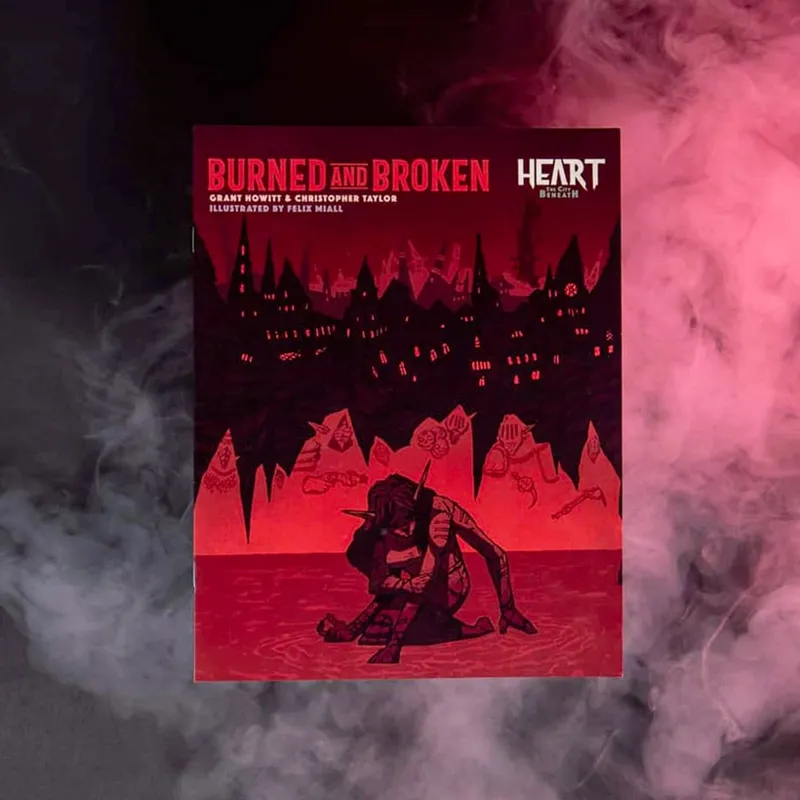
Enter BURNED AND BROKEN, our least popular Heart sourcebook, and the official means of converting a character from Spire to Heart. I want you to know that we tried to write a straight, by-the-numbers conversion kit to bodge one system into another, but it just didn’t work - and even the bits that did felt phoned-in. It wasn’t right: why would a Firebrand, or a Knight of the North Docks, or a Masked be trudging around the City Beneath?
(Here’s a confession: the real thing that stopped us was doors. There’s a Bound ability called The Saint of Doors (or something) and it means that every lock you try on every door is unlocked, magically, every time - tremendously useful in Spire, but what if your Heart adventure doesn’t have doors? What if they’re massive iron slabs from beyond time and space, unopenable except by the maudlin god that made them? What if you get the whole thing done with a series of contracting and relaxing sphincters? What if this bit takes place in a dream, and none of the doors are real?
And the Bound’s only the second class; we’d skipped Azurite because it seemed too difficult! The whole endeavour fell apart like wet cake.)
Instead, we figured that we could remake Spire characters in Heart by offering cut-down versions of the classes. They got a core ability (sometimes) and a couple of skills and maybe an interesting ability, but not much else. By hitting beats, they earned bits of their Heart class until they were a fully-fledged Delver. The fiction around it was that the Ministry - the paramilitary sect of shadowy lunatics in charge of revolution in Spire - had turned their backs on the player characters and sold them out to their enemies, so the PCs were forced to high-tail it into the Heart in search of survival. (Not a great plan, but it’s maybe better than being killed or forcibly reprogrammed by the cult.)
I’ll admit that I very much enjoyed writing those little classes - we already knew what we were working from, and effectively had to sketch out a thumbnail of a much larger work robust enough to last for three to four sessions - and they provided a neat solution for how we do our origin stories in Salt. So we’ve done, oh, twelve (or so? Definitely more than ten) Jobs you have at the start of the game, and they look like this:
The abilities you pick stick around for the rest of the campaign, so if you go from Jaeger to Fathom, say - weird progression but I’m not going to talk you out of it - then you’re a deep-sea wizard who knows how to use their rare sub-machine gun and has a solid grasp of small unit tactics. (Vicious is a new keyword that gives exploding damage dice that roll the requisite amount or higher. Which is nice. I’m trying to do more clever things by modifying the way you take and give stress, rather than just making the number bigger.)
I DO GIVE A DAMN ABOUT MY REPUTATION
The other thing you’ll notice on there is a Reputation list, which suggests six organisations your character could have history with, usually via employment or association, which might be present in the new frontier of Salt. The resurgent city and its empty flooded streets can feel a bit untethered at times, so giving us some people from outside to draw on - even as a loose suggestion - lets you and the GM talk about your old life, and how it contrasts to this strange new horizon, right from the get-go.
Plus it means that Chris and I got to write sixty-plus different gags about weirdo clubs and organisations, which is just about our favourite thing to do (aside from spending fifteen minutes or more digressing about etymology and cartoons). So there’s a Guild of Holesmen from Spire in there, there’s a heretical sliver of the hive-minded polar elves who’ve decided to write things down, there’s avant-garde Aelfir surgeon-dancers, and so on, and so forth. We don’t go into a great deal of detail about any of them, but we try to connect each one of them to somewhere in the wider world, so you’re from somewhere, and theoretically there’s somewhere you could go home to.
But how do you get to Benthic Occultist from Guy With A Gun?
XP IS FINE AND ALL, BUT WHAT IF YOU COULD PLAY BINGO INSTEAD
One of Heart’s most beloved features was the Beats system, in which you pick out some events that you’d like to happen to your character, and then when they happen you gain commensurate advances. I didn’t come up with it - I stole it from Marvel Heroic Roleplaying, where it was mainly used as a way to reward you for acting in-character as Wolverine (or whoever), as that system didn’t let you make your own original characters.
I knew that Salt would have to use Beats. But.
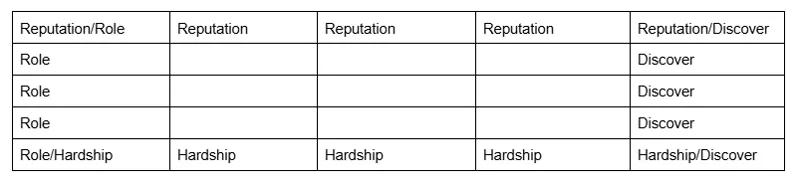
They’re all the same tier now, which is to say there’s no longer a division between Minor, Major and Zenith beats. The reason they’re all the same shape is because we’re going to put them in a fucking bingo grid. Witness our genius:
This is a blank advancement grid - beats from your class go in the middle. To get your class, you have to clear a row of five generic beats around the outside; these are Reputation (did you shift Rep with anyone?), Discover (did you discover something interesting?), Role (did you do your Job, or at least try to?) and Hardship (did you suffer?). We figured these are the basic “play Salt” actions that we should reward you for doing.
(And! We can change them later on, when you’re going robot mad from eating too many diode fish or whatever, you can change “Reputation” to “Drown” and you get points for drowning people but not for making friends with them.)
THEN you put your beats in. You can spend one cleared beat per session as a minor advance, or you can save up and get five in a row to unlock a major. It’s gamey in a way that our work - aside from Hollows - usually isn’t. But I think it’s a fun kind of gamey, and it doesn’t get too much in the way. Here’s the list from the Fathom:
LET’S START OVER
When I get spooked and/or inspired, I start a new document. The original document for Salt is lost to time; maybe we could dig it out somewhere. Before I grasped development with both hands six months ago, we were working from a document called Salt Working Doc, which itself emerged from three other documents collated or forgotten or harvested for scraps before being discarded. For a while, the official document I was using was called Salt Rules Modifications, which I then partially copied over into a document called Salt Playtest Rules, which was the same thing but intended to be read by the players (and which excised a lot of the stream-of-consciousness thinking that ended up in the manuscript) and clipped out the remainder to go into Salt Playtest Adventure which contains several screenshots of a Miro board that I stopped using maybe two months ago.
Anyway. Right after the playtest I made a new document called DEPTH.
Elaine - producer on Spire and Heart and therefore Salt, although she’s tied up with our new Children of Time game at present and honestly Salt is in such a state of flux that I don’t want to waste her time making a schedule we’ll have to rewrite in six months’ time - had some cracking ideas about making the city harder to explore. Or making the navigation, the traversal of it, more of a thing at least: rising and falling tides, expeditions getting trapped inside flooding buildings, frantic gold-rush dashes to newly-risen areas, that sort of thing. She even did a mockup of what a map with a third dimension in it might look like:
I liked it. The city wasn’t doing much as it stood - which made sense given that it’s older than time - but having it unstable and unpredictable felt more exciting, and made the very act of visiting it feel fraught.
Part of the problem with wrapping environmental mechanics into a Resistance game is that we don’t simulate the environment at all. Much like an Apocalypse World game, everything that has the capacity to mechanically change the game state is funneled through the players’ dice rolls. There’s no turns or rounds; there’s no distances, no minutes or hours, no regular space or time; the adversaries don’t even get to roll dice, and have to either just do the damned thing or wait until a player character tries to get all up in their business and hope they score badly.
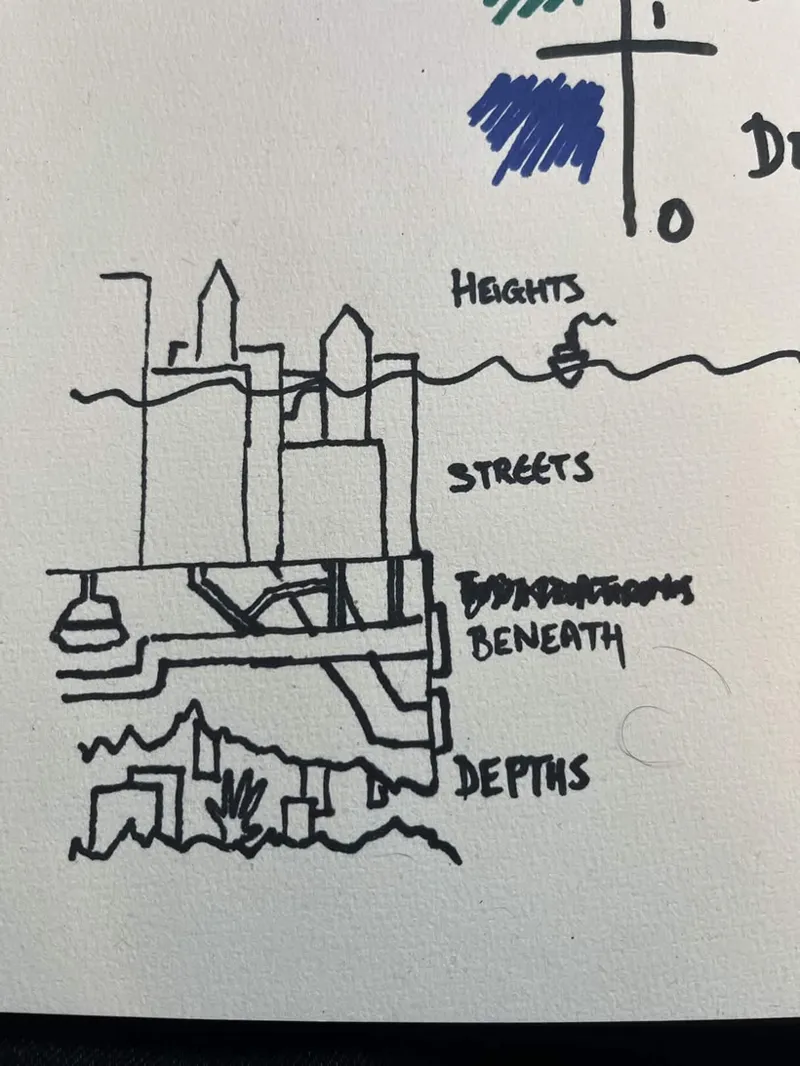
I had to invent some means of classifying the PCs’ location in the city, in as much as they could be in a bad or a good spot mechanically: something looser than grid references, something tighter than adjectives. What hit me was DEPTH, hence the name of the document. In an unusual move, rather than writing in my office, I did some drawings on a big pad of paper in front of the telly:
(This is how I used to design every game, back when I was a wide-eyed innocent, which makes for charming collections of notes and fun little drawings of orks and bears and the like but it takes longer, it’s harder to do, and it gets in the way of me watching the telly.)
It’s pretty straightforward: anywhere you are in Salt is at one of four depths, which are Heights (roofs and balconies and gantries), Streets (... streets), Beneath (tunnels and sepulchres) and Depths (foundations and sunken gods). The default sea level is Heights, and sometimes that shifts as the city extrudes itself from the ocean - so get in there while the getting’s good. One of the basic Fortune fallouts is rising sea level; try not to be too unlucky too fast.
I copied the writing bits into DEPTH. And started rewriting the game wholesale beneath it, because of course I did.
(And yes, we’ll need to change the names, probably. Three of them are plurals and one is a singular. And the deepest level of the Depth chart is Depths. We’ll get there.)
ON THE SUBJECT OF FALLOUTS, AND STRESS IN GENERAL
I have a lot of fallouts in the game, and many of them are bespoke comeuppances intended for use with a particular Relic which are required to advance to the next level of technobiological mastery. I didn’t want the GM to have to remember all of them - or even have to hold them in their mind at all - so I had players write them down ahead of time so they could be triggered later without looking them up in the manuscript.
But then: if players need to have particular fallouts to advance, what if they can’t get the stress they need to trigger them? (Similarly, the Fathom - as it worked at the time - powered up from taking specific Mind fallouts.) So I figured I’d put everything back on the players.
Now, when you roll, you tell the GM what’s at risk - what Resistance you’re putting on the line. If it’s mentally stressful, it’s Mind. If it’s physically dangerous, it’s Blood. If you’re using up stuff, it’s Supplies. If you can’t think of anything else, or you’re worried about running out of time or upsetting someone, it’s Fortune. If there’s a particular way you need to be hurt, you can just have it.
If it feels like you’re taking the piss, the GM’s at liberty to impose disadvantage on the roll. (Or, more likely, ask for some more details about what you’re doing to make it all hang together properly in the fiction.)
This also means that - whisper it - I’m removing Protection from the game, because being able to pick the Resistance that you’ve got 3 DR in means that you’re effectively having half stress all the time and it mangles what little balance this system has in place. (Protection in Heart negates incoming stress 1 for 1; Free Slots, the equivalent in Spire, gives you more places to put stress before it becomes a problem.)
Here’s a fun fact: I don’t like Protection. I never take it when I make my own characters, and when an Adversary has it, I rarely remember to use it. I believe it gets in the way of the fun bit of the game, which is smushing our characters directly against the most dangerous parts of the world and seeing which bits of them come off. It makes the whole thing take longer, and I’d much rather resolve a scene and then sprint forward into the next one than get nickel-and-dimed at 1 or 2 damage a pop for half an hour.
So: none of the new abilities we’ve written use Protection at all. There’s other ways of dealing with incoming stress, but I’ve tried to make it more interesting: tie it to background (the Digger takes half damage from environmental sources, for example), make it very specific, or do something weird like offloading Blood stress into the ceiling until it cracks asunder.
IN CLOSING
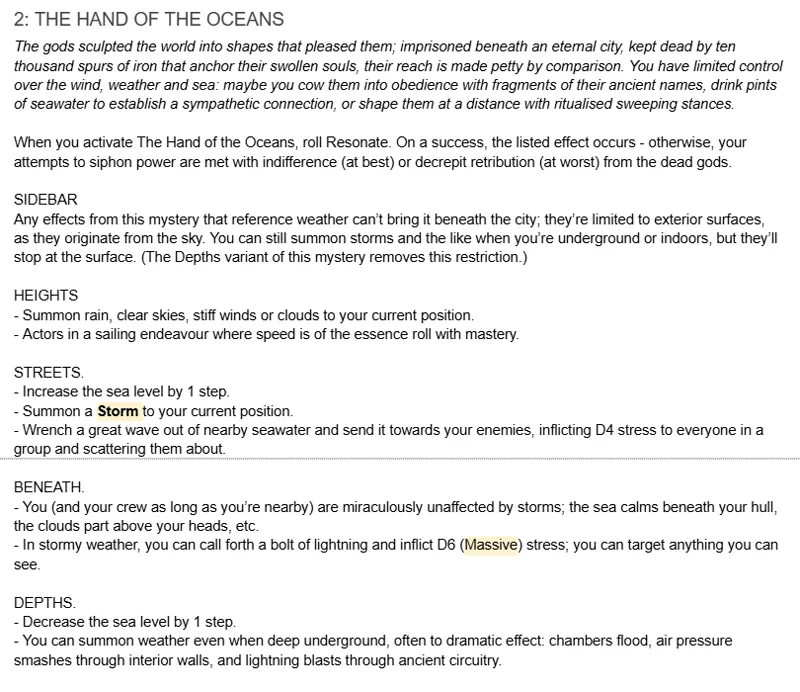
Today Chris and I finished off the Fathom, and it’s very cool. We knew we wanted to encourage them to explore the city and take risks, and what with the Depths system being all shiny and new, we incorporated it into their core ability. Given the unpredictable nature of the dead gods beneath the waves, they work differently from normal classes: each Major ability is rolled randomly at the start of each session, with bonuses allotted based on how deep they were beneath Salt. Each Major has four tiers of power - one at each depth when you make the roll - and, as you’d expect, the deeper you are the more dangerous and weird they become.
It took us a while to sort out the themes for the abilities; I knew that I wanted a deep-sea vibe to things, but it had to go through the lens of gods that were, presumably, at one time the gods of something else. We wrote up a big list of deities that could occupy the five available slots (D6 roll, and on a 6 you get to pick) but none of them were really catching on, and we were struggling to make them feel sufficiently wet.
So we scrapped the idea of individual gods entirely, and instead opted for broad concepts about the gods’ slumber (burial? Imprisonment? Containment?) over the millennia: bioluminescent majesty, crushing pressure, punishing storms, etc. Here’s one:
Fun stuff.
More next month,
- Grant “Hadalpelagic” Howitt
Comments (3)
I enjoyed this game after hearing it on a podcast. I was planning on playing it for randos at a convention (in Iowa, natch) but didn't get to. To put some meat on the bones (fat on the jowls?) I added some additional tables and mechanics to lead the players to the trough as it is. I'd love to share those with you and possibly release them as a free expansion with your permission, of course.
This is my favorite one page game I’ve ever seen. My friends who have never enjoyed table top are thrilled to give this a try. It’s kinda hitting the needs of a reality show drama
Oh definitely; you could do a straight-to-camera interview with the players once each, too.