





Ninety Six Men
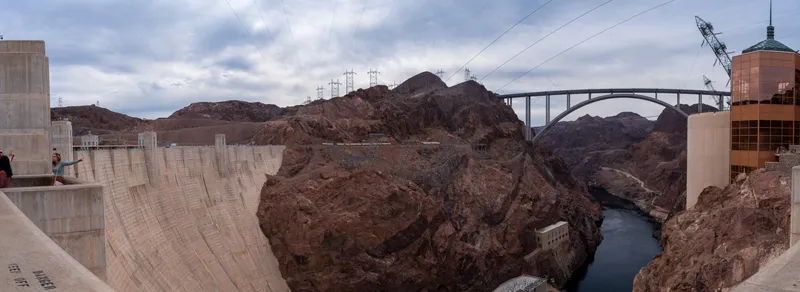
The Hoover Dam is one of the greatest engineering feats ever achieved. Over twelve hundred feet long, seven hundred and twenty six feet high, and holding back the entirety of Lake Mead, it supplies power to millions and water to millions more. 3,250,000 cubic yards of concrete comprise the main dam structure, and it still is impossible to fathom that number in any human scale when seeing it in person. Standing upon it is to reckon with a moment of near-religious awe that nothing I have ever seen inspired in quite the same way. Normally, my moments of awestruck silence or spirituality come from that natural sights of my trip—areas completely devoid of any sign of human touch, aged solely by desert rains and the shifting of the Earth’s plates—and those moments are special in themselves, but they come from a place of reverence about the Earth itself and its beauty. The Hoover Dam was built on a stunning expanse of mountains and desert flatlands in order to let the American Southwest thrive with water and life free of unpredictable flooding, but it is very clearly a place touched by man, which usually I eschew when traveling. Despite this—or really, because of this—it captivated me just as much as any canyon or mountaintop has elsewhere on my travels
The pure enormity of it, combined with its ambitious goals and general success at achieving them, certainly helps it take on a deeper significance than most engineering projects, but what really has lodged in my mind after touring it was the high-minded and idealistic notions of the designers and builders themselves. The dam is adorned with a variety of art-deco statues and sculptures, all paying tribute to the American dream of developing the Southwest. It is, at its core, a civil-works project intended to stop water with a massive amount of concrete and effort, and yet the art and general mindset of the architecture gives it so much more significance than it ever could just as another infrastructure project.
Oskar Hansen, a Norwegian-American artist, was responsible for the majority of the inspiring decor of the dam. The main feature piece of the Hoover Dam, unveiled for its dedication in 1935, are the Winged Figures of the Republic. They are a pair of thirty-foot-tall bronze winged men, aspirationally pointing to the heavens, that are their own engineering marvel (the molds for the statues alone weighed 492 tons, and were poured with a single molten stream of bronze, to prevent seams). They sit above a terrazzo star chart that precisely documents the heavens on the day the dam was officially dedicated. This is in the hopes that future generations who come across the Hoover Dam could precisely determine when it was built, and preserve memories of the culture and men who built it. When asked about the meaning for the art he designed, Hansen stated that the dam, and his artistic vision to correspond with it, was “a monument to collective genius exerting itself in community efforts around a common need or ideal.”
His vision is apparent throughout the rest of the pieces dedicated throughout the dam. There are acknowledgements of the designers of the project, the leaders that watched over it, the culture that could produce such an impressive work, even an expression of hope that the natives the land once belonged to could benefit from the project. All of them inherently recognize the collective effort that goes into a project this ambitious. None of them, however, had as deep an impact on me as the memorial he designed.
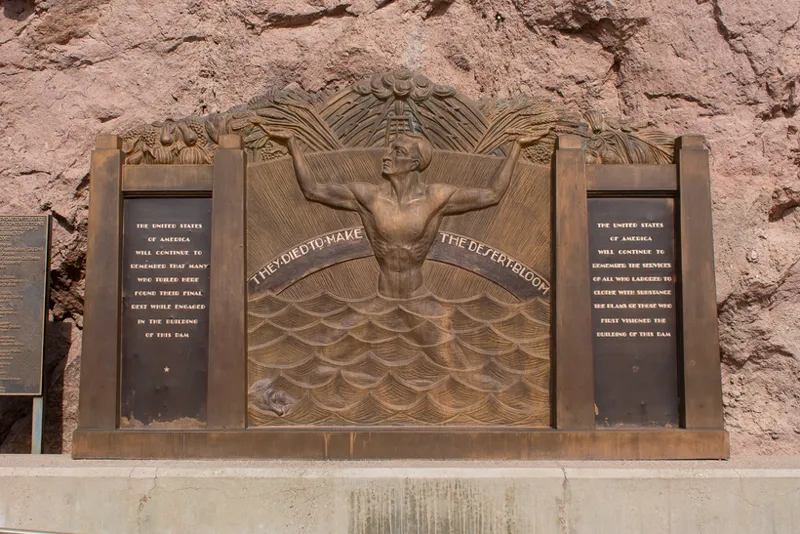
In the process of building the dam, twenty-one thousand men worked on it over the course of half a decade. Officially, ninety-six of them died, although actual numbers are probably closer to 140; many deaths were chalked up to “pneumonia” that were actually from carbon monoxide asphyxiation. Hansen designed the above relief panel that says “They died to make the desert bloom”. The reverence to collective planning, action, and struggle throughout the artistic pieces on the dam takes on an entirely new and serious weight when displayed next to this sculpture that remembers the workers who died so that such a project could be built. It is a sobering reminder that accomplishing something of this scale and ambition required genuine sacrifice.
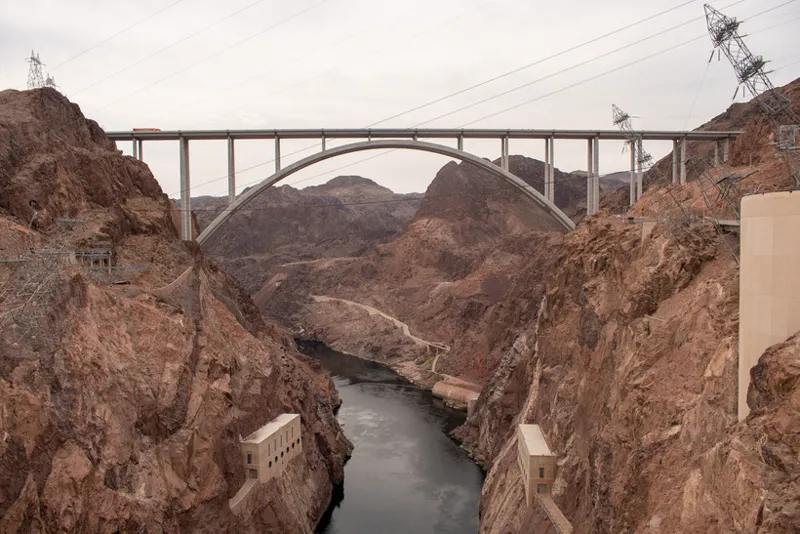
I realized as I stared at this beautiful piece how infrequently in my life I could recall seeing public art dedicated to people who died while building something. Frequently, the only memorials we see in America are to commemorate the dead of war; while still tragic, they carry a sinister jingoistic purpose, to encourage subservience to the country in the names of the dead. The monolithic, undecorated Pat Tillman memorial bypass bridge looming over the canyon the dam overlooks, built to reduce traffic over the dam itself in the post-9/11 fervor to protect all national monuments from terrorist attacks, is a solid reminder of that. The commemoration of collective struggle in this sobering, beautiful manner feels like a window into an alternate America, because the one I have lived in for my entire life has never shown a desire to attempt anything this significant or remember the people that labored to actually build our cities and the nation.
As I stood there and contemplated how the culture I have grown up in could have possibly ever created a public project this big and then gifted the world with such moving, significant art, a tour guide walked past. She was shepherding a group of older Americans, and she explained Hansen’s art beautifully. She pointed out to them—and me, as I was now transfixed on hearing more about this memorial—that the man holding the bountiful harvests of the Southwest up, triumphantly standing above the waters of Lake Mead, was actually standing on the body of one of the fallen workers. It was symbolic that without the dedication of those ninety-six that had perished while building the dam, it would have never come to fruition.
And then one of the tourists said “Wow that’s really not too many, is it? It could have been a lot more. That’s really not bad.” I stopped listening to the conversation after that because I was so taken aback I thought I would be sick.
I wished I had said something to her. I could not fathom the mindset that dismisses a fully loaded Bombardier CRJ700 worth of people crashing into a mountain. But as I thought more about this—and clearly, it has been bothering me—her Walter White level of callousness in the face of human suffering began to make sense to me, because not only has the shape of our ambition changed as Americans, the way we regard death has. In the wake of a year where 700,000 Americans have died, the collective response is truly a shrug. There is no high-minded artistic dedication to the noble struggle of medical workers or essential workers or first responders or scientists. There is no day of mourning. We have a free and widely available vaccine—one of the few impressive accomplishments of our government in recent memory—and half the population will not take it. More than one in every 500 Americans is dead from a pandemic that half of the population and our leaders fail to acknowledge is real, and there is no immortalization or even recognition of any of this; everything is just seven hundred thousand separate tragedies that do not matter unless one of them strikes too close to home.
So of course ninety-six people are a statistical error to this woman looking upon the greatest infrastructure achievement of America. They built the dam; at least they died for something. What have the people who we have lost in the past year and a half died for? The economy? Restaurant owners buying a second boat? Some political statement about microchips and Bill Gates? We have stared in the face of unimaginable suffering for no real reason and we have lost all meaning of what mass death is or how to handle it. Not only can we no longer look at ourselves as a collective and aspire to change the desert into a habitable home as the designers of the Hoover Dam did, but we have lost the ability to give a shit about the people around us.
Comments (2)
[New For Ninety Six Men]
Nice piece. If you're still in the area, check out Valley of Fire State Park. It's some of the most beautiful driving roads I've seen: really well-maintained, winding between canyon walls and scenic vistas.