
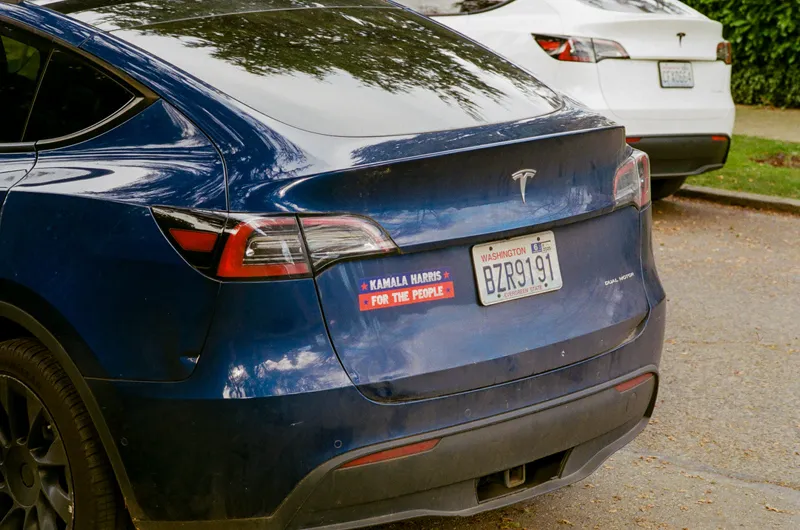
First As Tragedy, Then As Tesla: A History of Fascism and Automakers
Hi! Here's a piece I wrote a few months back and have (unsuccessfully) pitched around. I figured it was better it sees the light of day here rather than dying in my drafts folder. I have updated the introduction and conclusion for the present day, rather than the long-ago time of Three Months Ago.
When I wrote this piece shortly after the inauguration, it was at the peak of Elon Musk and Donald Trump’s friendship, which always felt like a paradox. Trump hates EVs, and has always hated anything that resembles an attempt at reducing greenhouse gases; his brand of ideology is nostalgic. Musk, before his open embrace of white nationalist ideology and relitigation of apartheid-era grievances, styled himself as a real-world Tony Stark; the rocketman with his sights on Mars who sold cars of the future. His vision and ideology have always been forward-looking. The two seem, at bare minimum, contradictory.
My goal in writing this story was to show that fascism is willing to put aside contradictions if it means more power and wealth for the few at the top of the pyramid. I sought to illustrate that corporations—specifically auto companies!—and fascists have been allies since the ideology was birthed, with this same principle in mind. Fascism to its supporters is about many things—glory, racial purity, imperial conquest—but to a dispassionate observer watching it take shape in many countries throughout history, it most often appears to be the marriage of many heads of the Hydra into a single apparatus.
In the words of Aimé Césaire, fascism is colonialism turned inward, and so the (external) military used for the repression of the colonies and the (internal) police commingle and blend until they are seen as interchangeable. The various Departments—of State, of Homeland Security, the FBI and the NSA and the CIA—are so fully integrated that boundaries of citizenship and state lines become afterthoughts.
And as these disparate offices intertwine and merge, corporations angle to become parts of the State; don’t take my word for it, take Benito Mussolini’s, who said that “Fascism should more properly be called corporatism, because it is the merger of state and corporate power”. Musk and SpaceX/Tesla simply follow in the footsteps of every entwining of capitalists and government to come before (including here, domestically; just ask a Lockheed, Boeing, Raytheon, Palantir, Geo Group, etc. shareholder how they have enjoyed the ride as their companies became increasingly required for the American state to perform its job.)
As Musk and Trump’s friendship starts to die out, it feels like this specific example is less pertinent, although I would argue it doesn’t invalidate my premise: their schism was reportedly over Musk’s desire for more favoritism, in the form of the EV tax credit.
Regardless, the piece is written, and I figured I’d share it, pertinent or not. Allow me to explain why I think these two teamed up to begin with, and it becomes easy to see why they’ve gone through such a messy breakup.
Futurism And The Beauty Of Speed
In 1909, Fillipo Marinetti penned the Futurist Manifesto, intended to outline his forward-looking, masculinity-and-war-idolizing ideology. Marinetti was spurred to write the Manifesto after he crashed his car trying to avoid a cyclist. He viewed the incident as a physical manifestation of outdated ways of being (cycling) impeding the future (driving).
Bullet point #4 of his Futurist Manifesto reads as follows:
We declare that the splendor of the world has been enriched by a new beauty: the beauty of speed. A racing automobile with its bonnet adorned with great tubes like serpents with explosive breath... a roaring motor car which seems to run on machine-gun fire is more beautiful than the Victory of Samothrace.
The Manifesto only goes on for four pages, much of it devoted to calling for the destruction of museums, libraries, morality, and feminism. Marinetti exalts immediate action, violence, and war above all else. He dramatically ends the pamphlet: “Standing on the world's summit we launch once again our insolent challenge to the stars!”
If his breathless melodrama sounds vaguely familiar, it has clear parallels to 2010s America: Futurism’s entire thesis can be distilled down to “move fast and break things”. The technology and its goals—whether early automobiles and biplanes or rocketships and EVs—are irrelevant; what matters is that only through fearless, reckless use of the cutting-edge can humanity transcend its current state, and progress to the next stage.
While Futurism never became a mainstream political ideology, Marinetti continued his political activism after World War I, and as he refined his beliefs he found traction. In 1919, Marinetti merged his nascent Futurist political party with Benito Mussolini’s Fascist party and co-wrote the Fascist Manifesto.
Where futurism failed, fascism caught on; by 1922, Mussolini and his Fascist blackshirt supporters had overthrown the government of Italy and turned it into the first Fascist state in Europe. From there, variants of the ideology spread across the continent as the decade wore on. Fascism continually moved away from its roots in Futurism—but it remained taken by the allure of the automobile.
Mussolini’s Darling: Alfa Romeo
Nowhere was this more evident than the racetracks of the 1920s. As historian Paul Baxa describes in The Intrepid One: Fascism & The Death of Antonio Ascari, “early Grand Prix races were akin to endurance contests… Mechanical sympathy seemed the main skill for a prewar Grand Prix driver.” In contrast, the postwar era was contested by high-society “gentlemen drivers” with a penchant for daring overtakes and fatal stakes. Simultaneously, manufacturers began using superchargers—originally developed for aircraft during WWI—to build cars that were vastly faster than anything dreamt up pre-war. Racing became fast and deadly, precisely what the Futurist Manifesto glorified.
This proved fertile ground for Fascism. In 1923, fresh off his successful coup d’etat, the new Prime Minister of Italy Benito Mussolini dropped the green flag to start the third-ever Italian Grand Prix. It was held at Monza Circuit in Milan, a brand-new autodrome known as the “Temple of Speed”. It was only the third such purpose-built racetrack in the world, and it was designed and constructed with massive straightaways to allow the post-war high-powered machines to break speed records. (It was also wildly dangerous; the 1923 event saw two competitors die in practice laps.)
The event was layered with importance for the nascent Fascist government. Many of the competitors were Italians piloting Italian machines, making the sport a point of nationalistic pride. Milan also held special importance to Mussolini: it was home to both the Fascist party and Il Duce’s favorite automaker, Alfa Romeo. The Milanese company—founded in 1910 as a spry upstart to compete with the already-massive Fiat—focused heavily on its racing team (and was hugely influential to future generations of car culture; for example, Enzo Ferrari’s automotive career began running Alfa race cars). Importantly, the company was good, dominating much of the international circuit through the mid-20s. Mussolini owned a variety of Alfa Romeos through the Twenties and Thirties, which he often drove himself, rather than having a chauffeur.
Mussolini’s love for automobile culture had material consequences for Italy. One of the largest infrastructure projects of Fascist Italy—and one that Mussolini made a point of breaking ground at early in his nascent dictatorship—was the construction of the autostrade, the first modern highway system. It was a bold undertaking for a country with only 41,000 registered cars. This network’s design was left to Piero Puricelli (the designer of the new Monza circuit). The goal, as Massimo Moraglio in Driving Modernity points out, was to hasten the adoption of private automobiles and move Italy further into the new epoch of motoring.
Mussolini took his Alfa interest personally, as well. When Alfa Romeo hit dire financial straits during the Great Depression, Mussolini personally stepped in to nationalize the company. From this point on, Alfa Romeo became a de facto instrument of the state, as the government stacked the company with Fascist loyalists, and the company continued devoting vast resources to the construction of ever-faster race cars until the outbreak of World War II.
And yet Alfa Romeo and Mussolini were just the first draft of the fascist-corporate partnership. The tightest link between a totalitarian state and its automaker would come later, in Germany.
Hitler, Benz, And Fascist Car Dealership Owners
From the earliest days of Adolf Hitler’s political career, he adored the German Benz automaker. He drove a Benz to the Beer Hall Putsch. While imprisoned for that unsuccessful coup d’etat, he corresponded with Jakob Werlin, the Benz branch chief in Munich, to purchase a new model. When he was released from prison, he was driven home in his new Benz by someone from the company—apocryphally, by Werlin himself (although Werlin’s children deny this).
Either way, Werlin saw the business opportunities inherent in befriending a dictator-to-be. By 1926—when Daimler and Benz merged, creating the modern-day Mercedes-Benz company—Werlin had been promoted to director for all of Upper Bavaria, and Hitler purportedly used his friendship with Werlin to purchase discounted cars for Nazi party members. Hitler’s fondness for the company only grew after he was in a car accident in 1930; he credited his survival to the robust construction of the car. Supposedly, from this moment forward, he chose to only ride in Mercedes-Benzes.
The love affair was a two-way street. As Hitler’s political sway increased, Mercedes-Benz remained extremely close-knit with the Nazis, going so far as to purchase massive ads in the Volkischer Beobachter, the official mouthpiece of the party. Werlin became a Nazi party member in 1933; the same year, he was promoted to the Mercedes-Benz board of directors. In 1934, he took an honorary position within the SS.
Shortly thereafter, as historian Blaine Taylor documented, Werlin was directly reporting to Hermann Göring as Hitler’s leading man for automotive policy. At this point, Mercedes-Benz was already profiting handsomely from the Nazi party’s destruction of labor unions and subsequent lowering of wages. The company’s cars were featured prominently in propaganda reels and at rallies as symbols of German manufacturing power.
By the time of Kristallnacht in 1938, Mercedes-Benz was the international pride of the Third Reich. Successful work on high-speed sections of the autobahn—a public highway akin to the Italian autostrade—had allowed a Mercedes to attain a world-record top speed of 268 miles per hour and successfully connected many disparate parts of the new Reich by private car. The 230-horsepower supercharged 7.6-liter Mercedes 770 limousine preferred by Hitler and his allies was one of the most powerful—and expensive—machines on the planet at the time. Export-model 540Ks showcased German engineering prowess and were favored by elites globally.
The tri-pointed star had become as much a symbol of Nazism as the swastika, and the company and Werlin were compensated for it. During World War II, Mercedes-Benz extensively used forced labor. At the peak of the war, the company estimates that half its 63,000 employees were slaves. During this time, the company was still intentionally keeping its factories ready for a switch to peacetime production, with the hopes of profiting.
After the war, Mercedes-Benz denied any intentional or willing involvement with the Reich until 1988. Werlin was cleared of collaboration by the Allies and returned to running the Munich branch of Mercedes-Benz. He died peacefully in 1965, at the age of 79.
The Tesla Takeover
It should be obvious to most Americans by now that the Trump administration is following the fascist model. If it is not, a recap (which I wrote three months ago, and which has only gotten far worse in the intervening period):
Over 200 people—not a single one formally accused of a crime—were deported without trial to what appears to be an overseas slave labor camp, and in the process the Trump administration openly flouted a court order. A legal US resident is currently imprisoned without charge for no apparent reason aside from his political speech. (When I wrote this paragraph three fucking months ago I desperately hoped it wouldn’t still be true by now, but we live in hell; as always, free Mahmoud Khalil.) The president is outright threatening judges with impeachment for subverting his will.
Musk was seeking Trump’s corporate arm. Musk has shown over the past decade he willing to be shrewd, or conniving, or unscrupulous, or all three. No matter what ideology he has espoused or collaborated with, he has continually taken advantage of government contracts. He wants to make money, he hates labor unions, and he has a proclivity for fascist beliefs like the immutability of gender and the so-called “great replacement theory”.
Even if Musk himself isn’t aware of the direct parallels to prior automakers collaborating with fascists, he already is seeing direct benefits, like tariff threats that damage other automakers, but leave Tesla relatively unscathed. Or the President hawking Teslas on the White House lawn. Or, hell, that keying a Tesla will probably get you hit with federal felony charges. He expected to be handsomely rewarded for standing by the President, just as the President has already reaped material benefits from Musk’s DOGE project and massive campaign contributions.
Epilogue (or Prelude, really)
And, of course, the only time the Musk/Trump relationship strained is when Trump somehow wasn’t showing Musk enough favoritism. Whether the relationship holds or falters from here is anyone’s guess. Personally, I wouldn’t be shocked if the Big Stupid Fucking Bill comes back with tax credits back in it for Musk, and the two make up until they have another drug-and-dementia addled fallout over some dumb squabble, but really it doesn’t matter. If Musk leaves the Oval Office and Tesla is relegated to the trash heap of history, there will be another corporation there waiting to take its place. That’s how fascism works.
Still, the Musk/Trump split—as well as the events of yesterday in Los Angeles—show first-hand that fascism is incredibly fragile. No one likes these bastards, including themselves. Relatively small numbers of people actually want fascism, and they’re all necessarily delusional, because they believe they will be at the top of the pyramid inflicting abuse on all others. They cannot pull this off, because they do not possess the ability to make the country work alone, no matter how much they’ve deluded themselves into believing they can.
Giving this unstable minority untold firepower and wealth, as capitalism naturally does, allows them to do horrible, horrible damage… but it also means they sow the seeds of their own destruction. In the Trump administration, there is untold greed, there is untold evil, there is venal corruption that could make Tammany Hall blush. But there are no tactical geniuses in a fascist state. These fuckin’ idiots aren’t getting far.
Comments (7)
Disappointing that no one wants to publish this. Excellent as always!
This was amazing. I raced through it, and it’s a welcome read after seeing stories this week about the HEMI V8 coming back as a protest (I want to write a piece about how Dodge is the Donald Trump of automakers, creating its own crises and then demanding praise when it tries to fix them). Not that you’re asking, but if you ever wanted to work on making this more sellable, I have some ideas.
Maybe, honestly - the problem here was just that my pitches never seemed to connect. I would love to know how to fix that!
Goddamn, I read this in a fugue state, just scrolling and absorbing at record speeds. It's a fantastic piece, and I appreciate you sharing it!
Thank you so much for reading, I'm glad you enjoyed it!!
Masterful and concise POV of how this cycle repeats itself, deeply appreciate your deep dive into Futurism as the bedrock upon all that came afterwards. The reality TV hell of our current existence is terrifyingly surreal, but I'm thankful you've been able to capture it so well.
if you ever want a much more thorough investigation on how capitalism turns everything into reality TV, I really recommend Guy Debord. and thank you so much!!!