
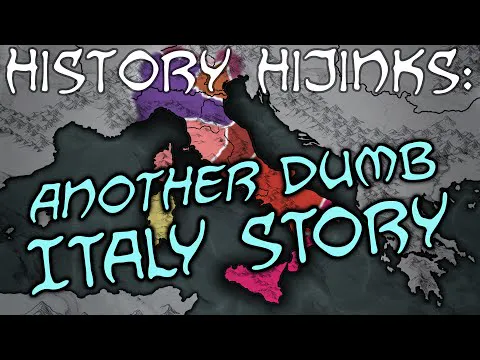
History Hijinks: Another Dumb Italy Story
It was going to be three dumb italy stories but linguistics had other ideas
-B
Comments (8)
I am absolutely okay with OSP incorporating linguistics and etymology into the rest of their humanities bingo card.
Also why does Venice’s endonym sound like it was named by Jar-Jar Binks?
Blue, as a voice teacher who has had to learn diction for French, Italian, German, Spanish, and Latin among others, I gotta say you nailed the description of how different languages feel like to speak.
I was shaking my hands in the air at 4am screaming “yes! He gets it!” when I saw the vid
this was fantastic. many kudos to Blue!
Entertaining and also thought provoking, teaching me not just a new fact but a new way of looking at things. Great video, OSP at it's best.
First of all: bluetiful episode, I loved it, and your Italian sounds very good. Italian and his dialects and adjacent languages are a literal hellscape. I hope this will not take too long, but probably it will, so I'm sorry for the wall of text that is going to happen. To clarify a couple of point in the video: - Florentia became Firenze because the "-t-" in latin in the Vulgars sometimes became a "-z-" sound (i don't remember the exact rule, but i swear there was one), so Florentia became Florenzia, then Fiorenza (name used during the Middle Ages) and then Firenze. - Italian has both Regional Languages and Dialects, the latter being basically a fusion between the Italian, Regional Languages and local distortions from the specific history of the place (i.e: Genova, Venezia, Pisa and Amalfi were all Merchant Republics, so they've had major external influences, while places like Brescia, part of the Serenissima but very far from the city, had less influences from there and more from the celtic and germanic populations) - To clarify when Italian was born: while is true that standard Italian has been codified as the Italian Language of the Italian Nation in the 1800s, it has existed as a language since the Middle Ages. The first instance was the "High" Sicilian language used in poetry; that language was then taken a century later by Tuscan poets and used mixed to their own vulgar to make the Poetic Language used by Dante, Petrarca, Boccaccio and others; then again in the 1500s this was codified by non-Tuscan writers and philosophers who wanted a common language and became a standard codified language of his own used in most of the Italian Peninsula as a Lingua Franca in poetry and literature, all of this while the majority of the population still used the Regional Languages and continued to do so basically until not so long ago.
It took so much restraint to not go into the poetic history of Italian languages like Sicilian and just leave it at the Dante nod. This video easily could have been several times longer if left to my own devices. Guess I've got more material to discuss in the future... -B