















VR New and Improved Arcade Bar + my retro gaming memories!
Hello!!
You might remember that a while ago, in my spare time, I was 3D modelling a virtual arcade for people to walk around in VR. Well, since then, VRChat has updated their SDK which broke many of the scripts and functions of my world. I'm very honoured that the world still receives visitors after so many years!
So I've renovated it, improved most of the models (I'm a lot better at 3D modelling and texturing now) and all around added a bunch more stuff:
-Trivia plaques about various games, consoles and events in gaming history
-Real-life-accurate consoles and cabinet models
-Scanned articles and posters from retro gaming magazines like Nintendo Power, Electronic Gaming Monthly, Mean Machines and more
Basically, I wanted to show off what my childhood playing arcade and console and home computer games was like, including all the sounds and the atmosphere.
All of videogaming history up until 1994 is represented in this one world (Prove me wrong if you can)!
I'm pretty happy with the result and would like to share it with you, my cultured audience, first before making if public.
If you have VRChat (which is free: https://hello.vrchat.com/ ) you can walk around it right now (you can use a VR headset or just use a monitor and keyboard) via this secret unlisted test link until I make it public- https://vrch.at/28duk2rx
Making this place has been a lot of fun and certainly a trip down memory lane! I set 1994 as the cutoff point, so everything in there is from before the year 1995. Basically, just before the Playstation and Sega Saturn launched.
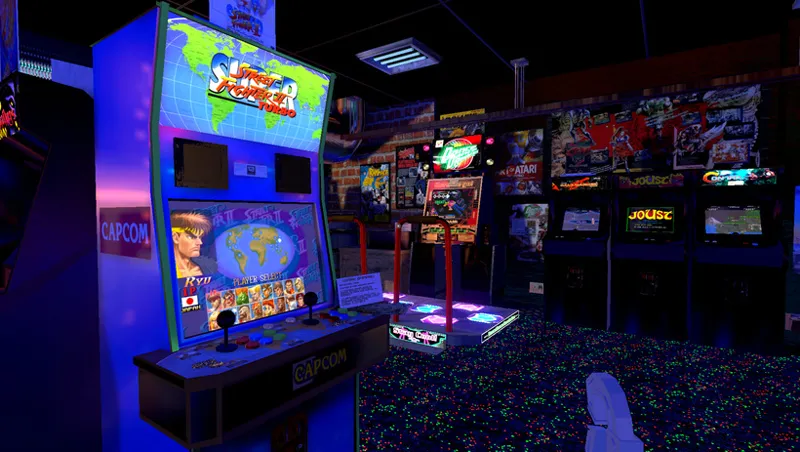
↑ Super Streetfighter 2 was pretty new at the time of this arcade's setting (it came out in 1993), so I gave it pride of place. You can see the fancy "Q-Sound" speakers on the machine - basically surround sound for arcade cabinets a the time.
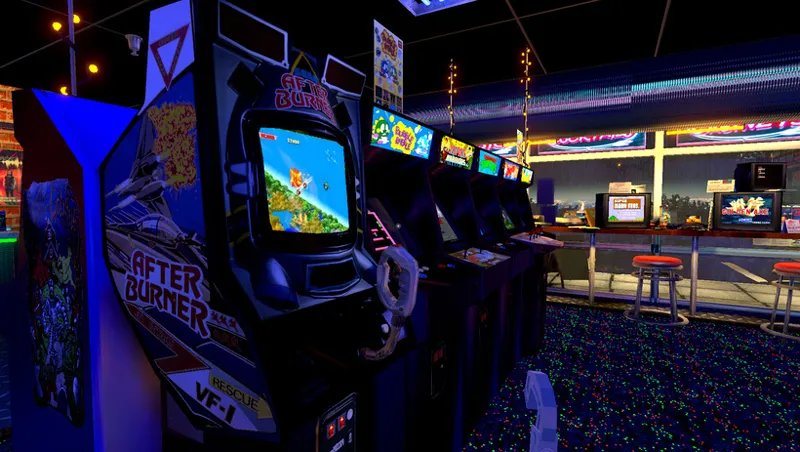
↑ At first I could only model simple cabinets, but I've worked my way up to more complex stuff like this After Burner machine by Sega (1987). All of the textures are copy pasted from online image searches and adjusted in Photoshop to make them the correct angle for me to slap onto 3D cubes and then sculpt them like polygon clay!
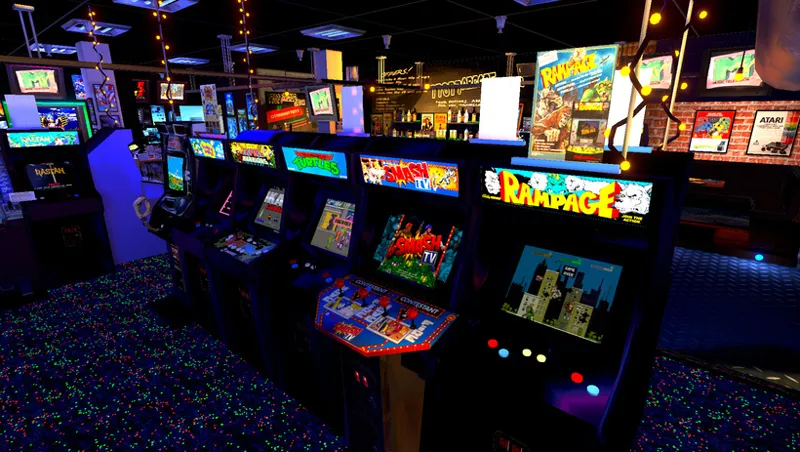
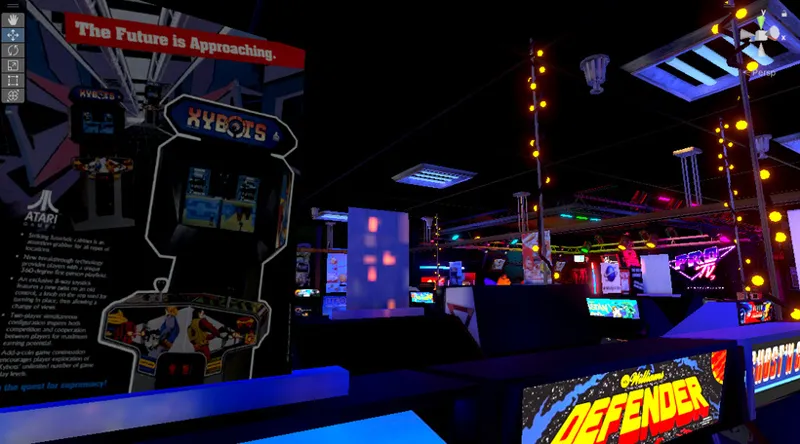
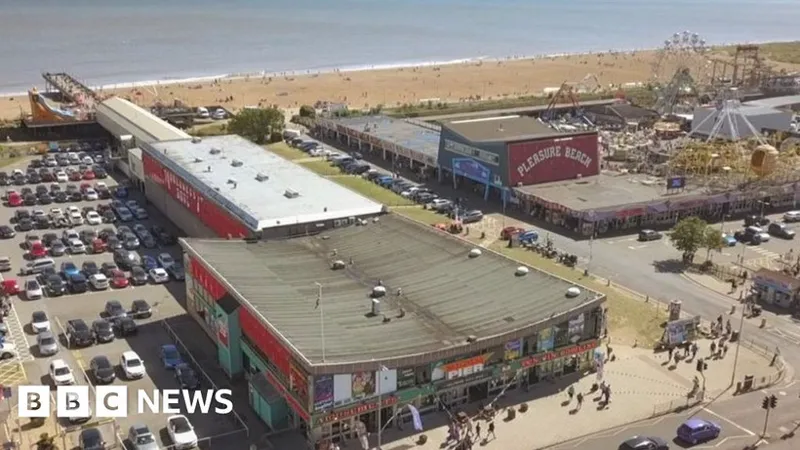
↑ I remember playing Rampage for hours down at the Pier arcade by the sea when I lived in the seaside town of Skegness, UK as a teenager. The pier was long (I mean, it was a pier) and divided into three sections, with the newest 1990s big arcade machines right at the front (Stuff like Starblade and Daytona), and older stuff from the the early days right in the back section, which is where titles like Rampage and Defender were). Recently, Producer Maki and I have been playing it on MAME and it really is loads of fun. Atari could just do no wrong back then (Rampage was 1986) and released hit after hit
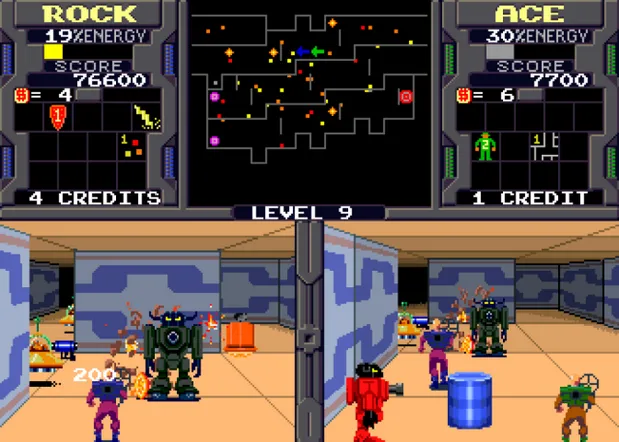
↑ A bunch of my favourite arcade hits populate the place. Xybots (1987) was a special favourite of mine that I played a lot on a family holiday to Center Parcs around 1989. It's a split screen cooperative sci-fi maze game where you turn corners by twisting the joystick! Give it a try on MAME if you have it! It was originally going to be a sort of first-person sequel to Atari's hit Gauntlet.
↑ Skegness Pier, just like I remember it!
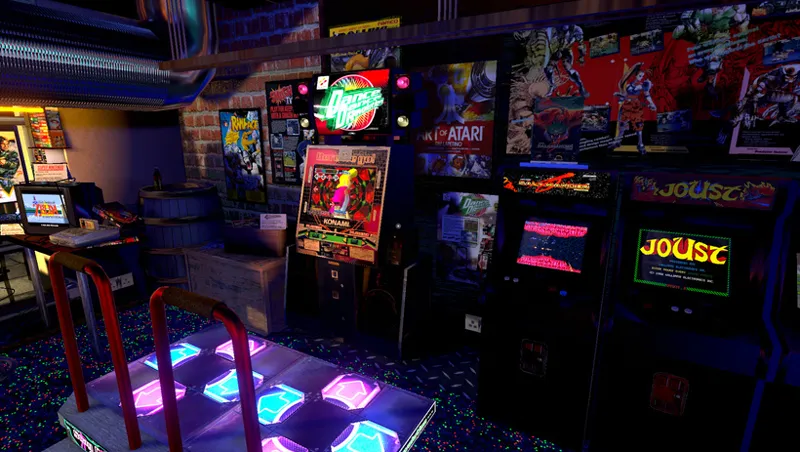
↑ I know I said it was supposed to be only things from 1994 and earlier, but I did cheat on this one item. The original Dance Dance Revolution is from 1998. Maki demanded it though, and since it was a big part of my life at University, I caved. When I did my BA in Japanese at the University of Sheffield in the early 2000s, we would all eat burgers for lunch down in the uni bar, in this little alcove that had a DDR machine. I was always crap at it, but the music is still burned into my brain!
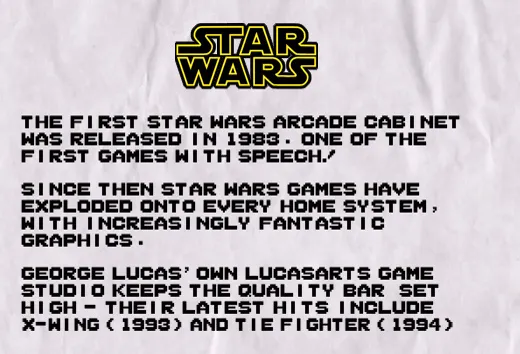
↑ Around the arcade are these paper notes pointing out some gaming history facts for any young folk who didn't get to experience arcades at the time. There are a couple here on the Power Drift machine and Virtua Fighter (which was brand new in 1994 and the first 3D fighting game ever made).
↑ Galaxy Force in action. It looks 3D, but it's all sprites! Hit play on this video to check it out.
This sprite scaling/rotating effect would be called "Mode 7" on the SNES. The only real downside to it, graphically, is that there's some pop-in of objects in the distance, but we saw the same problem with early 3D games of the time (with Silent Hill's famous fog effect being used to mask distant buildings "popping in").
I took inspiration from photos of bars to model the seating areas. I've been told that quite a few people use the world as a hangout place for comfy chats with friends in VR. I don't have a VR headset myself so I can't say how immersive it is, but I'm glad people like the atmosphere!
↑ My first ever gaming console was an Atari 2600 and I remember playing it all hours of the day when I was a around seven years old. So of course it had to go into the world. I could feel my past forming before my eyes as I modeled the console. That tasteful wood finish...
It was the first real games console and there'd be no games market without it. And because the graphics were limited, they had to focus on gameplay and fun. I played stuff like Solaris, Defender and Robot Tank for hours!
↑ My second ever system was a home computer. A Commodore 64! So I added an 8-bit home computer table for people to marvel at the fact that we used to load games from audio cassettes!
It meant really long load times, sadly - but because cassettes were cheap the games were about £2 / $2.5 each. This was kind of mind blowing to me at the time, because the graphics were much better than the Atari 2600 and the games were a tiny fraction of the price! Many of the games on the shelf above are from my personal collection from childhood.
If you've ever been to any of my streams you'll know that the C64 had really really good music as well.
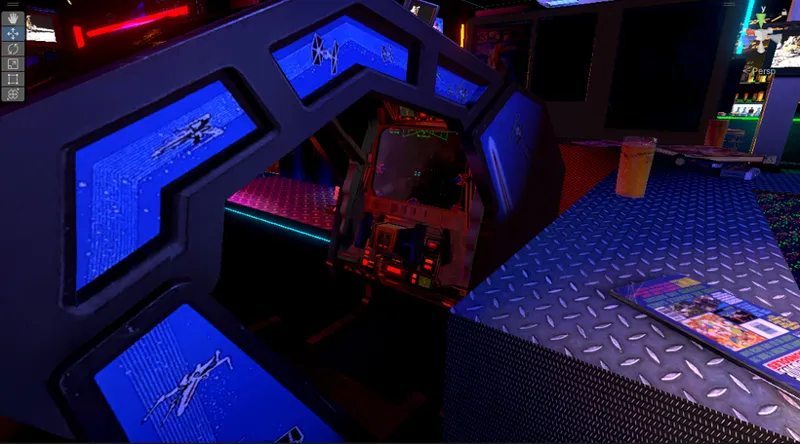
The 1983 Atari Star Wars arcade game was a thing of beauty when it was released! I was only five years old at the time, but I played it in the 80s and was amazed at the feeling of being in a cockpit and hearing all the digitised speech! Even today it has that cool, clean look that comes from vector-based graphics:
Other Atari games of the time like Battlezone and Tempest used vector graphics too. In a dark arcade they really popped out and had a feel that I can't really describe. Like being in a smoke-filled void playing a game made out of futuristic lasers.
Years later in 1999, Battlezone 2: Combat Commander would become one of my all-time favourite PC games, proving that on super rare occasions, a reboot can actually be good.
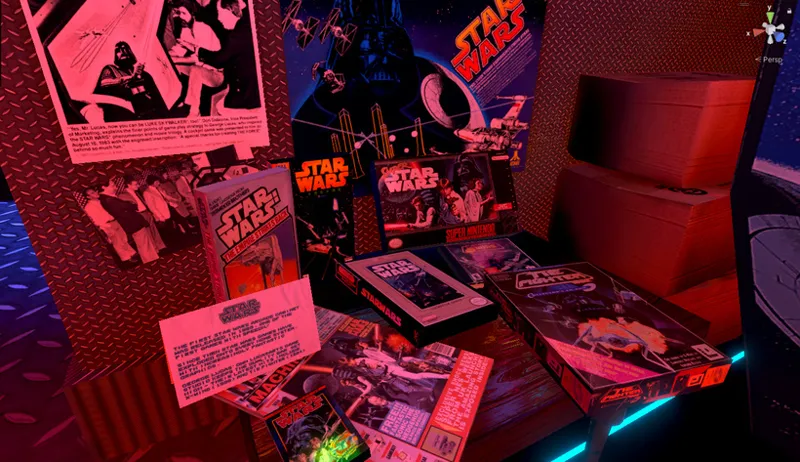
↑ The 1983 arcade game kicked off a flood of Star Wars games on every system pretty much ever, with the quality very often being incredibly high! I wanted to show that off in my arcade so I arranged this little display.
Titles like Empire Strikes Back on the Atari 2600, the Super Star Wars series on the SNES and the X-Wing and Tie Fighter series of flight sims on PC were all critically acclaimed. Much of this was probably thanks to George Lucas forming Lucasfilm Games (which later changed its name to LucasArts), which used its infinite Star Wars cash to take their time and make great games instead of cash-grab licensed slop.
Along with Star Wars games, Lucasarts also developed many home computer greats such as my beloved Rescue on Fractalus for the C64 and Maniac Mansion for, well, everything. They were masters of the point-and-click genre, with The Dig (1995), Day of the Tentacle (1993) and Monkey Island (1990) all being critically acclaimed by the gaming press. And rightfully so!
↑ Since I was making this world, I could do whatever I pleased. This included shining a spotlight on the criminally underrated Sega Mega CD system, which was admittedly expensive but had a bunch of really fantastic games like the best ever conversion of Final Fight (with better-than-the-arcade CD quality music), Snatcher, Silpheed, Sonic CD, Battlecorps, etc etc. There's also a White Russian cocktail so you know I was there.
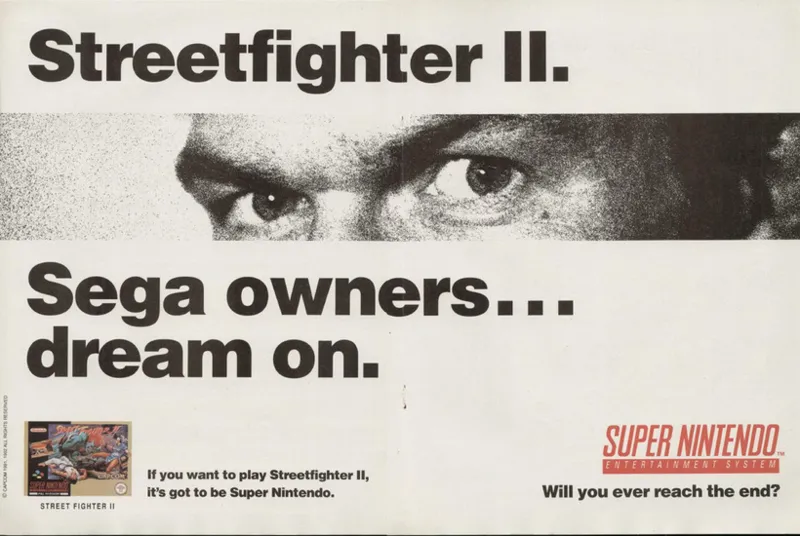
↑ A really big part of my teenage years was reading games magazines. I'd go to bed at 10pm and read until the wee hours. There was no internet yet, so these were our source of news, reviews and previews - often many months or years in advance! I can't accurately describe to you what it was being a Megadrive/Genesis owner at school reading all the previews and seeing all the screenshots of Street Fighter 2 finally coming to our console after Nintendo ran all those ads mocking us! The console wars were just as real as Genghis Khan's conquest of Asia, I tell you!
Many of us still have PTSD.
↑ 16-bit home computers were a thing as well, of course. The PC was really coming into its own around 1994, and the Amiga and Atari ST were very big in the UK. Their graphics were the best you could find outside of an arcade, but they were very expensive, which made consoles the more popular option for most kids.
Being computers, though, with full keyboards and mouse controls, they had a bunch of exclusive games that you could really only run on a computer. Games like Elite 2 made console owners like me very jealous indeed. I remember playing it at my friend's house over several days and just marveling at the size of it. You just couldn't do a realistic space flight combat game with real Newtonian physics and 100 million solar systems on a console. I still don't know how the hell they did it on a single floppy disk!
Picture for a moment. It's the year 1994.
You could take off from a planet, fly anywhere in the galaxy, land anywhere, press fast forward and watch the sun rise in real time because the planet you were on was actually rotating in real time around the sun.
Meanwhile, in 2014, Elite Dangerous was released after raising £8 million in funding, and you couldn't even land on planets!
The 90s was a different time. The scope and power of games was just exploding.
Part of my goal in making the arcade was for it to be a museum that would show people the consoles and computers of old. Obviously the NES had to go in there, being the best selling console of all time (at the time). That's a Neo Geo on the left - a true collector's machine and not for filthy casuals. Consoles had to convert arcade games down to run on them, reducing the colours, making sprites smaller, etc etc. The Neo Geo ran the actual Neo Geo arcade games themselves, 100% accurately. It was basically a small arcade board for your home. And it cost $650, with games being about $300 EACH.
It was a luxury system for gazillionaires only. One day I hope to touch one.
The PC Engine (TurboGrafx-16 in the US) was a big system in Japan, but not really that known to us English speakers. It was the most powerful 8-bit system (frankly, its graphics looked like 16-bit graphics a lot of the time) and had some really nice arcade conversions, like Splatterhouse and R-Type. It was also the first console to have a CD-based add-on, which gave really nice anime cutscenes like the Patlabor game seen above. It's the only system that the cult classic Castlevania: Rondo of Blood was released on (the one Netflix "adapted" to have absolutely nothing to do with the game).
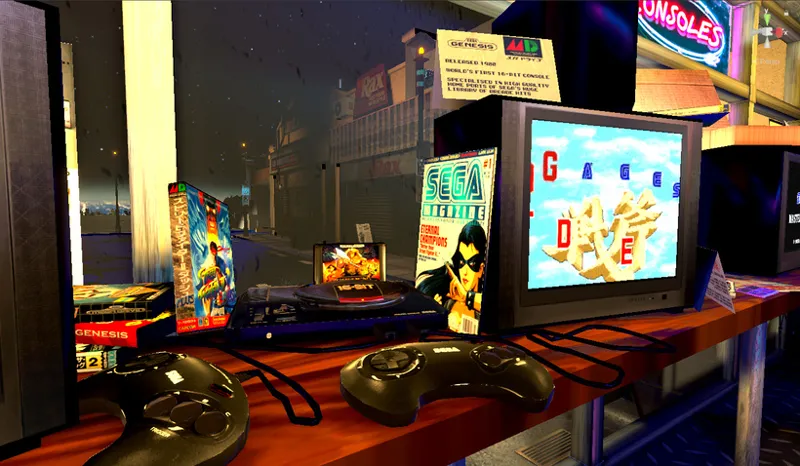
↑ The world's first 16-bit home console! The glorious Sega Megadrive/Genesis! This was my fourth console and I loved it like a dear child. Going from a Commodore 64 with games that cost £2 to a machine where every game was about £40 was a bit of a leap, though! I really had to read those magazines and only buy the games that were the absolute cream of the crop, because I could only afford about four a year.
I pretended to be ill the day Sonic 2 was released. I wonder what school attendance figures were like that day.
↑ The hardest thing to model was this broken arcade cabinet. It's not that easy to get high-resolution photos of the insides of arcade cabinets and I had to stitch it all together from tons of different videos and articles! If you visit the world with a VR headset you can stick your head in there and take a look at all the circuit boards and internals.
On the right is a box of arcade ROM boards. These are the actual games, and you slot them into the cabinet. Something like Super Streetfighter 2 would have cost around $2000!
In contrast, you could buy Super Streetfighter 2 for the SNES for $70 when it was released.
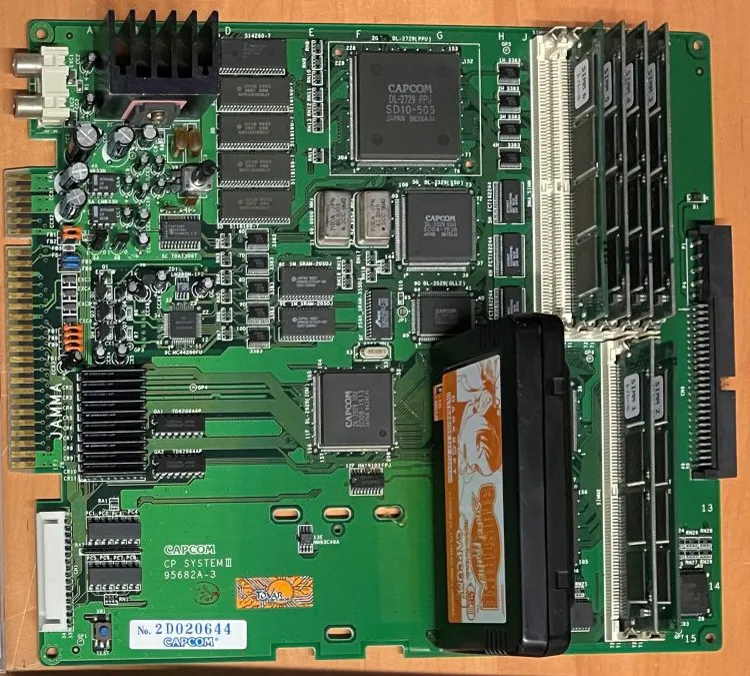
↑ A Street Fighter 3 arcade board. Also known as a ROM or a PCB (printed circuit board).
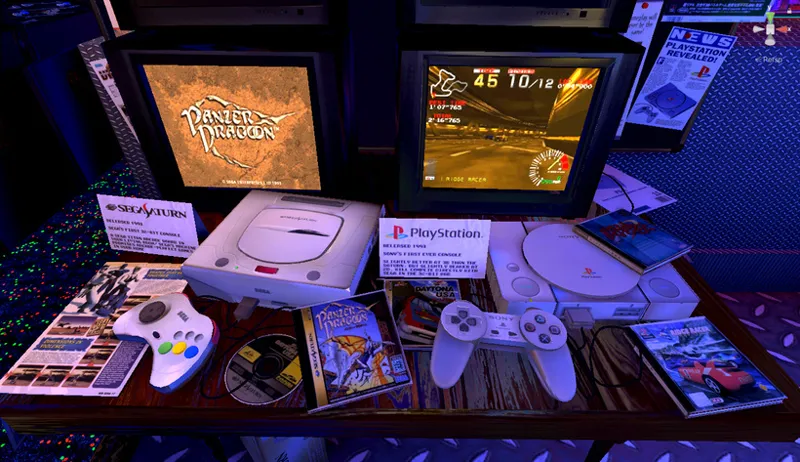
↑ Those who were around in 1994 can probably remember that the really big news were the big two fancy new 32-bit consoles being released in direct competition with each other: The Sega Saturn and the Sony Playstation! I attempted to relive the hype that was around at the time with this display and some of the launch games.
The Saturn started out very strong with Panzer Dragoon, Virtua Fighter, and a (not very good) conversion of Daytona USA as its launch games.
The Playstation launched with Toshinden, Ridge Racer, Rayman and NBA Jam.
As time went on, the Playstation took the lead with titles like Final Fantasy 7, Tekken and Metal Gear Solid, and the accepted version of history is that the Saturn was a complete failure.
HOWEVER! This is a purely US-centered view.
In Japan, the Saturn was a financial success due not only to its strong conversions of arcade fighting games like Virtua Fighter 2, Sega Rally and Fighting Vipers, but also because it was designed to be a god-level 2D powerhouse. Saturn home ports of 2D arcade fighters like X-Men Vs. Street Fighter, Marvel Super Heroes Vs. Street Fighter, and Street Fighter Alpha 3 were arcade-perfect conversions, whilst the Playstation versions had to cut many frames of animation whilst running slower and having longer load times (really long, in some cases). In addition, Japan-only RPG titles like Sakura Wars, Grandia and the Shining Force series are cult classics today that the foolish Sega of America didn't think anyone in the West would be interested in!
Don't get me wrong - I do love the PS1, and it certainly beat the Saturn at 3D. I just don't like the Saturn disinformation. The late 90s in the West were a time where only 3D seemed to matter. 3D was new and cool, and 2D games were often laughed at in magazines and reviewed poorly because they were "outdated." I'm glad that we're now in an era where 2D games are once again looked on with respect.
Special thanks to Knight0p and WolfOfMandalore for not only bringing the fixes to my attention but also all the time they took to help walk me through troubleshooting and getting things like the dance floor video player working again. Prolific VR avatar builder Ss7GoKu2000 put in hours of his free time fixing and debugging the world on video call with me, and I cannot thank him enough.
Anyway, that's a quick overview of some of things in my arcade! The link to it is at the top of the post, so please feel free to have a look and tell me what you think. If you weren't around for the arcade culture of the 80s and 90s, it might be interesting in a museum sort of way. And if you were around then, I hope it hits you right in the feels!
-Paul
When you enter the world, please feel free to plug in your own music and videos into the TV player. Just input any Youtube link and enjoy the fumes from the fog machine.