




Role Call Arcs: Early Game Tanks
Having got all of the Philosophy and Knowledge analysis up to date I'm going to start working through writing about various staple, interesting or powerful builds as I used to cover in the past. Knowledges have significantly powered up survivors, but they have also massively increased the complexity of assembling builds because we now have 9 gear slots (with potential for “slotless” gear cards), 1 Secret Fighting Art Slot, 3 to 4 Knowledge Slots, 3 Disorder Slots (Not that these are something you can build around) and a mostly vestigial Fighting Art Slot. That is a lot more cards interacting with each other and we're multiplying those numbers by 4 to create a complete hunt party.
As such, before we get into the meat of this article I'd first like to put out a request for people to send any interesting builds they've used themselves so I can test them out, tweak them if I somehow find something else that is interesting and then write about them in detail. The game has got so massive that I simply cannot remember everything and I know I've not tried out every possible combination because at this point there's more possible build configurations than stars in the observable universe. I will credit the person who provides the build in the first place in these.
It's also important that before we get into it, when I cover Knowledges I will be considering pairings of knowledges that match the number of different ones we get in a campaign. I will also be ignoring Dreamism for most of these builds because it is campaign specific and also it is frankly a bit overpowered; every hunt party is improved by sticking Dreamism elements like the Guardian Knowledge on survivors, but that's not interesting because we're just spamming good stuff.
With all that written, let us get into the Tanks.
What Are Tanks?
One of the greatest strengths that we have as people in general and players of this game is the ability to focus and specialise. Successful societies run on specialists and thanks to language allowing us to pass on our specialised knowledge to others we've been able to thrive over the time humans have been on this planet. Kingdom Death's societies are no different, if we specialise the survivors that head out on the hunt into specific roles they can perform those jobs to a higher level of efficiency and power due to knowing that others will handle the remaining tasks.
In a hunt party there are three main roles that survivors need to undertake; taking damage (Tanks), dealing damage (DPS) and support. Each of these relates to a major element of the showdown; the AI deck in the case of tanks, the HL deck in the case of DPS and everything else for supports. I've chosen to start this off with tanks because taking damage and dealing damage are the two essential pillars for any hunt party. The monster will always be trying to deal damage on its turn, someone has to handle that hit, this is where the Tank comes in.
Tanks make use of a number of different tools to handle monsters, these are in order of effectiveness:
Positioning
Evasion
Cancels
Soak
This is what we call Tank PECS and we'll briefly expand on each of these to explain what they are and why they are important.
Positioning
The AI deck cards usually have a target, the goal of the Tank is to place themselves in a square where they will be the target instead of their squishier fellows. Good positioning does have a second part to it, which is that once you have Dash unlocked if you are able to get the monster to target you and then Dash outside of its movement range you get to blank the AI card at the cost of 1 survival action. It's really powerful to be able to do these “Dash-Cancels” and it's a skill that not only helps Tanks but helps all survivors across the board. You can look on this as placing your castle on high ground in a place where invaders can only approach from specific directions.
Evasion
Evasion covers not just the literal Attribute, but all passive elements that can cause the monster to fail to secure a hit. It is usually the Evasion Attribute, but there are also passive protections such as Courage or Understanding for some intimidates. Essentially this provides a “moat” to keep the monster away from the important parts of our castle analogue.
Cancels
This category includes mechanics like Block, Deflect, Ignore, Dodge and so on. They mostly work on “Hits” but there are things like the Gorment Mask and Crimson Helm that do the same for intimidates. This is incredibly good when it follows up high evasion because there are less hits to deal with.
Soak
Our final element is Soak, soak is how much damage one can “soak up” before the monster starts forcing trauma rolls. Survivors have 9 natural damage soak spread across 5 hit locations along with Insanity for the brain. Soak also includes ways of letting the monster get to the injury/trauma roll and then ignoring it such as Accept Darkness or Dried Acanthus. There's even a high risk soak build that uses Gorment Armor to accept the injuries/trauma and then heal them up at the end of the showdown.
So with that we've covered our fundamentals for Tanks, why we need them, what they do and how they do it. So we'll now move onto looking at how one builds a Arc Tank at the start of a campaign. This means we want to look at the following elements; armor, items, weapons and knowledges.
Armor
The Tank is always the recipient of the first armor set in these campaigns, this will be Rawhide Armor because of its position as the best armor set in the entire game. Rawhide offers the highest level of value and return on investment for any armor we can possibly use. This is because it has a combination of Evasion, Monster AI Control, Soak and Survival gains. This means our first tank often lands in a dual role of Tank and Support, because they can “pull” the monster to them with the Rawhide Headband.
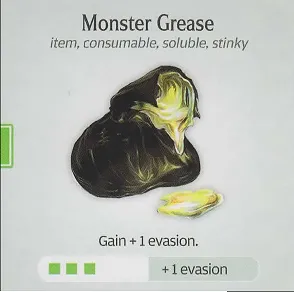
The next step in the Tank's armor path is normally Leather Armor, this is because it represents a lot of soak for a reasonable cost in addition to having a synergy combo with Monster Grease and the Leather Shield. For a long time that was the only real destination we had because other Node 1 and Node 2 Quarry monster armor sets failed when we checked for efficiency, value and overall protection. However that has changed with the more modern designs for Node 1+2 Armor Sets so we have other options that we can lean into, these are:
Crimson Armor (Crimson Crocodile) – Which when combined with smart bleed management can generate enough armor points to hold against even Node 4 Quarry Monsters.
Frogdog Armor (Frogdog) – Not capable of the same amount of soak, but has some excellent positioning abilities and a slow form of “healing” via its inflate ability. Frogdog Armor is usually replaced fairly quickly, but it is also a good armor set for Archers so it has high value.
Singer Armor (Smog Singers) – This is the first Node 2 Armor that ticks all the boxes for Tanking with a form of Cancel, lots of Soak, many great affinities and some positioning abilities.
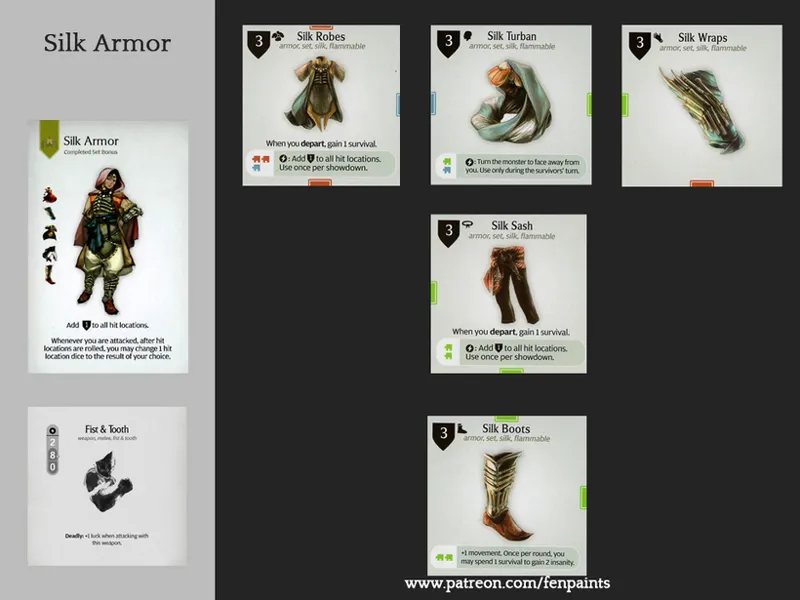
There are also a couple of armor sets that either fall a little bit short that is is worth baring in mind because with the right care and attention from Team Death in Campaigns of Death they'll make it back onto the table for early game tanking. These are Gorment Armor (Gorm) and Silk Armor (Spidicules), both can make for Tank sets, but they require beating the L3 version of their given monster and that's not something which is an early game action, it's more for when you've moved towards the second tier of gear (Leather Maker, Weapon Crafter, Node 3 Quarries). However, if Gorment Armor gets a base increase of armor points (+5 total) and Silk Armor has its Turban Crafting Cost changed it will change this situation and they will both become very competitive sets for early to mid game settlements. Same situation with Screaming Armor, it's about 3 to 5 armor points lower than it needs to be.
One final thing to note about the armors before we move on is the hit location imbalance, the body gets hit twice as often as other hit locations and the head is twice as likely to kill. This means that when we're deciding what to Block/Dodge/Etc we should give priority to preventing those locations making damage. The other three hit locations are a bit less important, you can lose one arm if you don't use a two-handed weapon, you can risk waist injuries if you're not going to be passing on weapon proficiency or other inherited traits, I generally don't want to lose a leg on a tank though so I'll often cancel those over arm injuries if I have to make the choice.
Items
As the Tank our most important items are ones that increase our evasion, ignore hits or prevent injuries. The poster child for these are Monster Grease and Dried Acanthus, though there are many others. The main issue is that as a tank our gear slots are very much at a premium because we often have two weapons eating up slots on top of the five already sacrificed to armor. This is one of the reasons why a support survivor tends to exist in hunt parties, because when you're tanking or dealing damage your gear slots are at a premium.
Weapons
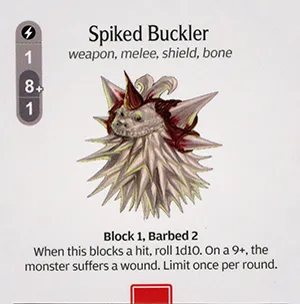
Our single most important weapon type for Tanks is Shields, shields offer us additional protection through block/deflect and on top of that they can also offer additional armor points either baked into the weapon's design or via the weapon proficiency. The best expansions for early game shields are The Gorm with its Knuckle Shield and the Frogdog with its Spiked Buckler. Otherwise the usual first shield we get access to is the Leather Shield, which is good on the protection front, but awkward for levelling up Shield Proficiency.
Knowledges
We're dealing with exclusively Tier 1 and Starting Philosophies in this portion of the examination, that's because the Tier 2 Philosophies require 13 total Collective Cognition (CC) and when you're at that amount of CC you are absolutely in the Mid Game portion of your campaign. Likewise the Tier 3 Philosophies are a good milestone to indicate arriving in the Late Game portion.
This means we're looking at Survivalism, Faceism, Deadism, Lanternism and Impermanism for our potential Knowledge combos and in addition to that we're usually combining two of them together (three if we play People of the Lantern, which is my preference) as such I'm going to stick to two philosophies when putting together early game builds, however I will “honourable mention” a third philosophies knowledge if there is one with really good synergy and could be implemented in PotLantern.
As for how good these philosophies are, I rank them in the following from weakest to strongest for tanks:
Deadism
Lanternism
Impermanism
Survivalism
Faceism
To explain that ordering; I've taken a look at all the knowledges for each of these philosophies and counted the knowledges that I'd want to have on my Tank (plus relevant bonuses from the rank ups). Deadism is last because you do not want it as your Tank's philosophy, though it does bring Evermore to the table which can be very strong for tanks, especially Gorment Armor ones. Lanternism comes next because the knowledges are all support and damage dealing in their focus. Death Collector is the closest to something a tank might want, but often they are not going to be the last survivor standing. Impermanism is terrible as a main philosophy for a Tank, but it offers multiple useful knowledges that protect against brain trauma. I'm not a fan of Impermanism, but I cannot deny that it's non-tenet knowledges include some incredible options to help protect survivors.
Survivalism makes it into second place because it has a great tenet in Tenacity that offers additional survival, allowing the tank to use survival actions for longer (and it's amazing with Rawhide Armor). Finally Faceism takes the top slot as it is the most tank focused of all the tier 1 and starting options we have at the moment, this is because every single one of its knowledges are of use to Tanks.
To provide a visual image of all of these, here is each of the philosophies and the knowledges I prefer to use for tanks.
This is of course not an exhaustive list, there are plenty of options that can be good depending on what weapons or other gear you are using, but this lot are my mainstays.
So with all of that done, let us put together a simple early game Rawhide Tank build including Knowledges. We'll take my preferred Philosophy of Faceism, which gives us Physiognomy as our core tenet and that's great because additional terrain means more chances to gain something that has defensive utility or at least generate resources. In addition we're only allowed to attack from the Monster's facing, but that is the place we intend to be in. That leaves just two slots at the moment because Romantisim isn't unlocked at this point, so while we do not have complete control over the knowledges we unlock or see in the forum my goals are to score some of the following, with the higher ones in the list being my priority hits:
Death Sense (Incredibly powerful with Rawhide Refunds)
Unyielding (Good all campaign and stacks with other forms of damage reduction)
Tenacity (Cheap and combos with Rawhide again)
Stone Heart (Especially if the Gorm is one of my quarry monsters)
Between these, if I get Death Sense first I'm more interested in Tenacity because of how tightly they synergise together (along with the Rawhide set bonus), otherwise I'll be keeping an eye out for Unyielding and any other possible damage reduction gear cards (White Gigalion, Spidicules are two prime suspects). We combine that with a traditional Rawhide Tank set and this is what we end up with:
This is the format I'm going to use going ahead for builds, this is because I've found that the best way to think about knowledges is like you are playing a deck builder. You don't always get what you want immediately, but the forum can produce interesting options and knowing which ones are good for the particular survivor build can do a lot to help advance this. If people are interested I can do the same for all of the Node 1 and Node 2 early campaign armor sets (that's everything apart from Silk Armor which is very much mid campaign). Please let me know in the comments, otherwise I'll move onto putting together the damage dealer one(s).
Comments (2)
so excited for this updated series of articles! i already learned so much just from the first one 🖤
This is really cool and useful! I'd love to see the other early-game armor sets presented like this.