



A Review of Encounters: Shattered Wastes
Disclaimer: Ryan Farmer of Almanac Games is a patron and sent me a copy of this game at no cost apart from Import Fees. There were no requirements attached to this copy of the game but please be aware that my opinions may be coloured by these facts. I try to not let this happen, but it is something that may happen without my conscious knowledge.
Before Ryan reached out to me I had previously seen Encounters: Shattered Wasters (Hereby referred to as Encounters) during its crowd funding period on Kickstarter (here) and while I was interested, I've had to massively scale back my backing of crowd funded games due to various increasing expenses. There have been a few situations like that in recent times and I'm always keen to try and rectify it later on, but Encounters didn't get a general retail release in the EU (It has been seen on Zatu, but that's not the EU and Zatu's got its own issues so I don't order from them regardless), so I had resigned myself to not being able to check it out. This is why when Ryan contacted me I was happy to check the game out because it is a boss battler that's trying a bunch of new things that are fresh to the format. It's always interesting to explore new innovations and iterations in the dungeon crawler/boss battler space.
For the images in this article I have used ones from the rulebook and Almanac Games website. As I was playing this one on our downstairs table because it has a relatively small, tight footprint I forgot to recreate the games for "glamor shots" later on. I hope this is OK Ryan!
Overview
Encounters is a cooperative game where 1 to 4 players work together to defeat a boss/bosses out in the Shattered Wastes. There are a total of eight different characters and boss enemies in this game and it can be played as either a single battle or over a short eight encounter campaign called a Journey.
The unique facets of this game in comparison to the rest of the genre is the use of attack “lanes” where the bosses attacks are targeted, the use of a mechanic that delays attacks in empty lanes until a threat threshold is met, an emphasis on letting weak attacks resolve rather than avoiding them entirely, the concept of limited windows where damage can be dealt (removing rushing the boss down as an option) and the shattering mechanic which functions as a second life for both the players and the boss. We'll get more into that later on, for now we'll start with a look at the main event, how the game is set up and how the bosses operate.
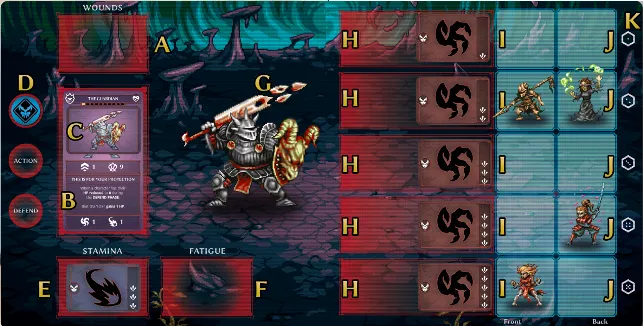
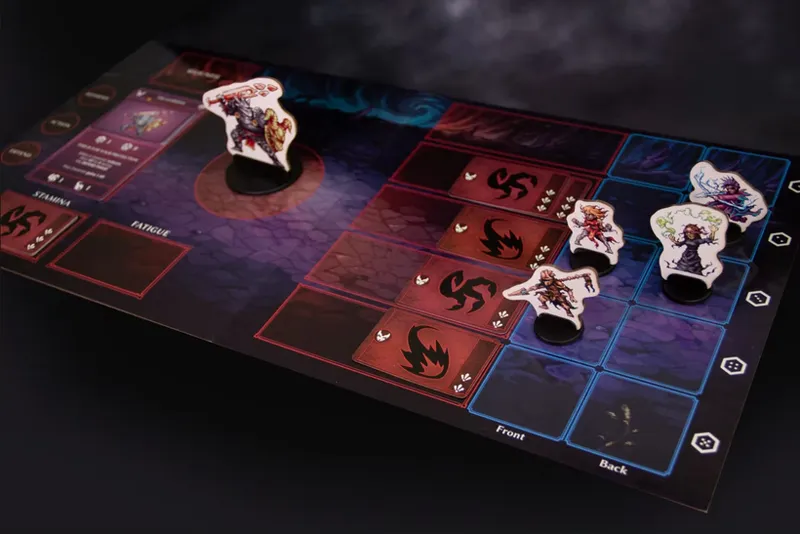
This example of the game set up is from the rulebook and uses the tutorial boss “The Guardian” in addition to the recommended starting characters. This is exactly how I set up my game for learning the game in my first play.
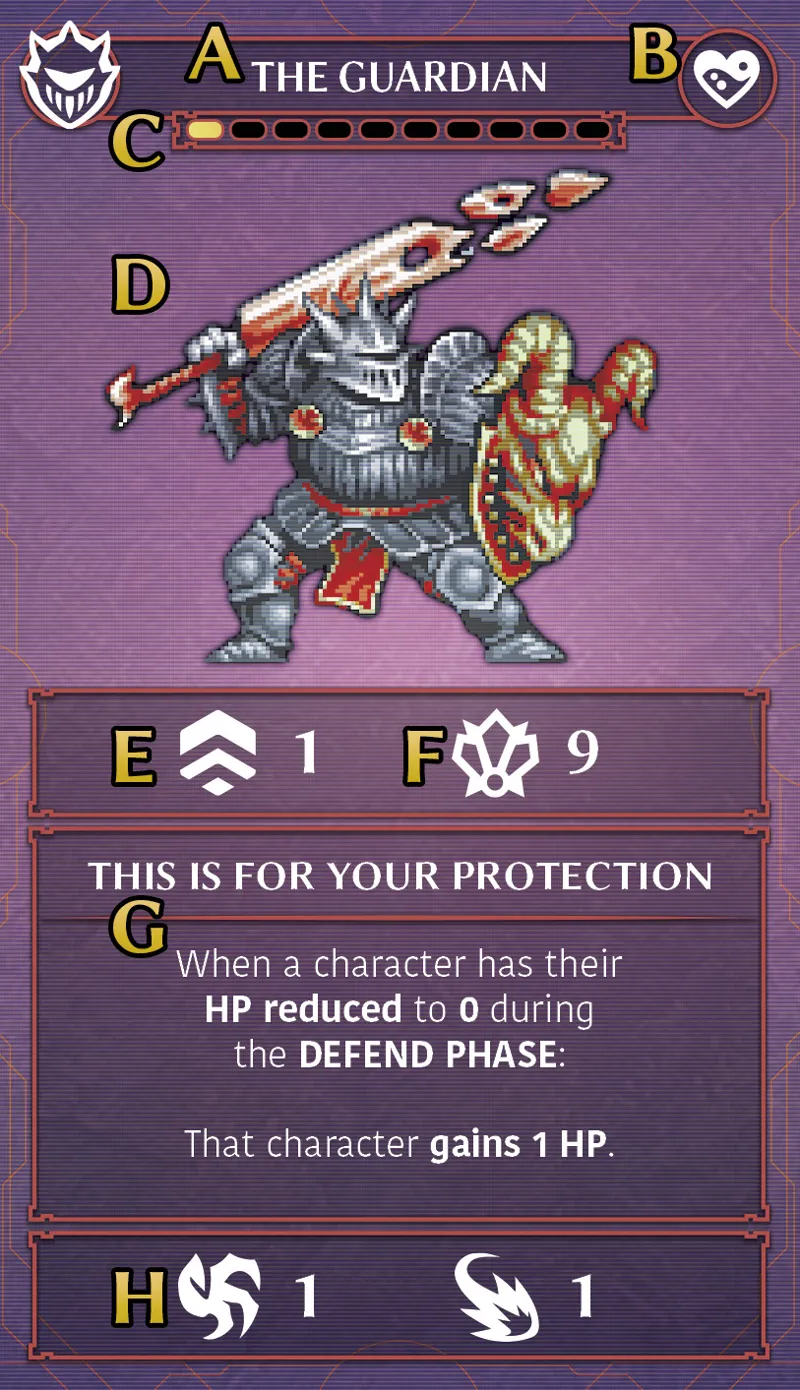
The board is broken into two halves, on the left are most of the cards that the boss will utilise, they have their specific Character Card (B) on which is placed the Rage Deck (C) that contains their most powerful and threatening attacks that are only deployed in certain circumstances. All Character Cards are double sided in this game, with the reverse side depicting the Shattered Form of the boss/player unit. You can see below the boss name there is a multi-section bar, this gives you an idea of how difficult the given boss is considerer. With 1 single bar you can see The Guardian is considered the weakest of these options.
Below the Sprite Image of the Boss is its Refresh Value and Area Limit, the refresh value is how Enemy Cards are added to the board per character. More on this later. The Area Limit indicates the threshold for attacks during the defense phase and we'll get back to that when we walk through the phases. The text box has specific rules for the given boss and the final two symbol/number combos list the strength deck construction for the boss. In the case of The Guardian it will have 1 Claw and 1 Bolt (Front Row/Melee vs. Back Row/Ranged) per player unit in the game. There is also always one Melee Stamina card per lane set up at the start of the game in addition to the deck.
To return to the board, the three circles on the left are for tracking the three phases of a round and the token itself is used to track if the boss is vulnerable to wounds or not depending on which side is face up. The three remaining areas are various places for the enemy's strength cards. I did notice there's no dedicated space for the Status cards, but it isn't a big deal to keep them next to the board.
On the right hand side of the board we have the five “lanes” where the boss attacks will occur and the players will position their characters to attack the boss strength cards. It's the main area where decisions are made and the action happens.
The Character cards are the same size as the boss cards (Tarot) and they contain your Health Points, Magic Points, how many dice you roll for your basic action (usually 1, with 2 appearing on Shattered Characters), how much damage each hit deals (strength cards removed) and what number is your critical hit. The critical hit number varies depending on the character rather than just being a 6 and this has some interesting implications when we get into how you roll and score hits.
The main box has the Character's Trait, something they have available to them all the time and the bottom row has the numbers and types of cards you get to draw when setting up (unless you use the recommended set up, which is good for learning). More cards seen there means more options for the given category, we'll only be selecting three cards each time, but as we can see here the Lancer will tend to have a higher quality Defence (Shield) Card due to having five options, but there is the chance for other card categories to throw out an unusual option. It's not a complicated way of setting up a character, but it does provide variety from one game to the next.
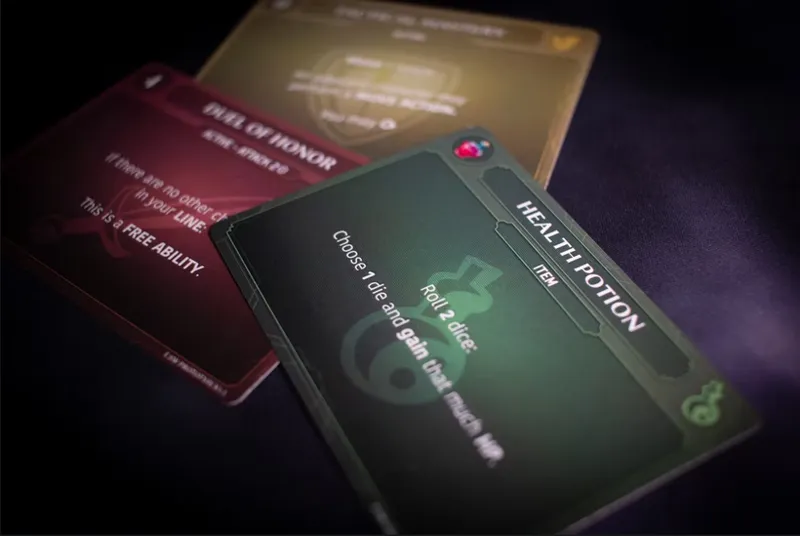
These cards offer a wide range of different options including passive buffs, actions you can spend your MP on for extra bonuses and one use disposable potions that can replenish things like your HP or provide other potent temporary bonuses.
Components
I was sent the base game plus the Character specific dice and the Acrylic Standees, the dice help make it easier to track when your character scores a Crit and the Acrylic Standees are nicer versions of the cardboard ones.
The box has a solid insert, though I have had a lot of trouble fitting the Acrylic Standees into their storage area, there is a guide about how to fit the standees into their tray, but I cannot get all of the Acrylic ones to fit in as it's a bit too shallow. I would have preferred something deeper and wider instead of needing to build a multiple layer jigsaw each time I pack the game away. This of course is not a problem with the cardboard standees.
The rest of the wells have room for the tokens, Character dashboards, dice and cards, including extra room for the cards if you choose to sleeve them, though with thicker sleeves on the cards the organisation of the standard size cards is a little tricky, they'll all fit, but I had to split one of the decks between two wells. so overall the insert is a little bit off from what I needed but not so much that it needs to be replaced and if you have the base game with no sleeves and no acrylics there are no issues in fitting things in.
The card design is functional and clean, there is no art on many of the types of cards, but the Item cards have a depiction in the top left, the Location Cards have art of the location and the relic cards can have art on them also. This is a game from a small company, so putting art on every card while nice, would be an expensive investment in time and effort even if it is “just” sprite art.
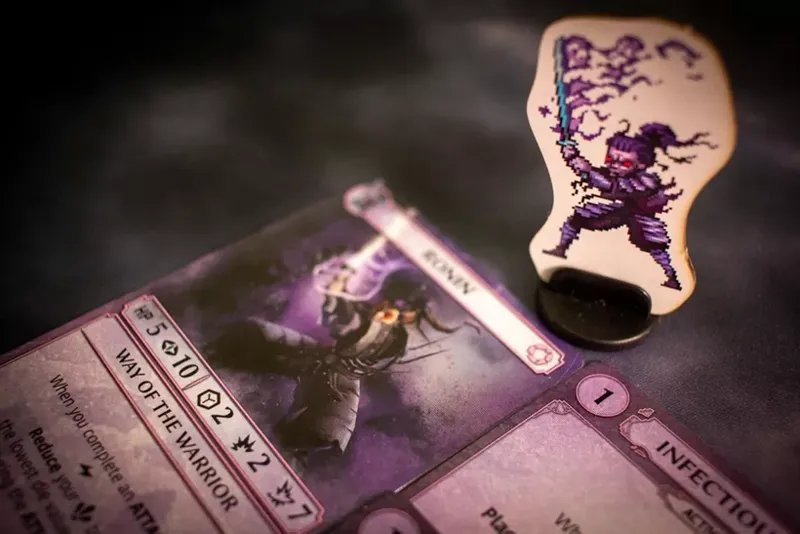
Speaking of which, where art is used it varies between being 8-Bit/16-Bit Japanese Roleplaying Game (JRPG) inspired designs and full traditional art. I think this mix is to evoke the feeling that the older JPRGs have where there is more detailed art in the books and cut scenes with sprite art for the rest. As someone who dabbles in Sprite Art here and there (I have used it here on the Patreon before) I really love the care and attention that has gone into each of the sprite illustrations used in this game. In fact I think I'd prefer it all to be consistently sprite art because it's a fairly unique art medium in board games and it is a big part of what gives this game a standout identity. For the record, the traditional style art is good, I simply find the Sprite work more engaging as it is more unique.
You can see the characters on the acrylic standees here in this image.
Gameplay and Round Structure
The round structure goes Refresh Phase → Action Phase → Defend Phase → Refresh Phase and this is tracked using the three circle track on the side of the board. During the Refresh Phase the boss will deploy new attacks from its Stamina deck, one to each empty space and then an additional number (X per player depending on the boss) are generated by rolling dice and assigning them to lanes 1 to 5. If you roll a 6 here on a dice then there's no attack coming. This means there's constant pressure everywhere and it scales with player count.
An additional element of this is if the Stamina deck empties during this phase the boss becomes Staggered; this is represented by flipping over the phase tracker and now the boss is vulnerable to being wounded. More on this later, but for now the important thing to note is that a large part of Encounters is playing a waiting game with damage management until you have those Stagger windows where you can try and deal permanent damage and progress towards victory.
The Action Phase is the bulk of where players will spend their time and here players will activate their Characters in any order with each character taking two actions sequentially. Our basic actions are moving up to 3 spaces orthogonally (forward, backwards in a lane or up and down to different lanes). Making a basic attack as listed on their Character card. Using an Active Ability (limit once per round per ability). Recovering to reduce threat (more on this in a moment), remove afflictions or gain MP and Shatter (more on that later).
Movement is undertaken for a few reasons, the first is to get in place to attack the Strength cards you want to remove, the second is because you have an ability that requires you to be in a certain spot to use it and the third general reason is because you want to have that particular attack card resolve against you (also sometimes you'll move to let another character occupy the spot you were in). As you'll see with how attack cards work, positioning with them in mind is a significant part of tactics in this game. The front and back row doesn't impact a character's ability to basic attack, but it does limit some other abilities and determine if they are hit or not if two characters are sharing the same row. Movement is quite deep which is an engaging part of this, not only are you moving to attack the right card at the right time, but you're also moving for your defense and to support others. I love map based games that ask you to do more than just “move to the right spot to attack and/or not be attacked” and instead ask players to consider how they should place themselves for others. I really like this movement system, it's got some space and hard decisions, but it also always feels tight and confined. Working out what order to use characters in is a delightful part of the game's crunch.
Attacking is also an interesting system, when you attack you are rolling against your threat level, in order to hit you need to roll equal to or over your current threat (or score a crit). Threat constantly increases as you remove attacking stamina cards with you gaining threat equal to the value on the cards you have removed. This means as you remove stamina cards you will find it harder to hit future cards and be forced to take time off with recover actions, this replicates the whole JRPG turn “cooldown” element that some of them have. It's a really good system that removes one blaming chance/the dice for a string of bad rolls because you chose to make those rolls rather than reduce threat before attacking. It's on you.
If you roll a Crit you hit regardless of your current threat level and you don't add more threat either and this mixes well with how Characters have different crit numbers. Not only do you have a desperate “roll X and hit” result but you can also calculate it into the odds of attacking. If you have a crit that works on a 4 and five threat then you actually have a 1 in 3 chance of scoring a hit because the 4 still works. That's a neat twist which I liked.
When you score a hit you'll remove 1 card in your row per damage dealt, most basic attacks remove 1 card, but some characters have a higher base damage like the Monk who deals 2 damage, thereby potentially removing two cards, with the most recent card played there being removed first. Because we know the threat level of the cards from the information on the backs (I love boss battlers giving us information about the boss intent on the card backs, it's an incredible improvement) we know some of the consequences of removing that card and not moving away afterwards. If you clear the row and don't move, that rage card is your fault. If you remove a 1 threat card and reveal a 5 threat one for the incoming attack, you did that, you knew in advance it was going to happen. It's very neat and gives a lot of agency to players.
Normally these cards removed by hits are moved into the fatigue pile for future laps of the Boss deck, but when the boss is Staggered that is when they will move to the wound pile. If the boss is caught with no cards in its Stamina or Fatigue piles it will Shatter and then you move into the second boss phase (even if there are still some cards deployed as attacks). Flipping the boss card, changing its form and triggering a bunch of other changes.
Defend Phase
During the Defend Phase attack cards will be flipped up and inflict their effects onto the characters impacted by them. The way we can determine which cards are flipped up is through a few conditions.
The first is the Area Limit, if any space has more threat than the enemy's Area limit it will reveal the top card deployed to that area (lane) and hit all Characters regardless of where they are.
Second is if an area has 1+ Characters in it (front column + back column) then the top most (recent) card placed will be flipped up and it will affect a target depending on who's in the area. If it is one character then that character is always the target of the card's effects; if there are two characters the type of the card will determine who is attacked (red/melee/claw = front purple/ranged/bolt = back) and if there are no cards in the area then a rage card is drawn and ALL characters in the lane (area) are affected. Rage cards are bad news and the goal is to avoid this situation.
Another neat part of these Stamina cards is they do not just deal damage, they can also increase their target's threat and inflict Status effects, this is better than taking damage, but it can put you in a position where you have to take a few actions off from attacking to get yourself into a good state.
I think it is worth noting that unlike the rage decks which are unique to every single Boss with a deck for the Normal and Shattered Forms they are just two generic decks split between Red/Physical/Melee and Purple/Magic/Ranged. This is one area where I think having specific pools for the bosses would have brought a lot more into the game, not only would we then have different mixes of cards but we could also have individual behaviours for the bosses.
This is the same root thing with the Status decks, the bosses do not have themed statuses, they are instead just inflicting whatever the deck throws out and that just doesn't feel thematically satisfying to me.
Overall though I like the core design a lot, having a huge punish for avoiding attacks entirely keeps the fight moving forwards, we're not able to stall out and instead things have to move to a conclusion.
Shattering
So the last thing I want to touch on here is the Shattering Mechanic. This is a thematic element of the game that gives all units a second phase, bosses reach it when their Stamina and Fatigue slots are empty and that replicates the experience of two phase bosses.
In their Shattered Form bosses will reset and rebalance their Stamina deck, in some cases they are adding cards, in others they are removing them. This can convert a Boss from full melee to ranged for example and that's a fun aspect to it.
Once Shattered the main threats here are the changes to the bosses' profile, area limit and rage deck. The goal now is not just to empty the Stamina/Fatigue deck but to move every single card into the wound pile. This ramps up the threat of the Rage deck near the end of a fight and lets it feel like it's escalating into a climax. Once the last Stamina card is in the wound pile there will be one final Rage attack that at least one Character must survive to win. I've not really written much about the Rage deck, but I would like to mention that the order of the deck never changes during the game, so you can learn and anticipate what each card will be. Though the main goal is to not get that familiar with the Rage deck if you can.
Characters also shatter, this usually happens when they reach 0 HP, and it flips their Character card over, removing all of their current cards and replacing it with a set number of Shattered Ability cards instead (Often just 1). The shattered profile for the characters trends towards being stronger but they now have multiple new ways they can succumb and be removed from the game. Not only will running out of HP take them out, but their Corruption (a track that replaces MP) reaching their limit will remove them as will reaching 12 threat.
Shattered and Succumbed characters can even rarely be returned to the field via a Reclaim ability, this is very rare, but if it does happen the resulting character can even potentially be stronger because they get so many more cards than the Shattered version and can even have multiple Shattered Ability cards. Super exciting if it does happen, but the limit there is you can't Shatter again and reaching 12 threat will remove you from the game on top of running out of HP.
It's worth noting that you can Shatter voluntarily as an action, there are reasons to do this but most of the time you won't do so.
Journey Mode
This is the campaign mode for the game, it's a rogue-lite experience that has you taking a fixed party size number (1 to 4) through eight encounters. You can take the full roster of 8 Characters with you in order to have back up characters, this is useful because there's no reset of HP, MP and Threat between encounters. The Characters will naturally be worn down through the progression of the game. Things are softened a little because players have a lot of control over what abilities their characters will be using, this means we have a form of party construction where we can try and ensure that the characters work well with their assigned abilities and with each other.
Encounters take place in a fixed order and have three different difficulties that can be selected from, Normal, Hard and Shattered. It's worth mentioning that all modifiers for difficulty are cumulative. Shattered is Hard + Shattered and that's going to be rough without a lot of experience and good play. That's good, we love to see ways to turn up the difficulty further once the basics are mastered.
Winning an encounter gives access to Relic cards which are added to the roster supply and can be used in the future. Losing the encounter moves the game forward, but all the shattered/succumbed characters are gone from the campaign. This makes for a high stakes experience that can ask the players to make difficult choices between preserving Characters and winning the Encounters.
The Relics in particular make this mode stand out from the base game and provide a draw, there is even a Journey+ Mode where lost/excluded Characters are replaced by powerful Class Relics which provides another level of variation and decisions to be made.
The Standalone mode was great for learning and it's perfect for a one off game, but the Journey mode is where the depth of the game and how you can synergise its characters and abilities together really starts to sing.
Final Thoughts
I'd place Encounters: Shattered Wastes a little lower than the Primal/Marvel Champions/Townsfolk Tussle tier for gameplay weight and game playtime. I think when it comes to overall crunchiness the trick here is how the game operates with four Characters. This is how I played the game after a couple of learning games and I found there to be a lot of very engaging depth to operating the Characters together and figuring out synergies from the options I had. There's always interesting or difficult choices to make, especially when considering the Threat/Hit Roll interaction, you can guarantee attacks if you're willing/able to run slower.
That's a big part of what I found engaging with Encounters; there's very little of that “I rolled a miss so I did nothing with my turn.” Which I can find sometimes exhausting in the games that use the more traditional hit roll Warhammer/D&D style attacks such as Kingdom Death and Townsfolk Tussle. We do still have that here, we even have exciting Crits still a part of the game, but there's also a lot more control offered to the players. The bosses also don't miss, they apply consistent pressure and I like how that is not always direct damage.
I personally would have preferred to see individual stamina and status decks for each of the bosses in the game as that would have given them all even more identity and individual attack styles to learn and adapt to, but that is a considerable amount of additional design work for what is a small company so I can understand why it's not there.
I think if you are looking for a lighter boss battler to play for shorter campaigns, especially if you find the JRPG influenced mechanics and sprite art style engaging then there is a lot to like here. It also feels like a solid platform for additional growth and expanding both for the game and the setting so I look forward to see what comes from Almanac Games in the future.
Almanac Games: https://www.almanacgames.com/
BoardGameGeek Entry for alternative reviews: https://boardgamegeek.com/boardgame/364049/encounters-shattered-wastes