






A Review of Aeon's End: Beyond the Breach
Reaching its 10th Birthday this year, Aeon's End is one of the earlier boss battling card games that came out in the wake of Sentinels of the Multiverse. Players take the role of “Breach Mages” battling to protect Gravehold from an attacking Nemesis. The game has a very unique set of mechanics, it is at its heart a deck builder, but player decks are not randomised. Instead once a player's deck is empty the entire thing is inverted and repositioned to become the new deck. This allows for a lot of skill expression because you are not only adding new cards to your deck as the game progresses, you are also somewhat in charge of the order they are placed in your deck.
Cards come in three types, Gems that work as currency, Relics that have a wide range of utility effects and Spells that deal damage to the nemesis. Spells are “Prepared” by being placed into Breaches, slots that can hold spells as long as they are/have been opened. You can also prepare spells into unopened breaches if they were focused on the turn, focusing is a mechanic that gradually reduces the cost to open a breach.
I'm not going to go much more deeply into the rules of the game, however if people do want an in depth review of Aeon's End I can go back and review the original box. Otherwise the goal for me is to review each new box as they arrive because the expansion boxes like Beyond the Breach are intended to stand as an experience players can jump into. You have everything you need to play the game inside the Beyond the Breach box and after that one can expand by adding either smaller expansions or bigger ones. It helps make the entire pseudo-Living Card Game model that Aeon's End follows a bit more approachable. So I'll be reviewing this box through the lens of 'what if it was your first purchase', but I will dip into how much this adds to the game overall near the end. This will work out as around one review every year or so.
Beyond the Breach is a 1 to 4 player game that is initially played via a small resettable campaign that has players battle five Nemeses one after another. It can take between five and ten sessions to complete as if you fail the first battle against a Nemesis you will fight it again a second time. If that second fight is a failure you're instructed to move on to the next part of the campaign story, however one can stay and keep fighting the Nemesis repeatedly until victory if you desire. Part of the fun of playing Aeon's End is figuring out how to handle each different Nemesis monster.
A lot of the content for this box is therefore placed inside envelopes and sealed packs with bookend cards that hide details of the cards inside. This system does help preserve a feeling of mystery, but I do wish that Indie Cards and Boards would get with the times and have the decks wrapped in paper the way that many other publishers now do. Paper wrapped decks would also eliminate the need for the bookend cards, the paper would just need the identifier of which deck it is and which end is the front printed on it.
Because of this initial games are intended to be a surprise element, it's a little tricky to review the set without spoiling things. What I'll do then is I'll break down the various generic elements such as the starting Breach Mages (you start with 4 and unlock 2 more during the campaign), Friends, Foes, Trinkets, Banners, Campaign Structure and so on. Then I'll go into the first Nemesis with a fair bit of detail (because that Nemesis is what you'll see when opening the game up, there's no surprises there) and for the other 4 Nemeses I'll have a short section titled Nemesis X for each. If you don't want spoilers for each of those you can skip past that to the Final Thoughts section at the bottom which will again be spoiler free and provide my opinion on how good I think this is for new players and existing players.
The Terror in Brass
The Terror in Brass (I'll call it The Terror from now on as that is the shorthand name the game uses) is our first Nemesis in the campaign and I'll be honest, it's my least favourite of all of them. The reason for this is its design, which is ambitious, but ultimately doesn't work for me. The reason for this is The Terror's specific gimmicks, it has the highest possible life total (99) and when it is attacked it takes exactly 1 damage per attack. It also comes with a separate tracking board called the Worldsplitter that has two sections, the left section has six slots that a counter will move up, most of these inflict damage directly to Gravehold and when you reach the end space the track will reset. The right side of the track has the Armor Chart. This is five slots that players may spend 3 aether (the purchasing currency of the game) to cover up and gain a small benefit. When all five of these armor chart slots are covered The Terror becomes “vulnerable” this resets and temporarily freezes its Worldsplitter progression, allows it to be damaged with a doubling multiplier and also puts into play The Terror's Regeneration power card, this card will heal The Terror before eventually removing all the armor tokens and returning the game to the non-vulnerable state.
The intended ebb and flow of this battle is that players spend part of the time paying for minor effects that eventually make The Terror vulnerable, then when it is vulnerable players attempt to burst The Terror with as much damage as possible while the window is open. This in itself isn't too bad, but you may have noticed one word I wrote above, Regeneration. Not only is The Terror only vulnerable to attacks in a set window that has to be reopened, it is also constantly healing itself during this battle, its Unleash (Nemesis specific “attack”) which normally advances the Worldsplitter track switches to healing 5 life per Unleash during the vulnerable period. So while you're dealing double damage, it's also clawing back some of that damage at a rate that mitigates a lot of the double portion of your damage.
The Terror's nine specific Nemesis cards are mostly split between increasing the speed that the Worldsplitter track advances/boosting damage from the track, removing nemesis tokens from the Armor track, dealing damage to the breach mages and giving a burst of regeneration near the end of the battle. It also has a tenth card that moves in and out of play, which is the aforementioned Regeneration power.
The Terror is probably one of the worst first bosses I've seen in any of these boxes, the idea that Beyond the Breach could work as an entry point is shattered just by this single Nemesis alone. As the last Nemesis in the introductory campaign it would be a bit more reasonable, but as the first one it's not only hard, it's not engaging and really consumes time. The concept of having a nemesis monster with limited windows where you can properly damage it is interesting, but having The Terror also have the gimmick of regenerating damage compounds onto the limited attacking windows and makes the entire experience feel like you're running on a treadmill.
Players need to juggle periods where they are paying for new cards and covering the Armor Chart against ones where they are dealing damage. It's hard for anyone to specialise too much because if you do that you'll end up sitting around during one phase or the other. This makes the experience very hostile to newer and less experienced players in a pretty atrocious manner, they are at high risk of experiencing “garbage time” a state where players are just going through the motions due to not having anything they can do because their current cards do not match the situation.
If The Terror had this massive health pool in addition to limited attack windows I would probably feel a bit more charitable towards it, but adding the regeneration on top of everything else makes the game experience slow, stodgy, frustrating and leaves one unengaged. It also makes the battle difficult, so much so that this is in my opinion the hardest Nemesis in the box despite it being rated a “5” for difficulty. That's the lowest difficulty rating in the entire box, but The Terror was the only Nemesis that I had to repeat the fight before progressing. I really can't overstress how bad a first impression this Nemesis gave me.
The Starting Breach Mages
Our starting four Breach Mages on the other hand faired a lot better, we have two returning characters in Nook and Indira, along with two new ones called Stake and Wolf (plus there are two additional breach mages in the envelopes, but I will not spoil them in this review). I've tried out every single one of the breach mages in this and I found them all to be interesting and unique.
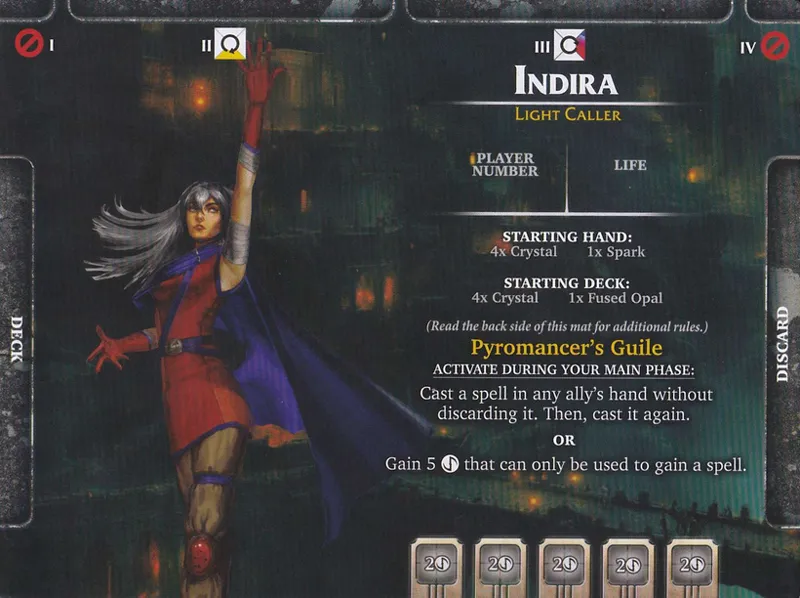
Indira follows her theme of casting spells from places other than breaches by having just two breaches instead of the usual four. This reduced number is mitigated by her unique breach taking a cast spell and putting it into an ally's hand (note there is errata here because in places the game mistakenly says this transfer of the spell is optional, it is not optional), she can also with her ability (kind of like an Ultimate that Breach mages have to spend aether to charge up) cast a spell from an allies hand twice or get 5 aether to spend immediately on purchasing cards. Indira works incredibly well as the purchaser / ”big money” mage who concentrates on economy, purchasing the big spells and then sending them to the other mages. Indira was pivotal in our victory over The Terror because of this, she had the economy to rapidly fill the Armor Chart and when she wasn't doing that she could deal decent damage by casting spells from other mages or handing them spells after she cast them.
Nook's gimmick is that he has a bunch of gems and spells in a place called the “Swap Zone”, these are Crystals and Sparks (the game's starting cards) with a range of different power levels. The strongest versions of these cards can be three times more effective than normal, but they degrade in power when used for that (represented by swapping them with the next step down of the same card from the Swap Zone). Nook's ability allows for placing Crystals and Sparks into the Swap Zone and then gaining a card back. Through this Nook can replenish the unique crystal/sparks he has to their best “Superior” version and also thin the trash out of his deck when he no longer needs it. Nook makes for a very good specialist, able to focus on economy or damage equally as needed. If you need a dedicated damage dealer in particular, Nook's great at it and his synergies with Indira are clear and potent.
Our next Breach Mage, Wolf's gimmick surrounds the concept of doom tokens. Wolf's starting cards include ones which either deliver a high amount of damage/aether at the cost of gaining two doom, or instead just remove 1 doom from Wolf. If Wolf ever reaches 5 doom she explodes, dealing 10 damage to herself, the Nemesis and each minion. Her ability; which requires a higher than normal 6 charges, removes all doom from Wolf while also allowing her allies to draw 1 card per doom removed. Wolf's a delightful Breach Mage to play with in larger group sizes as you can work on getting your Doom to 4 and then triggering your ability to turbo charge the hand size of your fellow mages. She also doesn't have any sparks in her starting deck at all because they are replaced by the Doom Howls and those cards; despite the doom, are something you want to keep around all game.
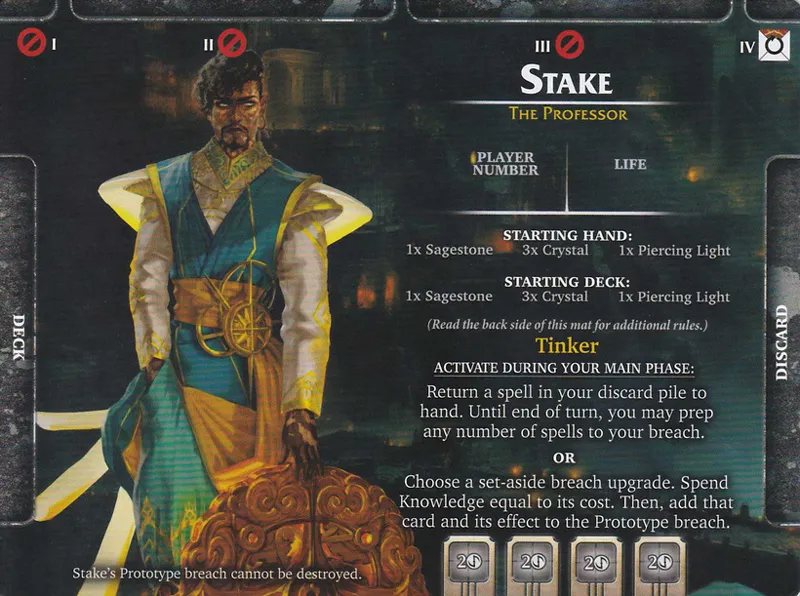
Our final breach mage is Stake, who is another take on the “low number of breaches” mage. Stake has but one single breach called the “Prototype Breach”. This breach cannot be destroyed, gives Stake 1 knowledge token per spell cast from it and via Stake's 4 charge ability Stake can spend this knowledge to upgrade the breach. Stake is one for players who really like to power scale across a game, Stake starts off weak compared to the other three breach mages but absolutely pushes ahead of them in respect of damage if he's given time to scale. His “sparks” called Piercing Light even support this because they are able to self destroy, removing them from the game very early on and thereby giving Stake a clean, lean deck with good economy. Personally I found Stake to be the most powerful of all six breach mages and he functioned as the damage dealing “carry” in most of the battles.
Friends, Foes and Banners
Friends and Foes were first introduced in The Descent (the release previous to this) and they provide additional difficulty modifiers for players. One can play with a Friend in the game in order to make it easier, a Foe to make it harder and both if you want a more varied experience with more complexity. These additional characters do not have life totals, so they cannot be removed by damage, and they have four card decks that all consist of aggressive attack actions. They will also have their own turn cards in the turn order deck. When their turn comes up, the top card of their deck is played and then the next one is revealed, you always get to see what the Friend/Foe will do on their next turn so you can plan appropriately even if you don't know exactly when it will happen in the round order.
Friends/Foes also have their own ability bar, which will charge up and if full trigger after their card. One can't buy charges for the Friend/Foe but players will start the game with a Banner that can interact with them when played. Overall I like this system as it provides a lot of knobs and dials to tweak in order to make battles easier or harder, but I think it does add more overhead and it's something that newer players may want to skip (or at least skip on the Foe part if they're struggling).
The Gems, Relics and Spells
The mechanics that the Supply in Beyond the Breach revolve around are trinkets, pulse tokens, recall and conjure. I'll cover trinkets in its own section beneath this one. Pulse tokens are simply another token currency that you build up and then spend for a bonus effect when supply cards ask for it, it's pretty neat
One frustrating element in the rulebook was that the reference page failed to have the rules for both Recall and Conjure alongside the other elements. if I'm honest the reference page felt like it was cut and pasted from older books rather than revised and updated.
Recall allows spells to have a once per turn effect if they are in the discard pile, this is a neat little play space that I enjoyed interacting with a lot. It rewards larger deck sizes in a positive manner because those recalls get to hang around a lot longer if the laps through your deck take longer. The starting gem "Phosphor Nugget" gives an ally an aether token, which is super neat as it allows someone to take a really supporting role by grabbing these and gifting the tokens to the designated big hitter, allowing them to pick up the big damage spells faster and with less need to invest in economy.
The starting relic version "Chronoid" gives an ally 3 aether tokens when played (more money, more support) and its recall looks at the top card of the turn order and allows you to either keep it there or send it to the bottom of the turn order deck. Turn manipulation can be a crutch thing, especially in larger group sizes because it can push the Nemesis turn further back if you're needing to clear a power card before the Nemesis has its next turn. It can also neatly push another player's turn back if others are planning to feed them more aether tokens or similar. Having X go after Y and Z if Y and Z are both going to give X more money can be incredible.
Conjure when triggered allows a player to look at the top card of their deck and either put it back there or prep it facedown to an open or focused breach. It becomes a 2 cost, Cast: Two Damage spell until it is cast. Then when cast it goes into your discard pile. This is a great way of handling weaker cards in your deck without needing to look for "destroy" options when the chaff starting cards are not needed anymore. The starting big hitter spell "Descent of Destruction" even goes further by boosting those conjured spells (and other spells that are 2 or less cost), allowing them to deal 2 additional damage.
Speaking of destroy cards, I'd also briefly like to shout Deadly Accord, this is a cheap spell that players want to spread around the team, then when one casts, the others can pitch and to deal more damage and trigger the destroy a card for you. It's a fun spin on the mechanic that feels more intricate and rewarding than other destroys I've played with.
While it's not a new mechanic, Developing is the last mechanic to mention here, you can see the icon in the top right of the Deadly Accord card (underneath the 3 Cost icon). You can pay the develop cost and move the card to the "Develop Zone", any player in the future can pay the develop cost a second time to gain the card. The ratio of cost to develop cost can vary, but even the cost of Deadly Accord proved useful at times because if you're maxed out on Ability charges, pushing cards to the develop zone is a neat way of helping other players by giving them cheap options.
Trinkets
Introduced in Beyond the Breach, Trinkets are an additional deck of cards that temporarily join player decks before returning to the Trinket deck. They are only involved in a game when other cards from sources such as Supply, Friend/Foe or Nemesis call for them. There is 10 total cards in 5 pairs of 2 and they're all sort of not great but not terrible. For the most part they function as another punishment mechanic because they interfere with the engine you've built, gumming up turns and pushing back cards you were planning on drawing. I think this is a perfectly fine mechanic, it's never over used and the cards all at least do something somewhat beneficial so they avoid feeling completely like “garbage time” generators.
Treasures
Treasures have been around for a while now, they are bonuses you gain after each battle in the campaign/expedition mode and they used to come in three levels. Now that the expedition mode is being expanded to 5 battles there is a fourth level of treasure to be gained before the final battle of the expedition. Expedition mode remains one of the most engaging elements of Aeon's End gameplay, asking players to deal with a randomised selection of mages, spells, relics, gems and similar against a random (but tiered by level) selection of nemesis monsters. It's fine enough, the right level of touch for Expedition modes, though at this point I'm not sure how much more I want added to expeditions outside of more choices and options for the existing elements.
The Story and Campaign Structure
Without getting into specific details, I found that the writing in Beyond the Breach was not great, Aeon's End has always been very much on rails for its story, even when you're given choices they're ones that do not end up mattering for the overall arching narrative. However, the story in this box is extra convoluted and difficult both to write and follow. I do like how Aeon's End's world evolves over time, but recently with Future and Past the lore/narrative team have gotten into time travel related elements and these when they turn up are not well executed at all. In Magic terms the quality is below the Gatewatch story arcs, and considering that portion contains one of the worst written characters in Magic history (Jace) well, it's not good. So in short I wouldn't want to reread the narrative for this campaign.
The campaign structure also suffers, the largest issue is the one I can write about here, The Terror in the Brass is just an awful first impression, regardless of experience level players did not have a good time and it didn't even feel cathartic when The Terror was defeated on the replay. The response across the table could be summed up as “I hope we never see that thing in a future expedition.” Without spoilering anything else, there were also negative opinions about the second and fifth nemeses in this box. The second nemesis is another damage mitigation type that creates a treadmill experience.
The third nemesis has a typo as a part of it set up asking for “Whirlpool Pendants” instead of “Abyssal Vials”, overall though it was the most fun fight, but very gimmick heavy in a way that doesn't allow for much room in varying strategy – seeing it on occasion via expeditions will be lovely, but it's hard to see how it'll play out much differently in the future, if you want more about that, I'll get into it in the “Nemesis 3” section. Nemesis fight 4 was a lot of fun, and while it once again leant into damage mitigation, it did it in a more interesting manner. As for nemesis 5, I'm going to leave that one to the spoiler section.
Spoilers for the remaining Nemeses start here, skip to Final Thoughts if you do not want them spoiled, I will not be referencing these Nemeses by their names to try and help preserve the mystery if possible.
Nemesis 2
Weirdly this was the second hardest fight in the entire box, it has a different spin on damage mitigation/regeneration from The Terror, one that felt a bit less frustrating because we were not also dealing with periods where it was basically taking no damage and instead asking for players to pay (aether) to play. It was also a sort of returning Nemesis, but frustratingly it is one from a different timeline, so its foreshadowing with the previous released version is wasted. At least it is a different fight from it's earlier release. Overall it's the third best Nemesis in the box, but that is only because of how little I like two of the others.
Nemesis 3
The third nemesis is genuinely a fun experience, this Nemesis takes reduced damage (down to 1) when attacked and instead you damage it by casting spells at its minion (who cannot be removed from play) and those spells go into a “Vortex Deck”. We also have access to two Nemesis specific cards in the supply. One of which puts used Gems into the “Vortex Deck” and the other, the win condition, that uses the total cost of all cards in the Vortex Deck as a part of its damage.
The Vortex deck initially starts full of nothing but basic crystals, and on occasion the Nemesis will “Expunge” the deck, throwing six of the cards randomly out of the deck and on top of player decks. If it can't fully expunge all six cards it starts to really harm Gravehold directly.
All of this creates a fun little puzzle to navigate, you're looking to build up a good amount of cards in the Vortex without harming your deck's economy too much and you're also seeking some efficient ways of removing cards from the deck as eventually you will have those extra crystals from the vortex to deal with. When you're past the economy part of the game you start flinging those spells at the minion to send them into the Vortex and the end part of the fight tends to play out with gigantic, big number attacks directly thrown at the Nemesis. It is genuinely a really fun progression arc for the fight and easily my favourite of the bunch in this box, though as mentioned its heavy reliance on this vortex deck gimmick means I don't want to see it too often as while it is a unique experience when compared to other Nemeses, it's not very varied during the actual game.
Nemesis 4
The gimmick for the fourth Nemesis fight is that it constantly shifts between four different “lanes” these lanes correspond to the numbers of the Mages breaches. If it is in position 3 for example (indicated by its token being on that position) then spells cast at are “aligned” and also give the caster +1 ability charge. If you attack it from a spell that is not in that position then you must pay 2 ability charges or have the damage reduced to 1. This nemesis moves about every 2 of its turns, so there is a delicate little dance between waiting and attacking. You can pretty much fling Sparks at any time due to their 1 damage, but other spells you may be forced to wait because you don't have enough charges.
The Unleash for this Nemesis builds on that further, it either asks for two charges from 1 player or it'll deal 2 damage to Gravehold and the Nemesis deck also has minions that follow the same position and position rules as the Nemesis. There's a lot to navigate with this Gimmick, though for myself I was playing Stake at the time and as I had just one Breach I was concentrating on building up ways of generating extra charges to help keep paying for my super dooper spells. I really enjoyed that, but I thought the dance that the other Breach Mages were going through looked even more fun.
Nemesis 5
This was the biggest disappointment outside of The Terror in Brass, this particular nemesis comes from the base Aeon's End box and is effectively a reprint with an updated Increased Difficulty mode. There is a new layout to match the modern design, but no mechanical changes outside of that new Increased Difficulty. This means that a fifth of the nemeses in this box are just errata'd reprints. We opened the envelope and everyone groaned, I then groaned a second time a while later when I realised that we're probably going to get served all of the remaining Nemesis monsters with updated board layouts and minor tweaks instead of new content elsewhere. I would have preferred an update pack as a separate purchase over this and I hope I am wrong in my fear that they'll stick one of the original Aeon's End nemesis monsters in each larger release for the foreseeable future.
Final Thoughts
I really can't recommend this box for new players unless they are experienced gamers who are fine with hard fights that ask you to fail a few times before mastering them. As such it's not really a very good introduction point for new players, especially when you consider that one of the most fun Nemesis monsters in this box has a design that will rapidly become less fun if you fight it too often. The Friends module is very helpful for players, but the default for the campaign is play with both a Friend and a Foe. This optional, but you're asked to opt out of it, which is something I've found players new to a game are less likely to do.
For experienced players, the Breach Mages are the best part of this box, all six of them are fun in unique ways and I look forward to seeing them turn up in future expeditions for sure. Stake, Wolf and Indira in particular were really a joy to use and I think Nook is neat, I just didn't enjoy the admin of swapping cards back and forth between the Swap Zone, he's certainly powerful. I also really like the additional Breach Mages that turn up during the story, but I won't be going through them in much detail here.
Overall, I can't really call this box a success or recommend it. The story is weak, I had mostly negative experiences with over half of the Nemesis monsters in this box and my favourite one isn't something I can fight over and over due to how scripted your decisions kind of are. Aeon's End is a unique, refreshing game that's nothing like any other deck builder or boss battler, but apart from the Breach Mages this release is not the game at its finest. I had fun, but I can't see myself returning to the mini-campaign at any point despite it being resettable.