


A Review of Lagomorph Prey – Des Beta Content | Kingdom Death: Monster
A sacrificial survivor nominated as prey during the blood rites of the Lagomorph festival. The fleet footed Des climbed deep into the tendrilled web that forms a canopy above the ground. Traversing the quivering strands to mask her footfalls, she escaped the ravening settlement's blood-crazed hunt. Regrettable Des stumbled on a strand of maturing buds. Bursting forth, the hatching kits devoured her. When the monsters descended upon the settlement, they all had Des' fearful ruby eyes.
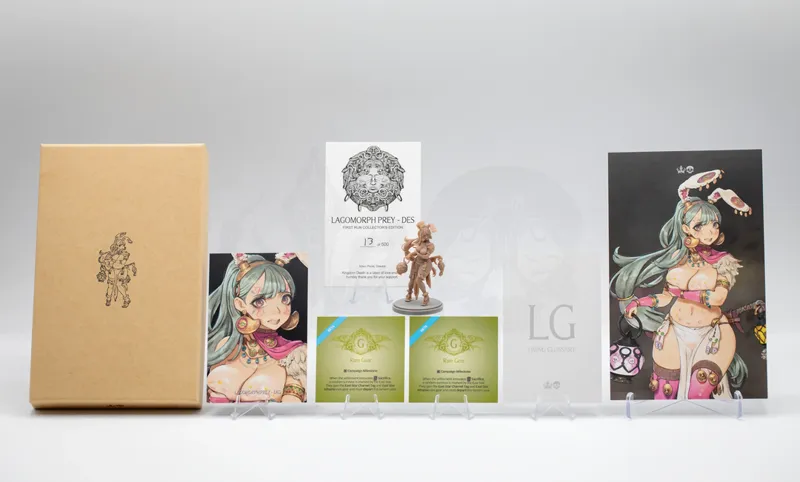
1x Lagomorph Prey - Des photoresin miniature and flat base
1x Living Glossary card
2x Beta Gear cards
Large Matte Art Print
Character Art Card
The Miniature
Des lands in the tier of miniatures that I don't want to use as a game piece, I've tried using photoresins with this level of thin outcropping parts on the board in the past but it has always required a great deal of care and delicacy when moving them around due to the brittle nature of photoresin in combination with thin parts. The hair, weapon lantern and lagomorph ears are the primary risk points here and this issue has become more significant since I switched to using the plastic showdown board. The surface of the plane is a stern, hard and unyielding one that shows no sympathy for neither Del's plight or fragile nature.
A positive about this is she doesn't have many elements overhanging the edge of her base, which does provide some protection from collisions with other miniatures but overall this just isn't a miniature I'm going to use on the board even if it is the best way to represent the gear in game. As such it'll join the increasing pile of resin that I have in a drawer in the office, a bit of a shame but I already have more miniatures than I think I could paint in my lifetime. Outside of that, there's some great detail on this miniature, the Lantern Designs in particular are really sweet and the overall depiction of this miniature does suggest a ritualistic sacrificial bunny.
The Gameplay
The trigger for this pairing of cursed gear cards is tied to Sacrifice. Because this is a milestone it's easier to remember it because you can add it to the other ones on the settlement sheet. Though it's still another thing to track among an ever increasing collection of Beta unlocks based on specific circumstances. Still, there are worse ones to remember.
Once Sacrifice is innovated, one random survivor will be designated as 'the sacrifice' by “the East Star” and will gain two cursed items along with a forced depart. We've seen the East Star mentioned before and The Witch of the East Star is linked to the Lagomorph sacrifices in flavour text that accompanied her release.
When enough blood is sacrificed during the chaotic tribulations of the Lagomorph festival, viscera soaked lanterns ignite an old effigy, a legend passed from one survivor to the next. The all seeing red star, may hinge and take upon its physical form. Walking among the carnage the Witch is made flesh but just for the duration of the festival. Adoring and dangerous the Witch demands a challenge to test the power of her form and to collect souvenirs from her time made flesh, things that embarrass her challengers and bring delight to the frenzied survivors that summoned her.
The allocation of these items being at random is quite a challenge for settlements because the only controls we have over this are the timing of when we innovate Sacrifice and having as many disposable survivors as possible so the odds of hitting a survivor of value are reduced. This matters because the two gear cards are a death sentence for the survivor who gets them as we'll see as we go through them.
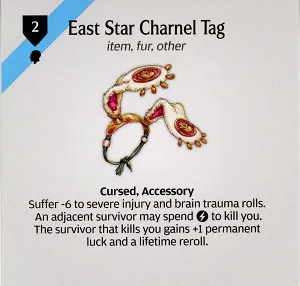
The East Star Charnel Tag is the ticking time bomb that is placed upon the crown of the doomed survivor. The simple goal of this item is force provide a situation where the player is encouraged to kill the Sacrifice during the showdown, and the tricky part for the players is trying to time that correctly (or avoid it entirely if the survivor is too valuable). Whatever survivor gets this will struggle to function as a front line tank or bruiser, as anything that causes random severe injuries is likely to result in death and if the monster does that you are missing out on the permanent +1 Luck and Lifetime Reroll.
It is certainly an interesting design, we're asked to gamble every round with the life of this survivor, we can stack the odds a bit in our favour by keeping them adjacent to a survivor with a surge available so they can maybe off the Sacrifice if there's a situation (with a survival window) by surging to kill the survivor. You could even do it in response to the monster targeting the Sacrifice. Which is a grimly amusing moment of “You don't get to kill this one, I do” that may be familiar to players who've explored all the play patterns of Homicidalism. It's a very grim dark version of the “Dash-Cancel” indeed.
Outside of that the design here is very compact. I appreciate that this is an accessory, so you can wear an armor set on the newly minted “Red Shirt”, that means if you have been unfortunate and a valuable survivor has gained this mark from the East Star you can try and risk keeping them around to complete whatever task you need them for (usually Weapon Proficiency, Knowledge/Philosophy progression related things). You can even use a Dried Acanthus or Green Charm to try and beat the odds for a while if you want.
Finally it's also worth remembering that Crystal Skin from Mineral Gathering can always allow for the sacrifice to slip this off their head, so there's an opportunity to move this gear away while still keeping the survivor and this also applies to the weapon we'll look at now.
The second gear card is the one that really seeks to put the nail in the coffin for the Sacrifice. This athame forces them to attack every round or suffer 6 brain damage (which suggests that 6 is a special number for the East Star, we'll need to keep an eye on other game elements to see if that continues). Also when they do attack, Bloodthirst is there to punish that also.
Bloodthirst: A gear special rule. When you activate this gear, gain a bleeding token.
This isn't too large of a punishment, it is in fact something that we can manage very easily with the current bleed removal options, but it does require you to be mindful and clean off the Blood tokens every couple of turns and given the brain damage for not attacking penalty this will require either surge or another survivor to deal with this.
We also have yet another ability to deal with before we get to look at the attack profile. That is Provoke.
Provoke: A gear special rule. When you wound with this weapon, gain the priority target token.
So we're forced to attack otherwise we suffer a massive amount of brain damage, and if that brain damage causes trauma then we're very likely to die. When we do attack we get a bleed token and if we wound we gain the Priority Target. This is pretty much the entire deck stacked against the Sacrifice and we're being told very firmly that this survivor must die.
However, the weapon itself does give us access to +2 evasion for a green affinity and it has a very strong attack profile at (3/6+/9) so we do have tools to try and avoid that fate if we want to lean into it. Getting 3 green affinities in combination with Monster Grease gives us +4 evasion that we can stack onto whatever else we can get. This means there is a very risky, evasion/block/deflect based build we could use if we have it ready and our survivor is valuable and we need to try and preserve them for as long as possible. It's nice to have the option and I think that's the best part of the design here, it isn't just “whelp they're dead” we can try to fight against that and we're given a very good tool to start with via this athame.
Before we move onto the final summary I did want to take a moment to write about what athames are for those who are not not familiar. These are a ceremonial dagger used in traditional rituals or other magic rites. It's usually (but not always) a double bladed dagger with a black handle and it's a core part of the traditions of modern traditions like Wiccan. Its significance is due to it being a part of the four Celtic talismans (sword, spear, shield and cauldron/grail) – which should be familiar to those of you who have read anything I've written about Celtic and Welsh folklore such as the Arthurian Legends.
An interesting party of this attribution to being based on “the sword” is that an athame is a symbolic blade rather than one that is actually used for cutting. It is a physical symbol rather than a tool, used not for living flesh, but instead for channelling an etheric fire (the sword in Celtic folklore is tied to the element of fire). However some traditions have the athame represent wind, so there is no true correct element here, but what is consistent is that the wand (as the spear) represents the other complementary element of wind or fire.
The name of the athame is, like many things, rooted in Latin. The original Latin word it has corrupted from is artavus, meaning quill knife, something that was used by scribes. There is; like most things in language, alternative originations including a French term for an artisan knife and even an Arabic one that was used for bloodletting. As a ritual knife the athame also has variants in other culture, this includes the kris and the Roman secespita. However the Roman blade is used in ritual sacrifice which is something the athame is strictly not for and the kris can have combat applications.
All of this is interesting to me at least because the athame we have here is clearly not simply ceremonial item. It still has that ritualistic relevance but it is being used by the survivor as a weapon and it has clearly been designed to be one. It also lacks the iconic black handle, but that is also something that happens here in our world.
If you're interested in seeing some examples of the various types of athame designs, the good old Etsy Witches have plenty to look at here and you can very much see how most of these are not designed for fighting.
Final Thoughts
I think this is one of the more thought provoking and interesting beta designs we've had. However, despite liking this for an interesting and fresh design, I won't be using this much in future campaigns as the play patterns are not something I tend to engage with too much. Sacrifice is an innovation that I've moved away from because I can't be trusted to not try and break it with Collective Toil population bombs or Homicidalism and I think it'll stay that way until we see an updated version of Homicidalism in the eventual Mythical Update Pack that has been promised to eventually come.
I do welcome these explorations into the religious or spiritual elements of Kingdom Death's world that this release and the Preacher represent. Religion can be a very important part of a society's make up and having different paths for that helps both vary the play experience and also make settlements distinct and individual. This release is just less substantial than Wanderer – Preacher's exploration, but that is the nature of these beta boxes.