






A Review of DANTE: Inferno
Published by Creative Games Studio, Dante: Inferno joins a long line of properties inspired by the first third of the 13th century Florence born poet Dante Alighieri's poem The Divine Comedy. While The Divine Comedy itself features not just the realm of Inferno (Hell), but also that of Purgatorio (Purgatory) and Paradiso (Heaven) through its three cantiche it is only Inferno that has really caught the imaginations of modern media and game design. Now before I get into the focus of the game, I'm going to provide a brief overview of who Dante Alighieri was, this is important because while usually one can untangle the writer from the written work, Dante Alighieri wrote a fictional version himself experiencing the journey through all three realms. I'll refer to Dante when writing about the fictional character and Dante Alighieri when writing about the poet, it's going to be a little clumsy and cumbersome but that's self insert characters for you.
The exact beginning of Dante Alighieri's life is not precisely known, but it is thought he was born around May 1265 in Florence in Tuscany Italy. Dante Alighieri's parents were a moneylender called Alighiero di Bellincione and a noble woman named Bella. Bella passed when Dante Alighieri was just 10 years old and eventually his father found a new love who bore him two more children, a half-brother and half-sister for Dante Alighieri.
When he was nine, Dante Alighieri met the eight year old Beatrice Portianari and experienced “love at first sight”, however due to Dante Alighieri's family status he was engaged and then married to Gemma di Manetto Donati. Even after this engagement Dante Alighieri continued to obsess over Beatrice despite only having infrequent, brief contact with Beatrice. This matters to the story of Inferno because Beatrice was a driving obsession for Dante Alighieri; he went as far as to write multiple sonnets about Beatrice. Even after she passed away at the young age of 25 Dante Alighieri was unable to get over his obsession for her and eventually she inspired the character of Beatrice in The Divine Comedy itself. I can't imagine how Gemma felt about this, not only was she placed into an arranged marriage, but her husband wrote love poetry about another woman and then cast her into the role of an angel and guiding light for his fictionalised version of himself.
During Dante Alighieri's life, Florence was involved in conflict and even saw some form of combat, eventually the Guelphs (of which Dante Alighieri was one) would triumph over the Ghibellines and Dante Alighieri came to hold political office in a city that was uneasy and restless. Eventually things came to a head when the Pope of the time got involved after Dante Alighieri was accused of corruption and various forms of financial fraud. This would result in his permanent exile on pain of death from Florence, to this day Dante Alighieri is laid to rest not in Florence but in Ravenna. Florence has a tomb for Dante Alighieri, but it is empty. Dante Alighieri claimed innocence of these crimes and refused to pay fines, which extended the threat of a death sentence if he returned to Florence and extended it to Dante Alighieri's sons.
Most of Dante Alighieri's writing came from the period in his life after his exile; the circumstances of his upbringing, religion, life, love and more provided much of the inspiration for these pieces. This is why knowing about Dante Alighieri's life matters when you consider The Divine Comedy, it is deeply influenced by his exile, Beatrice and Dante Alighieri's obsession over The Roman Empire. There's a joke that men think about The Roman Empire multiple times a week, but in the case of Dante Alighieri it was likely more than that because he was so proud of his purportedly Roman lineage that he hated the Greeks for the sacking of Troy. Romans believed they were descendants of the Trojan hero Aeneas, who came from Virgil's Aeneid, more on Virgil a bit later.
There have been countless analysis's written about The Divine Comedy; so I will be just brief when covering it here. There is no question that The Divine Comedy is not just a fundamental piece when it comes to Italian literature (Dante Alighieri wrote it in Tuscan, not Latin which helped birth what eventually became the modern Italian language), but it is also a foundational part of Western Culture. “Abandon hope, all ye who enter here.” and the concept of the Nine Circles of Hell (which were themselves based on Aristotle's ideas) are a just two of many, many things that still echo around us to this day.
Throughout the first cantiche of Inferno, Dante (the character) awakens in the first circle of Hell (Limbo), lost in a dark wood the 35 year old Dante soon finds his way blocked by three beasts; a lion, a leopard and a she-wolf. Dante is unable to progress and is close to giving up when he is saved by Dante Alighieri's role model, the Roman Poet Virgil. The modern concept for having a fictional Virgil rescue a fictional Dante would be “fan fiction”. Dante Alighieri is Virgil's biggest fan, but it is worth noting that Virgil is here in the first circle of Hell because Dante firmly believed that unless you were baptised you could never get into Heaven; even people who were born before baptism was a part of Dante Alighieri's religion or babies who died before baptism were not excused from this, though if they lived good lives they got to stay in Limbo. Note; that this condemnation includes Christian Prophets like Abraham and Moses, though in this cantiche we discover they were rescued from Hell by Jesus in the period between his crucifixion and resurrection. It is worth noting that Dante Alighieri did not have Jesus rescue the Prophet Muhammad and condemned the fictionalised version of Muhammad to the Eighth Circle because he viewed Islam as a heresy that had split Christianity. Dante Alighieri was certainly one of the people of all time.
Virgil is Dante's guide throughout Inferno and even a fair bit of Purgatorio, he was sent by Beatrice who Dante Alighieri has written into being the symbol of Divine Love (it really seems he just couldn't get over anything and move forward with his life doesn't it?) Virgil's role as the guide includes handling most of the obstacles during their journey through Hell, including carrying Dante during one of his many fainting spells. I do find it ever so funny that not only did Dante Alighieri write his hero Virgil into the story, but also had Virgil carry Dante around. I don't think Dante Alighieri is beating the fan fiction allegations any time soon is he?
Inferno's vision of Hell breaks the plane into nine distinct layers, each of which is themed around a particular sin, the sinners in each of these suffer punishment in a style that is called contrapasso; a poetic justice. These circles are Limbo, Lust, Gluttony, Greed, Wrath, Heresy, Violence, Fraud and Treachery. Though I do have to point out that between Wrath and Heresy is the City of Dis and that the Circles of Violence, Fraud and Treachery are split apart into multiple mini-circles of hell, resulting in a diabolical layer cake that has 24 flavours of sin.
Spread throughout these layers are many notable “sinners” with whom Dante Alighieri had an axe to grind. Most important people from Greek history and Mythology are here, because as Rome's Number One fan Dante Alighieri wanted them all punished for Troy. We also have many people who wronged or opposed Dante during his life, some of whom were still alive when Dante Alighieri wrote them into his poem. He even sticks both Tristan and Iseult from Welsh folklore into the second circle (Lust) because they sinned, even though the whole point of their particular story is a tragedy about how Tristan and Iseult were drugged with a love potion and are among the victims of the tragic story. Doesn't matter, off they go to Hell for punishment, how dare they fall under a magical spell they have no control over. There are so, so many people historical, mythological and even alive (at the time Dante Alighieri wrote this) who are stuck into various circles of Hell that to explain them all would balloon this already lengthy section into probably twice the length it is right now. Dante Alighieri was a petty man for sure.
In addition to putting everyone Dante Alighieri had even the smallest axe to grind with straight into Hell, Dante Alighieri's vision of the underworld was controversial even at the time because he added elements of Greek/Roman mythology to this very Christian concept. Charon ferries people between Limbo and Lust, Cerebus guards the third circle of hell (three heads, third circle, genius) and the Furies are present in the fifth circle. It is these characters from Greek legend/history that make up the bulk of the bosses in the board game Dante Inferno.
Eventually, after Virgil hard carries Dante (sometimes literally) all the way to the heart of Hell, they finally meet Lucifer. In this depiction, Lucifer is a mindless three-headed beast who chews constantly on the people whom Dante Alighieri considered to be the greatest sinners in history. Feel free to take a guess who Dante Alighieri would rank as the biggest sinners, ones worthy of an eternal punishment at the hands of none other than Satan himself. It's Judas Iscariot for his crimes against Christ, which makes sense. The other two are Marcus Junius Brutus and Gaius Cassius Longinus; for assassinating Julius Caesar. Frankly I find this mind boggling. Ladies and Gentlemen, if you thought the trend of men obsessing over The Roman Empire was a weird new thing, here's Dante Alighieri to showcase that it's been going on for literal centuries.
Oh and I almost forgot to mention Dante Alighieri sticks Hell underneath Jerusalem, what a champ. Anyway, Dante and Virgil climb down Satan's body and past his nether regions before coming out the other side into Purgatorio. I won't get into that because it isn't a subject of this board game, it doesn't seem we'll get to punch Henry III of England in Dante Purgatortio followed by Dante Paradiso's climax of punching God in the cosmic jewels at this time, which is not surprising as rarely does media based on the Divine Comedy follow up from Inferno with the other two parts. However it could really be something as the video game series Bayonetta demonstrated how delightful it is to inflict violence on pompus Angels if their design is done right.
Dante Inferno the Board Game
The primary reasons for going through all of the above is because it supports the narrative structure and antagonists of Dante Inferno, explaining the number of chapters and almost all of the bosses you encounter during this game. They are in this game because they are in the poem, you'll encounter people, mythological characters and beasts all in the correct circles and during the matching chapters. However, your guide throughout your journey is not Virgil, but Dante. Dante will lead you throughout this story; despite Dante's own journey being completed to a satisfying conclusion at the end of The Divine Comedy he is brought back here to take over Virgil's role. This decision is one that highlights the main weakness of Dante Inferno, while the individual passages are written well enough, the overall narrative and plotting of this game is very lacking. We'll get back to the issues surrounding Dante in a bit, but first of all I'm going to go into how the narrative portion of the game works.
Each Chapter of which the game naturally has nine comes with a box that contains a few different types of cards, there will be small cards that track decisions and important narrative beats that can provide small branching parts of the mostly linear path. Then there are the standard size cards that are used for the boss battles and finally there are tarot size cards that are placed onto one side of the game board and create a map of the game's world. This is supported by a spiral bound paragraph book which contains all of the classic paragraph book mechanics that have existed since the first Fighting Fantasy book reached shelves. On its own all of this works well enough, Sleeping Gods and 7th Continent have similar mechanics and they are great successes.
The issue I had with this section is these tarot cards and the associated map building, placing the cards on the map and moving the caravan piece around them is simply busy work. You never move to a place and then read the relevant passage in the book, instead the book tells you to move to a place. During the first Chapter I noticed how irrelevant the map was, I didn't make any decisions involving it, all I was doing was placing one or more cards and then moving Dante's caravan miniature onto the new card. In games like Sleeping Gods/7th Continent you decide where you are moving by looking at the map and making that move, you then follow what happens in the book (cards in the case of 7th Continent). I first dismissed this concern because it was the 1st Chapter, surely they would change this in the future, but they did not and by Chapter 4 I decided to see if I could play the entire chapter without using the map tarot cards. Turns out that yes, all you need is the small cards, the paragraph book and occasionally remembering one particular location if it has multiple path cards on it (path cards indicate a place where you may return and head off in a different direction). It is a shame that this vast amount of effort put into creating a map of each Circle is so unnecessary to the game's mechanics, this is a classic example of how important it can be to “Kill Your Darlings” when creating something a book or game. Especially in games where player autonomy is important and having players do things that feel “pointless” can frustrate or bore them. You don't want boredom or frustration with mechanic/narrative decisions to be something that turns players away because it can result in them packing up the game and moving on.
With that thought in our minds, let us get back to Dante the Guide; Dante the Guide is not the only way that a proxy for Dante Alighieri can be included in this game. There is also the optional content of playing with Dante the Poet (yes now we have Dante Alighieri, Dante the Guide and Dante the Poet as separate things) as one of the four champions controlled by the players. That's not a major issue in itself, as an optional piece of content it could work in other games. Here however it just does not cut it; Dante has no real character development over the course of this game, while he does get higher level cards at the same rate as everyone else, he has zero satisfying narrative progression because he's already completed his character arc. That's what The Divine Comedy was about, well that and also slinging mud at everyone Dante Alighieri didn't like.
This gets even worse in some chapters where narrative things happen that result in Dante the Poet being a part of the chapter's confrontation turning a bit nonsensical. In one such chapter if you want to play with Dante the Poet then you have to really stretch your imagination as there will be two of him on the board and they have different mechanics, one of which can lose you the game. Oh did I mention that at least in my version I don't even have two things to represent Dante with?
There are solutions to all this which could have been included in the game, Dante the Poet could have been designed to be played by a fifth player, mechanically the Dante hero doesn't really attack and just does supporting things so while he will make it easier overall, it's in a reasonable fashion. Also Dante the Poet could have came with a booklet that provided his own narrative during the upgrade sections. Or the narrative could not result in a situation where one player's Champion is missing for the entire story portion only to end up being a doppelgänger during the confrontation. Also these Dante the Poet issues are not contained to just one Chapter, it will happen again.
This could have easily been sidestepped by having either Virgil the Poet be the playable champion rather than Dante the Poet, or having Virgil be the guide instead of Dante. Or the big one, not writing a narrative that causes these issues in the first place. It's very much a self inflicted injury and while perfect is the enemy good, this isn't even good.
There's also another point in the narrative that I need to cover before moving onto the meat of the game (Champions, Bosses and Confrontations), skip this section if you don't want mild mechanical spoilers about one confrontation. I am going to file as much of the details off this area, but I can't completely remove everything without describing some of it. Skip to the section title Champions of Inferno to avoid those spoilers.
One of the confrontations that occurs around the middle of the campaign is designed to set up the players for failure. It is a fight that Creative Games Studio themselves have confirmed is intended to have around a 20% success rate. That in itself isn't great because it can frustrate players as they have been put into a losing situation; but at least it isn't an automatic loss. In fact I won it on my first attempt; when I read the confrontation victory text is when frustration really set in, if you win this particular confrontation then the campaign is over, congratulations I guess. It's incredibly unsatisfying, because there is no point to replaying this fight in the future. Either you win and then lose out on three more chapters of fights, or you win and still play them (unsatisfying) or you just throw the fight immediately and get on with the story. This one feels like a waste of time that you should skip on replays.
Also I noticed during this boss fight that it was possible for all four of your champions to get Arrested at the same time, and if that happens I could not find out how to handle it. Being Arrested effectively makes your champion stop existing until they are freed. That means the Malefactor (Boss) can't find any targets, when I realised this was the case I expected this to be an automatic loss and went to look for the specific area covering this, but there was nothing covering that in the books. When I couldn't find that, I expected to find that the boss would destroy the arresting elements while inflicting massive damage to the arrested champion. That is not the case. In fact, as written what happens is the champions all spend their time tied up watching their allies fight into a stalemate they can't win as the boss occasionally moves around. Again the answer is almost certainly that this is an auto loss, but not covering the corner case here with clarification in the Arrest glossary entry is an odd thing.
As we're wrapping up the narrative section, I wanted to just cover the narrative tests. Like many paragraph books there are moments where you'll be asked to test a stat, the stats are Aggression, Prowess and Willpower.
Champions of Inferno
Outside of Dante the Poet, players will control four distinct classes called the Artist, the Devotee, the Mercenary and the Outlaw. In the narrative these characters are referred to by these roles because there are multiple different options for each class. This all works fine, though one slight rough area is that the classes are not always set in specific boss battling/dungeon crawling roles. Generally in this genre of games you have a front-line character who takes the hits (the Tank), a supporting character who offers some kind of protection, healing or control over the battle (the support) and then a mix of damage dealers who can run the spectrum from front-line bruisers (tank/damage hybrid) all the way to glass cannons who deal massive damage but shatter into a thousand pieces if the boss dares say so much as a harsh word in their direction.
Each Champion Archetype doesn't automatically mean they are a specific role. The Outlaw Caine for example is pretty close to the best tank in the game even though he can fight exclusively with just ranged weapons (more on that in a bit). What was needed on each box/rules summary card was an indicator not just of their class archetype, but also their specific role in the group. Without this you could end up selecting a Champion that doesn't meet your expectations at all.
That brings me back to the weapons; each Champion is locked to using a specific category of weapons, two of which are the classic melee and ranged. Weapon distribution through the game expects you to be picking a two ranged, two melee mix for the most part, but for Champions who buck the trend like Caine this can be a bit of a detriment as he wants to be next to the Malefactor, but then he is at the wrong distance for attacking, so he always has to reposition or just not attack. Also if you lean too hard into predominantly one type over any others some Champions will end up running weapons that lag behind in power for multiple chapters. This is a massive issue for heavy melee teams in particular because like in all dungeon crawlers and boss battlers, ranged weapons are far better than melee ones. It's why “Pinning” exists in Warhammer Quest (1995), allowing the monsters to sometimes hold the heroes in place and stop them kiting around. In games like Kingdom Death: Monster the usual solution is to make it difficult to move and fire in the same turn with a unit, you're left with the choice of either staying close and attacking or moving away and potentially missing out on that attack.
Outside of this imbalance there's a lot to really like here, each of the Champions has a 7 card deck that contains their actions, somewhat similar to Kingdoms Forlorn, Primal and Oathsworn. The important things here is that basic actions like moving around or interacting with elements do not require specific cards and you can split up the Champion's actions in any order – allowing for a lot more reactive and interactive team play. The cards are for special feats and attacks, not basic manoeuvrability and that's something I like in both this and Kingdoms Forlorn.
There is a lot to enjoy with this card system, Champions are not limited to things that just help their own actions, they can share buffs with others, find and pass round consumable equipment (called Findings), there's even situations where the Malefactor might pick up one Champion and others can use specific attacks to free their ally.
The buff tokens are another great element, they are tokens that are given to Champions, these have different effects, Empowers can be spent to increase the number of attack dice rolled as long as they are used during the round, Aggression are a super charged version of Empower that can be stored up and offer +6 hits directly (the equivalent of the best possible roll on 3 dice). Prowess are spent to Block 6 points of damage inflicted on them/suffered by them. Willpower lets one play a second manoeuvrer card on top of one already played (great for the Artist in particular as that class often likes to play cards on top of each other) and Inspiration can be discarded to turn a Fumble into two hits. There are also trap tokens employed by the Outlaw class and Readiness/Wound tokens used for using Champions as Companions (simplified versions of the full Champions for younger players or reducing cognitive load). The Malefactors also get two token types, Enrage which increases their damage for actions/counter attacks and Fortify which increases the Sturdiness of the action deck which generated it. The Malefactor tokens are usually permanent and only removed by specific Malefactor actions, so avoiding a malefactor generating these is often a priority as otherwise it'll make the rest of the confrontation even harder.
There is also a lot of interesting push and pull with regards to how you play the cards. Each card can only be played in one of three slots on the Champion's board; the Confrontation starts with all of these slots filled by “stun” cards and they are removed one per turn. This means that at the start of the confrontation the players are limited in their actions to typically just one each. In the following turn a second stun card will be removed and now they can play two cards per turn. Playing these cards costs vitality, which is the very same resource used to soak up damage during the confrontation. While vitality replenishes three points at the start of each round, that's often not enough to keep pace with the Malefactor's damage output and if damage is dealt to a Champion that pushes their vigor to below zero then they will suffer a wound. A wound is a flipped over version of the stun card that cannot be removed without specific abilities. That means once a Champion is wounded they have less actions for the rest of the confrontation, if all three of your slots are filled up with wounds then the confrontation is a loss, which usually results in a game over rather than a fail forward. These wounds themselves have no further impact, but if you play the grim mode then there is text on them which adds negatives to your Champion and can really mess up their performance for the confrontation.
The action cards themselves also have slot limitations, you are typically limited to just four cards in your hand and at times you main gain a sin card. This will sit in your hand and cannot be removed or discarded normally. One of the main ways you'll gain a sin is each time your seven card deck is empty you have to draw a sin card into your hand and then reshuffle the rest back before drawing up to the hand limit. That means each full lap of the deck increases the number of cards clogging up your hand and/or board, putting a natural form of time pressure that feels interesting and engaging. When you have a sin in hand, your choices are to accept that you now have a smaller hand size, remove it somehow or yield to it. If you yield (and how/when you can do that varies) then the card goes onto your board and fills up a slot in the same way a wound does. So again, if you fill up your board with sins/wounds on any one Champion then that's it, game over man, game over.
This is really the best part of the Champions, the card system here is crunchy enough to be satisfying and cooperative enough to really encourage communication and collaboration. I just wish the same applied to the equipment, so many dungeon crawlers and boss battlers keep going back to the tired equipment slot system that comes from the 1980s games of Heroquest/Warhammer Quest. In Dante Inferno we have one weapon slot, one relic slot, one findings slot and one trait slot. It all works well enough because the seven card action deck is doing the bulk of the work, but there is a serious downside. If new Weapons/Relics/Traits are not creeping up in power and/or versatility then there's no reason to take them, in fact there are some relics I gained right in the first Chapter that I kept using all the way to the end. More slots for things means less chance that cardboard will be created for no impact. The play system is better than Oathsworn's one for sure, but nothing comes close to Kingdom Death's magnum ops that is the Gear Grid. Designers of Boss Battlers/Dungeon Crawlers, that's the platinum standard that you need to innovate around. Give us a modern 2020s equipment system, not an antiquated forty year old one.
Malefactors and their Battlefields
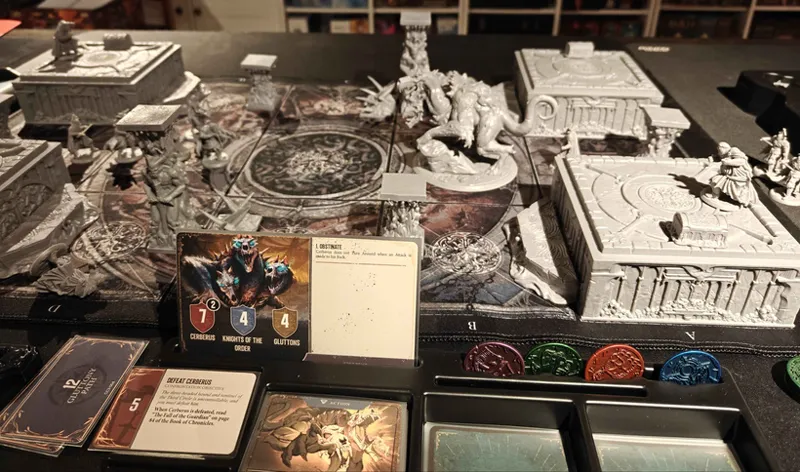
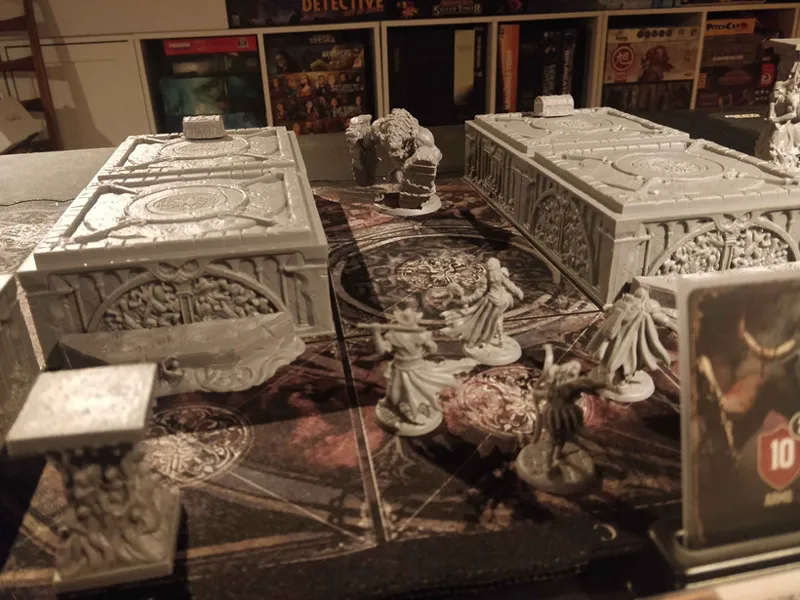
The confrontation board is made up of sixteen spaces in a three by 6 grid. Each of these sectors is split apart into 5 spaces. In the middle is a circular node where the Malefactor will stand and the four spaces located on cardinal points like quadrants around it are where Champions, furniture, allies and minions will stand. That means you can have a single space that contains the Malefactor, two Champions, a pillar and a minion all at the same time. It looks both great and easily readable. It's almost like every single sector is a complete Primal: The Awakening Board all by itself. They even play with this system sometimes by having massive oversized Malefactors that take up every single spot on a space so you're forced to attack them from the adjacent spaces in adjoining sectors.
Like Kingdoms Forlorn, VagrantSong, Oathsworn and Townsfolk Tussle the terrain features are also a prominent element in the confrontation. They offer tactical opportunities to the players and boss alike. King Minos, the tutorial boss for example will pick up pillars and Charon, the optional Triad of the Abyss Chapter 1 Boss even uses high ground as a mechanic to avoid floods. These are not just places to grab loot from, they're three dimensional elements where height can matter. Matthias the Mercenary for example has a grappling hook ability card that can let him get to high places quickly for looting.
Standing on top of a Pillar not only provides a perch for a ranged character to shoot down from, but it also provides protection because the Champion can “backflip” off the pillar if they are attacked and the pillar takes the hit instead, falling over and blocking the portion of the square it was in. The terrain is highly interactive and offers a bunch of interesting options to explore both offensively and defensively, even the six “box” buildings are way more exciting than they first seem to be as depending on what Champion or gear you have they can be jumped off to attack from or even moved across the board, slamming into the Malefactor, furniture or minions in order to deal damage or remove troublesome elements.
The Malefactor design is also very interactive and interesting; of course each boss has their own gimmick(s) that they employ, this is a staple of boss battlers and helps keep the game challenging and fresh. Dante Inferno employs the best version of boss actions by using a deck of cards. There are three slots on the Malefactor board for decks, these may be different individual bosses for each deck, or they might include a deck of random events that happen each turn. The boss decks in particular are great, on one side they show you the action that the boss will take next, but they also represent the health total of the boss. So if you wound the boss then that card is removed, changing how the boss behaves. That's interesting because sometimes it's better to not remove a card because you can handle the aggression the boss is putting out.
On the backs of these cards are the “reactions” for the boss called counter attacks, when you attack a boss you roll a bunch of attack dice determined by your weapon, the card you've played and any optional extras you've spent. These dice are six sided, but they're basically three sided because the sides are duplicated so there's two one pips, two two pips and two fumbles (fails). They're not that interesting to roll if I'm honest, the average result per dice is a score of 1 (1+1+2+2+0+0➗6 = 6➗6 = 1), so the maths for the most part is trying to roll as many dice as the target number because 10 dice on average equals a score of 10. Each multiple of the Malefactor's sturdiness becomes a wound (removing a card), but if you roll fumbles equal to or higher than the threshold shown on that boss (often 2 or 3, but it could be more) then the first card will flip over and resolve its counter attack before becoming a wound (you can also fail to wound but still trigger a counterattack with fumbles). Additional fumbles above the threshold make the counter attack hit even harder as they turn into +1 damage per fumble. The really interesting part of these counterattacks is each action card front doesn't automatically have the same counterattack side on the back as the rest of its copies. Just because King Minos Tackled you on his last Head-to-Head card doesn't mean that's what he will do this time.
This is a really neat system that takes Kingdom Death's AI and Hit Location decks and combines them. This gives players information to make decisions with, but it's always imperfect. You know what the boss will do next, but that can change if you score a wound, and you don't know if a boss will counterattack when attacking, nor do you know what counterattack it will do. You can learn the probabilities and make the best choice based on the expected outcome, but that's never a sure thing.
About the major negative I have in respect to the overall Malefactor design is that the facing feels way less relevant than it should be, it doesn't need to be as detailed as in Primal, but it is almost an afterthought here in many Confrontations. Facing doesn't matter most of the time for the Malefactors as they often target based on which champion is the most “Ferocious” rather than “Most Ferocious” in front or similar, this is determined by a track of four coins that move up past each other based on the number of points their manoeuvrer card was worth. If you're 3rd in Ferociousness and you play a 2 point card then you'll skip up two spaces to the top of the queue. That gives even more interplay between players, with good ordering you can place the right champion at the top of the queue and ensure that whoever takes the hit is best able to absorb it. It's really neat for situations where say the tank is floundering a bit and needs a breather, someone else can jump ahead and become the most ferocious while the tank concentrates on recovering for a turn or two. Sometimes facing matters, but not enough, I would have liked to see more attacks that just hit certain spaces in a sector instead of all of them.
The malefactor event decks are simple enough, they tend to be small decks and while the backs of each are identical (concealing information this time), they often cycle in a fixed order, so you may be able to memorise what's coming next. Some of them even work as a kind of timer, removing themselves until the final card which then triggers some story event that impacts the game.
All of this, the multiple slots, the ability for those slots to represent body parts of the same boss, multiple different bosses, allies, environment, minions or a ticking clock is really well utilised in this game.
Finally, I can't close this section without mentioning the Polymorph rules, there is a Capybara miniature, action deck, character card. Occasionally a Champion may be transformed and this is the form they all turn into. You're stuck like that until you suffer a wound or something tells you that you transform back, this could have been a frustrating moment, but instead the Capybara is reasonably well balanced. You don't want to be one if you can avoid it, but if it happens you're not a burden, you do get to attack, control and even generate findings cards. It's a fun moment and well done, same way that being Held by the malefactor is also interesting rather than just a punishment.
The Rulebook
I'm not going to mince words here, the rulebook is very poor. Its layout is both difficult to learn from and difficult to use during play (shout out to Paul Grogan of Gaming Rules! couldn't have played this without you). On top of the structure being poor, there are also additional rules buried in the Paragraph Book “Book of Chronicles”, there is no Index and the Glossary is not comprehensive in either number of entries or the detail of each entry. Aeon Trespass: Odyssey had a similar problem where they put rules at the front of each cycle instead of keeping everything in one single book. It's not as bad here because there are just three books instead of six, but it is so important to have one single place where all your rules can be found. I don't want to be flicking back to an older page in the narrative paragraph book to check rules for some previously used element.
There are numerous errors in both the books and the cards, sometimes incorrect values are used, sometimes details are just missing (especially in edge cases) and there are zero player handouts outside of the ones that cover a given Champions keywords. The fact that there was no token reference sheet was in particular an avoidable omission, we do have one on the website now, but just like errata this means more work for the owner of the board game.
Considering the price of this game, I do expect much better than this.
The Box, Miniatures and Cards
So before we get to wrapping this up, I always like to review the box, insert and game components. I got the Eternal Edition, which is the full fat (almost) all the trims game along with the dice tray. That Dice Tray is one of the nicest ones I've used. It has a good structure and shape, the quality feels good and the size is just right for rolling the maximum amount of dice.
The box insert is likewise well put together, I am always really frustrated when a board game insert is not up to the task (especially if they haven't considered sleeved cards). That is not the case here, everything has a place in the box and there is a storage guide to ensure you don't get lost. The only disappointment here is that the area for the caravan and colosseum cards can't be removed from the box which would really have improved that situation. The cards have every single divider you could possibly need which is fantastic.
There is a tray for all the various tokens, Arcana cards (extra boss actions that can get shuffled into the deck, it's a good mechanic that I really like), Stun/Wound cards, Findings cards and Sin cards are all held here also. It is an excellent tray. The malefactor boss tray holds all the relevant decks and cards, plus the threat coins, but it isn't as good as the resource tray because it lacks spots to place held Champions/Furniture when that happens. Not a big deal though.
Each champion gets their own box to hold them during campaigns and they have individual storage boxes for each of the individual champions set of cards. The plastic campaign storage boxes are completely satisfactory, the individual champion cardboard boxes are nearly top tier, there are so many well designed elements. They just made the boxes around 2 or 3mm too narrow to hold the tarot cards when sleeved, that is the only place where sleeved cards do not fit.
Each of the Chapter Boxes is solid, there's a lot of empty space, but I assume that the standees would be in there for the non-miniature version, so apart from shrinking their width slightly to create room for the champion boxes to expand there's no complains there.
When it comes to the miniatures, I think these ones are decent enough. The scale is a bit smaller than I want for a game like this. Boss Battlers have relatively few miniatures on the board at the same time, it's nice to scale them up like Oathsworn or Kingdoms Forlorn does because that's part of the spectacle. The detail on them is good, the sculpts read well and they are good enough that I am considering painting them in the future because that will be pleasant.
The Extras
There are a few additional extras beyond just the miniatures themselves, the main ones I want to cover are the additional Champions and the Triad of the Abyss. I consider the additional Champions to be a close to essential purchase if you want this game to have longevity, Champion development in this game is honestly pretty flat with it being mostly upgrades to whatever play style the particular Champion has. Rarely do they get to do a new thing, most of the time they get to do the same thing but better. Sometimes you don't even get an upgraded version of a good Level 1 card and so you end up hoarding it, a similar thing happens with some of the relics and traits. You find one that fits and only replace it if there's a better version that turns up later.
However, when playing with these new Champions be aware that they do not get any unique character development in the narrative (another place where the narrative falls down a bit), they're effectively reskins and have the same story beats as the original four classes they belong to. Dante is of course the worst offender of the lot, but I've already been through why his existence in the game wasn't handled as good as it could have been.
The Tainted Champions are my favourite of the bunch, they leverage gaining sins for extra power, something that is very strong, but you have to pick your moments to use it because removing sins from a champion is not always easy. Caine (The Outlaw) in particular is a real stand out, but he's also an example of a class that should have been allowed both melee and ranged options for weapons.
The Pristine and Veteran Champions have less of a distinct gimmick when compared to the Tainted ones, but they do still all offer different play styles to explore and there is usually a tank, damage and support orientated survivor in each category if you have all sixteen available. Some of the notable ones I have enjoyed include the Veteran Mercenary Matthias who focuses around collecting and abusing findings while employing a mobile ranged combat style, the Pristine Mercenary Oliver who takes on a heavily supporting front-line role, the Pristine Artist Zitsa and the Pristine Devotee Marie. There's a lot of interplay to explore with various combinations and that has been where the real mechanical development seems to be.
The Triad of the Abyss
This is a box that contains three additional Malefactors that expand on the encounters you have with them during the story. They are mostly baked in so that you can either take on the Triad confrontation at the appropriate moment, but if you don't have that then you instead perform some tests in the book. These three malefactors are Charon, who appears in the first chapter, Medusa the Gorgon who appears in chapter five and the Minotaur who appears in chapter seven.
All of these confrontations feel fresh and unique, there is no treading over old ideas and the thematic expressions of the mechanics are great. Charon moves back and forth across the length of the board while waters rise up and down, just like his eternal task as the ferryman. Medusa has a bunch of petrified statues that she will take advantage of and her gaze is likewise terrifying and the Minotaur takes the wrestling mechanic from Minos (carrying up to two pillars and/or champions), but uses them defensively rather than the offensive utilisation that Minos has (it's great that King Minos and the Minotaur share a mechanic). Also in the case of the Minotaur the confrontation is set up with a maze-like structure and then the Minotaur messes with that even further.
The sole weak spot that I experienced from playing these was that Charon turns up before King Minos in the game's campaign. Charon is not designed to be a tutorial boss in the way that Minos is, that's not a huge deal for more experienced players who will manage to get through it smoothly. For less experienced players I'd recommend if you have Charon you should still include him in the campaign, I don't think there's much value in replaying this because the plot just doesn't vary enough to make it worthwhile. Instead play the tutorial fight against King Minos to learn and then after that get into the campaign and really enjoy how thematic Charon's confrontation is.
The Additional Dice
I also got four sets of dice, one set in each colour. These aren't really too essential when solo playing, but they are great when playing with three others because then everyone gets their own set. They were also very helpful when working through the challenge system in the narrative because you need to keep each Champion's roll separate in order to determine what additional dice you want to roll and if you want to reroll all of them. Playing solo I always used those dice for the various skill checks, but during the confrontations I used just one set because there wasn't a reason to distinguish them.
The Colosseum Mode
Having completed the campaign and played a fair bit of the Colosseum Mode, I think that this expansion is pretty much the best way to play the game. This mode is its own separate thing, though some elements can be used in the campaign. You have to run the gauntlet of six malefactor groups and if you take too long fighting a group a sudden death mode will start to attrition your Champions heavily. This works like a six fight campaign, upgrading as you go along but also offers varied layouts, different malefactors at each tier (except for the last tier which is always the same opponents) even the gear progression feels better here, at the end of each confrontation victory you can choose to either gain a new rank 1 relic or upgrade an existing one to its next rank.
You also have to manage your sins and wounds as they will build up from one confrontation to the next. Victory points allow you to take actions to remove sins from hand, or wounds/sins from your dashboard. There's enough space in the design to be able to pack the game up and restore it next session if you need to recover your table between sessions.
The colosseum book even has a section that covers a whole bunch of rules for the malefactors in one place, something I really felt the core rulebook needed and there's cards for the various objects that can turn up. I do think this package is an essential part of giving Dante Inferno longevity and without it I wouldn't feel as confident in recommending this game.
Final Thoughts
Dante Inferno is an uneven product that has a lot of unique and exciting elements that contribute in new ways to the Boss Battling genre. The steps towards more verticality and interacting with the terrain in multiple offensive or defensive manners is a very exciting development. We don't just have a tree that blocks up spaces, we've got pillars to hope around on, buildings to scale for access to high ground or treasure, spiked palisades to push the malefactor into (or get shoved into) and much much more. There are some Malefactor designs that I think could have been better put together, but those are the exceptions with just rough corners for the most part and I think the board design of using nodes for the Malefactors and having spaces for players/minions/furniture to position in the areas around that has a lot of untapped potential, with more facing related mechanics this would be a grand innovation on Primal's system and I hope to see this further developed in future games.
The narrative portion is where the game is let down, that combination of mostly meaningless map cards along with some weak choices for the overall narrative including the choice of Dante over Virgil in the Guide role hold this back. The offered “Quick Combat” mode doesn't offer a good way to replay the campaign because it's completely removing all of the narrative entirely and just breaking each circle down to some basic upgrades. For an example of where this was done well I'd point to Oathsworn's Instant Action mode that distils the story down to a single page along with some simple choices and skill checks, we could very much do with that as a downloadable resource on CGS's page as it would provide a good middle ground between the full campaign and the colosseum mode experiences.
Champion development could also be a bit deeper and more robust, I didn't get into it in the Champions section because there's so much to cover, but it is little more than the occasional swapping out of the hero portrait with either a red or white variant for the next level and exchanging level 1 manoeuvre cards for level 2, level 3 or level 4 ones. The core of each Champion's play style doesn't change too much, if you want that you'd need to switch to a different champion or class. There's also no real mechanical reason beyond possible balance issues and narrative ones as to why you couldn't run four of the same class if you wanted (Probably need unique trap tokens for each Outlaw if you were crazy enough to do this). Also after testing it's worth pointing out that like Oathsworn the Companion versions are good enough to the point that you can push through the entire game without playing the full ones. On one hand, great that means Companion players don't feel underpowered, but on the other hand you may well feel “what's the point?” with playing the full versions. It's not a negative overall, it is nice to have the options and choice for sure.
I also very much appreciate the Colosseum mode, I've not had a chance to really get into it at this point, but early impressions are that it is hard and varied. It's quite possibly the “actual” game mode in the same way that one plays through a Marvel Champions campaign box once and after that you play individual battles rather than repeating the campaign.
With some heavier editing, tightening of the rules, a few more passes from play testers (especially external ones) a new rulebook and a full rewrite of narrative campaign we'd have a contender for entry point boss battling that could muscle in on Oathsworn or Primal's territory. Even with these rough edges there is a stuff to like here with plenty of re-playability between the various classes and confrontations in the colosseum, however as it stands the intended introductory experience for DANTE Inferno falls very short of the mark.
This means that in respect of CGS's next boss battler, as my budget is exceedingly tight and it seems they are going with a new system rather than refining the current one it is very unlikely I'll be reviewing that one.
FINAL SPOILER SNARK
Comments (2)
I havent recieved mine yet, but i think i will be selling it straight away, too many other games to waste time on half decent ones like this. I am looking forward to Dragori's new boss battler, Ronin's Revenge, that looks awesome, think the campaign starts in march or april. Its on Gamefound, have a look if u havemt seen it. Cheers Fen, off to battle the Mad Steed, wish me luck.
Good luck, give it a smack in the teeth for me!