






Bad Santa Part 2: AI Cards – An Overview and Deep Dive into Atnas | Kingdom Death: Monster
With the hopefully thorough look into the who and why of Atnas now over it's time to get into the mechanics of Atnas during the showdown. Kingdom Death: Monster is a game with a lot of top down design where the concept of the monster comes first and the specific mechanics are constructed to support that thematic design, so that is why I always open my analysis with a dive into the lore and real world/fiction/pop culture references. Doing this helps see what the mechanics are attempting to present and it can help make even the less engaging bosses hold up a bit better.
Nemesis Node and Reference/Basic Action card
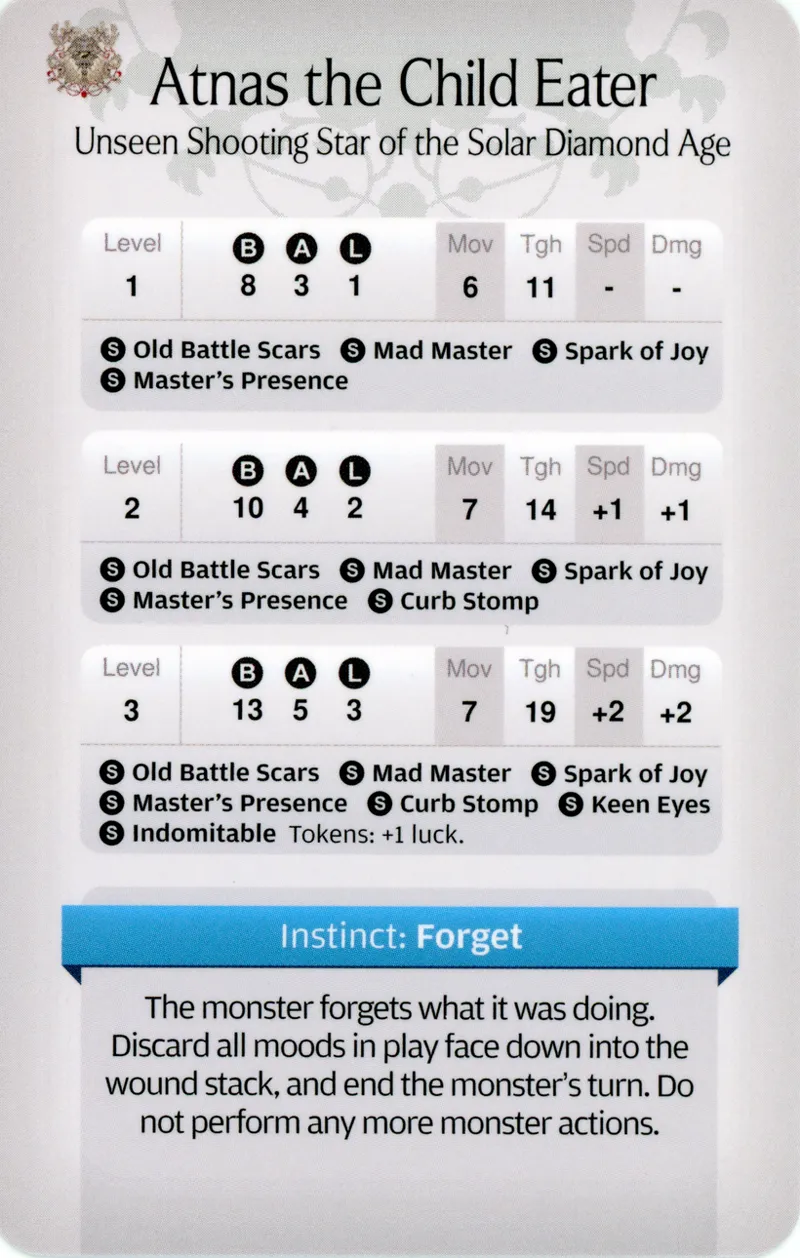
Atnas is a Node 2 Nemesis monster, this means that the level 1 iteration of the showdown should be somewhere between a Level 1 and Level 2 Node 3 Quarry monster, and when we look at the reference card we can see this is very closely where Atnas's block of stats lands.
A Level 1 Phoenix is B8, A3, L1 with Move 8 and Toughness 10, while part of the power with each monster reference card is of course located separately in the trait cards it is very much on target and this continues with the Level 2 version of Atnas, however the Level 3 Atnas falls off a lot with Atnas having less total life, movement, toughness, damage and additional tokens. If you've played a fair bit with the level 3 Node 2 Nemesis (NN2) monsters you may recognise this trend however, it happens with all NN2 monsters as an intentional part of the design. NN2s tend to come into the campaign swinging hard, keep pace at Level 2 and then have to lean into their gimmicks in order to keep the pressure on at Level 3.
When we consider Instincts, there are three main categories, the first is a straight up Punishment that effectively says “Let my AI card work or you'll be sorry.”; the second kind is “I'm making sure I get to use my AI card next turn.” and the third kind is “Thematic and often weak”. Atnas has the third kind of Instinct, though it is worth noting that not all of Atnas's moods are strictly bad for the survivors. Some of them offer a benefit followed by the punishment that is “Spark of Joy”, we'll get into the moods more in a moment.
Atnas's Basic Action has simple, direct targeting that has a unique trigger of caring about “standing survivors”, its stats are a little higher than the Kingsman with that 4 Damage and a little more accurate than the Slender Man at 3+ accuracy. It's actually the best basic attack profile in our current selection of NN2s, especially if we consider how dangerous the After Damage trigger is because it is handing out Sword Craft cards. We don't like this Basic Action and prefer Atnas to not deploy it if at all possible.
AI Trait Cards
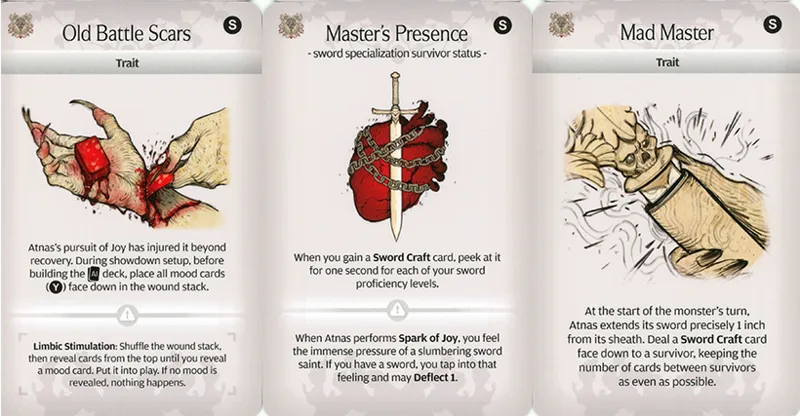
These first three traits are relatively straight forward, but they highlight two of the main themes of the showdown, the first is that unique piece of design where Atnas starts with AI Mood cards in its discard pile and it can pull them from there in order to put them into play. This ensures that Atnas will always have access to its moods because it can pull them from a place survivors cannot normally interact with.
Ballads from the Smog Singers are an exception to this, these abilities archive wound cards in order to activate and this interaction is an intentional one designed alongside Atnas as a part of the Dream Keeper campaign. That helps deal with the Moods very quickly and also gets a Ballad into play as soon as possible, we will see a card designed to punish this interaction, but even if you have archived all those moods you can still play around the card as it gives players time to deal with it.
Mad Master and Master's Presence are both elements that revolve around the Sword Craft cards, Mad Master ensures that survivors get one each every round and Master's Presence provides a way for players to see what Sword Craft cards are coming if they have survivors training in swords. I'll be upfront here, I think the real time “peeking” mechanic is cute, but ultimately should be ignored. Timed elements in board games that are not otherwise real time, especially ones that are as complex as Kingdom Death are honestly among the worst aspects of the game design (like roll a certain result and die). In fact I'd rank them as worse than even roll a dice and you die because they have the potential to force people to disclose disabilities that they may not even want to. One of my gaming friends has Aphantasia, another one is legally blind, several of them have differing degrees of dyslexia and some even have ADHD. They just cannot process cards like this quickly enough and being neurodivergent is something that is very common in the gaming space. It is by design exclusionary and that is something to be avoided.
In addition I am very much and advocate of letting players see derived information any time they want to, that is if a game mechanic revealed something then they are free to go back and look at that information even if the card has now been turned face down or gone to some other “hidden” area. This comes from my time playing competitive magic, where players would write down revealed cards from an opponent's hand and track as they are used. I do not think players with memory limitations, sight issues, ADHD, dyslexia, slower reading and so on should be deprived information. One of the largest benefits of turn based games like board games is people can take their time before making their move. This is one of the few mechanics that I flat out never use because of that and it is a black mark against this monster's design. Frankly it should have allowed a player to have the cards face up during that survivor's Act at Sword Proficiency level (3 points) and keep the cards face up all the time if they are a Sword Master, I'll probably design and print up that card for playing with friends in the future because its play patterns are really interesting (more on that when I get to Sword Craft cards)
To be positive about one element of it, it is nice to see that Atnas's role as The Sword Saint is mentioned here, it's otherwise mostly buried in the extra Deathmas releases.
Keen eyes is a very straightforward piece of design, don't bring evasion against the L3 Atnas because it doesn't do anything. You'll have to rely on Dodge, Block, Deflect, Soak and Ignore instead. The Imaginary Elf is created by one of the Legendary cards, so we'll get into it into it a bit later on in this article.
Curb Stomp arrives with the L2 monster and its main function here is to tax survival, having just one knocked down survivor can result in any survivor being crushed and the amount of damage is so high that most armor sets can't handle it, plus you're getting hit by Spark of Joy afterwards. As long as you have survival you can keep this from happening, be careful with Survival Philosophy and Deaf survivors because they have limitations and issues with the encourage mechanic.
AI Moods
Here are our five moods, they all function in a somewhat similar fashion, providing some sort of modifier and then triggering Spark of Joy when that condition is met. Yearning for Fear and Surprise are the softest because these are only triggered if the players choose to do so. You don't need to attack from the facing or blind spot, one can always go for the flanks or choose to not attack and instead reposition. Overall though there's not much more to write about here, Yearning for Vanity is probably the nastiest of the bunch, but it's also difficult to stop Yearning for Misery or Nostalgia from triggering either.
AI Attacks
Atnas has a lot of attacks in his repertoire of moves, if you count the Sword Crafts in addition to the normal selection of AI Deck cards they make up over three quarters of every trick he has in his jellyfish bag. There's a number of moves which are duplicates, or mirrored pairs, so there is some predictability despite the sheer volume of them.
Our first selection is a prime example of that, Both Inner Lantern Slashes are identical and the Cane attacks only vary in their choice of target. Inner Lantern Slash in particular can be an incredibly nasty card as the Joyless impairment is a permanent removal of Surge. This is one of those areas where the strategy of having a Quarry hunt team and separate Nemesis team(s) or sending out newbie plebs for the nemesis showdowns pays off. Nemesis monsters trend towards being more punishing and less rewarding than quarries, so lower value Survivors are more cost effective to spend there. If you lose, you lose less and if any of them win and come out reforged into a more powerful survivor you can promote them to the quarry pool. I very much like that trial by fire play style and this is one of those places where it really pays off.
Outside of that catastrophic punishment, the move isn't that bad because every survivor has the opportunity to Dash out of the corridor once Atnas has gotten into position. It's like Curb Stomp in that the main thing it does is tax and drain your survival, so a high survival limit and good forms of departing or showdown survival generation are goals to have. If you can manage that and position well so that the closest survivor doesn't have other survivors behind them, the card virtually reads -1 survival to the closest survivor.
The Freezing Cane attacks are more traditional types of attack, ones where unless you can Dash outside of Atnas's movement it will catch you. Mitigation here comes down to positioning as this is a Synchronic attack, if you ensure your survivors keep 1 square clear on either side and don't stand in the two rows behind any survivor then this will only catch one survivor. If you're having trouble visualising that during the showdown, keep a 100mm base to hand, place it with the survivor in the front middle square and the rest of the base highlights where one should not end their act. There's also a little reward for wearing fur or heavy gear here, that's going to be campaign dependant, but there are almost always solid options available on the heavy front.
Our next quartet has another pair of cards with an iconic clown move Pratfall; these are two of the rare AI cards that are impacted by a persistent injury, so if you're given a choice it's worth letting these resolve instead of wounding them when dealing with the L1 Atnas, at L2+ it's a little harder to justify that strategy because of Curb Stomp triggering at the end of the monster turn. The Infectious Giggle HL card is the one you want to critically wound in order to turn these cards into dead draws for the dead dropping Sword Saint.
Mini Mucus Javelin is one of those rare range attacks, it's utterly disgusting but it is a place where the Smog Singer Spinning Swords can be of use, but only against the L1 version of Atnas. It's low speed, so dodge/block/deflect mitigation can neuter or blank this card and the after damage trigger is relatively mild as it is only limbic stimulation (mood spawning).
Bloodflakes has one of the more unique targeting rules in the game and one you can take advantage of if all of your survivors are rocking swords. Swords have an interesting place in Kingdom Death, because they're one of the few ways to have access to Block or Deflect printed on a weapon (shields of course are another). This means you can justify having some of them in your gear grid even if you're not attacking with them. A party of four survivors all with swords turn this card into a Forget instinct instead of an attack with Bleed 1. We'll come back to this sword usage later on.
Freezing Club Party is a very nasty card that runs counter to a lot of the other AI cards, normally you are rewarded for wearing fur/heavy gear, but this card punishes you for it. I think that's not really a fair piece of design overall, this card doesn't stop until there are no standing threats. However, there is a flow step between the attack and the repeat, so one can dash away all the standing survivors. There's other edge case moves you can perform like quickly surging to apply a faecal salve and stop being a threat or employing other ways of knocking yourself down so keep an eye out for them.
Freezing Blast is another card that bucks the trend, this time however it is because of its attack profile. High speed, low damage moves are very threatening when employed by monsters because it is more effective at overwhelming survivor defenses. That makes for a rough time as the monster's innate damage and speed climb up through the levels. Keen Eyes strengthens this card even further because the normal protection against attacks like this is to use high evasion to remove as many hits as possible before dodge/blocks/ignores and armor point soak are employed. That -1 movement token is also potentially deadly, movement is a stat that you don't realise the importance of until it gets reduced. You can function well enough at 4 movement, but 3 movement becomes painful and if somehow you get pushed down to two movement those Inner Lantern Slashes are going to catch you.
Joy Crusher is a “standard” attack when you consider its profile, but that “Dead Inside” impairment is one of the ones that I consider to be an cause of early retirement for a survivor. Without access to Survival spending in this game using a survivor is asking to be obliterated by hunt events and monsters alike. Another point for saving your quarry hunters and keeping them away from this Jovial Jokester and his Jellyfish Jockey.
False Slash is another of the (relatively speaking) weaker cards in Atnas's arsenal, it's an attack acting like an intimidate, with a massive amount of brain damage and that Sword Craft card. I absolutely want to not let this one resolve if I have the opportunity to scout it and set it up as a wound for an attack because it's very punishing.
Intimidates
Outside that pseudo-intimidate Atnas has just the one intimidate card, Laughter's Paradise. There's a lot of risk surrounding this card, it's pretty soft at level 1 because suffering Bash isn't a big deal and lunacy is a soft disorder to suffer.
Still, like many of these cards, it gets more threatening as you go up the monster levels because those Sword Craft cards are no joke even if some people are laughing. Also I find myself wishing there was a second of these Intimidates called Laughter's Slaughter cause it's a very satisfying name for a move.
Unique AI Cards
Our last category is the selection of cards that do things outside the normal suite of attacks, intimidates and moods. This is where all three of Atnas's Legendary cards lurk, but before we get to them we have these three cards to consider.
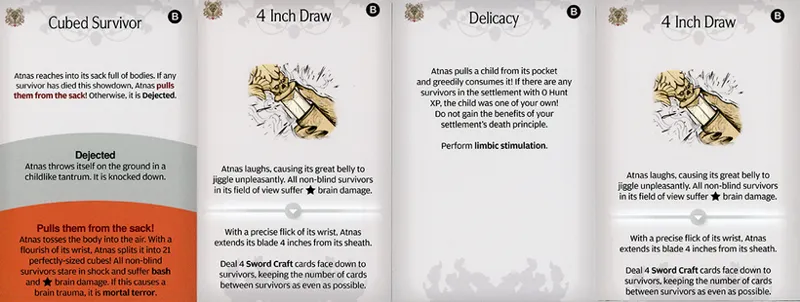
Apologies for the order of the cards here, I'm not going to spend another 5 or 10 mins fixing it, but we'll start with the two 4 Inch Draws. These cards act like intimidates without having that text and they're both quite nasty because they cause that brain damage to non-blind survivors that are not hidden from sight (blind spot, behind obstacles) and they hand out Sword Craft cards. Sword Craft cards are the primary way that Atnas becomes a threat, the lower level of danger that this NN2 monster presents when compared to the King's Man and Slender Man is offset by the incredibly high danger of the Sword Craft cards.
Cubed Survivor is a card that either does nothing or can be incredibly punishing. I'm not a fan of this type of design because it does nothing when you're ahead and punishes you when you're behind. Snowball mechanics make for non-games, this is a snowball mechanic. Ignore this card until someone dies, then AI control it into a wound.
Delicacy is a bit stronger and a more interesting design than The Cube, it usually kills a survivor but they are 0 hunt XP and in your settlement, so as long as you've been good at maintaining population this should be fine. Not ideal, nor is it something you want to repeatedly trigger. The counter here is to keep a focus on the core principle of settlement development – Intimacy. If you've got less than 20 survivors in your settlement one should always be working on getting more anyway.
In this second batch, Forgotten Century has Atnas lose some more of itself and the only thing you can do outside of removing this as a wound is to get some hits in during that flow step survival opportunity via surge. I'd recommend getting as many in as you can manage because this card puts you on a severe time limit, it may archive itself after resolving (effectively being a self inflicted wound) but gaining +2 damage tokens is terrifying even before considering how it combos with Keen Eyes. There are ways to remove attribute tokens from the monster, so keep an eye out for them because they can turn this card into a mostly positive moment for the survivors. Without those tools you're going to have to be, aggressive, be be aggressive. If you don't then you're going to lose the damage race.
The lone duration card that Atnas has is as brutal as you'd expect from an L tier card, not only is it dishing out a fair chunk of brain damage, but if you do not remove this as a wound and it gets to be drawn that second time you're either dealing with a big pile of moods and toughness tokens or an absurd amount of torment. You may want to pack a founding stone plus HL manipulation for every showdown against the L2 and L3 Atnas incarnations because lining up an automatic critical wound can be the difference between winning, losing or winning with every survivor who made it to the Victory being effectively “retired”.
Miraculous Imagination is an incredibly unique card, it gives Atnas a minion, but this minion does not use a miniature.
Instead we have a small version of Elgnirk to deal with, as mentioned last time I think that this card's imaginary creature is a representation of Atnas's sibling Elgnirk the Choas Elf. It is an incredibly tough opponent that can only be attacked by survivors with 25+ insanity. This is another reference to Elgnirk as her box comes with a Secret Fighting Art that is given to the first survivor that dies with 25+ insanity. If you can't deal with this then you're going to have to remove the moods from the wound pile (if you can) or weather the storm. The 6+ don't die protection for Atnas is also a little rough, but given that we've managed to handle the original L3 butcher who had 6+ protection on all wounds, we can overcome it.
The SFA gained as a reward for wounding is another Sword specific Fighting Art, it's very satisfying to use because it utilises high speed in an unusual manner. Allowing you to sink extra rolls (regardless of the result rolled) to improve another roll. Suddenly you're in charge of how many hits on a monster actually convert into HL draws, that's a super interesting mechanic as it allows for a lot of precision when you need it. This is also another reason why you want to take as many sword proficiency survivors into this nemesis showdown as you can manage. An all sword anti-Atnas team can be a very effective quartet to put together.
The last AI card is a powered up version of the 4 Inch Draw, as it deals out 8 Sword Craft cards, but we are given a little respite because this version doesn't deal any brain damage. There's not much more to cover here beyond the usual Rawhide Scout it and remove it as a wound so you don't have to deal with it.
Final Thoughts
First of all, please forgive me, but I'm going to have to split the Atnas deep dive into three or four parts. I really can't cover everything left to go through here. I'll try and put out a second article with at least one of those two if it ends up being four parts in order to not spend a whole month on just Atnas, but it's hard, The Sword Saint is a complicated monster and the Sword Craft deck is a whole beast all by itself that I have many thoughts about.
To get to the AI deck, I think that this selection of cards is pretty on the money for what you want your AI cards to be doing when you're dealing with a NN2 monsters, the softer part of Atnas is the HL deck and the hardest part are the Sword Craft cards. All of this contributes to create the greatest weakness in Atnas's mechanical design, the fight is incredibly uneven and can swing from being a monster that is doing nothing relevant into one that's making pain rain down from the sky. That's not a good design for a monster, but Kingdom Death has a major issue that limits monster design, the monsters become weaker as time passes because the AI deck shrinks in size. Showdowns start off at their most spectacular level and become a more and more desperate struggle on both sides as the defensive resources are worn down. We'll get into how this comes together when we look at the Sword Craft cards, but the main crux of my point here is you can't easily design a monster in KDM that becomes more threatening the closer to the end of the showdown it is. There are ways to do this, but Atnas doesn't represent a growing threat that become stronger over time, it instead acts more like a balloon filling with water (or blood) and sometimes that balloon doesn't even pop and the survivors go home after a deflating showdown against an old man who keeps trying to lay down for a nap.
In many ways this reminds me of the Smog Singers design, they are also a punching bag when you look at their AI cards (even more so than Atnas) and they're meant to turn that against you when you hit the trap. They don't really come to life until the second level as a consequence and it's similar here with Atnas, if there aren't enough cards (life) to provide a long enough period where the Sword Craft cards can come into play then the showdown is going to be soft. On the other hand if you keep hitting the Sword Craft trigger or you hit it near the end of the showdown then it's going to feel like, and I quote Holden from the discord here “showing up for [a fight against an] absolutely horrifyingly powerful anime swordsman”.
Hopefully the third part will cover both Hit Location cards and Sword Craft cards, so we can wrap up with just a three parter, we'll see.
Comments (2)
I think you've misread Freezing Club Party?
The point I am getting at here is if you are wearing heavy/furs then you do not get Bashed, so the attack repeats. It doesn't have a "repeat once" clause or similar though it clearly should have. As such it is particulaly brutal if you have heavy/fur/Leather Armor Set and you can't Dash everyone in the targeted spaces clear.