


The Forlorn Encyclopedia: Introduction to the Series | Kingdoms Forlorn
Kingdoms Forlorn is the second game since Kingdom Death: Monster that has for me the potential to be a “lifestyle” game rather than simply another member of the Campaign Boss Battling stable. By lifestyle game I mean games such as Arkham Horror LCG, Warhammer, Magic: The Gathering or KD:M, games that become the main focus of your gaming sessions due to offering varied play that has depth and the potential to be expanded for as long as the creators desire to do so. Kingdoms Forlorn manages this through a combination of its very puzzle-like battles (called Clashes) and the modularity of the game via its Knights and Kingdoms. Each Knight offers a new play style and perspective through which to explore the game and each Kingdom offers a fresh new setting to explore along with a collection of various bosses that help bring the history and environment of the place to life. Older places can even be expanded upon with the addition of extra monsters because many of the occupants during a delve are randomised from a selection of possibilities based on the progression of the knights delving.
One of the things I love most of all is taking a deep dive into designs in boss battlers in particular because they seek to combine mechanics and thematics as tightly as possible, we don't just get a thing that acts in a particular way, we also get the why of it and that is interesting to someone like myself who enjoys not just nature documentaries on the real world but also ones that cover fictional places. (As an aside, I've read through the Godhusk: Rebirth book recently and that's a fascinating look at a fictional game's fictional world setting).
However, when it comes to Kingdoms Forlorn, I do find myself in a slightly tricky situation. I want to write about the bosses and knights in the game but when attempting to pull together the lore aspects the simple truth is it's too much work for myself in the state it is in. There's so much writing and I don't have the time to go through every single passage in the text of all the kingdom and knight books in order to tease out all the details for the specific boss I'm dealing with. I also can't take the FromSoft lore route which involves pulling all the text from the game into documents and then searching via keywords to catch every point that builds on the lore. I don't have that material to hand and putting it all together myself would probably require me to take months off from writing. It's a shame, because insights into the lifecycle of the monsters when I do come across them are really neat, I love the Eggknight in particular for that.
The second part is that I actually really value the “blind play experience”, that is the experience of learning as you play and unlike Kingdom Death, Kingdoms Forlorn has a lot of in game secrets to uncover as you play (similar thing with Aeon Trespass: Odyssey only more reasonable, I'm still a bit upset about the accessibility issues surrounding the Cycle 4 and 5 ciphers, but that's for another time).
Simply put, I don't want to spoil the lore of the various knights or kingdoms at this time.
What this means is I'm going to be taking a mostly mechanical perspective in respect to my breakdown and analysis of the various antagonists and protagonists in this series. I'll cover the lore in the most surface manner as possible, using just the introductory passages for the knights/monsters alongside their cards and otherwise referencing the tropes or real world inspirations that each thing evokes. The benefit of doing it this way means that I can not only preserve as much of the mystery as possible but it also allows me to focus on the Clashes by playing the game via the Rosengraal 'rogue-like' mode.
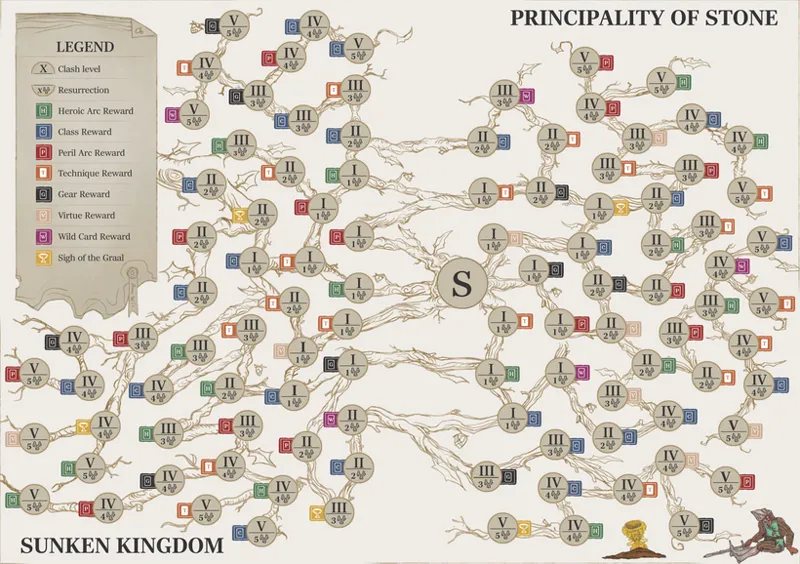
If you're not familiar with it; the Rosengraal is an alternative way of playing that gives you a finite number of “lives” (resurrections) for which to get through the entire tree which you see here.
This mode has a few benefits for me when it comes to writing this series, first of all it's a harder game than the main mode because you have less resources generated per Clash, there's no exploration rewards to get here and money is also tighter as a consequence. You also can't really 'fail forward' the way that the normal campaign mode allows because of that resurrection limit. I also get a lot more control over the progression of the knights, I can choose to target specific nodes that have what I need to grow in power, Arcs, Gear, Technique cards and so forth. It's also a lot faster to reach the higher level versions of the monsters because one clash is progressing all four knights at the same time. I also can't take a 'free roam' expedition if I need some extra oomph for a knight, the best I can do is go to an easier node and fight that if I've not already completed it.
There are some negatives though, Squires are not really powerful enough to function in this mode and that means I still have to rely on normal campaigns in order to fully explore them. Also without squires I am controlling four knights at a time, while it's easier than handling four full Oathsworn Mercenaries it is still a serious cognitive load and limits the amount I can play each day to around one clash at a time. I'll also not be able to be as detailed with the delve side of technique cards as I'd like. I know enough to be able to evaluate them, but there may be some specific tricks or interactions that I've not experienced.
Another sticking point is this doesn't allow me to cover the post game (Level 6+) clashes, but if I'm honest looking at those is a few years away regardless so that's not a large issue. I think I can probably bring Knights that have completed the Rosengraal into the post game mode relatively smoothly however, so I may well try that eventually. I also don't get to explore Jura's mechanics or the codes hidden in various parts of the game (fortunately I've already been through all of the codes I could find and explored that part pretty extensively, enough to have decided to not share what's there).
Also, due to there being so many different bosses/mobs and which ones you face per kingdom being random, I still have to run multiple Rosengraals in order to face everything that's release for each kingdom at levels 1 to 5. Even if I chose exactly which one I wanted to face in each node, in order to have clean progression that's still going to need more than one run. At this point I've successfully completed the Rosengraal twice now and I still don't have enough data and notes on multiple different enemies, but I do have enough to get started on some of the earlier ones.
It's all a compromise that I've had to go through in order to be able to get the entries written up with the level of detail and depth that I want to use. Kingdoms Forlorn may have simpler gear, but it has multiple technique cards and many, many different bosses/mobs across two entire kingdoms (and the generic ones that turn up anywhere).
The Knight Analysis Structure
When it comes to each of the knights, the vast majority of their party roles are provided by their individual cards; between Talents, Arcs, Techniques, Portraits and so on, a lot of what makes a given knight unique from the others comes down to those. You even have the ability to specialize further, some techniques will favour one style/role over the other.
When it comes to analysing the Knights I'm going to be breaking down every single one of their cards, I'm not sure how many articles it'll take per knight. I'm hoping to keep that as low as possible, but because the cards are double sided, I can't see it being less than two parts per knight. The technique cards alone ask for a breakdown of what each side does, they can vary in power with some delve cards being far more potent than the clash version on their back side. Knights tend to have around 20 technique cards, so that's 40 individual “cards” to go through, as such I might even end up not discussing the delve sides at this time (playing via the Rosengraal means I've only experienced four knights in full so far). That is another limitation and compromise because some knights bring a lot to the table during the exploration portion of the normal campaign, Ser Sonch is a great example of this.
In respect to gear, I'll be going through just the knight specific gear cards during the Knight part of my analysis, I won't be covering mob/boss gear beyond some generic references such as Ser Sonch benefiting from extra mobility due to his advanced years slowing his speed. I will mention some of the merchant/kingdom gear that I found useful if it is appropriate.
Overall I'm pretty excited about breaking these knights apart mechanically, yes I am disappointed in the overall framework of the gear mechanics, but that's the case with every non-Kingdom Death boss battler, at least here in Kingdoms Forlorn the techniques do a lot to make up for that as they provide a rich and customisable system. Gear in this game could have been more interesting, however the technique system is an engaging and fun puzzle in its own right - it very much feels to me like Oathsworn's card system, but neater and more fluid to operate.
The Boss Analysis Structure
When it comes to the Mobs/Bosses I will use the structure I've always employed with these automated entities in the past. An opening section discussing any tropes or real life/mythological/fictional influences that I've noticed followed by a full breakdown of each aspect of the boss. This means I'll be covering the first five levels via the data sheets, the layout of their specific showdown (as terrain is very intentionally placed in clashes as part of the puzzle) and then covering the cards in the various decks broken apart by type and AI. I'm not sure if I'll cover each and every card, I'm more likely to group some of them together if they are similar enough to justify this.
Mobs in particular have been a really interesting opponent to interact with, as each model represents a specific individual there are patterns to the groups and probabilities to consider. The First Men Warriors or Ironcast Dead have duplicate mob cards which means they're a bit more predictable when you get used to their BP (Body Part) cards, the Haunts of Utrebant on the other hand have three levels of distinct specific individuals. You can learn each of these and know exactly how they react to being attacked, something which becomes very valuable. If you know who two of them are, you know who the third one is and if one of them is revealed you know enough to be able to roll with the punches that either of the other two have when you attack blind. It's a 50/50 shot. The Pumpkin Heads are even more transparent than the Haunts, you know exactly what each and every individual is because there are only six BP cards total and they're double sided meaning identification is certain.
The single figure bosses on the other hand are more similar to the Aeon Trespass ones in their structure, they have a single AI and BP deck of six cards that gradually escalate in level while you successfully wound BPs. But even there we have a lot of interesting and unique gimmicks that make the clashes different from each other. Tackling the Winged Nightmare is a very different experience from the Eggknight or Toad Dragon for example.
There's also neat variations in the behaviour of the enemies caused by trait cards, some like the First Men can have their behaviours act out in one of three different ways, the “everywhere” opponents who turn up in each kingdom have spins and variations caused by the place they are in. This can change the terrain set up, their AI cards or their BP behaviour. It's all very interesting and adds to the character of both the Kingdom and the monsters.
I'll also be covering the gear that drops from each tier of the monsters (Mob, Vassal etc) as a part of this analysis and that's where I'll mention places where I've found them to be very useful with specific knights. I cannot claim to have navigated every combination of monster gear + knight, there's far too many to cover, but I will share any interesting interactions I've experienced myself
Final Thoughts
I hope all of this is clear and transparent enough to allow understanding of the technique I'm following in order to write about this game while also keeping other games in writing rotation. It has strengths, speed in particular, but it also has limitations because I've chosen to step away from the exploration part of the game, essentially I'm cutting the Kingdom away from its inhabitants for the moment. I do hope to at some point explore all the lore, background and historical secrets of each Kingdom, discuss their specific mechanics and similar but to do that right now is simply too much for me to get through. The thematic part of the game is going to suffer a bit, but hopefully the mechanical portions get to shine brighter as a consequence of this.
That's why I've ended up writing this piece rather than jumping straight into the first part, it's because I just cannot approach this the same way that I approach KDM monsters, there's too many differences because Into the Unknown Studio approach and present their worlds with a very different style. It's a lot easier for me to look at the handful of paragraphs and card text that Kingdom Death presents and pull everything together along with support from the real world inspirations. It's harder to do that here because each of the kingdoms feels crafted with a long written history that sits behind the detailed artwork and writing. There's more world and with that comes less space for speculation.
Comments (5)
Fen have you completed a proper campaign, doing all the delves and everything? Did u do it with four knights or did u use squires? With the tree mode, do u still learn the story? Im not a fan of the delve phase, but i thought it was essential for the story progression.
I have at this point completed a story campaign with every knight and I've completed three runs through the Rosengraal, which was the baseline I wanted to get done before this series. I've used a bunch of different mixtures of Knights and Squires for the story campaigns. The knights level up during the Rosengraal so you get progression, but not their story. That is fine for me and I enjoyed the Rogue's Path (Rosengraal) a great deal as it was more challenging and technical due to using four knights.
Thanks for the article and the clarifications, looking forward to the rest. For your interest, I am no longer receiving your mail updates, no idea about the case. I hope it is only my problem.
I guess, that has to be something to do with either your Patreon settings or perhaps your mail settings. Everything is working as normal at this end and for others.
Nice to know there will be Kingdoms Forlorn content for 2026. I think this game deserves more love from the community than it receives. I totally agree on the somewhat generic aspect of gear in this game, wich acts more as a traditionnal Leveling-up gate, than a truly central and puzzly system like that of KdM. I also agree that mob fights are very well executed. Those hybrid systems iterating on a solid (boss fight) base, are hit or miss. I usually don't like mob fights in boardgames (the exception being Cephalofair's games). In KF, I'm looking forwards to these mob clashes. I think I love them all. Each sufficiently unique for the immersion to work well.