





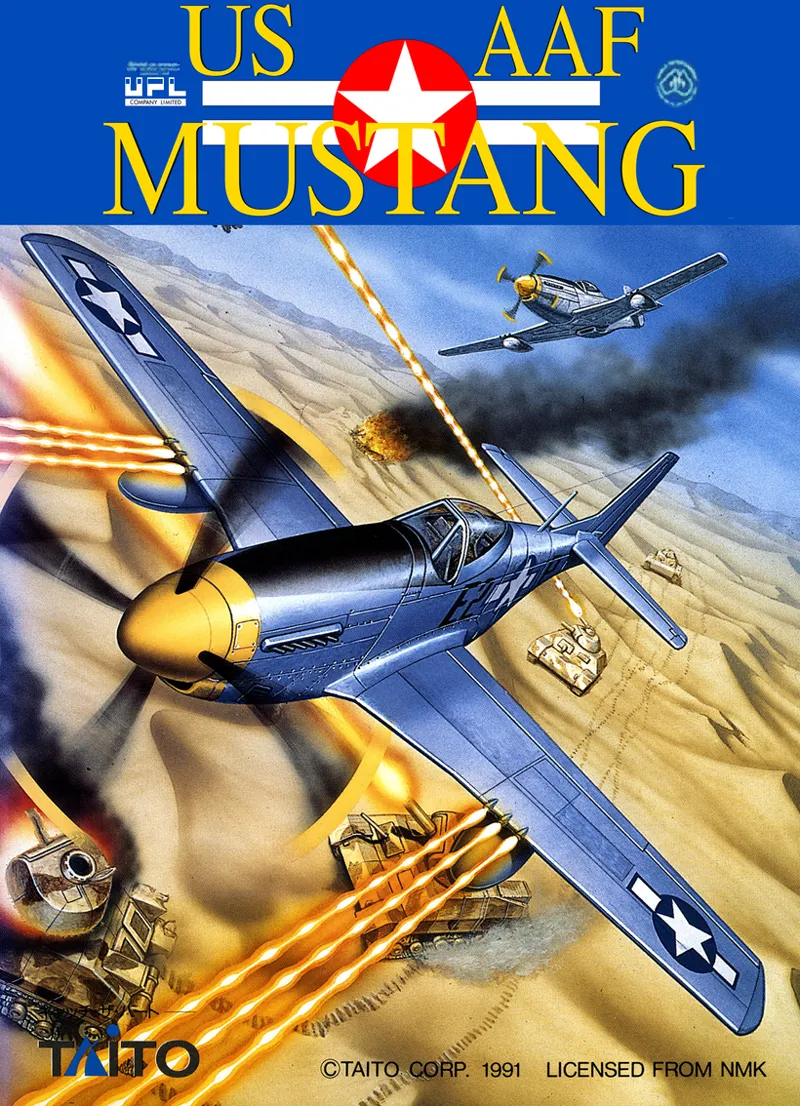
Coin-Op Collection Presents: NMK16 (US AAF Mustang)
Today's release for the Analogue Pocket and MiSTerFPGA platforms is the second entry in the NMK16 platform. US AAF Mustang is a horizontal scrolling shooter built on NMK's 68000-based custom chipsets, the same hardware family behind:
Task Force Harrier (1989)
US AAF Mustang (1990)
Vandyke (1990)
Bio-ship Paladin (1990)
Black Heart (1991)
Acrobat Mission (1991)
Thunder Dragon (1991)
Hacha Mecha Fighter (1991)
Super Dimension Fortress Macross (1992)
Koutetsu Yousai Strahl (1992)
Saboten Bombers (1992)
GunNail (1993)
Super Dimension Fortress Macross II (1993)
Thunder Dragon 2 (1993)
Bombjack Twin (1993)
Power Instinct (1993)
Rapid Hero (1994)
Released in 1990 by UPL, US AAF Mustang follows Super Dimension Fortress Macross as the second NMK16 core, and the first to run the platform without its protection hardware in the way.
This post covers a technical overview of US AAF Mustang on NMK16 and how it builds on the IP introduced with the first release.
Licensing:
US AAF Mustang is distributed through the Coin-Op Collection licensing portal, which serves both MiSTerFPGA and Pocket from the same dashboard.
Pocket patrons need to register their device and generate a key before launching the core. Step-by-step instructions and the FAQ are available on the Help page. More information can be found by clicking here and here.
Overview:
US AAF Mustang runs on NMK's 68000-based hardware (PCB UPL-90058), driven by a single Motorola MC68000 at 8 MHz. The audio system is the same one introduced with Macross: the NMK004, a Toshiba TMP90C840 microcontroller running at 8 MHz, takes sound commands from the main CPU and drives a YM2203 (OPN) at 1.5 MHz for FM and PSG output along with two OKI M6295 ADPCM samplers at 4 MHz, each with its own bank-switched sample ROM. Audio output is mono. Unlike Macross, this board carries no protection or graphics-descramble hardware.
The video system outputs 256x224 at approximately 56.205 Hz. Graphics are handled by a set of NMK custom ICs: the NMK902 generates the interrupt and video timing chain, the NMK901 manages the sprite attribute table and its DMA, and two NMK903s latch and multiplex the graphics data. The display composites three layers from back to front, a scrolling 16x16 4bpp background tilemap, 16x16 4bpp sprites pulled from a DMA-buffered list, and a fixed 8x8 4bpp text layer on top for HUD elements. The palette holds 1024 entries split evenly across the background, sprites, and text layer.
As on Macross, video timing is not generated by a programmable register set. Two bipolar PROMs drive it directly: a horizontal-timing PROM and a vertical-timing PROM, both 256x8. The NMK902 holds the two counters that address them, one stepping the horizontal PROM every two pixels to define the H counter chain and blanking, the other stepping the vertical PROM every two scanlines to walk the frame. Each vertical PROM entry packs the active video, VBLANK, and VSYNC signals together with an interrupt trigger, a three-bit interrupt level, and a sprite DMA trigger.
The NMK902 reads that PROM to raise the raster interrupts mid-frame, the vertical-blank-in and vertical-blank-out interrupts at the top and bottom of the active area, and the sprite DMA at the end of the frame, with no main CPU involvement. The displayed color is generated from the 16-bit palette RAM, with four bits per channel plus a shared intensity bit expanded to eight bits at output.
Development Challenges:
US AAF Mustang reuses the components developed for Macross. The NMK004 sound MCU and the YM2203 were the two components that took up the majority of the time to stand up the NMK16 platform; both have been validated, and Mustang uses them as they are: the NMK004 is the same x90840, and its FM and PSG come from the same x2203.
The US AAF Mustang PCB is far less complex than Macross. It has no NMK215 protection MCU or NMK214 graphics descramblers, so the ROMs are stored and read directly. The rest of the work was adapting the core to this board.
With this post, we'll continue covering the remaining development challenges. Every component used in US AAF Mustang stems from the work done for Macross.
NMK901 sprite controller: The NMK901 owns the sprite path. It manages the sprite attribute table and runs the DMA that copies the active sprite list into the display buffer once per frame, triggered off the vertical-timing PROM at the end of the frame. The core reads that DMA-buffered list at render time, walks up to 256 sprites in priority order, and draws each one from its eight attribute words: a visible flag, width and height in 16x16 tiles, a flip pair, the tile code, a nine-bit X and Y on a 512-pixel plane, and a four-bit color. Sprites can be up to sixteen tiles wide and sixteen tall, with the tile codes advancing column-first across the block.
NMK903 graphics latch: A pair of NMK903s sit on the graphics data path, latching and multiplexing the tile and sprite ROM data as it is read out. In the core the equivalent work is the fetch and repack of the 16x16 tile and sprite data: a single wide read returns two complete pixel rows at a time, and the next column or line is prefetched while the current one is still drawing to hide memory latency.
The background and text tilemaps are drawn by the NMK tile path, the same one used on Macross, a scrolling 16x16 background under a fixed 8x8 text layer for the HUD. With the sprite and tilemap hardware described here, the NMK901 and NMK903 are accounted for, and the NMK902 timing chip is left for a future post alongside the remaining NMK customs.
Core Options:
The MiSTer core includes video settings for aspect ratio, vertical scaling and cropping, scandoubler effects, and vertical positioning and sync adjustments. Horizontal positioning and sync adjustments are not available: the board's horizontal timing is fixed by the 82S129 horizontal-timing PROM, just as it is on hardware, while the 82S135 vertical-timing PROM leaves the vertical adjustments open. The refresh rate toggle is disabled due to this.
Audio settings provide separate OPN FM, OPN PSG, and two M6295 PCM toggles with volume control for each. Arcade dip switches are directly accessible from the OSD. Game settings include per-player auto-fire with adjustable rates, mapping options for Player 1 and Player 2, and a synced mapping mode that mirrors Player 1 to the Player 2 layout.
Cheats are accessible from the OSD. The set includes a stage select that places the player on any of the eight stages, infinite credits, and per-player invincibility, infinite lives, infinite bombs, and maximum shot power.
The Pocket core provides auto-fire with per-button targeting and adjustable rates. Its cheat set is a single-player-focused subset: stage select, invincibility, maximum shot power, and infinite bombs. Arcade dip switches available on Pocket are Demo Sounds, Difficulty, and Lives.
History, Gameplay, and Regional Information:
US AAF Mustang was developed by NMK and published by UPL in June 1990. NMK had built the same style of horizontally scrolling shooter once before with P-47 in 1987, and Mustang carried the working title P-51 during development as a nod to that earlier game before taking the Mustang name.
Players fly a P-51 Mustang through a World War II campaign, fighting across European and Asian fronts. Movement is on an 8-way joystick with two buttons, one button for shot and one for bomb.
The machine gun fires straight ahead and upgrades twice as power-ups are collected, first adding an upper diagonal line of fire and then a three-way spread, while the bombs arc down onto ground and naval targets and raise their on-screen limit from two to four to eight as they are leveled up. A second weapon, the Strike Forcer, clears the screen and grants a brief stretch of invulnerability, and the player can carry up to eight at a time. Each of the eight stages closes on a boss, and clearing the eighth loops the game into a harder pass that continues without end.
US AAF Mustang stayed in Japanese arcades on release and did not reach players elsewhere until 2021, when Hamster added it to its Arcade Archives line on Nintendo Switch and PlayStation 4, its first availability outside Japan.
Updates:
With US AAF Mustang out, the next NMK16 titles are Task Force Harrier and Vandyke. Both reuse the audio and video work already in place and fill in the parts of the board that differ from set to set.
Disclaimer: All product names, trademarks, and registered trademarks mentioned are the property of their respective owners. "Analogue", "Analogue Pocket", "MiSTer", "MiSTerFPGA", "OpenFPGA", "Motorola", "Toshiba", "Yamaha", "OKI Semiconductor", "NMK", "UPL", "Taito", "Hamster", and all derivative works are trademarks, registered trademarks, or copyrighted materials of their respective holders. Use of these names does not imply endorsement or association with this post. All rights reserved to their respective owners. This post is for educational and research purposes only.

Comments (6)
Where do I get the key?
I'd love to see the bootleg version (Raiden sound track) working on the core =)
Two NMK shmups in as many days, couldn't help but sign up
Awesome job! But for Sidi128 don't create cores?
I don't own the device and know anything about it.
I’ve got your 6.