


Degloving (Medical Injury Images Ahead)
Showing the Inner You
If you’ve ever peeled an orange, you already understand the concept of a degloving injury. The “glove” in question? Your own skin and soft tissue. A degloving injury happens when layers of skin, fat, and sometimes muscle are literally torn away from the underlying structures, i.e. bone, tendon, or fascia. It’s not subtle. It’s visceral. This is the worst anatomical magic trick you have ever seen. Now you see the flesh, now you don’t.
Physiology: Skin vs. Substrate
Your skin isn’t just a cover; it’s anchored by blood vessels, connective tissue, and nerves. A violent pulling force can shear these attachments apart. The result is a flap (sometimes still hanging on, sometimes completely detached) with compromised blood flow. Without blood, tissue dies fast and the dead skin is basically a free buffet for bacteria.
Fun Fact: your skin accounts for about 15% of your body weight. Meaning, if you weigh 150 pounds, your fleshy cover weighs around 22 pounds.
Mechanism of Injury
Degloving requires one thing: brutal traction. Think of force pulling the skin in one direction while the underlying body part stays put. Common scenarios include:
Industrial machinery – rollers, conveyor belts, or any rotating parts that “catch” clothing, hair, or jewelry and keep pulling.
Vehicle accidents – especially motorcycles, where limbs slide or get trapped.
Ring avulsion (Pictured Below) – the wedding band nightmare: your ring gets caught, your body keeps moving, and the finger’s skin gets stripped like a banana.
Common Machine Culprits
Factories and farms are prime ground for degloving. Conveyor belts, presses, drills, harvesters, and even heavy doors can trap and yank with terrifying efficiency. The hands are usually the victims (because we insist on sticking them into things), but legs, arms, and scalps (Pictured Below) can get the treatment too.
Treatment (Grim Choices)
Reattachment: If the skin is intact and viable, surgeons will attempt to reattach it with microvascular surgery.
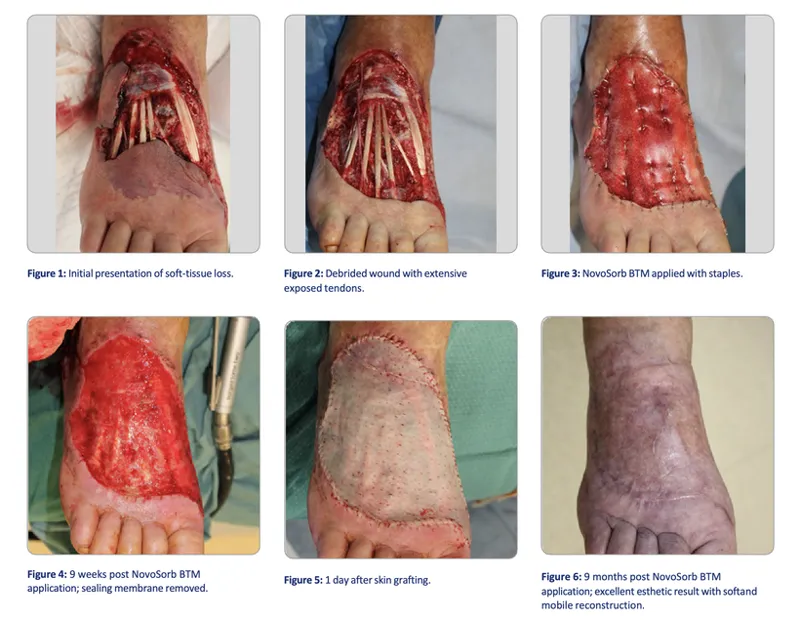
Skin grafts: (Pictured Below) If the tissue is too mangled, they may harvest skin from elsewhere on the body.
Flaps: Surgeons can rotate or transplant tissue from nearby areas to patch the damage.
Amputation: When circulation is hopeless and infection risk too high, removing the part altogether is often the safer option.
Survival isn’t usually the issue here—it’s function and quality of life. Reconstructive surgery can take years, and outcomes vary wildly.
Why It’s So Terrible
Degloving injuries straddle that uncanny valley of body horror. You’re not eviscerated, you’re not bleeding out instantly, but your body has been rearranged in a way that feels utterly wrong. It's a rawness and nakedness that is hard to make sense of. You are likely very aware of and a bit uneasy with your own skin right now.
Comments (7)
Can a person survive a degloving like the photo of the scalp and neck that you posted?
Yes remember there were many men and women who were scalped by the many tribes and it is essentially the same thing. It may not have been the entire head just the crown of their head or a little more but they did survive it. I read about it in college history books for extra credit.
I've worked with mice that degloved tails and it is the creepiest thing to see.
This is why silicone wedding rings are the way to go
The first thing I was taught when I started sewing was to remove any jewelry on my hands and wrist so this didn't happen.
Learnt about these at medical school. That's why when I got a Vespa I spent half the purchase price of the scooter on protective gear. Nothing was too expensive if it had Kevlar and 1200 denier nylon or kangaroo leather for the gloves
Figure 6 categorizes that 9-month result as excellent! Yowza... It looks like a dead body... Doesn't it ever heal to some good looking tissue?