
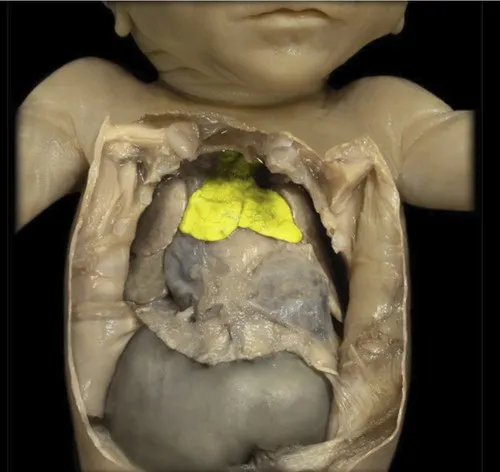
You Can't Find This Gland
If I asked you to point to your thymus, would you even know where to begin?
Don’t worry, you’re not alone. Most people don’t even realize they have a thymus, let alone that it played a starring role in a bizarre chapter of medical history where kids were intentionally exposed to radiation, just to shrink it.
Yes. That happened.
So let’s pull back the curtain on this little gland with a big identity crisis—and how it went from misunderstood immune MVP to target practice for 20th-century medicine.
What is the Thymus?
The thymus is a small, spongy gland that sits right behind your breastbone and just in front of your heart. It looks kind of like a deflated pink butterfly, and it plays a critical role in training your immune system.
Its main job? Turning baby immune cells (called T lymphocytes, or T cells) into smart, educated defenders that know the difference between YOU and everything else. Without this bootcamp, your immune system would be clueless and possibly dangerous (say hello to autoimmune disease).
This training happens mostly in childhood. In fact, the thymus is largest and most active when you’re young. After puberty, it starts to shrink via a process called involution. The functional tissue gets replaced with fat and its function declines markedly. By the time you’re an adult, your thymus is so small and inconspicuous that it's nearly impossible to find.
Some Weird History: Status Lymphaticus
In the early 1900s, autopsies of young people who died suddenly (especially children and teens) occasionally revealed something curious: a large thymus.
Rather than recognizing this as a normal variant of a healthy, active gland, some physicians labeled it a pathology. They ominously named the condition status lymphaticus. According to the theory, an “enlarged” thymus could compress the airway or heart and cause sudden death.
Cue the medical panic.
Suddenly, the thymus went from “what’s that?” to public enemy number one. Pediatricians and radiologists began recommending radiation therapy to shrink it. Yes, radiation, aimed at the chest and it was recommended for kids with asthma, tonsillitis, or just plain old “nervous energy.”
A Cure in Search of a Disease
Between the 1910s and 1950s, hundreds of thousands of children received thymus radiation, often multiple sessions, with no clear diagnosis all based on the belief it would prevent sudden death.
It didn’t.
Status lymphaticus was never proven to be a real condition. The supposed “enlarged” thymuses were probably just normal for the child's age. The autopsy findings that launched the hysteria were misinterpreted. The science was shaky. But the fear was real.
The legacy of that overzealous treatment? A huge spike in thyroid cancer, breast cancer, and other radiation-linked conditions among those children decades later. All because we misunderstood what a healthy thymus looks like.
The Thymus Today: Unsung Hero of Immunity
Even in its twilight years, the gland continues to be a quiet but crucial player in immune healt and, in some cases, the canary in the coal mine for autoimmune disease.
Immunity Bootcamp HQ
Let’s recap: the thymus is like a military academy for T cells, the immune system’s frontline soldiers. Bone marrow makes these cells, but they’re noobs until the thymus trains them up.
Immature T cells go through a brutal training programin the Thymus
They must recognize your own MHC proteins (a kind of ID badge for your body’s cells)
But they must not react strongly to your own tissues and proteins
This process is called central tolerance. It ensures that only T cells who can distinguish self from non-self get to graduate and patrol your body. The others? They get eliminated in a process charmingly called clonal deletion. Basically, you fail the training, you die.
But Sometimes... the Training Fails
If the thymus doesn’t eliminate self-reactive T cells properly, those rogue cells can escape into the bloodstream and launch attacks on the body’s own tissues.
In other words: autoimmune disease.
Conditions linked to thymic dysfunction or abnormalities include:
Myasthenia Gravis: An autoimmune disease that causes muscle weakness. Up to 75% of patients with MG have thymic abnormalities, including thymic hyperplasia or thymomas (tumors of the thymus). In fact, removing the thymus—a thymectomy—is a common treatment that can improve symptoms in many cases.
Lupus (SLE) and Rheumatoid Arthritis (RA): While not directly caused by the thymus, improper T cell education early in life may play a role in predisposing people to these conditions.
Type 1 Diabetes: Some studies suggest that defects in central tolerance within the thymus may contribute to the immune system's mistaken attack on pancreatic beta cellz.
There’s also evidence that age-related thymic shrinkage may contribute to an increase in autoimmunity in older adults. The smaller the thymus, the fewer new T cells are made especially regulatory T cells, which are essential for keeping the immune system in check.
Comments (3)
I knew exactly what it was! Although I don’t know where mine is because it was removed in 2005. I have myasthenia gravis!
Has it helped being gone?
I know where mine is