
Maximum Utility
The Cybermen, The Borg, Capitalism, Collectivism, and the Gothic
The literature of terror is born precisely out of the terror of a split society and out of the desire to heal it.
- Franco Moretti
0. Introduction
People often compare the Borg, the cyborg gestalt from the Star Trek franchise, to Doctor Who's Cybermen. Both races were conceived as humanoids physically augmented with technology, hence a certain superficial visual resemblance, particularly between the Borg and the earliest Cybermen, from 1966's 'The Tenth Planet'.
But the Cybermen were written by various different writers, under different conditions, with different levels of interest and different levels of knowledge of past depictions, over the course of six decades. By contrast, the Borg - at least during their initial era, disregarding recent revivals - were written by a small number of tightly associated people, under the aegis of a carefully controlled franchise, over the course of just under 15 years. The two 'races' differ markedly in the circumstances of their production and in cultural profile. As noted, the Borg's various appearances weren't separated by the same kinds of time-lags, and weren't a product of the same kind of radical turnover/variety of 'authors'. Also, the haute Borg's concentration in time, and their near-immediate claiming of a significant and visible role in global narrative culture (owing to their success and the global success of Star Trek: The Next Generation and its spin-offs), gave them a prominent position within a concentrated historical moment: the 1990s. The Cybermen, by contrast, disappeared from television during that same historical moment, and before that they had only enjoyed a smaller cultural spotlight in one country - Britain - during the late 1960s. By 2006, when the Cybermen tried to reclaim their place in culture, and went on to be more globally recognisable than they'd ever been before (owing to the international success of 21st Century Doctor Who), the historical moment of the Borg was long over.
Even so, the similarity of the Cybermen and the Borg is real, and rests upon kindred incoherent anxieties about capitalism.
Cyber Capitalism
There's a real incoherence at the heart of the Cybermen. They are definitely communistic monsters, expressing a 'Soviet-version' of the associations between the loss of individuality and collectivism. They seek the total upgrade of the universe, working towards a chilly utopian telos lacking any inequality or variation, and therefore - at least according to the ideological assumptions in play - devoid of individual freedom. But they are also deeply corporate monsters. They merged or allied themselves with International Electromatics in 'The Invasion'. IE was an expression of capitalist standardisation and mass production. Everything they make is the same, from their disposable radios to their CEO's offices. This is explicitly linked to capitalist production and business practices, and is implicitly linked with the uniformity of the Cybermen.
In many ways, the alliance between Tobias Vaughn (CEO of IE) and the Cybermen is a business partnership, with the invasion a hostile takeover. The partnership is possible because, in Vaughn's ultra-streamlined corporate context, there is a synergy with the Cybermen. In the 21st century series, the alt-world Cybermen actually emerged from a corporation, Cybus Industries. They were a Cybus product, complete with a corporate logo on their chests. (With their divided nature, it's fitting that they take over Battersea Power Station, which began life as a venture of a private company, got nationalised and then closed down, and has since been auctioned to a Malaysian consortium and turned into a complex of apartments and an event venue.)
The Cybus-Cybermen are semiotically linked with the internet, computer software and mobile phone technology, even acquiring the concept of conversion as an "upgrade" which expresses deep ambivalence about the frenetic rush of capitalist technology in the digital age, and the word "delete" (an everyday word now owing to home computing and text messaging) as a euphemism for 'kill'. Moreover, as Simon Kinnear pointed out in Doctor Who Magazine #410 (June 2009), the Cybermen behave like the psychopathic corporation described by the 2003 documentary film The Corporation, and the accompanying book by Joel Bakan. More than this, the Cybermen
conform to the lean mentality of business. Like so many companies, they use aptitude tests to secure the best candidates for Cyber-conversion: what else are the Tombs of Telos but a (somewhat unusual) recruiting station? The Cybermen's standardised functions sound suspiciously like a corporate hierarchy, with job titles (Controller, Leader) to match.
Also, remember how the Cybermen adapt themselves so well to England during the Industrial Revolution in 'The Next Doctor'. It's a flawed episode certainly, but it might just be the best televised Cyberman story (faint praise) because it connects the Cybermen to the innate and submerged unease about industrial capitalism that has always lurked within them... and, in the process, does a much better job of noticing the problems usually glossed over by Steampunk than Moffat managed in 'The Girl in the Fireplace'. Steampunk fetishizes the commodities of the Industrial Revolution (literally, in the case of cosplayers, etc.) while forgetting the conditions under which they came into being, i.e. the horrors of primitive accumulation, the factory system, imperialism, colonialism, etc. Moffat has his clockwork men trying to cut the head off a French aristocrat (which doesn't really get at the nub of the problem for me) while Davies has his retro-industrial monster as a rampaging mad god, built by the sweated labour of (mostly) poor children, stomping through Victorian London, driven by the gothic returning-repression of a victim of respectable yet abusive philanthropy. I refer, of course, to the much-maligned Cyber-King... the product of a smooth and fruitful union between the Cybermen and the methods of high Victorian capitalism. SF has always been very much about the products of capitalist modernity and industry running amok. The Cyber-King shows us a literal intersection of this with the Cybermen. It is itself a massive factory, filled with workers, made of chimneys and pipes and dark, satanic mill-wheels.
What’s In A Name?
The Cybermen initially had names. They went from having names, as in their debut serial, to not having names within one particular story, their second appearance, 'The Moonbase'. They had names in the script but these were not mentioned on screen.
This was the story in which they went from being threatening because they are emotionless and logical to being threatening because they're one of those "terrible things" bred in those "corners of the universe" that "we" have to fight (as per the Doctor’s monologue), when they were no longer fighting to save their planet but to steal ours, when they lost their human hands, when they started diabolical dialogue, i.e. when they became overtly and deliberately evil. But there has to be more to it than that. After all, vampires keep their names. Loss of humanity and the acquisition of evil intent are not enough to strip them of their names.
Moreover, the Cybermen are not the only Doctor Who monsters to lose their names. There's also the Daleks, who lost their names when they stopped being Kaleds.
This loss of name is very important. In the 'Moonbase' Cybermen, it seems more like the final stripping away of individual identity. It works similarly for the Daleks as for the Cybermen, and has similar wider connotations when it comes to both these races.
(Notice - once again - how blithely one talks about 'races' in this sci-fi context. This is an example of an entire cultural discourse - in this case, that of racialism or ‘scientific racism’ - taking refuge in a 'pocket universe' within culture once the wider culture has officially - i.e. aesthetically - rejected and banished it.)
Notice how the conversion of the characters of Lytton into a Cyberman (‘Attack of the Cybermen’, 1986) or Stengos into a Dalek (‘Revelation of the Daleks’, 1986) involves the loss of identity, thus the loss of name. When Stengos sees his daughter, his first word is her name. He remembers her name, and hence his own, which is what launches his psychological struggle against his Dalek conditioning.
The named/nameless distinction maps roughly onto the biological/robot-or-cyborg distinction, and both are really about individuality vs. the loss of individuality. The Daleks and Cybermen act far more on a kind of groupthink than, say, the Silurians (‘Doctor Who and The Silurians’, 1970). The mechanically-augmented Rutans (‘Horror of Fang Rock’, 1977) too seem like a hive mind (the individual Rutan refers to itself as "we"). The robot or cyborg is the expression of the non-individual, the impersonal, the standardised.
At one end (the left end, one could say), this horror of the artificial as bringing the destruction of individuality is connected with the capitalist productive mode, with mass-production, industrialism, alienation of humanity through commodification and the menacing autonomy of the product (i.e. the Autons - ‘Spearhead from Space’, 1970 - as gothic emblems of commodity fetishism). At the other end (the Right end) it is connected with collectivism (i.e. the groupthink mentioned above). (By the way, this also seeps into the Left end, with the Nestenes being a group entity... though, to me, this seems connected to the way in which 'Spearhead from Space' recuperates its incipient critical convergence upon capitalism by introducing the Weird at the last moment as a sort of semiotic ‘scrambler’.)
The critique of collectivism implied by these monsters of conformity, mechanisation, organisation, groupthink, lack of individuality, etc., connects with the prevailing conception of collectivism as being inextricably bound up with authoritarian statist government, an absence of formal democracy, an official political ideology, regimentation of the individual, the destruction of privacy, the imposition of conformity, etc. This conception lumps together those two bogus-collectivisms, fascism and communism, in the manner of the influential concept of totalitarianism.
The Daleks and Cybermen are the two great monsters of classic Doctor Who, which was a product of the Western liberal capitalist culture industries in the aftermath of World War II and during the Cold War, and they actualise this set of notions almost too specifically. Akin but separate and ultimately opposed, not from moral imbalance but because of their essential similarity, both emerging from differentiated but kindred forms of anti-individualist state control, the Daleks and Cybermen are differentiated but kindred forms of the dehumanised, collectivised, 'technologised' totalitarian robot/cyborg monster. They are the Nazi and Soviet forms of the same totalitarian species.
The Daleks emerge from a fascist collectivism: the regimented, indoctrinated, Nazi-esque Kaleds in 'Genesis of the Daleks' (1975). The Cybermen eventually find their own genesis (courtesy of a Big Finish audio production) in a snowbound revolutionary emergency government: the policed and surveilled Mondasians in 'Spare Parts' (2003) live in a mirror version of the '50s (the high point of the Cold War), ruled by the "champions of the proletariat" who are suppressing private enterprise. Even the critical nature of life on Mondas, and the Cybermen's on-screen tendency to find themselves fighting for survival as well as attacking people, seems like a haunting half-memory of the fact that the Soviet regime was under external attack for much of its existence (the Russian Civil War and, later, Operation Barbarossa). The two 'big' monsters of the show seem like echoes of the two great 'cousin' totalitarianisms (as they were seen by people like Carl Friedrich and Zbigniew Brzezinski).
In this light, the confused similarity and interpenetration of these monsters seems as salient as the fact that, until long after the end of the Cold War, they never met. The Daleks and Cybermen are both races of robots with flesh hidden within them, i.e. bodies augmented and changed by technology. They are both said, at various times, to be emotionless, dependent upon rationality and logic. Both have absolute leaders which function like centralised brains (the Cyber Controller, the Dalek Emperor... with Davros, all his Hitlerian attributes notwithstanding, something of an outlier... though, of course, he eventually merges with the Emperor in 'Remembrance of the Daleks' (1988). They both recruit by forcible conversion. They both employ covert infiltration, brainwashing, mind control and/or replacement of people by 'duplicates' (body snatcher paranoia style) . They are both aggressive imperialisms that attack secure, human (implicitly Western) structures (the Moobase, the colony on Vulcan (‘Power of the Daleks, 1966), etc.). They are both defined by regimentation, conformity, unanimity, groupthink, ideology. They both have absolute political philosophies that motivate them: racial chauvinism (Nazism) in the case of the Daleks, ruthless utopian utilitarianism (Communism, as it was perceived) for the Cybermen... so it's not hard to see the differentiation amidst the similarities, or their referents. Both alter the mind of the human as conversion takes place, c.f. Lytton, 'Attack of the Cybermen' and Stengos, 'Revelation of the Daleks', both 1986. The Daleks are even said to be played "indoctrination tapes" in their infancy according to Ben Aaronovitch's Target novelisation of 'Remembrance of the Daleks'.
It's surely not hard to see how all this echoes the perceived features of 'totalitarianism': regimentation, conformity, thought control, leader cults, ruthlessly mechanised military utilitarianism, state ideologies, the destruction of individuality and personal freedom, insidious encroachment upon the freedom of others, etc.
So, Daleks and Cybermen are different iterations of the same thing, or at least of intimately similar things. (Which isn't to say that either always mean exactly the same thing from story to story over their long histories.) And yet they never meet. They remain divided from each other by an absence, a gap, a field of silence. There is a peculiar frisson whenever this silent field is almost breached, as when both races are mentioned and shown in succession at the end of 'The War Games' (1969), or when a Cyberman briefly appears on Vorg's Miniscope (‘Carnival of Monsters’, 1973) shortly after he mentions Daleks.
(Interesting, by the way, that near-breachings of the silence occur in those two stories. The former is about humans as fodder for regimented imperialism. The latter features a grey-faced, bureaucratic, statist nomenklatura. And, once again, neither story will permit a qualitative distinction between Right and Left totalitarianism. The War Lords could be Soviets as much as Nazis. The Inter-Minorans look like bigoted slavers as well as censorious commissars. And, being very interesting stories, both can also be read as harbouring implied criticisms of British imperialist behaviour.)
Of course, when they eventually do meet (‘Army of Ghosts’, 2006), the Daleks and the Cybermen come into immediate conflict... just as Nazi Germany and Stalin's Russia ended up at war. There is even a moment before this happens when the Cybermen moot the idea of a pact - "Together we could convert the universe!" - mirroring the Nazi-Soviet deal often referred to as the 'midnight of the century'.)
The story that best expresses the widespread cultural notion of totalitarianism, with its lack of qualitative differentiation between fascism and communism, is 'Inferno' (1970), which - irritatingly - has biological monsters (albeit ones which are inextricably linked to machinery because of their origins). In this story, the Doctor is transported to an alternate version of Earth/England (essentially equivalents in the show at this time) under an authoritarian dictatorship which seems to be neither recognisably fascist nor communist, but also somehow both at once. On the whole, however, the totalitarian idea is expressed in Doctor Who via the robot/cyborg monster that has lost its name, and hence its individuality.
Daleks and Cybermen are embedded in the basic assumption - implicit in 'totalitarian theory' and its colloquial and/or revisionist variants - that political forms other than bourgeois liberal capitalist democracy are pretty-much-inherently tyrannical and destructive to the freedom of the individual (the implicit flipside being that liberal capitalism offers the only opposite path and that all challenges to it run the inevitable course into tyranny).
The basic circular chain of associations that mirrors this within the semiotic system of Doctor Who runs like this: robotic/cybernetic = anti-individualist = totalitarian = robotic/cybernetic. In a superb example of the promulgation of ideology through the culture industries, freedom is thus assumed and asserted to be the freedom of the individual, apparently exemplified by the fundamentally Western 'humanity' of, say, the crew of the Wheel (‘The Wheel in Space’, 1967), a military hierarchy with a multi-racial crew but firmly under the control of white Western males.
Notice how hierarchy, rank, patriarchy, white supremacy, etc., are all essentially supported via the implicit comparison with the featureless Cybermen, i.e. the comparison of the nameless and un-individual with human diversity. The liberal celebration of gendered, multi-racial and multicultural humanity is bounded tacitly by the fact that the white guys remain in charge, high-status professional females remain adjuncts and romantic interests, ‘Oirish’ people remain comically pugilistic and loquacious, other ethnicities stay down the pecking order and act in stereotypical ways even as they enjoy their place in a fundamentally Westernised (i.e. business-like) power structure, etc. The humans, with their hierarchical and utilitarian military/scientific structure of position and value, weather the internal challenge of an unstable commander and emerge with their system bolstered by contact with the totalitarian cyborgs, a different white man taking the place of the unstable one. And bear in mind... I could've used the intensely racist story 'Tomb of the Cybermen' (1966) to illustrate how this works, so I'm actually pulling my punches here. The point being that there's no need for a story to be as offensively reactionary as 'Tomb' for it to be promulgating capitalist ideology. It works with stories that seem to celebrate ethnic diversity (though, to be fair to 'Wheel', it's got nothing on Star Trek when it comes to pushing a bourgeois ideological agenda via lip-service to liberal multi-ethnic casting.)
Between them, the Daleks and Cybermen represent the two flavours of 'totalitarianism' that menaced the ‘free West’ (i.e. the liberal capitalist order), their innermost and most essential evil being the suppression of individual liberty.
Individualism and liberty are cornerstones of bourgeois democratic ideology. They are the quasi-truths upon which capitalism has based its prevailing 'optimum mode', i.e. electoral democracy (which leaves the basic class structure intact and untouched by genuine popular sovereignty), property rights, free trade (at least in appearance), a free media (at least in appearance) and the ethical ideology of human rights. While undoubtedly a great advance on feudalism, or upon capitalism as it originally developed, or upon capitalism as it is still practised successfully in many parts of the world, the above features of the Western capitalist order are all based on a fundamentally 'market' idea of social life, with all of us confronting each other as competitors and dealers, seeking our greatest advantage, freedom, etc. The individual as the focus of human life (rather than the social) is an expression of bourgeois property relations but presents itself (partly truthfully) as an ideal of freedom, the fruit of progress. (Of course, such freedom as exists is largely the result not of 'History' or 'Progress' or enlightened leaders or the free market, but of organised popular struggle... but that truth is largely suppressed.)
None of this is to say, by the way, that individual freedom is actually 'bad' or unimportant... on the contrary. But the best expression of how our culture really views individual freedom is the fact that corporations are legally classed as people, thus entitling them to many personal liberties, while real people are usually far more circumscribed and punished by the law than the corporations they work for or buy from. As usual, capitalism's boasts are lies. It is actually a very bad system when it comes to the individual liberty of most people (who have to spend most of their lives working for others just in order to live) while there is nothing inherently destructive of personal freedom and individual liberty in the idea of social collectivism.
Nevertheless, these ideas are cornerstones of liberal capitalist democratic ideology in the 20th and 21st centuries. Capitalism is democracy, and democracy is an aggregation of individual liberty... meanwhile, collectivism is inherently undemocratic and will always destroy personal freedom and self-determination. To be fair, the great self-trumpeting collectivisms of the 20th century were destructive of personal freedom in many ways, but the idea that they were 'socialist' may be evaluated by remembering that the Nazis' favourite early slogan was "Death to Marxism", their central idea being the Bolshevism was a Jewish conspiracy to conquer the world. To think that their (or Stalin's) authoritarian statisms were collectivist or socialist is to fundamentally misunderstand collectivism or socialism... indeed, it is to misunderstand these ideas in the exactly the way that Hitler and other capitalist leaders wanted people to misunderstand them. The Nazi hatred of Bolshevism, the American anti-communist rhetoric, the banalities and misprisions of 'totalitarian theory', the hollow impostures of the nouveau philosophes and the revisionist historians of revolution, the tendency of the modern U.S. far-right to use ‘Marxism’ to refer to anything they don’t like, the widespread feeling (evinced in 'Inferno' for example) that fascism and communism were so alike in their opposition to individual freedom as not to need differentiation.... these are all (amongst other things) expressions of that overarching ideological notion: the liberty of the individual is essential to capitalism (which is thus inherently democratic) and inimical to collectivism (which is thus inherently totalitarian).
That, essentially, is what's in a name: the individual human right... to live under capitalism forever.
The Auto-Nightmares
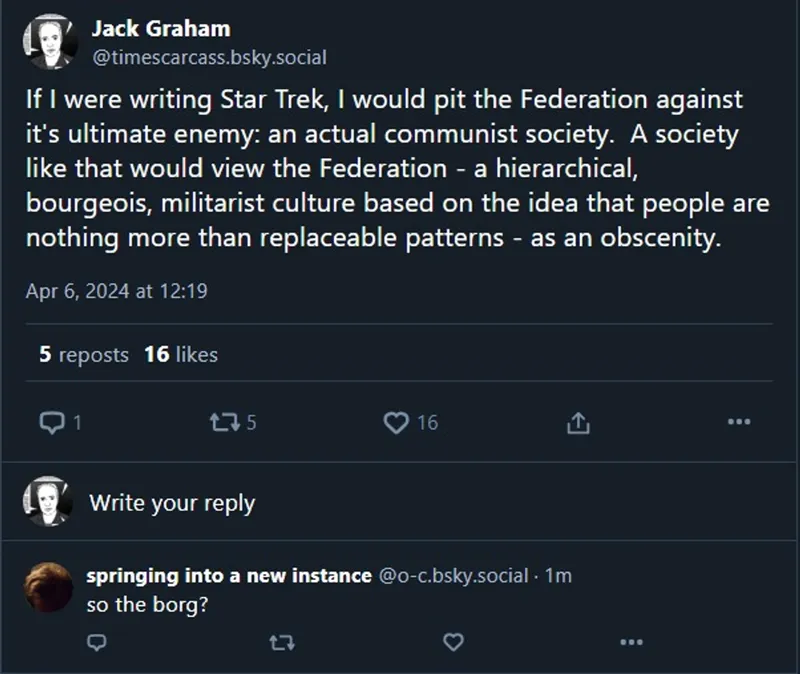
So, the Cybermen are a Soviet version of the same set of associations that make the (Nazi) Daleks tick: namelessness, robotic/cyborg nature, collectivism, 'totalitarianism'. It's initially tempting to simply characterise the Borg as also an expression of the bourgeois liberal horror of collectivism, or of the widespread mainstream idea of collectivism, i.e. of communism. However, the Borg share much the same ambivalence as that already detected in the Cybermen. Indeed, in many ways, they express the same ambivalence much more clearly and completely.
It's actually rather unconvincing to describe the Borg as collectivist monsters in the Soviet sense. Apart from anything else, they appear at the precise moment when the Soviet Union had never looked less collectivist or less threatening. They arose in the immediate post-Cold War era, making their first appearance just before the demolition of the Berlin Wall. The Borg appeared just as communism was crumbling. Glasnost, perestroika, decay, strife, queues for cabbage, branches of McDonalds opening in Moscow... Walls were about to fall. The ‘evil empire’ had never looked more wobbly and vulnerable. The Borg, by contrast, are monolithic, powerful, undefeatable in their first appearance. So, in short, they weren't Russians in 1989.
There is a deep sense of ambivalent confusion embodied within the Borg. While they undoubtedly speak to the horror of collectivism as widely perceived (loss of individual freedom, political tyranny, etc.) they also represent a lurking horror of capitalist rationality, of rationally self interested utility maximisers This is the de facto herd of individual rational actors who are supposed to make up the population in mainstream economics, all of them seeking their own rational self interest and thus giving rise to an unstoppable (and, for the late C20th left/liberal, sometimes destructive) market system. It isn't necessary for us to accept the scandalously absurd descriptions of capitalism offered by mainstream economics to acknowledge that many people do accept them, worry about them, or about what they perceive to be their effects. If our culture doesn't really run on rational self-interest and maximised utility, that doesn't mean that people can't perceive ruthlessly rational self-interest and utility maximisation in the system... and fear them.
The fear of such mentalities usually coincides with an idea that they float freely in a society that is split, but not fundamentally divided on lines of class. Thus, the acceptance of antisocial ideas - or the pushing of rational ideas to antisocial extremes - is something that happens within decentralised pluralities. This liberal fear is of dangerous ideas spreading virally through society. The memetic view of religion pushed by Richard Dawkins is an example, albeit an example of dangerous 'irrationality'... but then, for Dawkins, it is the genes or memes which are the selfish rational actors, not the people who carry them... thus making the people a bit like drones. These kinds of fears are always tied to a fear of the decentralised crowd: the 'mob', in one form or other. Look at the view of consumerism that sees it as a kind of emotional disease which has infected all of 'us'. What is that but a fear of the decentralised crowd, mobilised en masse by a dangerously selfish rationale of consumption? This left/liberal complaint rests upon assumptions based in, or at least supported by, mainstream economics: that the movements of the market are determined on a large scale by the trends created by the small scale rational choices of selfish actors. This very decentralised crowd - an orderly mob - is the personality of the original Borg.
One essential trait of capitalism is the impulse to turn everything into more capitalism. It exists to convert all resources into commodities or productive forces, i.e. to turn everything into capital which then dominates further production, to assimilate everything and convert everything into itself. It is, as Q called the Borg in their debut, "the ultimate user", going after everything it identifies as something it can consume, utilise, transform and make into an image or aspect of itself. You don't have to be a Marxist to notice the ravenousness of the system. Indeed, non-Marxist currents of left/liberal thought in the 90s - often very much the same currents that were working out theories of consumerism - developed this idea further than the moribund, disoriented Marxism that was clinging on (at the extreme margins) at the time. (There is also the left/liberal unease at the Western cultural imperialism, itself piggybacking on neoliberal expansion in new markets... just look at the above image of the McDonalds in Moscow, an emblem of such processes in the 90s. The worry is about the assimilation and homogenization of other cultures. The relevance of this is obvious.)
It isn't necessary to accept as true the notion that the market 'works' because of atomised individuals flocking in formations of rational selfishness, or the details of the attendant left/liberal critique of consumerism, in order to see how these ideas - if accepted - might become a source of anxiety to liberals within a triumphant capitalist world. We can see how such liberal anxieties - about an all-conquering capitalism, newly unrestrained, ravenous and consumerist, fueled by a dangerously selfish form of rationality which supposedly permeates society in a decentralised way - might well manifest as something like the Borg... something unstoppable, ruthlessly utilitarian, utterly self-involved, blankly arrogant, destructive, acquisitive and all-consuming, and manifested as a monolithic force composed of an aggregation of atomised individuals.
Liberalism - particularly C20th Liberalism - has always had the divided character that both supports capitalism, and capitalist notions, as liberating or at least optimal, while at the same time fretting over the imbalances, inequalities and injustices which seem - puzzlingly - always to beset the system. Liberalism in the 90s was uniquely placed to have bad dreams about this contradiction, about the horrors lurking within the best of all possible worlds, precisely because of the seeming final triumph of the 'market system'.
Speaking of liberal bad dreams, just look at the 'Descent' two-parter, which becomes a clunky parable about the rise of fascism (complete with red, white and black banners) by showing the disoriented, individualised Borg spellbound by a charismatic warmonger who offers them unity and purpose. Hands up anyone who spots the contours of the classic liberal interpretation of the rise of Hitler. The bewildered people, dizzy after a catastrophe, become mesmerised by the false promises of a demagogue. Here again, the Borg express liberal anxieties about the faultlines in the capitalist millenium.
The Borg are a nightmare that liberal capitalism had about itself.
This is, of course, why the Borg are a dark mirror held up to the Federation. If the Federation is the ultimate flowering of liberal hopes for capitalism (or, at least, Western liberal modernity) as a liberating, utopian force, then the Borg are the atavistic 'dark side' of the same system, repressed but - in the classic gothic move - returning with a vengeance.
Cyber Gothic
Gothic is, of course, very much the word. It can hardly be a coincidence that, as they evolve, the Borg develop features of previous such liberal nightmares about capitalism.... and that these features make them more and more openly gothic. They acquire the decadence of aristocracy, and with it the traits of vampires. The Borg gradually became the nomadic nosferatus of the Trek universe, spreading their plague with a bite and an infection of the blood. From Star Trek: First Contact onwards (i.e. from the moment they are shown to have a Queen), they are shown to shoot tubes into the neck (often leaving two little puncture marks) and assimilate by pumping Borg nanotech into the veins, which are often seen to ripple and turn greyish green beneath the skin as Borgness (i.e evil) flows into them. They become the Undead, the moment they start being lead by Countess Dracula.
This can hardly be an accident, this confluence of vampirism and aristocratic hierarchy. The greatest C19th Gothic vampire story - Dracula - traded on the disdainful, fearful, insecure, resentful, supercilious inferiority-complex felt by a rising professional middle class for aristocracy, something that Stoker took from the iconoclastic Byron's 'Lord Ruthven' and which ended up getting taken up by C20th vampire pop-culture. The vampire is nowadays quite unpicked from his/her previous semiotic entanglement with aristos, when he/she appears in his/her own person (the semiotic entanglement of female vampires with lesbianism is a whole different essay). Your actual fanged, blood-drinking coffin-sleeper can be an emo youth these days. But when vampirism is subtextually invoked in a disguised form - as in the later Borg - it also tends to bring its blue-blooded baggage with it, albeit in submerged ways. Hence, the Borg get a Queen when they get vampiric. (Of course, the Queen also comes from the bee-hive analogy... which is part of the 'surface level' of the semiotics of the Borg, the thematic meniscus that the writers consciously 'get'.)
Also, as has long been understood, the vampire is connected to fears of monopoly capital vs free trade. What can be more monopolistic than the vampire, converting everyone into copies of itself, threatening to infect the race with its bacillus and reconfigure us all in its own image? The vampire is a nightmarish figure of exponential expansion... to the point where one of the great mid-C20th vampire stories - Richard Matheson's I Am Legend - takes them to their logical extreme and puts them in the majority, their monopoly achieved, the last non-vampire brought to the point where he - the rarest of creatures - will become their folklore. It isn't hard to see that these vampiric traits and significations fit the Borg like a glove. The nightmare of capitalism as the great user, the great converter of everything into itself, becomes - in the liberal imagination - the nightmare of monopoly, restriction, control, all configured in terms of a return of the feudal and aristocratic. The Borg eventually slide perfectly into this set of associations.
As they become vampires, so the Borg drones among them also become zombies. The zombie, initially to do with slavery and imperialism (i.e. as the Haitian black slave reduced to mindless physicality, pure labour), later became transformed by Western horror into being profoundly about things like class and - once again - consumerism. George Romero's Dawn of the Dead makes the zombies (with their grey faces) into mindless consumers of more than just flesh; they become the shambling and clownish denizens of a shopping mall. Again, the Borg absorb the gothic category of the zombie, absorbing also the immanent critique of consumerism, which gained traction in the period after 'the 60s' when the global tide of struggle and protest receded, along with the Black Power movement, etc. The dodgy basis of this critique is, as we've seen, the fear of the decentralised mass of atomised individuals collectively infected with, and ruthlessly acting upon, bad and empty ideas about what will make them happy. As it fits perfectly onto the zombie, so the zombie - now containing this anti-consumerist anxiety - fits perfectly onto the Borg drone. Indeed, the reconfiguration of the Borg as vampire/zombie is an almost inevitable development as soon as the idea of 'assimilation' takes shape. This idea was itself almost inevitable given that the Borg emerged into a world of strong capitalism confronted by weak, disorganised communists... which almost immediately gave way to a post-communist world in which capitalism seemed to have been finally vindicated, to have emerged triumphant, unbeaten and unbeatable, challenged and challengeable no longer. If Dracula was the nightmare that the liberal bourgeois world had about its own systemic terrors in the 1880s, the vampire-Borg are recognisably a version of the same nightmare reshaped in the global political landscape of the 1990s. If the zombies are the insane consumers of the 70s and 80s, the zombie-Borg are their inheritors in the 90s: organised and unbeatable.
Something They Can Consume
The Borg drive to consume, adapt and utilise all technology they come across is also an echo of primitive accumulation, the process by which capitalism assembles the material and materiel it needs in order to function and expand. Capitalism achieved this, most drastically, via enclosures, which gradually brought the land out of feudal forms of ownership and control, and into the new bourgeois forms of property. Attendant upon this process was the steady appropriation of the common lands, and the displacement of millions of people, no longer able to make a living from the land and thus forced into cities, into factories. Proletarianization. Essentially the same process was repeated in the great colonial empires of the C19th-20th, with mass deracination a constant product. Primitive accumulation was also built on the ruthless suppression of women, pushing them into new roles that accompanied the atomised bourgeois family, subjugating unpaid female labour to the reproduction of employable workers (both in terms of the creation of new people and the maintenance of already existing workers, ie husbands who needed feeding). Primitive accumulation reached its horrific apogee in the slave trade, with millions of Africans abducted, traded, bought, sold, dragged in chains to plantations in the 'New World, sold again, and forced into the work upon which the 'New World' was 'opened' to the conquest and expansion of Western capital. The genocide of native peoples in these 'New Worlds' - as in the gradual expansion of the United States across the American West - was a similarly crucial aspect of the rise of the modern capitalist world. The shockwaves of these epochal crimes still reverberate today. Modern sexism and racism are creations of this era, to name only the most obvious such legacies. Capitalism came into the world "dripping from head to foot, from every pore, with blood and dirt" as Marx puts it. If we decide (as I think we should) to see Stalin's Russia as a 'state-capitalist' form, in which a bureaucratic class of managers takes the place of private capitalists but, essentially, still runs a capitalist economy (with wage labour and surplus value) albeit a heavily state-controlled one, then we can see just the same process of primitive accumulation and dispossession taking place when Stalin industrialises Russia. Ironically, the 'failure' of 'communism' thus helps prove Marx's analysis of the nature of capitalism. And the very 'mirror-image' aspect in the relation between Western 'free market' capitalism and Soviet state capitalism... especially for those liberals who, like Chomsky, see Western capitalism as also statist in a different way... is part of how figures like the Cybermen and the Borg develop with these incoherences and ambivalences within them, especially their dual capitalist/collectivist (Soviet) nature.
There are problems with relating the Borg to capitalism, partly engendered by such incoherences. Capitalists are not a collective intelligence, much as they share underlying class interests and allegiances. They are, as Marx put it in Capital vol.3, "hostile brothers", constantly at each other's throats, compelled to competition. Indeed, capitalists have personal interests that are at war with the capitalist class as a whole, let alone their direct competitors. But remember, the idea is not that the Borg correspond directly to capitalism, but that they express ways in which capitalism is perceived, particularly by sections of liberalism. It certainly looks, much of the time, as though capitalists share a single mind, especially when they flock to the same investment opportunities.
But even this hive-minded collectivity can be seen as expressing liberal anxieties about capitalism. It certainly functions as an elision of the nameless, the robotic, the cybernetic and the collectivist... reliant upon the assumption that all alternatives to capitalist freedom lead straight to totalitarianism. But the thing about the collectivism of the Borg is that they collect people as a workforce. To become part of the collective is to become a drone, a worker. In this way, assimilation echoes that proletarianization of humans which took place during primitive accumulation. The Borg appropriate human bodies, acquire an incoherent and heterogenous mass of people, and assemble them into a concentrated mass of drones (i.e. workers), crowded together and cooperating in a factory-like area of technological and industrial production. A hive of activity. This collecting of drones can be read as a retelling of the historical process whereby peasants were forced off the land and into the towns and factories, of how complex social and familial ties were destroyed by the coming of a more atomised (and supposedly more rationalised) society, of how human labour was violently reorganised into massively concentrated and complex sites of industrial or intellectual work (i.e. the factory system, the office). And don't think that the element of compulsion invalidates the analogy. The story of the creation of the proletariat is the story of centuries of ferociously violent and venomous compulsion. Even 'free labour' (ie those other than black people dragged to plantations in chains) found that they had to submit to capitalist wage labour or starve... and if they tried to find 'unlawful' ways to avoid starvation, they found themselves liable to be tortured and murdered by the state. For centuries, anyone considered to be resisting the drive to the assimilation of all workers - ie tramps, bandits, beggers, those who clung to the forest or the land, those who refused in any way the imperatives of working for the new system - were considered objects of terror and evil, whipped and beaten into line, or executed. There was a lot of this, because the transition to wage labour was bitterly resented and resisted. It still is, in every place where it continues today as neoliberalism restructures the world. But there is no alternative. The "archaic culture" (to use Borg phraseology) of the pre-capitalist world was "authority-driven" by God and Church and King, Headman and kin-group, season and harvest and tide... but the new culture smashes all such distinctions, all such old ways. (Of course, capitalism is authority-driven in different ways... but then so do the Borg prove to be.) All that is solid melts into air. The culture of the people must adapt to service the capitalist system. Freedom is irrelevant. The worker, separated from the land and thus from any way of producing the means of life for him/herself, has the freedom to work or starve. Death is irrelevant, since the workers are an amorphous mass of 'hands', each instantly replaceable. And, as we've seen, capital spread across the globe. From 1989-onwards, it really looked as if there was no way left for anyone, anywhere to resist it. Resistance is futile.
Even as some of the anxieties the Borg express rest upon a classless view of society, formed of a decentralised 'mob' (one way of seeing the uniform Borg), so other anxieties they express rest upon a deep awareness of the reality (and potential threat) of the working class. This shouldn't surprise us. The gothic has never been internally consistent; indeed, part of its unique power is its ability to allow dialectical oscillations of meaning within single signs. The 'assembledness' of the Borg, mirroring the same assembledness of the proletariat, is deeply gothic, in that a very similar thing occurs in Frankenstein. The monster is a proletarian monster, assembled just as surely as the proletariat was assembled, a collective whole constructed from heterogenous parts artificially brought together in the process of production, made from the assembled fragments of the poor (the kinds of people who were dug up by grave robbers and sold, on the C18/19th 'corpse economy' to anatomists). Maybe some of the paupers who furnished Victor Frankenstein with parts were hanged for 'crimes' that amounted to violations of private property, or refusal to meekly accept entry into the wage labour system (see above). To quote Moretti:
Like the proletariat, the monster is denied a name and an individuality. He is the Frankenstein monster; he belongs wholly to his creator (just as one can speak of 'a Ford worker'). Like the proletariat, he is a collective and artificial creature.
Denied a name and individuality, the assimilated person is a Borg drone, like 'a Ford worker'. Collective; in the capitalist workplace, quite different to pre-capitalist forms of collectivity from which the proletariat were drawn. Literally collective, in the case of the Borg, but also bodily concentrated, like the proletariat, in a totally 'rationalised' space. Artificial; a new class, surrounded and dominated by machinery (ie capital). Literally artificial in the case of the Borg; a newly synthesised race, surrounded and penetrated by technology (ie capital).
So, once again, the Borg express liberal anxiety over capitalism. Once again, the anxiety is ambivalent. And, once again, the anxiety is both relevant to the 90s context and a reiteration of older liberal anxieties. The faceless, mindless, collective entity: the mob. Engulfed in the horror of labour under capitalism. To be pitied. Also to be feared. This ties directly in with the faultlines in the Godwinian liberalism with which Frankenstein is soaked (Godwin was Mary Shelley's father). Godwin's Political Justice and Caleb Williams demanded democratic reform, and savagely criticised injustice and inequality, but recommended fireside chats with educated people as the only form of agitation. He begged Shelley not to get drawn into organisation among the proletariat themselves, saying "Shelley, you are preparing a scene of blood!". Mary's monster is many things, but among these he is the terrifying threat of the monstrous proletariat, back for revenge for the way he has been abused and mistreated. Also, remember the fear that makes Frankenstein finally and irrevocably reject his creature: the fear that, by making him a mate, he will allow this new race to breed, expand and cover the world. Conversion and monopoly again. As noted, there is ambivalence and incoherence embedded in the Borg, and it's deeply gothic. The liberal terror at capitalist monopoly, expressed by the vampire, has a flipside in the liberal terror at proletarian takeover, expressed by Frankenstein's monster. The Borg reiterate both. In so doing, they express perhaps a submerged fear of the 90s liberal: that he faces either the eternal, capitalist 'end of history' (an unstoppable juggernaut) or, in the absence of Soviet style communism as a domineering force on the left, some new and unknown and uncontrollable way in which the disavowed and repressed underlings of the world will return to express their displeasure. The Borg become the system, and its own internal gravediggers, in one.
Voodoo Economics
Another aspect of both the Cybermen and the Borg is their basis in fears of bodily mutilation. From the start, the Cybermen threaten to physically invade the humans. Becoming like them implicitly involves the cutting-up and dismemberment of the human body. And this dismemberment, this invasion of the body by technology, is linked to work. Both 'The Tenth Planet' and 'Earthshock' show remnants of the physical body (hands and jaws) still integrated into the machinery. 'Attack of the Cybermen' has Bates and Stratton (and the other rejected subjects the Cybermen use as slave labour, pure working meat), with their arms (the things they work with) replaced with cyber technology. The Cybermen started with Toberman's arms too. He was also a slave, remember? Lytton ends up being the only human we see in the process of conversion in the classic series. Again, the Cybermen have made the arms a priority. On the whole, however, the suggestive emphasis on arms notwithstanding, Doctor Who never made as much as it could've done from the horror of Cyber-conversion, despite such things being very much in the wheelhouse of Eric Saward at just the time when SF/Horror cinema started concentrating on the meshing of the body and the machine.
This penetration of the body by the machine is explored far more thoroughly by the Borg in the various Star Trek franchises. The Borg episodes, and the movie, repeatedly focus on machinery that infibulates and conjoins with the body. We see cables plugged directly into head sockets (very 90s, via Cyberpunk) and various body parts removed and replaced by technological appendages. As noted, the Borg insert tubials into their victims and inject their essence, causing the skin to turn zombie-grey. Indeed, the Borg adopt something that is only obliquely hinted at with regards to the Cybermen: cellular bio-mechanics, ie nanobots that restructure the body on a cellular level, and which allow technology to grow and sprout and breed like an organism. This is all deeply connected with perennial fears generated by capitalist modernity: the fear of bodily invasion and mutilation.
David McNally's brilliant book - Monsters of the Market - states and explores this topic in greater detail (and if you find what I'm saying here interesting then you should totes go and read McNally because I'm getting tonnes of it from him). Pared right down to the bone, the idea is that capitalism not only disciplines and punishes the body of the worker (see above), it also breaks up her life experience, dividing labour, subjecting her to the rigours of a new kind of measured and organised time, dissecting her life into sections of work (whether at home or 'at work'... because home isn't a workplace, oh ho no). There is, for instance, the working day, and then the various subdivisions of the day. The day is made up of "dead time", when the worker must labour for the capitalist to make her wage. This is the alienation of life activity from the worker, just as the products of her labour are alienated from her control. The result is that the workers experience working life as a kind of living death. The intersection of dissected life and dead time finds literal expression in the "corpse economy", ie the punishment of proletarian bodies even after death in the dissection halls of the ruling class, often via the theft of bodies by 'resurrectionists' and their sale to anatomists. This was fiercely resisted by the London crowd of the C18/19th (that ever-present mob of bourgeois nightmare) at public executions, when riots would break out as people attempted to stop the bodies of the pauper criminals being handed over for further, posthumous, punishment. The cultural expression of all this is in tales of evisceration, dismemberment and anatomisation... and in the various nightmares of capitalist modernity which centre upon terror of (and terror of becoming) the living dead. It stretches right back from that evening in 1816 when Frankenstein and the Vampyre were simultaneously born, right up to today as we swim in a cultural sea of zombies.
Again, it isn't hard to see how the Cybermen and the Borg tie into this. If, as I've tried to show, both (most explicitly and clearly the Borg) are totally products of liberal anxieties about capitalism (as both unstoppable system and generator of the terrifying mob) then the mutilation fantasy implicit in both can be interpreted in light of McNally's ideas. Capital not only surrounds and controls the worker, embedding the worker within technology and the factory and the office, etc., it also penetrates the worker physically, looms over the worker as a force that historically and potentially violates/punishes the working body. The product of this violent interpenetration is the creation of an army of the walking dead.
This is all gothic, you see. It's gothic all the way down. Listen to the language we're compelled to use. It's the language of death. Gravediggers, vampires, Frankenstein's monster, zombies. The Cybermen are steeped in it too. Think of their first appearance, wrapped in bandages like mummies, their white faces skull-like with their big round empty eye sockets and their inexpressive straight mouths. Think of their appropriation of the cursed-Egyptian-tomb narrative in 'Tomb of the Cybermen'. As I've noted in the past, whatever its flaws, 'Attack of the Cybermen' is probably the best Cyberman tale of the 80s because it remembers that the Cybermen are bodily imperialists who convert you into a zombie... and also because it seems more in tune with wider society than other later-Cyberman tales. It hooks into the decade of Thatcher, with its smash 'n' grab crooks run by a suave pinstriped businessman (Lytton), and its decidedly more anxious post-Falklands approach to militarism than 'Earthshock' manages (depicting the Cybermen as military conquerors of the native Cryons). It's better, if still pretty weak. But at least it reconnects the Cybermen with work, bodily mutilation and economic factors.
Zombie Capital
The Cybermen never quite attain the clarity and force of the Borg, precisely because of the different circumstances of their production (I mean, their TV production) which means that, once they're out of the 60s, they never again hook directly into the anxieties of their age the way the Borg do. Indeed, the Cybermen have lots more decades to try covering than the Borg did. Born into the post-Cold War world, the Borg had a field of distinct cultural anxieties to connect with... and, in many ways, they manage it. The Cybermen are a product of the 60s. Alongside those left/liberal anxieties about the self-interested rational actor that we mentioned earlier (expressed by the Cybermen as "logic"), they are also born from worries about the "white heat of the technological revolution", about ‘technocratization’ (not least, of the Labour Party), about computerization, about the ambivalent potentialities of new tech that (50 years on from Wilson's speech) has indeed proved to have deeply ambivalent legacies. This was the postwar boom world, worrying about exactly what kind of utopia was going to be built, given that it was ostensibly going to be built by exactly the same kind of scientific instrumentalism that also built Auschwitz and Hiroshima. You might be tempted to bring up the word Luddite... but, of course, the Luddites were fighting the dispossession and disenfranchisement brought by just such ambivalent new technology. And Luddism is a profound inflection within Frankenstein; not in the crude sense of worry about 'the dangers of science' and 'playing god' (the mainstream philistine view of the book) but in the sense of worry about the failure of the Enlightenment project, of modernity itself, in the face of social injustice. None of which is to say that the Cybermen don't contain some pretty reactionary anxieties about the future of technology... not least their Soviet inflection.
This incoherence and ambivalence - found within the Cybermen and Borg - expresses the liberal anxiety over the splits in society (fundamentally, we're talking about class), and the desire to heal them, to resolve them. The splits are forced together into one (splitless; classless) form, a monolithic threat that must be destroyed... and yet, when destroyed, the monolith becomes a great mass of equally-threatening rubble within which totalitarianism will plot against democracy (cf 'Descent'). So even the liberal fear of 'extremism', unleashed by any challenge to the system, finds expression in the Borg. There is something about the splits that always adapts to any attempt (within Liberalism) to contain or eradicate it. Parenthetically, this may be way the concept of 'adaptation' is so central to the Borg threat, with their seemingly endless ability to adapt to new assaults (while also, of course, hinting at unease about the constant revolutionising of production... something hinted at in the evolution of the Cybermen and their latter-day concept of the "upgrade").
We know that the years since the recession have produced a slew of zombies. Indeed, Time Magazine called zombies "the official monster of the recession", and there's been lots of talk about "zombie banks" and "zombie economies" and "zombie capitalism". The economy continues after its death. As noted, the zombie has, in the past, stood for rather conceptually dodgy ideas about consumerism run amok... which has an obvious relevance to the credit crunch, if a superficial one that tends to blame the victims. But, as also noted, the zombie was also an expression of horror at slavery, at the reduction of the worker to labouring meat. (There is, by the way, a resurgence of zombie tales in those parts of Africa being restructured and socially demolished by neoliberalism... including Nigeria. See McNally, again, for details.) In zombie cinema, the zombie runs riot and smashes up the world. And, if the world as it stands is not to your liking (if, for example, you're not a fan of long recession, zombie neoliberalism, imperialism, genocide, austerity, corporate rule, drastic inequality, climate catastrophe, and resurrected fascism), there is pleasure to be taken in this spectacle, this violent carnival. The zombie is the faceless, mindless, proletarian mob of bourgeois nightmare, in open urban rebellion.
Which we could do with, to be honest.
*
It's only fair to acknowledge that this post is deeply indebted to the work of Franco Moretti and David McNally... indeed, any genuine insights here are almost certainly theirs; I've just adapted them to my topic. It's also necessary to stress that I diverge from them in my own directions, that I fail to do their ideas justice above, and that any consequent errors are entirely my own.
Comments (1)
Great piece, really gives the social conditions of the construction of various "totalitarian" sci-fi goes its due diligence.