

From Concept to Creature: Forest Dragon
Table of contents
Meet the Artist: Magdalena Meronk
Forest Dragon Design Process
...And if you want to add Adult Forest Dragon to your collection...
Meet the Artist: Magdalena Meronk
Magdalena Meronk is a master creature sculptor at The Printing Goes Ever On, specializing in beasts, monsters, and fantastical creatures of all shapes and sizes. A self-proclaimed dragon freak, she’s always looking for a fresh twist on her favorite subject - grounding each design in a mix of believable biology, environment, and just the right amount of magic.
What does it take to turn an idea into a creature that feels alive?
We sit down with sculptor Magdalena to explore the creative process behind her latest creature design, the Forest Dragon. From real-world animal anatomy and evolutionary adaptations to movement, camouflage, and storytelling, Magdalena takes us behind the scenes of developing a creature where every detail has a purpose.
Join us as we uncover the ideas, inspirations, and design decisions that shaped this silent guardian of the forest!
Forest Dragon Design Process
Can you tell us about the Forest Dragon and the main idea behind the design?
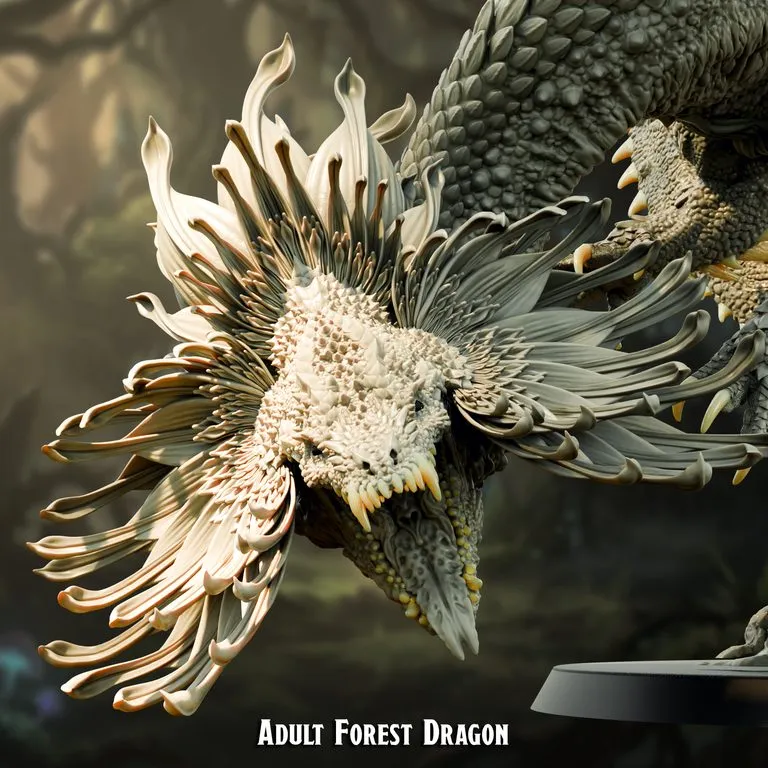
The main idea was to explore how a forest environment could shape a dragon’s anatomy and behavior. I wanted to create something different from the traditional flying dragon, more of a silent hunter that feels completely adapted to the forest, almost like its guardian.
What inspired the head design?
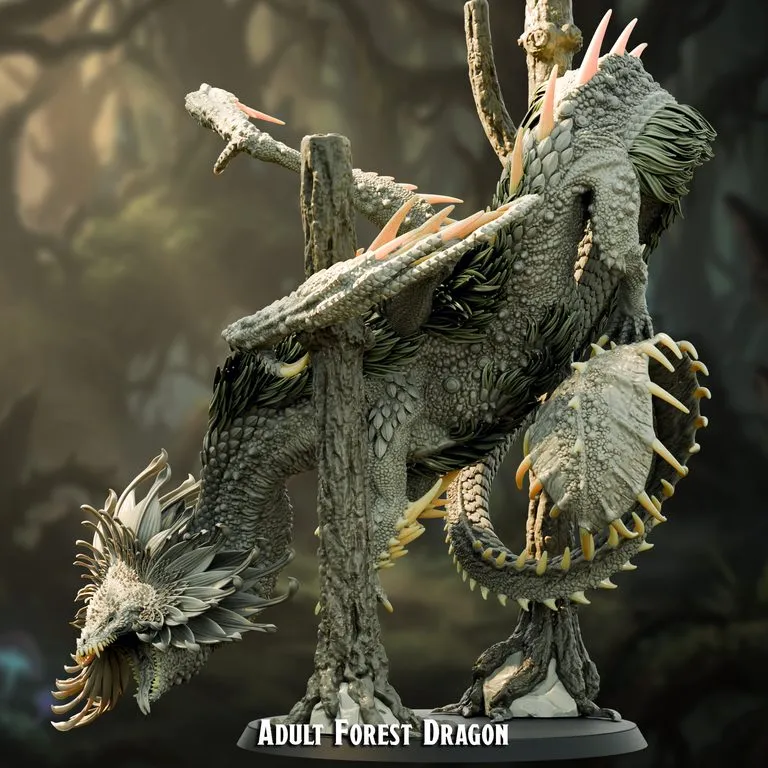
I took a lot of inspiration from real animals. The mouth is based on crocodilian anatomy, especially the teeth and overall geometry, but I wanted to contrast that aggressive shape with this large flower-like structure on the head.
The flower actually has several functions. It can lure prey with its bright colors, help with camouflage, or be used as a mating display. The dragon can also fold and expand it. When fully opened, it makes the creature appear much larger and more threatening, similar to the defensive display of a frilled lizard.
Movement seems to be an important part of the design as well.
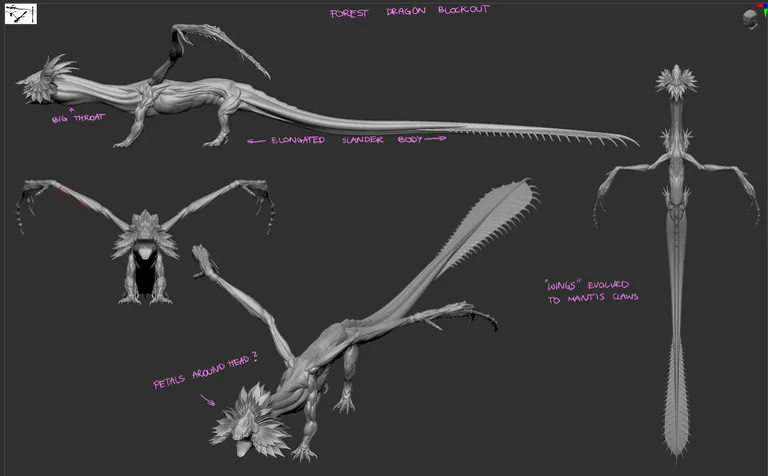
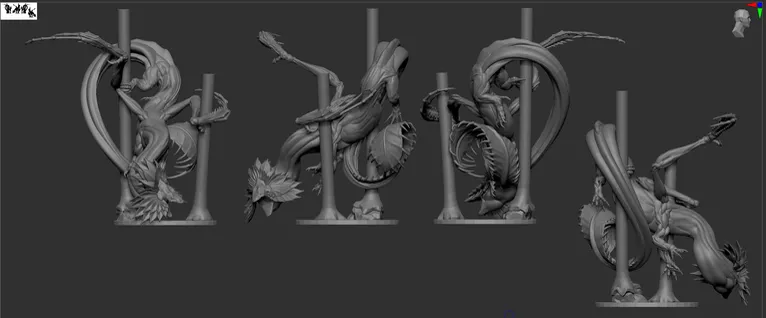
Definitely. I wanted the body to feel long and very flexible. The main inspiration was wind moving through the forest canopy and flowing between branches. That idea influenced both the anatomy and the way I wanted to pose the creature – it shouldn’t feel heavy or rigid, but almost like it’s flowing through the trees.
The dragon doesn’t have traditional wings. Why did you make that choice?
I wanted to imagine what could happen if a dragon evolved in an environment where flying became less important than climbing.
Over time, this species lost the large wing membranes, while the remaining limbs became stronger. The hand and finger bones fused into mantis-like gripping limbs that help the dragon move silently between trunks and branches.
This also keeps its primary front limbs free, so it can quickly grab prey while the modified wing-limbs support its movement through the canopy.
How did you adapt the rest of the anatomy for climbing?
The hind legs have powerful gripping feet with opposable digits inspired by chameleons. They give the dragon a very secure hold on branches and tree trunks.
The tail is prehensile as well, so it works almost like another climbing limb. It can anchor the dragon while moving or sleeping high in the trees. The broad fan at the end also has a hunting function – it can help restrain prey until the dragon’s toxin causes paralysis. The tail can even wrap around the body for additional protection from bad weather.
How does camouflage work for such a large creature?
Instead of relying only on color, I wanted the camouflage to physically become part of the dragon.
Its enlarged dorsal scales collect soil and organic matter, creating small areas where moss, lichens, grasses, and other plants can actually grow. This helps break up the dragon’s silhouette when it’s resting or sleeping.
It also means every individual can look slightly different depending on where it lives and what kind of vegetation grows on its body. Even the geometry of the scales is inspired by coniferous forest floors and tree bark.
What ties all of these elements together for you?
For me, it’s the idea that every feature should feel like a response to the environment rather than just decoration. The flower, modified wings, gripping feet, tail, body shape, and living camouflage all serve a purpose.
I wanted the final creature to feel like something that doesn’t simply live in the forest – it has evolved to become part of it.
How would you describe the design in three words?
Beauty. Nature. Silence.
We hope you enjoyed this glimpse into Magdalena’s creative process and the thinking behind the sculpture. Would you like to read more artist interviews or behind-the-scenes insights?
Let us know your opinion – we are waiting for you in the Discord server!
...And if you want to add Adult Forest Dragon to your collection...
Adult Forest Dragon is available exclusively to collectors of the whole Courts of Gwynavir Season.
Missed a month?
Here is how to become eligible to receive the dragon:
Step 1.
Join the Combined Tier here (BEST VALUE) if you haven't yet. This grants you access to September’s bundle.
Step 2.
Then apply the 70% newcomer discount to get the August bundle (code found here):
Courts of Gwynavir – Part 2 – The Wild Hunt - Complete Bundle
Step 3.
Use your automatic member discount code to get the July bundle:
Courts of Gwynavir – Part 1 – The Bright Court - Complete Bundle
Step 4.
You will receive the dragon file at the end of the month in the second distribution wave.
(Already have it all? Check your Evervault Library - the file is waiting for you!)