
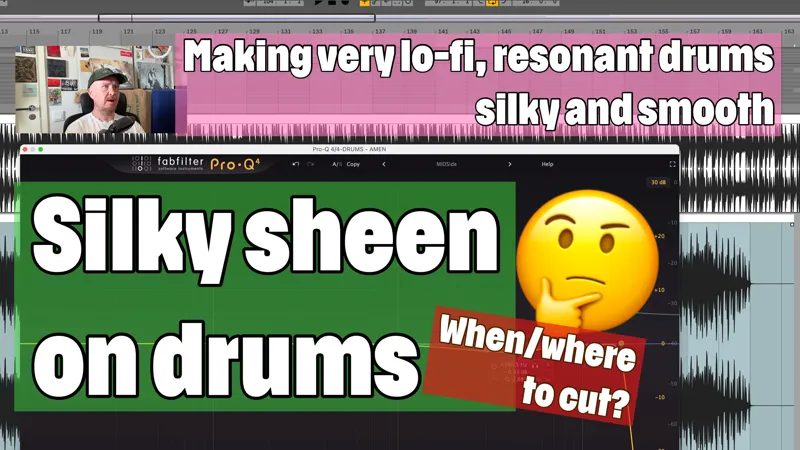

Creating silky tops on drums (+ potential downside)
One thing I always like to do in my mixes and masters is open up the top end for that contemporary silky sheen. If you've heard my mixes/masters (a curated portfolio HERE), you know what I mean.
Where to boost and where to cut and why?
I wanted to cover that. Once again, good audio is often somewhat simple, and no expensive 3rd party plugins are not needed most of the time (while some can help, but it's good to understand the basics and handle it all manually, as shown on the video).
But you'll also hear a scenario where I ended up recently where the highs of a snare affect the whole master. Hear and see how I treated it and how it affects the punch. Learn something every day, still, myself. Never been there before, and I've seen and heard a lot, but this was a good takeaway for myself, too.
Join me for yet another tutorial to pimp your audio engineering toolbox.
Enjoy 100 mix/master posts in the Mixing & Mastering collection - phew, it's a lot. If that won't improve your mixes and masters, I will eat my shorts!
PS: I wanted to address a rule I hear sometimes, "Never boost - only cut" as a bonus.
Sometimes people throw around that rule: "Never boost, only cut."
I think that's just another useless blanket statement, very briefly put, that is just confusing.
If my bass needs a bit more 60 Hz, I will boost it.
If I need more highs like in this video? I will boost it.
You'd just overcomplicate things by cutting in those scenarios.
But as this video proves, both have their place.
Comments (6)
Do you recommend this treatment on the tops group, or individual channels/loops?
Can work on anything: sometimes I even wiggle it on master!
How do you treat breaks that don't really have much information up there to boost?
That's a great Q. I'm no stranger these days to layering drums: a lot of times I use the 808 hat for hihats, for example, and I've even used it on snares. There's tools like Shaperbox that react dynamically on the signal, which can inject a bit of white noise on drums, which can work surprisingly well. There's also a tool called Fosfat by Klevgrand that aims to do a similar thing that I've used a few times.
What's the reason for boosting just the mid instead of doing stereo on Pro-Q? I've noticed you doing it on other videos with EQ as well but couldn't find it explained anywhere. Great vid as always
I don’t like the tops on sides (just like transients): never liked it there.