

10 golden rules for a dynamic, loud mix + master
Over the years, I've had a few hard rules in my productions and engineering, which have helped me tremendously with my sound, which is punchy, clear, rich, bassy, and loud.
I know there's a whole lot of info and advice thrown around online these days, and it can be confusing to many - and also very detrimental to one's mix and master, and I hear it all the time.
I'll give you these tips on what to do and what to avoid, and I guarantee these will help.
I am constantly being asked about some of these things, so in the future I can refer people to this one. I've talked about some of these before, but I felt I need one heavy-hitter that combines my most important stuff into one, and here it is.
None of this is genre-specific: applies to all styles of bassy electronic music (DNB, tech house etc).
Let's get a few hard facts straight and have your song bang a bit better!
📝 CHECKLIST:
I will update this by each episode, so it will be a ten-point list in the end!
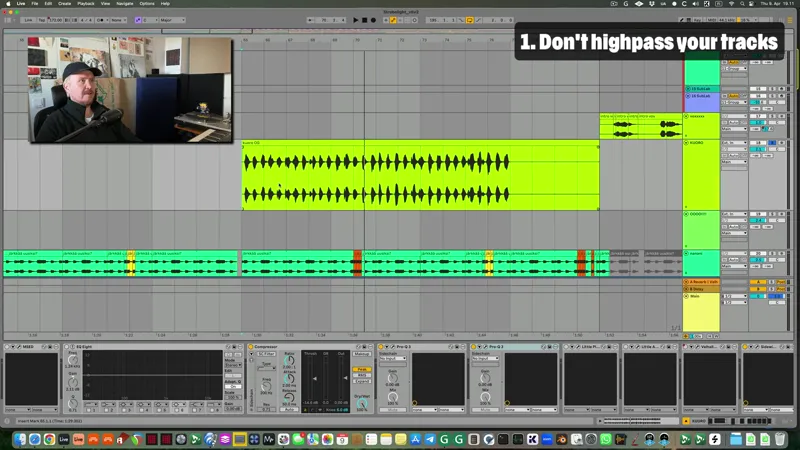
1. Do not highpass your tracks.
Be a critical mixer. Your precise mixing mindset starts (or stops…) here.
If you have excess lows on a sound, use a bell node in isolation mode to find the stuff you think is too heavy, and dip there.
This makes you a more critical mixer. Instead of approximation, you will cut exactly the amount that matters, where it matters.
2. Do not clip things.
Quite honestly, as popular this is…this is quite unnecessary. I don't clip things.
There is nothing to gain. Clipping creates distortion and hurts dynamics. Most of the time it is not needed.
Clipping the master especially creates intermodulation distortion and sounds like garbage. Puke.
3. Limit your bass bus.
Bass is one of the elements that hits your master limiter hard.
It makes sense to limit your bass bus by around 3 dB with any stock limiter, as it takes away stress from your master limiters. You will get no audible change doing this (do on/off and listen).
Do not clip the bass: you'll get distortion easily. Ewww.
4. Use two limiters for your master instead of one.
Simply, sharing the heavy lifting between two instances always gives your nicer end result than one. If you get distortion, try and make the limiter a bit slower, make sure there's not too much bass on your kick or bassline, try and slightly compress the subs of the master, etc.
5. Get your sub right.
In SPAN, have that overall sub hit that -30 line and you know you'll be in the ballpark.
Make it hit roughly 45-65 Hz to get the ideal pressure and weight.
6. Kick/bass sidechain.
I usually don't like audible pump, but it's important to me to duck the lows of the kick on the bass. Soothe 2 is great for this.
7. Loudness is a combination of several things.
Don't be too hung up on the loudness number.
A minimal song often cannot hit the same LUFS as a more dense song.
If you try and push the LUFS of a minimal song to that of a more thick mix, you may be chasing it the wrong way.
It's what's in the dough that makes it big, not just the master push.
8. Get drums levels right.
Kick is usually the loudest element, looking at meters in your DAW.
Snare and bass usually sit slightly below it.
9. Celebrate the 1K range (give or take).
It's great for the power and body of almost all elements in the mix, and a lot of the "audible" range is here: not low enough to be boomy (500 and below) and not too high to be resonant (2-6K)
10. Embrace level automation.
This way you can hone levels as you wish, without compression.
Remember: an elements doesn't have to stay at the same level throughout the whole song.
This is for a more dynamic vibe.
Got a clap in a drumloop that's too loud? Automate its level down instead of compressing (which may change the tone, take the hihat up etc, creating further issues).
BONUS MYTHBUSTING: Premaster has to hit -6?
No, not really. Everyone repeats this like a mantra. There is no real rule behind this.
Sure, headroom is fine - actually any headroom is. Could be -1 or -10.
Why? Any engineer worth their salt can level the premaster.
If your engineer is insisting on -6, you should 1) ask why and then 2) sack the person, because hanging on to imaginary numbers without being to explain it without facts is just silly.
💡 Let's do some creative breakbeat stuff soon 🥁
Breakbeat of the month is way overdue…soon!
Comments (20)
Thank you so much! I’ve been producing music since I was 15 years old. I watched countless YouTube videos and taught myself everything from scratch. I’m 23 now, and after watching your videos, I mixed and mastered a track last night. Honestly, it’s the best mix and master I’ve ever made — all because of your tips. I literally have goosebumps while writing this right now. You’ve helped me so much and made me incredibly happy. To be honest, gain staging is such a powerful tool. When you gain-stage your song properly, it makes an unbelievable difference. I used to put a low cut on almost everything simply because that’s what people on the internet told me to do. The same goes for automatically putting a clipper on the master without really understanding why. Your videos helped me understand what I’m actually doing instead of just following random rules. Thank you so much for sharing your knowledge!
Wow, thanks so much for letting me know. I appreciate you! 👊🏻
How do you get your sub to hit at -30 what plugins do you use for it? I’m sitting around -35 - -40 an km dialing in parallel compression and saturation to get more volume
Simply just level or EQ the bass 🎚️👌🏻
Clipping has been a thing in my workflow for years, started after a Ed rush interview where he was clipping his drums in sound forge before sending to his samplers “ to get rid of the pokey bits” I’ve learned my lessons with clipping bass, and clipping my master, but I’m curious on the use of soft clipping drums. In theory it wouldn’t create as much grossness. Whats your thoughts on soft clippers?
I don't use it much :P My master limiters deal with "the pokey bits" that don't necessarily cause much harm tbh. I think a lot of ppl clip things they see while they (pokey bits) don't really pose any real challenge.
Speaking of levels - the kick is usually the loudest, but when the kick and snare/clap hit together, that combination often hits the limiter first. I’ve seen tutorials where they offset the snare transient by 1–2 ms before or after the kick, or even group the kick and clap/snare and lightly limit the group. What’s your approach to this?
I rarely have any trouble while not nudging the snare (or bass) but it is a fact that when one element is nudged, the total power combo is a bit less. I always limit the bass by 2-3 dB, and sometimes gently limit the kick and/or clap - I rarely nudge them myself.
Top level info 💯 Do you ever use "summing" plugins on channels/ groups? Like slate's vcc, waves nls etc
thank you! Not really, but been meaning to try out Waves NLS as ive heard a lot of good about it, and I understand it offers a few different models, so should be worth the try. I know Jaycen Joshua uses it heavily.
I've noticed that sidechaining every element to the kick brings in a lot of pumping - on the other hand the master limiting distorts much earlier when its not sidechained. How do you deal with that?
I only sidechain the subs of the bass to the kick - not anything else. I don't like pumping in general. I think I mentioned on the video what to look for if it distorts, in the limiter context.
On the subject of drum levels– when I'm mixing down a track, my clap/snare is frequently sitting a little above my kick. If I bring the clap/snare down it get's buried in the mix. If I bring the kick up it throws off the whole mix. I've tried things like adding more saturation, or transient shaping to the clap/snare, or EQing it differently. None of these seem to really help– any pointers on this?
If it sounds right and is true to your style, that's fine. Peak-based readings _can_ be slightly misleading in a way, for example, if the transient is very sharp and boosted.
I’m currently working on a tune where there’s a lot of filter movement on sounds, and getting the filter settings (frequency/resonance/drive) just right so the sound retains the character I want is a process. I’m seeing in real time why using a high pass is imprecise 😄 I wanted to ask if there was anything you usually did alongside filtering (EQ/Soothe after) to make sure the only things standing out are what you want, and nothing gets too resonant or boxy? Is the other piece of the puzzle making sure other song elements make space for whatever is taking the lead for that section?
Technically resonant filters are supposed to sound resonant. I do sometimes use Soothe if the resonance is too sharp (or just lessen it in the filter). And I do use dynamic EQs to establish a bit of "hierarchy" between sounds in the mix quite often.
Love this, thanks for the breakdown. You've convinced me recently to stop clipping my master and move to a limiter instead. Will implement the "use a bell for low cuts not a full cut" next. Glad to hear I've been using SPAN correctly to dial in my sub.
Yeah nobody wants that intermodulation distortion! 🚫
So no clippers on claps & hats either? So when they feel harsh or spiky just edit volume, eqing, transiet shaping or deessing? thx!
The harsh spiky stuff you _hear_ is not what a clipper would tame! Harshness is often EQ work.