
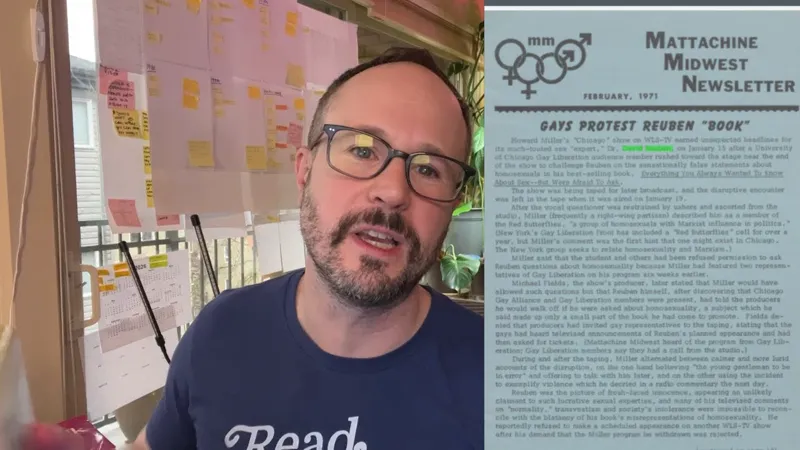
Bonus! The myths, mistakes, and measured ideas in a 70s-era book about homosexuals
Last week we looked at the hilarious wrongness of the book Everything You Always Wanted to Know About Sex but Were Afraid to Ask, and this week we're looking at another 1970s publication with a catchy title: GAY. That's it, that's the title. This one actually manages to get things right ... at least, some of the time. So, how do our modern ideas about the gays compare to the ideas in GAY?
Here's a backup link to this week's video: https://youtu.be/tzOiKuMyqww
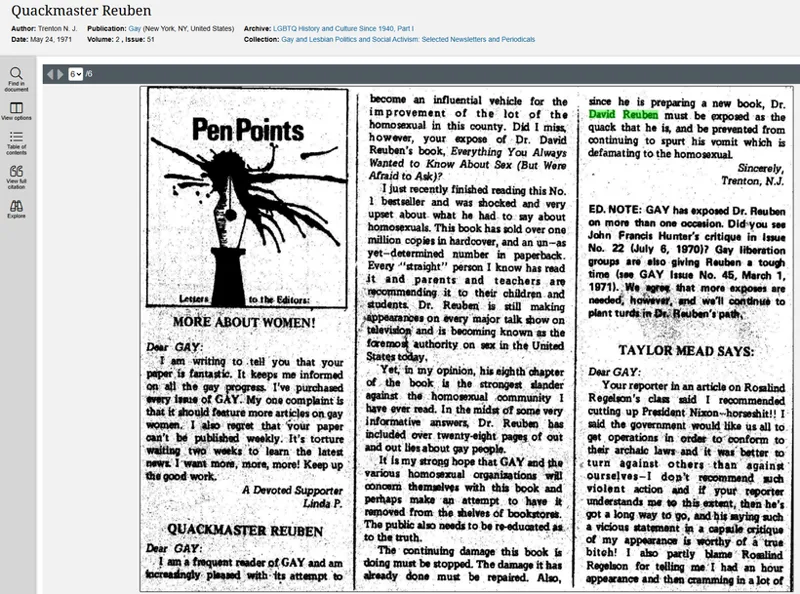
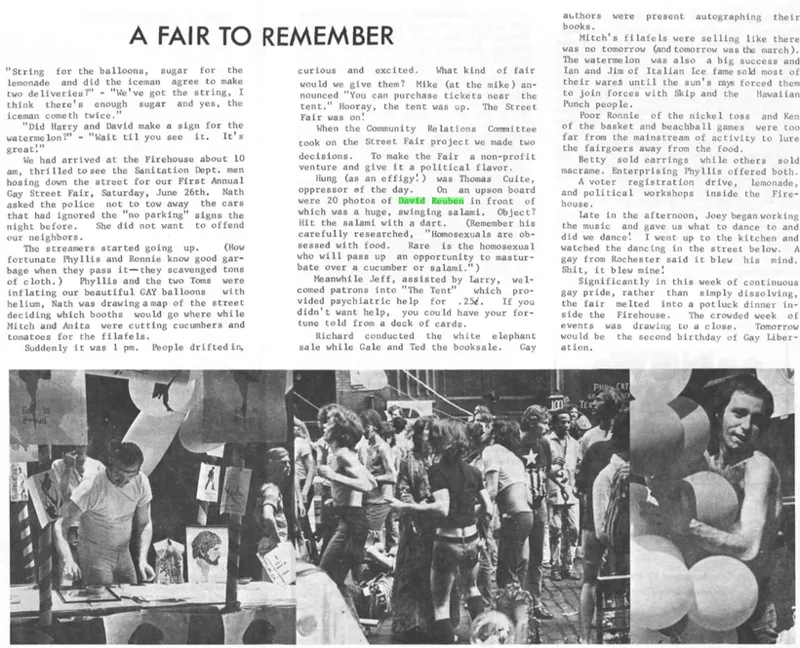
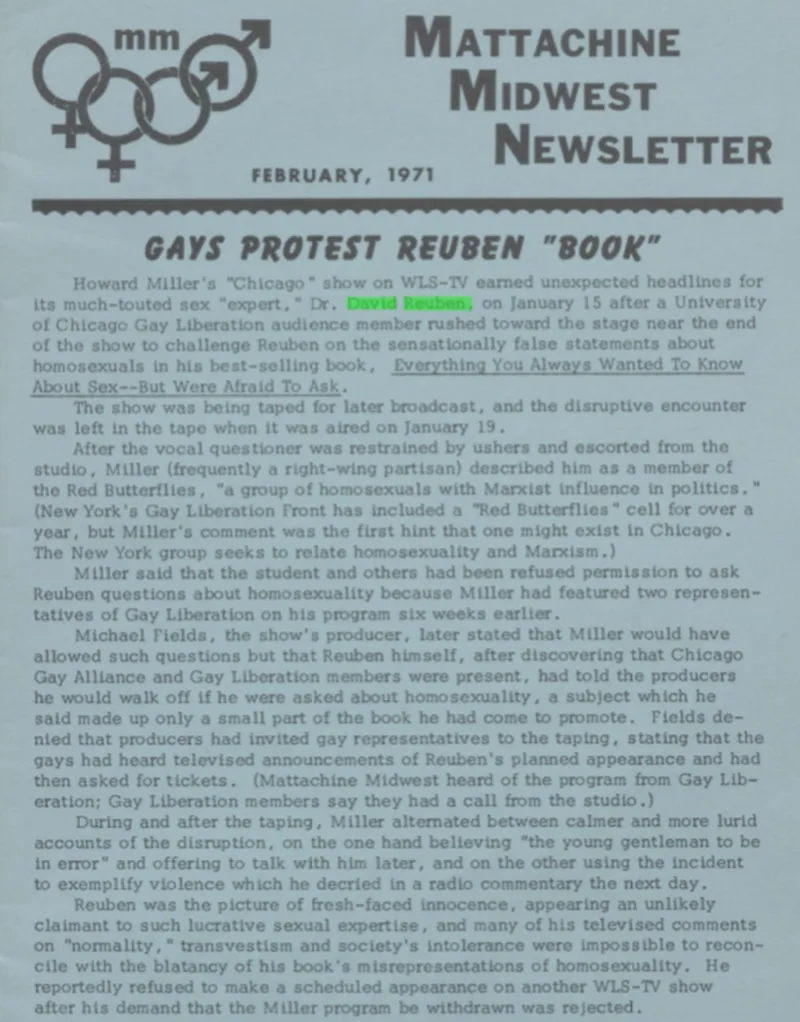
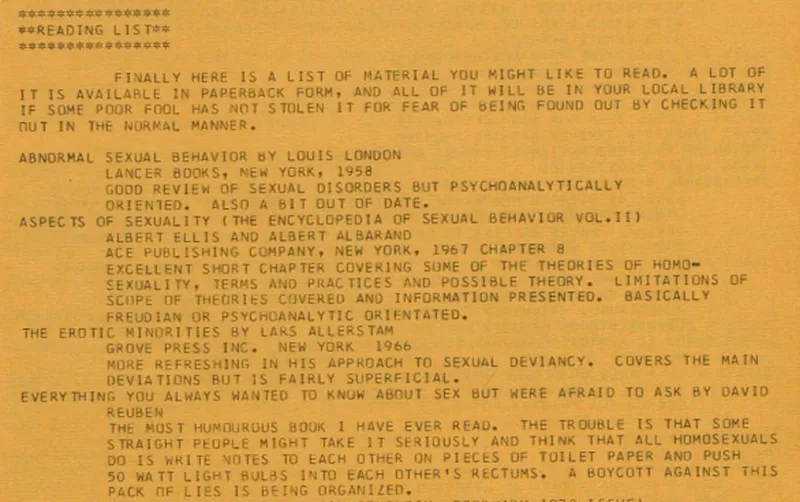
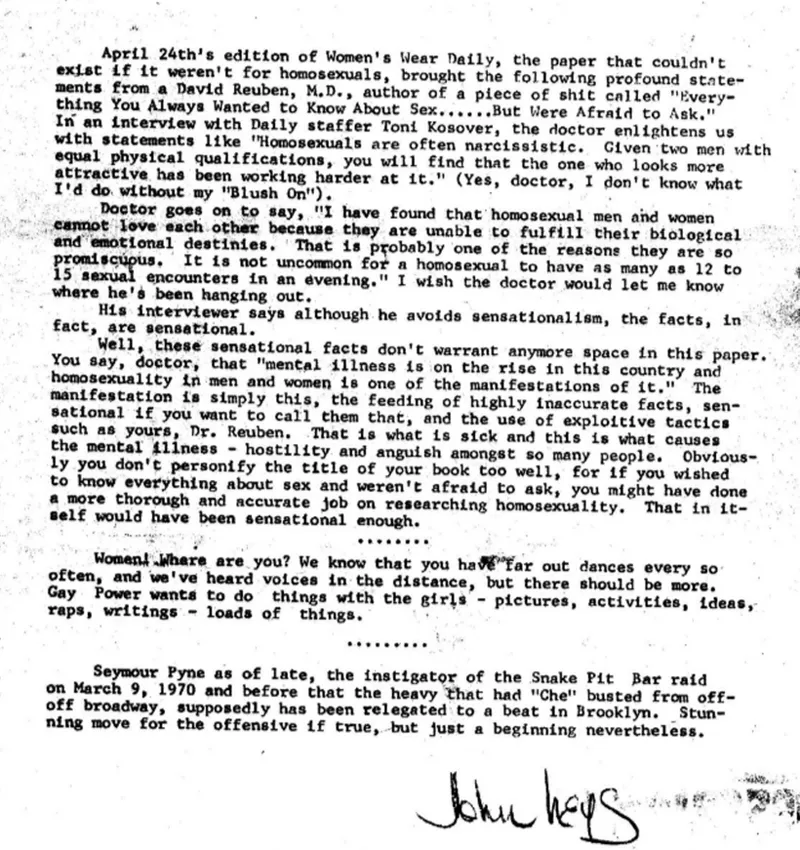
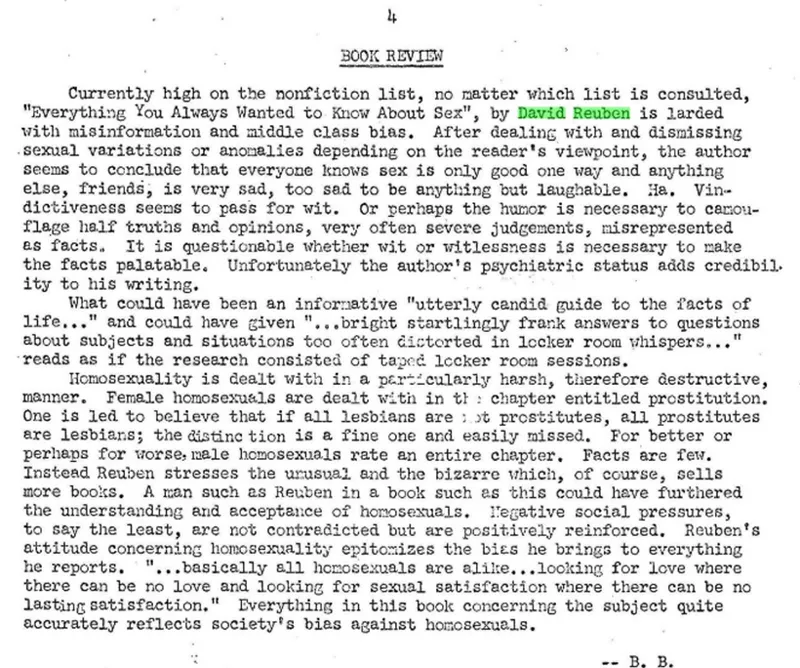
And here are some screengrabs of how queer people responded to David Reuben's book back in the 70s:
Bonus! The myths, mistakes, and measured ideas in a 70s-era book about homosexuals (YouTube)
Comments (6)
Aaand for a bit of extra context, here is an episode in which Kukla and Ollie act at least a bit coupley (go to 10 mins in if you don't want to have to watch the whole thing!) https://www.youtube.com/watch?v=bv-5HP_tuT8
Hi, if you're going to be doing a video on the history of the fight for marriage equality (and presumably also looking at how it was being depicted in popular culture at the time), you might want to check out this episode of Kukla, Fran and Ollie from 1954, in which Ollie (who is male) dresses as a bride for a prank, and Kukla (also male) dresses as his groom. The bit I'm talking about comes 25 mins in https://www.youtube.com/watch?v=tTtHUyqH4_Q&t=1538s I think I mentioned KFO once before, in the Era of the Essay-Length Comment, as a kids' puppet show that somehow managed to get away with having male characters kiss each other and sing love songs to each other; so in that context, the fact that Kukla and Ollie have kind of had something slightly resembling a wedding is pretty interesting, I think!
will you be dissecting the companion book 'Lesbian' written by Morton Hunt's brother Mike Hunt?
I remember about twenty years ago in slash fandom there being a discourse about whether liking slash as a straight cis woman constituted a different sexual orientation…turns out a whole hecking lot of us weren’t straight or cis! (Queer accountant shout out!)
“If Heated Rivalry has taught us anything….” I foresee that many-a-Queer will be using that opening to many-a-sentence for the next many-a-year :) I don’t happen to be a gay with much artistic sense. Definitely no fashion sense, I can’t draw to save my life and I’m not really into music either. I work in psychology, but from that basis, I can say that yes, I do believe that there is a sense that almost all Queer people have that goes beyond just a simple sense of gaydar, and your description of it being an extra “observance” sense it’s as good of a descriptor that I’ve heard. One of the core tenets of modern Queer theory is that “otherness” is intrinsic to the Queer experience but not necessarily to the identity itself. I’ve never full bought into this though. After all, we all have to come out to ourselves, on some level, before we come out to the word. We need to accept that we’re this thing that often been described by others before we internalize our own version of it and go onto to live our unique take on the Queer experience. So, we’re all kind of strangers to ourselves first, then when we come to know ourselves, we become a stranger of sorts to the other people we know – until we make the choice to come out to them or not. This “otherness” that we all feel when we’re younger, I think would act as the crucible through which we become better observers, always unconsciously making the calculations of whether we’ll be safe being who we are in this new place or with these new people. I do have to commend this book as you did Matt, for centering the choice of Queerness on the question of being honest versus the question of choosing to be Queer at all – even if only in tiptoeing form. That is remarkably progressive for that time. After all, psychologists only removed homosexuality as a mental disorder from the DSM in 1974, only a few years before this book was published. Although, it’s a bit of a misnomer to say it was removed entirely though. It was replaced with “Sexual Orientation Disturbance” in 1974 and then later by “Ego-Dystonic Homosexuality” in 1980. Both of these latter categorizations explained the disorder as occurring only when someone had gay feelings and didn’t want them, a backdoor way of still encouraging conversation therapy as a sop to the conservative wing of the APA. It took until 1987 for any homosexual linked disorder to be dropped entirely. So, again, I gotta hand it to Morton for being ahead of that particular curve. It’s especially true when you consider that gender dysphoria still is regarded as a “disorder” today. So, again you still have the identity of a group of people still being pathologized by people in my profession in 2026, with continuing and ongoing harm being caused by that pathologization – especially over this last year. It’s a tough to know that I’m a part of a job that is doing that, even if that is not the intention of most. Maybe I should have looked to get into the arts as a career after all…
This is only a comment on toilet paper quality. I grew up in NYC 60s/70s and the type of toilet.paper in public stalls were individual pieces interfolded similar to how paper towels are today. I remember them distinctly because, to quote Joan Rivers "Better to die than sit without paper", moms taught young girls how to cover the seat with each individual sheet and then sloooooowly (so the breeze didnt move them) turn around and sit.