
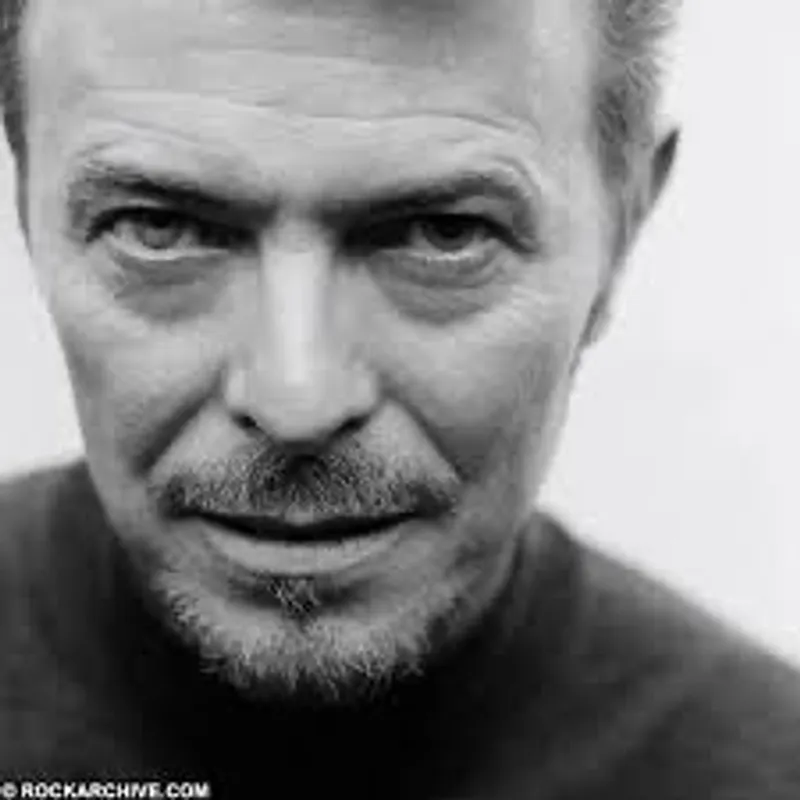
Happy Birthday David
It's been almost eight years.
Eight years since I was hit with the realization that I could exist in a world that David Bowie was no longer in. It was a strange realization, because he'd been there as long as I could remember, in one way or another. First, it was a combination of radio, and the record collections of different adults who were part of my life or whose lives I passed through. I had a thing about looking through people's record collections, every chance I got. For people my parent's age, there was at least one Bowie record in almost everyone's collection. Of course, Ziggy Stardust was the most regularly found, but sometimes, there'd be no Ziggy, Aladin Sane, or Diamond Dogs and instead, there'd be one or all of the Berlin trilogy. It told you something about the person, and their taste, or it at least told you what they wanted to think about their taste. Other times, it would just be Hunky Dory or The Man Who Sold The World, which said something else. Let's Dance was also fairly popular, but at the time, it was the most recent of Bowie's big hits, so that wasn't a surprise either.
It wasn't like Rumors or Tapestry, which seemed like they must have been issued to my parents generation at birth, and were in practically every record collection. Their inclusion in a collection didn't really tell you anything, other than the relative age of the collector. There wasn't always a Bowie record in the collection, but there were far more collections that included one of his records than not, and as popular as Ziggy Stardust was, it wasn't the one big record everyone had, which was interesting. Lots of artists had that record. Let It Bleed was one of those records. The White Album and Abbey Road were records like that too. Hotel California was another.
I know I was around twelve or thirteen when I got into David Bowie's music. I can't remember what drew him from the background of rock radio and the record collections of people my parent's age and into focus. Honestly, it could have been Heroes, a song I fixated on at that age. It could also have been that I somehow learned he'd been involved with producing music from The Stooges, Iggy Pop as a solo artist and Lou Reed, after he departed The Velvet Underground. It seemed odd, at the time. Here was this guy, who was as much showman as he was musician, switching personas every few years, making records with people who were almost synonymous with authenticity as the draw for their music, and had produced some of their most beloved work. I'm not sure whether learning all of that resulted in starting to take interest in his work or it was the result of starting to take interest in his work.
I do know it wasn't just interest for long. It was plain obsession for a while, and then his music became something like a security blanket. No matter how good or bad things were, Bowie's music was always there. To this day, I don't think more than a week goes by without me listening to one of his songs, if not an entire record, from start to finish. I can go through obsessions with artists who are new to me for months at a time, but Bowie's music has always been in the mix.
It seemed, to me at least, at the time, he was a person of amazing creative courage, and a no holds barred genius. In listening to his music, over and over and over, and listening to as many different albums as I could get my hands on, the picture I got, and the picture the press painted, was of a genius who was cycling through styles and personas out of an insatiable creative curiosity, and he was able to do so because he was a genius. The thing about listening to all of that music, no matter the era or the style he adopted, there was something inextricably Bowie at the center, almost always. There were a few of the records in the eighties, where in comparison to the rest of his work, you can't hear the Bowie-ness coming through, but as it turns out, those were the records he recorded at the point he was most lost in drug addiction, the self loathing which is always attendant to it, and tired of being a rock star.
I didn't lose interest in the nineties, as so many did. Maybe the records didn't feel so immediate. Maybe they didn't have those instant hits he'd so easily cranked out through the seventies and part of the eighties, but they were still interesting, if for not other reason than to listen to this artistic chameleon still trying on different styles and personas. Outside, Earthling and Hours all have their charms, it just took sitting with them a little longer to discover them. They didn't jump out the way his earlier work did. Reality and The Next Day are very much the same, though I somehow missed Hours in there, probably because it was released in one of the periods I was struggling with the most savage of my own demons.
I didn't always drop everything if I came across an interview with a musician or artist whose work I liked. No small number of them really didn't have all that much to say that was any different from one interview to the next. I don't know Bowie necessarily had something different to say each time, but he was always thoughtful, considered, and interesting.
David Bowie was just ever present, as a musical force in my life. I'd spent the majority of it being amazed by the journey he was taking, looking at it as this person who was so deeply in touch with who he was, he was able to assume so many different creative identities. It was the kind of measuring stick which seemed almost impossible to ever stand up against, so I can't even say I looked at him as an example. He was truly other, in all of the most positive ways.
Then came Blackstar, which I didn't even have a chance to hear all the way through, before news of his death reoriented my understanding of life in the universe, because he was no longer in it.
At earlier points in my life, I'd been one of those snide shits who thought it was ridiculous when the deaths of celebrities they didn't know personally caused people to publicly express pain or grief. "You didn't even know the person. How could you feel that much for someone you didn't know? Get some perspective. Sheesh." I can recognize I was being a snide shit because of what my reaction to the news his death taught me. Even as the obsession with his music had waned long ago, the music was so ingrained in every period or era of my own life, I hadn't considered or even thought that I took some comfort in the idea that whether or not he was making records at any given time, David Bowie was out there, doing David Bowie shit. Maybe it was because of all those personas, maybe it was because of the way he talked about artistic expression and the commodification of art, after the years of being one of the world's biggest rock stars, I'm not sure. I do know, that for some reason, I had come to feel that as long as David Bowie was out there, someone knew what the fuck was going on where the arts, commerce and creativity were concerned, and they also recognized how absurd and crazy this whole thing we call civilization is. Someone got it. It might not have been me, but he did, and it didn't drive him completely insane. By itself, that was comforting.
How the fuck was I still here, and David Bowie wasn't? It seemed like an inversion of universal priorities.
I love Blackstar. It's the best album he'd done in a long time, but hell if I still can't listen to that album without feelings of grief and heartache still. I love that he thought enough and cared enough about the people who'd been his audience, his fans, people like me, that he chose to create this parting gift for us. How many artists get to do a project that's basically the summation of their creative and personal life, when they know the end is right around the corner? I don't think many do, and in a way, it was the most Bowie thing to do too. I'm glad for him that he got the opportunity. In a career I saw as the result of creative courage, it may have been the most courageous act, to record those thoughts and feelings about the impending end, when he knew how close it was. I don't know I'd be able to do that.
Even in death, this fucking guy was an example of creative courage that was mind boggling. He had that career, that depth and scope of influence and then set about creating this astonishing piece of work as his swan song. What an artistic titan. Only Bowie.
I was fortunate to get to see Moonage Daydream in theaters, when I was visiting with some friends who also have a love for Bowie. I'd read the reviews, so I did expect something good. I didn't quite expect what I got. It was as good as I'd been lead to believe, but in a completely different way.
I didn't expect it to be as much as story about someone searching for themselves, their identity, their place in the insane world of the music business, rock stardom and life more generally. I didn't expect a middle aged and older Bowie to talk about his early work and career as trying on personas in the search for who he was. It had always seemed so much the opposite to me. This was a person who was so centered, so intelligent, with a strength of character, they could play with all these characters and styles out of pure curiosity or artistic ambition. It was a huge part of what I admired about him. It was what made him an example to not even attempt to follow.
It was completely wrong. Backwards, really. David fucking Bowie had been searching for himself in all those creations. Insecurities, anxieties, the things we all struggle with, the things that make us all question ourselves, who we are, where we belong, they were as much the driving force behind this incredible body of work of as anything else. It turned my understanding of the man and his work on its head. Bowie's genius wasn't in conquering these things so many different artists struggle with. His genius was in creating through them, as in through them as he was experiencing them, but also into turning them into creations.
I still listen to his music, regularly. Over the last year or so, I also watch different pieces of Moonage Daydream with some regularity, especially when I'm struggling with the anxieties and insecurities that can get in the way of my writing. Sometimes, late at night, after a bad day sitting at the keyboard, wrestling with all the doubts and anxieties, as I try to just keep writing. Sometimes, it's in the morning or early part of the day, as I'm about to embark on attempting to get some productive time in on whatever I'm working on.
I can't even say David Bowie was some kind of North Star in my life in some way. He was beyond that, like the magnitude of his genius was too much to even attempt to follow. How could someone be so centered, so sure of themselves, to publicly cycle through all of those styles and personas? It was beyond my comprehension.
Yet six years after his death when Moonage Daydream was released, two more since then, the most profound lesson Bowie's life and career had are just coming to be the most important, they are the North Star. It was the lesson of his death, that the world will go on without all of us. No one, not even David Bowie's death, stops the world from turning. There is still great creative working being done and to be done. This, with his reflections on his early work being his search for his way out of insecurity, anxiety, self doubt, made him human. Musically, he was a genius. Through all of that, he created this undeniable body of work, but it wasn't in spite of those things. It was in part because of them. He was no longer some distant, impossible to reach figure. He was someone who happened to have a talent, and through work, living, luck and searching, he created all of that. Fortunately for him, and us, a good deal of what he created were things a lot of people really enjoyed and respected.
I'll never be a David Bowie, and fortunately for me, I've always known that. David Bowie was a genius, whose achievements few others have reached. However, I can be a David Jones. David Jones was just someone doing a thing he loved, following his interests, simultaneously in spite of and because of all the fears and anxieties. That's something I can do. I can work hard, keep living, keep searching for my creative identity through that work, create some work I'm happy with, some work I'm not, and do all of that as I'm experiencing the anxieties and fears so many people struggle with and if I keep trying, keep being willing to be honest with myself about it, I might get to a place where I can feel content with it.
Six years after his death, David Bowie had something new to teach me, which is as pertinent, as important as knowing he was out there, when I thought he "got it" and was going through the years of tumult, failure and struggling in my own life. I'll never sell millions of books. I'll never be seen as some kind of shining representation of human expression and artistic freedom. If I'm really lucky, I'll sell a few thousand books, and maybe be a guy whose books people feel are good enough to occupy their time, until the next great book comes along, from some other writer whose being hailed as the next Great American Voice or the next Great Voice in Horror. If I had one billionth of a percent of his success, I'd be able to be pretty comfortable, financially, which would be great. It's not really about that though either.
The world is going to go on, whether or not I even attempt write any books. Nothing I write is going to stop the world from turning. The person who really needs my writing to be as good as I can make it, is me. Because it's what I want to do, because it matters to me, and that's reason enough. I was wrong about Bowie for all those years, and I was definitely not alone. The music press and more or less the whole world painted a picture of someone who was some fully formed genius from the time Space Oddity was released as a single, till his death. We were all wrong. He may have had a genius for making music people would like, but that was a byproduct of everything else.
I can't be David Bowie, and shouldn't even try, because it turns out, David Bowie wasn't even David Bowie. He was always just David Jones, and what was probably his most courageous piece of work, came from being David Jones, in a world that believed he was David Bowie.