
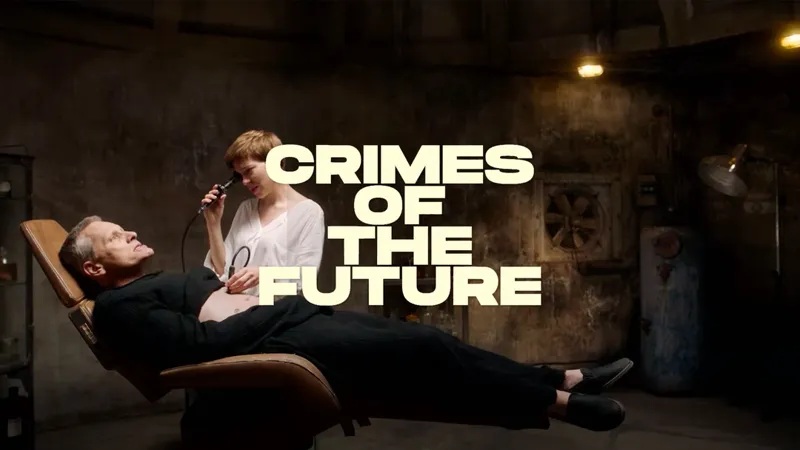
Crimes Of The Future (David Cronenberg, 2022)
In 1975, Shivers was introduced to the world and with it, a thirty-two year old Canadian director named David Cronenberg. Cronenberg would go on to be one of the most influential horror directors of his generation. He's not the first to use what is now referred to as body horror, but it's hard to think of another director who is more closely associated with it or more influential on the work using body horror that came after.
In 2022, two decades since his last foray into what would generally be considered the realm of horror (his last being the under appreciated Spider in 2002, which can now be seen exactly nowhere), he returned with Crimes Of The Future. In between, Cronenberg has built a respectable filmography in more mainstream dramas, with a reliable creative partner in Viggo Mortensen as the lead in many of them. Now seventy-nine, making Crimes Of The Future, he's brought Mortensen into what many fans considered the hallowed realm of "Cronenberg body horror." Mortensen, Léa Seydoux, Kristen Stewart are outstanding. All of the performances are good, but these three are the beating heart of the film, giving it life and keeping it from being quite as distant and cold as so much of Cronenberg's early work was.
It was an exciting moment for the crowd of people who were introduced to and whose ideas about body horror, and horror more generally, were influenced by Cronenberg. The maestro was coming back to the form he helped establish and that made him an icon. Crimes Of The Future released to mostly positive, but somewhat lukewarm reviews (not unusual for Cronenberg), from mainstream critics, horror critics and fans alike. Of course, this being 2022, there were certainly extremes on the spectrum, some lauding it as one of the best films of the new century, others as one of the most boring.
David Cronenberg's early work, those years when he established what it mean for a film to be called, "Cronenbergian," were urgent, provocative and angry in that provocation. He's always had a style that is distant and clinical, but the anger is there, driving those early films. It's the work of a young person, publicly wrestling with fears about identity, the future (often in the form of technology), and authority. That early work is provocative, and brilliant in a number of ways. He was rewarded or punished by being referred to as profane or brilliant, depending on the perspective of the critic. Even his adaptation of Stephen King's The Dead Zone, dealing with a psychic being introduced into the world of American politics reflects this. In both King and Cronenberg's worlds, what is being psychic if not a profane technology, a power authority wants to but can't control? His remake of The Fly is concerned with technology very directly making someone inhuman on an atomic/molecular level and what that means for the people around them. Through his more mainstream work, Eastern Promises, A History Of Violence, and A Dangerous Method Cronenberg's obsession with identity still is an element, though with less fantastic narrative tools to explore it. Maybe it's the introduction of Mortensen as a creative partner, but his work has grown less clinical, less distant, and has come to be slightly more intimate with his characters. It's a bit counterintuitive, but it also suggests Cronenberg has been aware of his own shortcomings as a director and storyteller to have established this partnership with a leading man who is capable of projecting a level of warmth, care and compassion which is somewhat uncommon in his generation.
His early work is also shot through with paranoia about the future, scientific hubris and technology most specifically, and what it will do to humanity. They are, thematically, deeply conservative works. Not in the sense of the American political definition of the word, but in the more original meaning of the word. They feel like a constant questioning, a feverish stream of questions, about how we and the world around us are going to be changed by the technology we're creating. It's the questioning of genuine intelligence, and not superficial at all, but behind them is fear, driving the angry provocation so many of what those films are. In a way, Cronenberg spent the early part of his career picking up the questions Mary Shelley left us, and looking a little closer at them foremost among them, "What is what we've created doing to us? What are we losing? Can we prevent it from changing us and not lose our humanity in the way we attempt to prevent it?" These are the looming questions in most of his early work and they are properly looming, in the sense of being threatening, unsettling and full of dread.
Crimes Of The Future is very clearly the work of the same man, but he's seventy-nine when he makes it, not thirty-two. Nearly fifty years have elapsed. One of the more common criticisms of Crimes Of The Future was that it "feels like Cronenberg is imitating himself." Aesthetically, it's very clearly the same man, the same visual imagination. Looking at the design of the technology in Crimes Of The Future and what technology is doing to humans in Videodrome, its unmistakably Cronenbergian. These criticism often expressed a sentiment which boils down to "I was waiting for the old Cronenberg to show up, and he never did."
It's important to note this isn't his first film titled Crimes Of The Future. David Cronenberg has always been too cerebral, intellectual and considered in his approach as a filmmaker for this to be a matter of just being a simple, easy answer to the question of what to name his latest film. His second feature length film in 1970, was also titled Crimes Of The Future. This film, the Crimes Of The Future of today, is very much about this man, at almost eighty, looking back at his fifty year career as an influential filmmaker. He's created bookends for his life's work.
There's a kind of subtle cruelty to that common criticism of this film being disappointing because it's "Cronenberg imitating himself, and the guy who made those influential films never showed up," because it demonstrates part of our relationship to art and artists that is cruel. Cronenberg is fifty years older. He is, simultaneously, the same man who made Shivers, Rabid, Videodrome, The Brood, Scanners, The Fly, Naked Lunch, eXistenz and whatever other films we may have felt were particularly important, thought provoking or personal to us as an audience, and also not at all that same man. This 2022 Crimes Of The Future is about the man he is today, the artist he is today, knowing he doesn't have much time left to create more, looking back on being that artist, today and then.
Expecting a person to be the same at seventy-nine as they were at thirty-two is cruel because it requires them to experience the time in between without learning, without being touched by anything, because these are the things which cause us to mature. It's not unusual to see this with artists either. An artist finds an audience with a particular style or a particular set of themes or subject matter, but when the artistic motivation, the curiosity to explore, points them in a direction away from what that audience has come to expect, the audience dwindles. The grumbling and accusations come. The criticism becomes hostile. They sold out. They lost what made them great. Success ruined them. All these things are constant in our discussions of artists who do find some level of success, and then change too much for the audience which propelled them to that success. Occasionally, an artist develops a relationship with an audience with is about exploring all of that together to some degree, David Bowie and Prince being among the rare examples. Anyone becoming a fan of Bob Dylan's work since he went electric is going to see that kind of progression, when at the time, just going from an acoustic guitar to an electric band was, infamously, a heresy to his fanbase.
We often require an inhuman stasis from artists, which discounts the degree to which they are human beings, not just creators of content to be consumed for our satisfaction.
Cronenberg has come back to body horror, in part, to interrogate his own place in being one of the people who helped established our ideas about what body horror is. He's not exactly pleased with the children of his invention. He's a bit terrified by them. He's not at all sure he really understands them. Most importantly though, he's not condemning them and he's pushing back against the variety of paranoia which was so characteristic in his earlier work. It's the justification of fear, anger and paranoia that's missing in Crimes Of The Future, and to this, all I can say is good for Cronenberg. He's acknowledging that it exists, and that it's a very human reaction, but it's more a problem than the changes inevitably coming, as he seems to see it now. The resolution, he's suggesting, is in finding peace, and in realizing that the pain is in the fight against a future which is inevitable, because as much as we believe our nature is static, it's not. It is as much in our nature to change as it is to be the who and what we are today or were ten, twenty or forty years ago. Stasis is impossible. When people are criticizing Crimes Of The Future for being a kind of Cronenberg self cosplay, what they're criticizing is the degree of peace the man has found with the anxieties and paranoia that drove his early work, and that's a bit cruel, even if unintentionally so.
He's wrestling with his place as an artist, and the artist we see him as, as much as he's wrestling with all those same themes which have been part of so much of his work, identity, technology, sexuality, intimacy, and Crimes Of The Future is suggesting nourishment is the thing we need most, however that may come. That nourishment gives us the peace and intimacy we're seeking, and the peace and intimacy are itself nourishment too.
In its strange Cronenbergian way, Crimes Of The Future is the most hopeful piece of work he's ever produced. There is an intimacy and subtlety to the relationships between these characters which wasn't part of his early work, giving this a warmth that could seem like it doesn't belong if all you are looking for is a carbon copy of that work. Looking at Mortensen's characters relationship to Seydoux's character, compared to his relationship to Stewart's character, he's highlighting the difference between the clinical excitement of ideas and the philosophical and the necessity of an intimacy more personal. He's not saying they aren't both necessary, but he is making the importance of knowing the difference clear.
It's an interesting thing to see for a filmmaker whose filmography has been so clinical and cold, more interested in ideas than the emotional. Saul (Mortensen) may be intrigued and inspired by the excitement for ideas and the philosophical connections Timlin (Stewart) is animated by, and even as Caprice (Seydoux) has some moments of anxiety about what Timlin's literal whispering in his ear means for her relationship with Saul, he seems very clear on the difference. He's not divided or conflicted, and at each possible opportunity, responds to Caprice with openness, even when he's unsure of his comfort with what she wants. At no point does there seem to be a question of "either/or." The intimacy of his relationship with Caprice is never in question and is the central heart from which the rest of the film proceeds. The emotional dimensions of their relationship are all subtly conveyed, even as their artistic partnership is rather garishly conveyed through the scenes of their exhibitions and it is all simultaneously supported by and supporting to the resolution. There's a depth of emotional intelligence and maturity in Crimes Of The Future the young Cronenberg either didn't have or for whatever reason, had no interest in making part of his storytelling. This Cronenberg understands its importance.
Crimes Of The Future is profoundly beautiful in what it's trying to say, and that a filmmaker and storyteller whose been visionary, in the proper definition of the word, is suggesting something this hopeful could be a comfort to those of us who've seen ourselves, our fears, anxieties and paranoias in his past work. It could be comforting, if we can see this film for what it is, whether or not the filmmaker is still the artist we wanted him to be.
Considering that we're just now being forced to societally wrestle with the kinds of questions and ideas he presented in Videodrome almost forty years ago, there could be something comforting in the idea that he sees a possible future not so full of paranoia, terror and anxiety, nor does he see peace as a surrender to the way we dehumanize ourselves in our attempts to fight the future, to fight the monster we're afraid our relationship to technology will make us. What he's proposing is a peace in acceptance of change as both inevitable and human, even if that change means we have to expand what we think it means to be human, because it's better than the unavoidable pain of that fight or becoming the monsters we have to become to wage that battle, because of the destruction that comes with it, as human as it may be to do so. In its way, the film is saying that what is essentially human, the intimacy of our connections to one another, and our desire to do this, can't be changed.
There's a strong likelihood that as time passes, this is going to be one of, if not my preferred film in Cronenberg's filmography. The more I think about it, the more moving and inspired I find it. I'm currently leaning toward the extreme of this being one of my favorite films of the 21st century. It's a brilliant film, and Cronenberg probably won't be around to see it recognized as being as visionary and forward looking as the films of his youth, but he knows that and has made peace with it.