
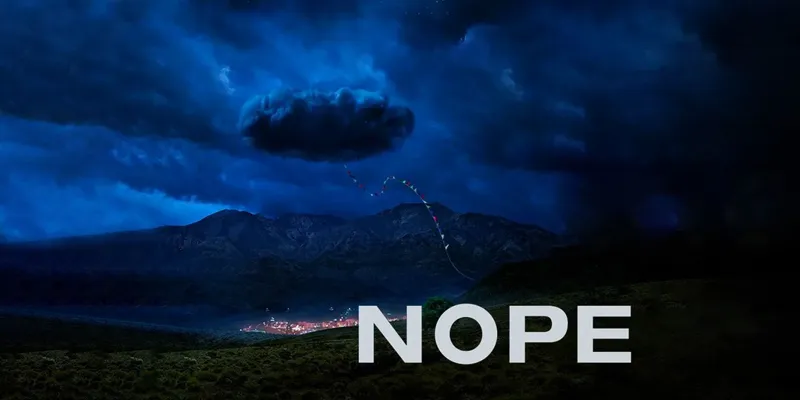
Nope (Jordan Peele, 2022)
Spoiler Free Review
Every spoiler free review comes down to one question, "Would I suggest you see the film?" The answer here is, "Absolutely." Not only would I suggest you go see it, I'd suggest you see it on the biggest possible screen. If there were an Imax theater accessible to me, I'd be going to see Nope again, ASAP. In this spoiler free section of my reaction/review, I won't be spoiling anything that can't be seen in the first, very detail limited trailer of the film.
Nope is a blast. Jordan Peele succeeds, yet again, at wearing his influences on his sleeve without those influences teetering into cheap imitation. He manages to do something different, even as astute movie goers are going to see what films inspired his latest genre conflagration. The story is strong. The execution is very fun, and has a few of the tense, anxious sequences which horror fans go to the theater looking for, but it's not solely a horror film either. There are elements of science fiction (obvious from the trailers) and the western (also obvious from the trailers).
Nope is also going to bring deeper enjoyment on subsequent viewings, in part because of the visual presentation. There is some phenomenal camera work here. Since Get Out, we've known Jordan Peele has the imagination to produce iconic imagery, the visual representation of The Sunken Place, the image of Chris in the chair in the basement. Later, in Us, Red and her family standing at the mouth of the driveway, Red's son backing into the fire, the rabbits. They are iconic images that are instantly recognizable. In Nope, Peele partnered with cinematographer Hoyte Van Hoytema, arguably todays master of the Imax format and regular Christopher Nolan collaborator. This is without doubt Jordan Peele's most visually adventurous and exciting film. It is worth the price of an Imax ticket, for this reason alone. To put it plainly, it's gorgeous, and the sense of scale and scope achieved by seeing it on the largest possible screen will add to the experience of the film. Those aspects of scale and scope are designed as part of the experience of the film, so it's not just about being showy and pretentious about its cinematography either. The visual choices fit with the themes of the film. There are things in Nope, on both the visual level and in the storytelling, that I've never seen before. Peele again proves not only can he craft an iconic image, but that he is a courageous and intuitive storyteller.
Beyond being able to further luxuriate in the cinematography, repeated viewings are going to make this even more enjoyable because of what's going on under the hood. Get Out was thematically straightforward, and then on subsequent viewings, there were all of these other details to pick up. It's kind of like finding breadcrumbs pointing toward where the film was going and that add evidence to its central themes. Even if you hadn't picked them all up on the first viewing, it was still very clear what Peele was saying and what he was going for, as well as being fun to go back and see what you may have missed once you know where it goes.
The most consistent complaint about Us, was that it was so thematically opaque. It's a film where Peele was much more comfortable with letting the audience put the pieces together on their own, and was far less interested in leading them to the conclusions of what it was about, thematically. Nope splits the difference. There is a lot going on under the hood in this film. It's running on a big, muscular, finely tuned engine of themes. It's thematically rich, but that never intrudes on the straightforward surface storytelling enough to subtract from the pure visceral enjoyment. The details to support those themes are all there, but missing them (as it seems no shortage of the movie going public and film journalists have) may lead to questions about what the themes of the film are and how well it supports them. This is Jordan Peele's version of a summer blockbuster, and we could use a whole lot more directors who approach a summer blockbuster with this level of care and thought. It's a big movie, with big ideas, and exciting execution.
Daniel Kaluuya is excellent. He is one of the most talented actors working today, without doubt. Jordan Peele has recently referred to him as "my De Niro," and it's not an inaccurate description. He's playing something close to the classic laconic cowboy, and can convey so much about a character through a simple expression. It's great fun to see him taking on this kind of role, in a film as inventive as Nope.
Keke Palmer is a joy, as always. Having a box office success like this will hopefully start bringing her some more starring roles in high profile films. She's a joyous, infectious presence. Brandon Perea is great as a kind of foil to Palmer and Kaluuya, adding to some of the comedic elements, and serving as a bit of an audience surrogate. Michael Wincott plays cinematographer Antlers Hoist, and it's a reminder of why Wincott was so ubiquitous in the nineties. He's a phenomenal actor, and does a lot with a small role. Then there's Steven Yeun. If there's an actor working in Hollywood today whose talent far outweighs the profile of the roles they are consistently given, it's Yeun. The day we get a film with Yeun and Kaluuya starring opposite each other is going to be a great one, and he's just as good here as he is in everything else. Keith David rounds out the cast, and he's Keith David. He's been making films and uplifting small roles for going on forty years. He's been around this long because he deserves to be.
If you haven't gotten around to seeing Nope, stop waiting. It's more than worth the cost of the ticket and time. It's a great time at the movies in the middle of the summer blockbuster season when there are often big, fun movies, but rarely movies as interesting and as artistically well realized as this is. To my mind, Nope is the second masterpiece Jordan Peele has created. When you've seen the film, come back and read the spoiler heavy review to see my argument for treating it as a masterpiece.
SPOILER HEAVY REACTION/REVIEW
Nope opens with a Bible quote: "Nahum 3:6: I will cast abominable filth upon you, make you vile, and make you a spectacle." Spectacle, and what abominable filth we engage in, making ourselves vile in the process, is the thematic underpinning of the film. How do we react to spectacle? How does the existence of spectacle effect us? How do we create spectacle, and how does that process effect how we act in the world around and even how we remember the events which have become spectacle?
As with Us, one of the primary criticisms of Nope has been that it doesn't sufficiently tie up the themes it lays out. Interestingly, this tends to come from the "serious critic" crowd. It's an odd thing, simultaneously demanding cinema be more than the kind of spectacle driven, spoon fed narrative of the superhero genre, and apparently at the same time, demanding they not have to inject any effort into engaging with a piece of narrative fiction after the house lights come up. Are audiences and the critical community intelligent and savvy enough to pick up on themes and ideas not presented in a didactic monologue presenting itself as a film? The answer is subjective and objective, at the same time. Some audiences are and some audiences aren't. Not everyone spends their time obsessing over the intricacies of storytelling, and no small number of film critics tend to focus on the particulars of the technical aspects of the art form. We're also living in the age when things like Cinema Sins have reduced the question of whether or not a film is good to nitpicking every single detail they feel is out of place.
Nope does lay out all of its themes and gives them support, if you're watching closely and willing to do a little work of your own. Personally, I enjoy a thematically ambitious film more than I enjoy a thematically staid film, rehashing the approach to themes we've seen a few hundred thousand times. One of the many beautiful things about film, and storytelling of every variety, is what we do with the when they're over. Something I have to puzzle over to see the threads tied together is enjoyable, and Nope is that kind of film in some ways, even as it is just as much a film of spectacle. It is enjoyable and supremely well crafted as a purely visceral, in the moment experience. It has the added depth of being enjoyable as something to puzzle over and think about afterwards, if you're into that sort of thing.
One of the most referenced pieces of evidence to this idea Nope isn't giving the audience enough to support its themes is the shoe. My initial reaction is that the scene where it's called attention to is among the best of its kind at evoking a profound level of disturbance and anxiety. I'm assuming if you're reading this far, you've seen the film, so I'm not going to go too in depth on describing the scenes etc. Halfway through the film, we come to realize what we saw following the Bible quote at the beginning of the film is the memory of the filming the infamous final episode of Gordy's Home, through the eyes Steven Yeun's character, Jupe. When we see the full memory, Peele takes a quick moment to focus on a child's shoe in the middle of the set, standing on end in an impossible feat of physics. In the middle of this horrific scene, there is this obviously intentional shot. It focuses the audience on this shoe, standing in this impossible position.
I've read and listened to dozens of written and podcast reviews referring to this shoe. There are probably thousands of them. What does it mean? Why does Peele intentionally show us this shoe?
This scene isn't the first time we've seen the shoe though. We saw it earlier in the film, when Jupe shows Em and OJ the room full of memorabilia from Gordy's Home. The shoe is there, in a case, in the same position. We learn in that scene Jupe usually charges people money to see this exhibit he has hidden away behind a secret door in his office. The last people paid $50,000 to see it. The Old West amusement park which is now his living is called Jupe's Claim. Jupe isn't his real name. His name is Ricky Park. He's known as Jupe, and has named the amusement park Jupe's Claim because he starred in a hit children's film called Kid Sheriff, and the character's name was Jupiter, shortened to Jupe. Ricky Park's entire existence is hinged on capitalizing on tragedy and being a person who never existed outside of a fictional universe. This is to say, Ricky Park barely exist. This process of creating spectacle made Ricky Park into Jupe. We're so used to living with spectacle in the way we do, the idea that Ricky Park barely exists doesn't rise to the level of catching our attention. That he'd essentially participate in supplanting himself doesn't register as something which might effect any other part of how he sees himself, the world around him or how it might effect the way he sees his own past.
The shoe, as we see it on the day Gordy attacked the cast and crew of Gordy's Home, is Peele's indication of how unreliable Jupe's memory about the day is. What we're seeing is him replacing the details of the day, with the details he's lived with in profiting from tragedy being turned into spectacle. He sees the shoe regularly, in that same position, in its glass case. This is an indication we can't trust what we're seeing. It's been infected, in the way that remembering anything through the lens of spectacle is infected. We can't separate the facts of the reality from the way we experience it as spectacle afterwards. It inevitably colors how we remember any event turned into a spectacle. If Ricky Park barely exists, how reliable are his memories of the day that made him a subject of spectacle, and also insured his participation in turning that trauma into a matter of spectacle to survive?
The only thing we can really be certain of is that in order to survive and thrive, most probably in part because of the trauma, Jupe has had to participate in turning that trauma into spectacle. Jupe is still a tragic character, a person caught up in this cycle of spectacle. It leaves open question of whether or not Jupe, his family, his former co-star and all the other people who were sitting in the stands all died because Jupe's memory of that day isn't accurate, and therefore his decision to try to create this show is itself a result of his pursuit and engagement with spectacle. We don't really know Gordy even attempted to give Jupe a fist bump. We know that's how Jupe remembers it, and it leads to Jupe believing the "visitors" trust him. Jupe's memory isn't reliable though, and it's as possible his memory is colored by the way he's both been dehumanized and pursued the spectacle. How much of this memory is colored by the fact that he thinks he has a guaranteed golden ticket, essentially selling tickets to see a UFO? The shoe is an indication of the tragedy that is Ricky Park, and how that tragedy leads to the terrible decisions that bring the creature into contact with OJ and Em, who then go about making decisions not at all dissimilar to those Jupe has made. The point about memory also ties back into the erasure of the jockey, in this case OJ and Em's ancestor from film history. The spectacle has erased him, even as the Haywood family is trying to keep that legacy alive, through engaging with that same spectacle.
OJ and Em have a little bit of an advantage, having realized it's not a ship. It is a UFO/UAP, but it's an animal, and their experience with animals gives them an edge Jupe didn't have. OJ, particularly, sees animals as more than just product or fodder, even as he is trying to profit off of their existence. "You don't tame a predator," he says at one point, "You make an agreement with it." Jupe sees the horses as nothing more than the bait for his way to make a fortune off the spectacle, in part because he's not familiar enough with the world beyond the spectacle to understand the thing in the sky is an animal. For OJ and Em, their legacy, the ability to remember clearly, in spite of the spectacle, is the thing which gives them an edge.
Jupe, as a character, is about spectacle consuming who we are, which does fit quite nicely with everything else the film has to say. Jupe goes to lengths which ultimately make him abominable, being responsible for the deaths of some forty or fifty people. It's understandable to us as an audience, because it is representative of the world we live in. Of course he would capitalize on all of these things. It's the kind of choice people make everyday, and it's a choice encouraged by the norms and standards of our culture. Capitalism more or less demands it. In many cases, we don't even have a choice about whether or not our tragedies are turned into spectacles. Jupe certainly didn't. We end up with the choice about whether or not we're going to participate in turning them into spectacle, and we have to then make peace with the fact that, inevitably, someone else is going to profit from it. How often is the confrontation with that reality answered with, "It might as well be me who profits from it."
This all looks to be of a piece, with the other themes Peele has brought to his films. Us was focused on privilege and it's layers. Wealth and fame are what the characters in Nope are chasing, both of which are forms of privilege. In Us, using the concept of The Tethered, he's demonstrating the way the underprivileged, depicted as literally being underground, are forced into aping some empty version of the lives of the privileged, and how that robs them of agency. The most privileged make the rules, and the further we move away from that most privileged state of being, whether we may bend or break those rules changes, until finally, the only real autonomy the least privileged among us have is in how they follow the rules. Get Out is a thorough indictment of the privileges of racism, and how they twist everyone they touch.
Jupe is Peele's comment as spectacle as access to privilege, and what it does to us as people to live with spectacle as an aspect of our lives. Em and OJ have history with this industry of spectacle, for lack of a better way to address it, the society of the spectacle. It's part of their family legacy. They're driven to take the actions they are as a way to preserve that access, but it's their legacy, that ability to remember accurately, which ultimately helps them to not make the same mistakes Jupe does. Peele never treats their material concerns or the concerns for their legacy as insubstantial or superficial. They are real, and still, it's part of the same process which essentially robs Jupe of who he is or might have been if he were allowed to be Ricky Park. Not getting to be Ricky Park, but more or less being forced to be Jupe is central to his undoing. Part of the reason OJ is the one who realizes they're dealing with an animal, and a predator, is that he's not quite as mystified or hypnotized by the spectacle itself. He's been adjacent to and in a way involved in it his whole life, much like Jupe. It's a practical concern for OJ though. Keeping the ranch, having a future not being beholden to someone else, not having his family legacy erased by the spectacle, these are his reasons for engaging with it. OJ has always been concerned with the spectacle as something to engage with on a practical level, which is why we get the memory of him turning to Em as his father is teaching him to train the horse which was supposed to be Em's. He's also engaged by concern for his sister. "I see you," is the gesture he makes. The spectacle and the fact that he's about to take part in it can't erase his recognition of her.
We see it in the way he deals with the horses. It's important that at no point does he use the horses as bait, as Jupe does. His first encounters with the creature come from his sense of responsibility toward the horses. When they're taken, there's nothing he can do, and it's never something he puts ahead of the rest of what he's concerned with, but he also never treats the horses like they're expendable, like meat. This spectacle that's come to the valley where the ranch is, and where Jupe has made his amusement park, is treating every living thing like exactly that, meat. Jupe's fatal miscalculation was that it wouldn't treat him and everyone else it could like meat for its chaw.
Em, unlike OJ, is fully mystified or hypnotized by the spectacle. It's not until the end of the film, when her engagement with the spectacle becomes a matter of saving OJ's life that something else comes to be as important as her desire to be part of it. Releasing the giant Jupe balloon is the way to get the creature to take its focus away from OJ, and by doing so, making something else equally important, she finally gets the thing she's been seeking as she takes the picture of the creature with the camera in the well.
Even Antlers hoist, the cinematographer isn't engaging with the spectacle as being behold to or mystified by it. He has something else altogether driving him. Antlers is Peele's comment on where the artist fits in all of this. His ends up being a completely selfish motive. He wants the perfect shot, and he dies knowing he got it, and it doesn't matter whether anyone else will ever see it because his reason to live and exist has been fulfilled. He literally gives himself to the spectacle in order to achieve this internal drive, without care for whether or not he's ever recognized for having achieved what he does. In fact, he chooses to die getting the perfect shot because in his eyes, the dedication to the spectacle, instead of the art, makes everyone else unworthy of seeing the perfect shot.
In all, Peele seems to be saying that this thing of spectacle which runs loose in our lives is indeed a predator, and as OJ said, "You can't tame a predator. You make an agreement with it." The agreement he seems to be suggesting is that we can engage with it, as Peele is himself creating Nope as a matter of spectacle, but we can't ever let the spectacle be everything to us. He demonstrates this, by also giving his film this theme, a comment on exactly what it is he's doing and wrapping it so deeply in the characters and their motivations, ideas and lives.
What's underlying Nope thematically, is the notion that treating this aspect of spectacle in our lives naively, without respect for how dangerous it is, means it will eat us alive like a giant, free floating predator with its own sense agency we can only minimally understand, and which doesn't care to understand us. It's here to consume us. We're not safe from the spectacle unless we can keep a balance between it and the other things that are important to us, otherwise we'll end up sacrificing everything to it, whether we mean to or not. Whether it's Hollywood, the drive to become internet famous, the drive to achieve power through politics or any other way of participating in the spectacle, Peele is right, and in creating this way of presenting these ideas, Nope is a masterpiece.