
The Invitation: When Grief Becomes Prophesy
Ah, 2015... Remember those halcyon days before we had experienced the cascading torrent of nightmares the last eleven years has been?
It was also the year Karyn Kusama's The Invitation played film festivals. It would get a limited theatrical release and video on demand in April of 2016. Though it was praised critically, it didn't generate much attention or praise beyond the few critics and bloggers who caught it at festivals. When it became available on Netflix, it began to generate positive word of mouth among the horror focused audience, and has since developed a loyal cult following, including myself. I was already shocked a movie with such intensity of impact hadn't generated more attention, when I found out it was made for one million dollars. On top of the performances, the editing, the set design, in just the cinematography alone, it looks better than most films with thirty, forty or ninety times its budget. With all of this coming together, it results in an emotional impact beyond what the majority of movies achieve. It's a film blending incisive, emotionally and psychologically mature writing with technical excellence to create an ever tightening sense of suspense, until a climax of sheer, intimate, visceral and emotionally impactful horror.
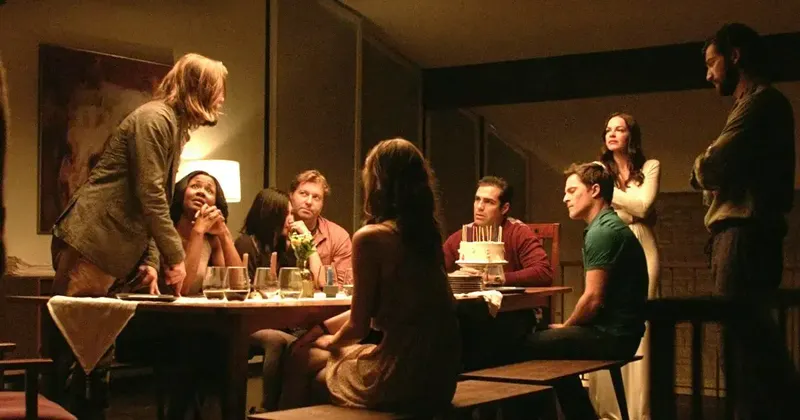
As a premise, The Invitation is relatively simple, and could almost be imagined as a stage play. The movie opens with Will (Logan Marshall-Green) and Kira (Emayatzy Corinealdi) driving on a relatively secluded road in the Hollywood hills, and through dialog we come to understand they are going to a dinner party, given by Will's ex-wife and new husband, bringing together the friend group Will and his ex-wife, Eden (Tammy Blanchard), had been part of. The majority of the run time is devoted to mining the discomfort of this basic setup, and creating a greater depth by exploring the way grief has visited a number of the characters, and how they have tried to deal with it. It also then adds some of the character who have found their resolution for this grief and guilt in what is recognizable as either a new age cult. All of this happens in one house, during one dinner party. The understanding of how to use a movie as a medium, using all of its elements to both root and shift perspective, creates a kind of intimacy which can't be achieved in in live theater. A play has a variety of intimacy that comes from watching the performance live. The Invitation reaches this intimacy through the combination of the perspective of its writing, as well as how the cinematography and sound design are conceived as vehicles to foster that intimacy.
It is an experience of consistently escalating discomfort and suspense. It's ability to create emotional identification with its characters, as well as questions about whether everything is as it appears or if the intentions of the characters around its protagonist, Will, are as straight forward as those characters want him (and the audience) to believe, is akin to the more intense experiences of social anxiety. It builds on the question of what is actually happening, sometimes successfully changing the interpretation the audience is identifying with, until it reaches a crescendo, and then adds yet another layer of shock to its finale.
Part of this is the result of the decision to write the film in what would be considered a close perspective of the protagonist. We, as the audience, are experiencing the entire film through his psychological perspective. The camera work, the sound, the editing are all designed to keep us tied tightly to his sense of discomfort.
At points though, the film will also use all of those tools to slip out of the Will's perspective, for a few moments, into the perspective of the members of this party who were Will and Eden's group of friends. The result is that we can't fully be sure his discomfort is situational, being at a dinner party hosted by his ex-wife and her new husband, in a home he lived in with her, where their son died in the yard or if there really is something more sinister happening.
Either of these possibilities seems plausible through the first ninety percent of the movie, and there is a particular scene where Will voices his suspicion, only for what seems to be proof that his perception has been paranoia to be presented. We as the audience feel simultaneously indicted by it with Will, because we've been sharing those suspicions, and an extreme sense of sympathy for him, because of how horrible it would be to so wrongly accuse Eden in this scenario.
In the climax, Will's suspicions are proven to have bee true, in a shocking sequence. We're then dealt another shock when it's revealed horror hasn't been contained to this house, but that it's been happening across the Hollywood hills, and, likely, because of what we've learned earlier in the film, in many other places throughout the country.
Director Karyn Kusama, and writers Phil Hay and Matt Manfredini, crafted an emotionally mature movie about the power of grief, and the consequences of attempting to run from it. It's also a movie demonstrating one of the most important aspects of cult and extremist indoctrination over its hour and forty minute run. By doing so, with the impressive level of artistry everyone involved brought to bear, they unknowingly predicted the experience many of us were about to have for the next decade.
There's a stereotype of people who become embroiled in cults and extremism. They're spoken about as if they are either lacking intellect, cognitive ability, and are for all intents and purposes hapless suckers or are somehow so desperate for a place to belong, they throw all caution to the wind in when the slightest possibility presents itself. The majority of us believe we'd never be so gullible as to end up ensnared in a cult or extremist group or movement. We don't fit the description of the stereotypical cult follower, and we never could. The truth is more complicated. Some cults have a specific kind of target, and they tailor their recruitment efforts around it. Some have a few different personality types, people with specific kinds of traits they'll be looking for. They will all, eventually, end up preying on the human need to belong, but that's an effect of the re-socialization process. That process starts with putting people in a social environment where new norms, different from most of the social standard, are the accepted norms.
We see this through the way that this group of friends react to Will's discomfort with Eden, David (Michael Huisman), Pruitt (John Carroll Lynch) and Sadie's (Lindsey Burdge) pushing those social boundaries. We are embedded in that discomfort with him, and it's partially due to the personal history between Will, Eden and their shared group of friends, but would still be uncomfortable if that history weren't part of the social reality. The rest of the group accepts this shared personal history as the sole source of that discomfort, because Eden is, as far as they're concerned, already part of their group. We see it in the way Will's discomfort is treated as hostility, and not just discomfort. Will is violating their sense of who is and isn't part of their in group. It's the treatment of that discomfort as hostility, that eventually turns his discomfort into hostility, which then gives the appearance of proving their assumptions about his suspicions correct, and we see this in the shame with which he reacts.
All of this is natural. It's part of how we related to each other as human beings. This group of friends is trying to be open to, tolerant of David, Pruitt and Sadie, because in their minds Eden is already one of them. The sense of trust is already established, and they have no prior evidence to suggest it would be abused. Once we've seen the movie, and it's climax, it's easy to say the signs were all there, and they were, but those signs are no different than they would be if two different groups of people, who'd established intimate relationships among their members were to be brought together. It comes back to that age old question, "Is it paranoia if they really are out to get you?" Actual cults, and what are referred to as "high control groups" in sociology and behavioral science, like those typically defined as religious and political extremist groups, rely on this in their recruitment and to create acceptance of greater control over those they ensare.
They can do this, because human reality is cooperative and reciprocal. We are hard wired to cooperate, which makes that reality reciprocal too. The problem comes in when this understanding is put to use by those whose interest in a shared reality is their desire to exploit it. People who've become indoctrinated in these cults and high control groups, can and often do, reproduce the means of their own indoctrination, without even knowing that is what they're doing. They can be among the most successful evangelists, for that very reason. All they're doing, is sharing with other people the "gift" that was given to them. Their motives are genuine.
In many ways, The Invitation is a speed run through the indoctrination process, demonstrating why it can't work in ninety minutes, and rarely even works over the course of a few hours. In reality, it more often a process taking place over weeks or months, because trust has to be established before it can be exploited. In the film, the speed with which David, Eden, Pruitt and Sadie are running past those boundaries consecutively, is why they are so noticeable to Will and to us as the audience, why we feel discomfort in response. In the story of the film, the reason for this is preparation, a kind of pre-authorization for violation.
One of the most interesting aspects of The Invitation, is that at least David and Eden know what they're doing. During the climax, when it's been revealed this has all been an elaborate ruse in order to poison the people Eden cares about most, because she wants them in the afterlife with her, we find out the truth. As Will and Kira are trying to find a way out of the house, and overhear the conversation between Eden and David, with David saying, "We were chosen, remember? We were chosen. This is the only way we can leave this hurting. This is right. This is the only way we can stop hurting. We can leave all this, all this pain, all this shit behind. You can do this. Hey. We can still get there. Come on. Come on." It's the moment we get the truth. David and Eden haven't overcome the pain of their grief, as they've repeatedly been telling the rest of the group. They haven't moved to some state of grace and peace, beyond what the others might have understood. They've been lying, and all of this, the dinner party, joining The Invitation, two years in Mexico... it's all been about trying to hide, trying to run, trying to deny that grief and pain. The entirety of the film we've seen, is the members of this group called The Invitation, efforts to enforce that fiction on everyone around them, and not just in the house, but across the Hollywood hills, and likely many other places in the country, as we've heard there are "thousands of people across the country" who are The Invitation's faithful.
We've seen, earlier, this is a significant part of Will's discomfort. At the point Will explodes, voicing his discomfort with both string of strange events of the night and his anger at Eden's attempts to erase the pain of their son's death, "All right, no, it’s about denial. You know what it is? It’s a fucking brainwash. Our son died Edie, and you’re trying to ignore it. It meant something when he died, and don’t you try to erase that. Ty was real. It is real." He can't handle Eden's denial. For him, it's an abandonment, a disrespect, to their son, to his memory and the marriage they had, and of Will himself. Denial, to Will, is a betrayal of all of those things.
In the midst of this explosion Choi arrives, creating the sense that Will's outburst is just a product of his own inability to manage his grief. Considering that it was a voicemail from Choi in the driveway, and the fact that he's been missing from the party all night, that was Will's final reason to stop himself from voicing his concerns, he is clearly ashamed of having accused David and Eden of having some sinister intention. Eden responds, "I know it’s hard, Will, but you can’t criticize us for finding our own way through this. I’ve never done that to you."
Will and Eden are both right. It is a betrayal to try and act as if their son's death, and by extension his life, had no meaning. Eden's also right that how each of us makes our way through grief is individual to us, and to require someone perform grief in the way we find acceptable is both useless and unfair. What she says it right, but Eden is lying too. They're about to try to impose the consequences of their denial and refusal of their grief on Will, and everyone else.
This is something we've all been experiencing, in a more broad way. There's no shortage of grief to go around, for so many different reasons, and there are those hiding from it, denying it, trying to impose a narrative on it that has no relationship to reality, with consequences to everyone around them, whether we are denying that grief or, like Will, struggling to find some different path that doesn't deny it. We're all being effected by the way those consequences, those violations, have been and are still being normalized, dismissed as unimportant, as phantasms of our own psychology or pathology.
This grief comes in many different forms. For conservatives, it's the grief of the violation of the fantasy they've built their lives around. The violation, in their terms, is the greater social environment accepting a reality that challenges the lives so many of them have built. Being confronted with the existence of this other, broader reality is what they rebel against. "Just don't shove it down my throat," is such a common sentiment in response to anything which presents an acknowledgement of that broader reality. Queer people exist, and the confrontation with this is a violation. Not only do Black people exist as more than simple stereotypes, but racism, and that these stereotypes are racist is a confrontation. How much of the current fascist movement is really a response to the acknowledgement that diversity does exist, outside of the small, insular picture of the world built by a history of Christian white nationalism, and the fact of the existence of human diversity is neither sin nor immoral, but just is? They grieve a social reality which allowed that mythology to continue unchallenged, deny that it is grief, and have been succeeding in enforcing that on the society as a whole for some time. Like any high control environment or group, it's a reality self reinforced through the social nature of the human being. They build their lives to reinforce it.
The moderate grieves American Exceptionalism. Unlike conservatives, the moderate finds pride in seeing the diversity of the United States represented in media, boardrooms, political office and all the places it's been denied as part of the project of building and maintaining an empire. They are also incapable of accepting the fullness of what that means, because it does mean being confronted with the degree the United States hasn't been exceptional. It's confronting that the convenient narratives which are the foundation of and uphold American Exceptionalism, have to deny the very clear, basic ways the United States has been utterly unexceptional in its pursuit and execution of empire. The moderate grieves the ability to revel in the mythology of the nation, without being confronted with the dehumanization required to believe some variation in the mythology of empire.
In fact, what we're seeing now, is a conflict between variations in mythologizing of empire.
What we call the American right, is telling the one of the oldest versions of a mythology of empire. Dominance and dehumanization are the will of God. We are chosen. God commands we assert dominance, establish His order. In some cases, recognizing an order built by Enlightenment ideas requires secular language, they assert human nature demands it, citing the evidence of the existence of empire in human history. This conveniently obfuscates that those empires were all built by and on this old mythology of empire. It's not empire as a project of leaders of nations, it's human nature, despite the fact that overwhelming majority of the people within those nations and empires, were subject to the whims of those leaders and one of the things inherent in power, is the ability to influence and lie without accountability. The mythology of the American right does, however, recognize dehumanization and dominance as necessary in the project of empire. It's not ashamed of them, and instead treats them as proof of its supremacy. The ability to dominate and dehumanize is proof of the preference of God, not that this mythology means to produce the desire, will and rationalization to do so.
The moderate recognizes these are the old mythologies, and prefers a mythology born of the Enlightenment's explorations of freedom, morality, and philosophy. For the moderate, the "exceptionalism" of the United States isn't that it's created a different mythology for the project of empire, it's that the order empire produced is proof of its exceptionalism. The dehumanization it's produced is the result of "mistakes," not part and parcel in the project of empire. It's a secularized mythology, but a mythology all the same. It's a different set of rationalizations and excuses, that produces the same outcome as that old mythology. Instead of God's blessing, it's the legacy of Locke, DesCarte, Freud and so on.
The American right, what we've called conservatism, in their grief at the possibility of no longer being able to live in a reality which protects that mythology, have turned to fascism as the way to reinstitute the conditions that make this possible. The moderate, in their grief of being confronted with the unexceptional nature of the project of empire that was both created by the mythology of a cosmic exceptionalism in the religious sense, and then itself created the mythology of moral, philosophical, intellectual exceptionalism of secularism to maintain it, can't separate themselves from the need for the project of empire, and refuse to confront the reality of fascism's ascendance.
Then there are those who have long recognized this is all in service of the project of empire, in some sense. They may recognize it as the capitalist drive for exploitation. They may recognize it as many headed hydra of the systems of discrimination necessary to maintain capitalism. Then there are those who have most accurately recognized all of this as the result and ongoing project of colonialism, and even in this, colonialism is just another word for the project of empire, and then they grieve the lack of recognition of colonialism as the project of empire when they name it. They all grieve the inability of the people around them to displace the mythologies of a religious or secular exceptionalism. They experience this denial as disrespect, because among them are the people who carry the actual weight of the dehumanization the project of empire requires, domestically and internationally. We refer to these as marginalized, minoritized, the people whom systemic and systematic discrimination must hold in place for the project of empire to function with any efficacy, so that the only people who have access to power, are the ones who will cooperate and participate in that project.
The Christian nationalist version of exceptionalism, and the more moderate, mainstream variety of American Exceptionalism, are nothing if not being "chosen." One suggests the choice of a deity. The other suggests the choice of history and its legacy.
And even in those who've been harmed by it, the mythologies of empire have convinced no small number of these victims of empire what they should grieve is access to a fuller, more effective, active participation in the project of empire, not freedom from what the project requires and creates. The problem isn't the idea that there is no religious, cosmic, intellectual or philosophical supremacy that's been gifted to the United States, but that we're denied access to its spoils, based on the definitions of supremacy it has used as its rational to engage in the project of empire. The problem isn't that one must accept supremacy and superiority to accept the project of empire, but whether supremacy and superiority are defined as innate, despite the evidence being clear that the United States possesses neither, and that's the very reason supremacy and superiority are needed to defend empire.
If we aren't David, Eden, Pruitt, or Sadie, we're the rest of the group, finding out the party isn't at all what we thought it was going to be, and their grief has dire consequences for us. Even if we're Will, having recognized some threat in the way this cultish indoctrination has been happening around us, we're still met with the horrifying reality of what we have to do, what we have to become ourselves, to prevent the most final and dire of those consequences being visited upon us.
The Invitation, the group/cult Eden, David, Pruitt and Sadie have been indoctrinated into, proves to be a death cult, and yet Pruitt is in no way wrong when he says, "Human beings have believed this for thousands of years." The belief that the loss, the grief, the pain of living will be solved in death, that we will be reunited with our loved ones in some paradise, has been an idea galloping through human civilization since we were capable of forming it. We're living, today, in a world that's being very definitively shaped by people who believe the end of the world, the end of human civilization, in one form or another, isn't just inevitable, but is preferable than having to continue to live as human. It informs geopolitics, it informs massive industries that shape so much of our lives. Whether its the variety of Christian interpretation of the Bible that believes Israel will be the site of the Final Battle between the forces of God and the forces of Satan or if its the belief in AI as the god of human destiny, threatening out existence by way of techno apocalypse, it's the same thing. Even if we consider the belief that the answer to the climate crisis is to build bunkers in which we horde resources in preparation for the fall of civilization and the chaos that will reign, it's still the same belief. It's all the belief that the end of the world tomorrow, is preferable to doing the hardest of the work of living today.
Life as and among human beings guarantees grief, from the moment we are born. There is no running from it. There is no hiding from it. There is no way to prevent it from being experienced. It is because we love that we experience grief. We are human beings, and if we live amongst other living, conscious beings, we will love. We even love other species whom we don't share language, we don't share a cooperative, reciprocal perception of reality. Because we live, because they live, we experience grief. Everything that lives dies, and they don't even have to die for us to experience grief. The people and things we love can leave our lives for an entire universe of reasons. What's left is the recognition we have loved. Grief, in this way, is the aching realization of the beauty that life is. It is the recognition that living, as human, is inextricable from the value, the warmth, the effort, the time that makes life, by its very nature, cooperative and reciprocal. This is why grief is so overwhelming, because it carries with it the enormity of life, the enormity of love, and that for human beings these things are inextricable. To be faced with this, as the small, finite things we are, couldn't be anything other than overwhelming.
If you live, you will love. If you love, you will grieve. If you grieve, you will face the enormity of it, because you are facing and experiencing the enormity of life itself, and in the mundanity of life, that is overwhelming. We are insignificant, but the grief we experience is so enormous, we understand those we grieve aren't insignificant. We know they aren't and weren't insignificant, and yet the mundanity that is the act of living says we all are.
We create phantasms and mythologies, to escape this. We create entire religions that have been the foundations of empires, to ease the pain of grief, and to try to shelter us from its enormity. We create complex social systems to obscure it. In those systems we have created and instilled power, and power always promises to shield us from grief and pain. That is what The Invitation is. It is a system of ideas, creating by a man, whose promise is that he can shield his followers from the pain and grief that are the evidence of life. As storytellers, Karyn Kusama, Phil Hay, and Matt Manfredi assess that as destructive and poisonous, because it is impossible.
Dr. Joseph, played by Toby Huss, isn't promising anything any different than the techno zealots who promise we will one day be able to upload our consciousness to the cloud, we will live forever in some paladium and lithium walled utopia or we'll be able to load consciousness into some new, techno miracle stand in for a human body. But because he can't deliver the miracle he's been promising, the answer to grief, the answer to pain, the chance to somehow live without the evidence of life, instead of facing the grief of the spell of his mythology being broken, he turns to death. Because of the power given him by the allure of his promise, David, Eden, Pruitt, Sadie, and apparently many others, choose to follow.
To fear grief is to fear life, and to fear life is to seek death, and this, maybe more than anything, characterizes the state of life in the United States today. Everyone is living grief and the fear of grief. The loss of what was, the fear of the loss of what was, the loss of loved ones, the fear of the loss of loved ones, the grief of the loss of hope, the fear of the loss of some sense of hope for the future, and in this, so many have turned to seeking death. They may not be seeking death individually and for themselves, but they're seeking escape from grieving what they believed the nation was is, which is to court the destruction and death of what the nation is. They are seeking the death of the present, because of the allure of being reunited with the past, and they truly believe it is for our own good that they will take us all with them.
"I'm tired of grief being the monster," is a sentiment now expressed fairly regularly in horror crowd circles. The thing is, we're getting so many of these films, because grief is such an ever present aspect of our lives today. Maybe, we wouldn't need so many now, if we had heeded or began to heed today, what The Invitation had to say about grief, just eleven years ago.