
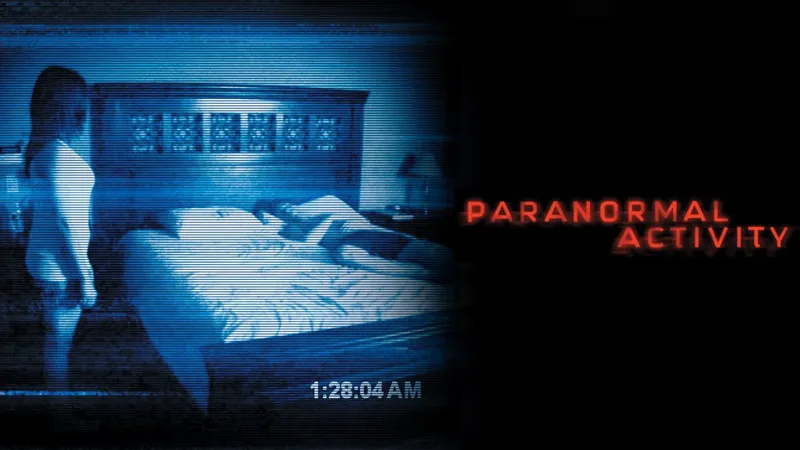
Paranormal Activity: Impossible Contradictions
On October 14, 2007, Paranormal Activity ends a long, circuitous journey to theaters, dethroning the Saw franchise from the position of Halloween season box office champion. The Saw franchise had dominated the October box office for five previous installments, and generated mountains of money.
A film shot with the equivalent of a seven person crew, on an original budget of fifteen thousand dollars (before some reshoots and tinkering by the director during the process of selling it to Dreamworks Studios), erupts as a cultural phenomenon grossing over two hundred million at the box office, and becomes progenitor of a franchise spanning six sequels, with a reboot currently in production. It also provides a more replicable model for found footage and first person POV horror films to be financially successful. The Blair Witch Project had been a phenomenon of its own in 1999, but it’s production model was far more experimental, meaning an inherently greater financial risk. In being the phenomenon it was,The Blair Witch Project introduced general audiences to the found footage/first person POV style horror film, but Paranormal Activity demonstrates The Blair Witch Project wasn’t a fluke, by creating a production model accessible to more filmmakers that producers and financiers are more likely to invest in. The result is many thousands of imitators and variations in the following years, establishing Found Footage as a niche sub genre.
These are the terms Paranormal Activity is most often discussed because it inspired an avalanche of imitators. The moniker found footage gets applied to a range of films which don’t technically fit the term, but that all rely on first person POV and/or faux documentary style. That they can be produced at much lower financial risk, and the style itself helps audiences look past their expectations from a traditional dramatic narrative film, while creating a more immersive experience by nature of removing the omniscient or third person point of view, has also meant there are many, many thousands of terrible found footage, first person POV and faux documentary horror films. Streamings services like Amazon and Tubi are teeming with them. There's even a streaming service dedicated solely to this sub genre, called Found TV. When these films are well made and they work, they’re uniquely unsettling and discomforting. When they don’t, they’re uniquely bad, ranging from laughable to unbearably boring. To be clear, “found footage” isn’t only confined to the horror genre and the way its been regularly combined with the faux documentary conceit, is proof of the influence of Spinal Tap, the film most responsible for exposing a wide audience to that narrative conceit. There are also examples in science fiction, comedy, and various mixtures of all three.
The more cynical critics of the sub genre write it off as the realm of talentless hacks, trying to rend a few dollars from audiences at the lowest possible financial risk, using cheap tricks a street magician could employ. In their perspective, it’s not “real art,” in the traditional sense of cinematic arts. Though I do think this characterizes too many of the terrible found footage films, I know this isn’t particular to found footage. If it weren’t for people who love storytelling and the art form of film itself, the commercial film landscape would be nothing but lazy, stupid, artless attempts to separate people from a few dollars. It’s the people responsible for creating films, the artists behind them, that create cultural phenomenons and spawn new genres and sub genres.
Given the history of storytelling in human culture, I don’t buy that marketing alone can create impact and influence over the long term. If that were the case, the 2014 Godzilla film wouldn’t have fallen into obscurity, except with a very small cult following. It was as heavily marketed as a film can be, and it made plenty of money at the box office, and very few people care that it exists just twelve years later. I inherently distrust the opinion of anyone who can only see an art form, a genre or sub genre for the worst it has to offer, because every art form, genre and sub genre produces a whole lot of stuff that doesn’t work, and is perceived as not very good. Part of the beauty of any art form, maybe especially film, is that any of it works. This incurious criticism of found footage also relies on an assumption of the worst about audiences, and I’ve written about why this a flawed perspective in film criticism and cultural criticism more generally. In this case, the assumption is that audiences are reacting to the funhouse scares of found footage alone, not so different from cats reacting to a laser pointer. It refuses to ask what about each individual film’s story audiences might be reacting to. Beyond that, the last few decades of scholarship and a new body of analytic criticism related to genres previously considered unworthy of "serious" investigation, has demonstrated that even films we think are terrible are expressions of important aspects of human experience and life.
In part because of it being recognized as the film that introduced found footage and first person POV to general audiences, The Blair Witch Project has been subject to the tradition of interrogation and investigation influential films are recognized as deserving. Paranormal Activity has more often been treated as the cheap imitation, probably in part because it spawned a franchise that’s a case of diminishing returns. But, with the twentieth anniversary of the film coming next year, the fact that it still remains influential in its own right, and new audiences are still finding it compelling when encountering it for the first time today, it’s worth asking what about it spoke to audiences and viewers in 2007, and still does.
The foundation of Paranormal Activity’s ability to effect audiences is in the authenticity derived from its improvised performances. Oren Peli may have come up with the concept and basic story outline, but essentially, Katie Featherston and Micah Sloat are creating the script in each scene, as their filming. The characters, Katie and Micah, draw the audience into the reality of the film, because the characterization and the interaction of those characters feels authentic. A part of this sense of authenticity less often referred to is also the fact that we recognize them as people, who’d exist in the environment the film portrays them in too. Micah and Katie are stereotypical young, white, heterosexual, upper middle class suburbanites,
One of the other major contributors to Paranormal Activity evoking the effect it does, and the success and influence its had as a result, is the verisimilitude for it’s faceless, formless supernatural tormentor to something very real.
From the time human beings started telling stories, the supernatural has been a stand in for power we can’t exert influence or accountability over. The supernatural exists separate from us, in terms of the physical reality we inhabit. If there are rules, we don't know what they are. It can exert influence over our reality, whether it’s at our behest or not. Witches, wizards, sorcerers are characters who through either inherited ability or arcane knowledge, are able to channel or petition some power beyond that of human reality, to be able to exert their will over human reality. Demons, ghosts, the various other supernatural entities we find in storytelling, are exerting this power for some purpose of their own. They are perceived to be malevolent, even when in some cases a ghost is understood to have some kind of sympathetic motivation, the intrusion of this power into the human experience is destructive. Demons, are essentially anthropormophization of the concept of malevolence performed by power.
In this way, we’re using storytelling involving the supernatural to question, portray and express our relationships, experiences with and feelings about power. Often, in the case of human beings attempting to gain power through some kind of pact with the supernatural or some kind of arcane knowledge, we’re simultaneously creating cautionary tales about the well established patterns human behavior when given access to or imbued with power, while simultaneously expressing social norms about the acceptable uses of power. This includes, but isn’t limited to, who we are socialized and acculturated into seeing as being acceptable to represent and wield power.
Paranormal Activity names its antagonist a demon, and the closest we get to confirmation is a psychic Katie has called for help, who tells them his area of expertise is ghosts, which are the spirits of human beings. What they are dealing with is not his area, and he’s not comfortable trying to deal with it. He also says that moving isn't going to solve the problem. In the common understanding of “hauntings,” ghosts are connected to places, the spirit of a human being that hasn’t “moved on” to the next plane of existence after their death, because of some emotional or psychological connection to the location. Micah is explicitly told not to try and communicate with it, because it would be an invitation. What Micah is essentially proposing when he’s told this, is to open a negotiation with this power. “We’ll find out what it wants, and give it what it wants.” He’s told, “In all likelihood, what it wants is Katie.” The film sidesteps a purely Christian interpretation with the psychic asserting that demons aren’t human spirits, and there are many theories about what they are.
This simple story using an authentic but stereotypical, white, heteronormative couple, a suburban setting and a supernatural representation of malevolent power, create a subtext that speaks to audiences about more than its surface storyline would suggests, as is so often the case with horror. Part of the reason horror is experiencing such explosive success at the moment, is intertwined with the fact that it often uses subtext to speak to more impactful aspects of the human experience. Not only do we as human beings respond to this emotionally and psychologically, during times when our social environments and the spaces we use to directly navigate conflict become too conflict ridden to directly address what those conflicts are about, storytelling by its nature provides an outlet for the necessary exploration of those conflicts. The human brain has evolved to ask questions as a matter of survival, and organizes itself through creating associations among the answers it encounters. Narratives is, in many ways, the shape of human consciousness.
One of the reasons horror is such an important part of the greater tapestry of storytelling, is that it is the art we turn to in order to investigate and explore our fears. As I’m getting older, one of the things that becomes clearer all the time is how much we underestimate fears affect on human behavior. Fear is older than any other emotion we have. It’s old enough, and so central to the survival of every organism, it may even be incorrect to call it an emotion. The fear response is built into our biology. It is so central to us, it’s built into our nervous systems. We can realize we are afraid, because of the responses our bodies are producing as a result of stimulation in the environment our conscious minds haven’t even detected. Our heart rates rise, our pupils dilate, our endocrine systems will be flooded with hormones that help create a greater focus on our immediate senses, and at times, it's this experience that alerts us to the fact that we’re afraid, before our conscious minds are aware there is something to be afraid of. The fear response can seize control of our bodies, from our conscious minds, in response to stimulus in the environment. We involuntarily jump, raising our hands and arms in a defensive response, before we even know what we’re defending against. Laughter is the closest thing to fear's ability to bypass our conscious mind's ability to mitigate our physical response to stimuli in the environment, where what we consider associated with emotions is concerned.
Paranormal Activity, at base, is the story of Katie being terrorized, and then possessed, by a power that can’t be negotiated with, can’t be bargained with, there is no way to influence and there is no way to extract accountability from. Micah spends the entirety of the film treating her lived and learned experience as if it can’t have any bearing on how they might solve the problem or develop some strategy to protect Katie. It’s not an unusual story. If we were to replace this supernatural power, a demon, with a man whose status or position in the world affords him a power beyond what Katie and Micah have access to, the story wouldn’t be very different throughout most of human history. The more stratified the society, in terms of things like class, race and gender, the less likely it has been for men who victimize women to be held accountable, creating more opportunities for victimization.
Part of what Paranormal Activity does, is to illuminate the way that our social norms related to gender create an interdependent set of patterns, using the victimization of women in order to create an ever present sense of anxiety, insecurity and for all practical intents and purposes, neuroses in men about their ability to perform the imperatives of masculinity. One of the foremost imperatives of masculinity in thiese gender norms, is the protection of women in proximity to a man. Yet, the social environment they all exist in, creates a never ending set of permissions for women’s victimization.
If we think about the many different ways society has created ways for men who victimize, abuse and exploit women to defer or escape accountability, the only way an individual man can “protect” the women in proximity to him would be to essentially enclose them in a glass box. We know that women are subject to exploitation and victimization in the work place, especially where power and status differences exist. This was the most forward aspect of the #MeToo movement. We know that even in education, women are subject to victimization, abuse and exploitation at greater rates than men. The stereotype of the lecherous professor isn’t an invention of fantasy, for instance, not to mention the number of scandals involving college and high school aged athletes. There are entire religious movements that hold the exploitation and dehumanization of women as fundamental to their practices, and the record of victimization within religious movements, organizations and institutions speaks for itself. Even in areas or sectors of human experience generally considered, “less important” or "less substantial," like the arts, the victimization and exploitation of women is treated as an acceptable norm. #MeToo and it's examples in Harvey Weinstein, Bill Cosby, and all the way down to the many thousands of examples of touring musicians committing statutory rape, even the arts are subject to this. There is, currently, an actor still getting extremely high profile parts, whose period of being a successful as a musician produced credible accusations of behavior with minors that go beyond the questionable to the criminal. So far as the public record suggests, there has been no criminal investigation of those accusations.
Even there, in what we consider our system for accountability, the justice system, it could not be more clear the barrier to securing accountability for victimization, abuse and exploitation of women is far higher than other kinds of violations, and the decrees we associate with accountability, sentences and judgments, come with far lower impacts than the impact of the acts women are more likely to experience or the judgments and sentences related to crimes with far less impact.
The reality is, there is no way for an individual man to protect any woman in proximity to him, but the social environment treats him as if there is a significant relationship between his value in society and his ability to protect women in proximity to him. When the social environment requires the impossible from the individuals, we are going to see a variety of disordered outcomes. Human beings respond to these conditions differently, because of the variation in the experiences we have as we grow into adults. Those experiences form the patterns we understand as acceptable behavior.
We are hardwired to try, in every possible way, to meet the expectations of our social environment, because doing so is central to the survival of the individual, the group the individual understands as central to their survival, and because of the way this has been central to the survival and success of the species. When we combine this with how entrenched the system of fear response is in human beings, a picture starts to arise of an organism whose survival is based simultaneously on its ability to conform to social norms, and whose fear response is going to be activated when that social environment creates a set norms the individual can’t have any expectation of meeting, given the predictive model that social environment creates. What that leaves, is anxieties, insecurities and neuroses that power has learned to manipulate to its benefit.
What we see in Micah, is that in order to meet the social norms of gender, he has to discount or dismiss Katie’s lived experience, her understanding of something she’s been experiencing far longer than he has. Part of how he understands his value to the society he exists in, is to perform masculinity, hence he has to protect her, whether or not he’s in the best position to even understand what that means. This is in keeping with the contradiction inherent that is the meeting place of the requirement to protect women in an environment of permissiveness for women’s victimization. There is no way to simultaneously respect a woman’s autonomy, and to protect her in that environment.
This is how even well meaning men, end up engaging in behaviors they don’t understand are dismissive or controlling, and why our norms related to gender have to discount or dismiss women’s lived experience and the wisdom gathered over decades and centuries about the kind of threat they live with. At the individual level, to allow the decisions about what “protection” means is to essentially not be responsible for that protection. Social norms dismiss and discount women’s lived experience and collective wisdom about how they experience threat, in order to make it possible at the individual level, but also because collaboration between men and women to achieve the goal of removing this scaffolding of permissiveness, would so significantly change our relationship with power, it would automatically trigger asking reams of other questions it’s not beneficial to power for those of us subject to it to be asking. It would lead to far too much recognition of the way our understanding of power veils or erases how vast its manipulation of our fears is as a method of control.
One of the other reasons Paranormal Activity evoked, and still evokes, the response from audiences that it has, is in who is being presented as vulnerable to this cycle. History, both US and human, is full of men who were rendered incapable of protecting women in their proximity because the threat to them was coming from another man of greater status in some way. The basic structure and story of Paranormal Activity could be a story about a Jim Crowe sharecropper, his wife, and a landowner. It could be a story about Chinese immigrants and a railroad foreman or landowner. It could be a story about immigrant laborers today, and any number of different people men who decided they wanted possession of the woman in the couple. Switch the Ouija board with a note tied to a brick, thrown through a window. Switch the small, slowly escalating intimidations the night vision camera captures with a feudal lord, making excuses to visit a peasants dwelling. Paranormal Activity changes the threat to the supernatural, a stand in human beings have been using as the stand in for unaccountable power for about as long as we’ve been telling stories.
Paranormal Activity places a white, heteronormative, middle class couple in this position, in a social environment where the people who fit that description have spent seventy years being the center of culture, and as a result, have been specifically acculturated to consciously believe they would have some recourse for accountability to justice. Seeing a white, heteronormative, middle class couple subjected to the same kind of power imbalance that creates the permissive environment for women’s victimization creates the kind of cognitive dissonance where fear grows and is often most effective. The sense of privilege people who fit this description are afforded, suggests this isn’t supposed to happen to them, but if we listen to the lived experience of the women who live in this class and social status, it’s very clear the environment we live in is only interested in protecting them from people from lower class and social status. It has little interest in providing them protection or accountability from men in their class and social status, and if we look at the abominable reality of the Epstein scandals, it has zero interest in providing them protection or accountability from men above their class and social status. Power must be forced to provide accountability or anything like justice, and what we're seeing now, in this lack of response to the Epstein scandals, is power reacting to being forced to do so by the #MeToo movement.
In Katie’s possession by this power is also metaphorical, and Micah’s death at her hands is representative of the inevitable failure at the heart of this contradiction in gender norms for masculinity. His self identity clearly has a heavy foundation in these “traditional” gender norms, and to “lose” is to be robbed of his masculinity, which for all intents and purposes, is death. This is, again, as I outlined in my piece about the tropes of love, relationships and romance in film, the transitive association of the word possession. It has multiple meanings, and when we’re talking about it in terms of the supernatural, a spiritual possession, it’s a metaphor for physical possession.
Ultimately, what Paranormal Activity is revealing, through a fun, seemingly superficial narrative that provides the audience with the experience of a haunted house attraction, through it’s improvisational production process, is that rape culture threatens women’s physical and spiritual well being, and it also threatens the ability for men to find psychological and emotional well being because it denies them what patriarchy and their sense of a place in the social environment requires. It puts on screen the fears that bubble below the surface in the environment that creates an impossible to solve contradiction about men’s ability to fulfill the needs society tells them they must, and requires they deny women the kind of respect that is more likely to result in fulfilling, reciprocal, relationships two people work out together, in relation to their individual needs, wants and experiences.