


The Art of Fear and the Power of the Frame: The Fear of Fear Itself
Horror is the art of fear, the uncomfortable and the taboo. This is to say it's the storytelling genre we use to explore those things. This can mean very specific, individual fears. It can also mean collective fears. It also means exploring ideas, themes and topics that sit at the nexus of that relationship between the individual and the collective and so on.
Growing up, there was a prevailing attitude that being too interested, too passionate about horror as a genre was weird. To those who believed this most fervently, it was a sign of being "off" somehow, a sign of what we would now call a personality disorder or a sign of a predatory nature otherwise well hidden. It seems there's some generation divide with this experience, which I take as a positive, but if I had a nickel for every time someone responded to the revelation I was passionate about the horror genre with something resembling low grade revulsion, I'd have enough money to get a creative writing degree or financing my own film, something the majority of those same people would deem throwing said money away. "How could you like that stuff?" would be accompanied by a scrunched nose and squinting eyes, as if I'd said I loved Twinkies stuffed with raw fish guts.
There's a growing body of research into why people are passionate devotees to the horror genre. For a long time into adulthood, I didn't have much of an answer for why horror was the genre that captured my imagination and inspired so much passion. Reading and listening to others talking about their relationship to it, both those who loved it and those who loathed it, helped me find my way to understanding my answer. Having come across this research has demonstrated not only am I not alone in the reason I fell for horror, but the reasons are varied, and other people have made it theirs for reasons different than my own.
I was alerted to the existence of formal research when I read one of the perennial articles dedicated to the question, some years ago. It’s a tradition. Some piece of horror media or storytelling becomes part of the zeitgeist of its time, and newspapers and other periodicals start assigning reporters to do some quick interviews, get a few pull quotes from different artists in the genre and other people who represent other cultural institutions, to try to answer the question, “Why horror?” If you search the archives of The New York Times or Time, you’ll find some version of these stretching at least as far back as the period when the Universal monster films were dominating the box office. The Universal monsters were de rigueur by the time I was a kid. Freddy Krueger, Jason Voorhees, and Michael Myers had made their way out of theaters, onto lunchboxes and into the cultural lexicon as recognizable icons. Even people who didn’t sprint to theaters for each of the new film featuring those characters knew who they were. It was during that time I came across the first versions of these articles I'd seen. By the time Rick Grimes and the cast of scraggily survivors follwing him in The Walking Dead became a cultural phenomenon, I’d read a few thousand of these articles. In the period that began the current era of horror, that string of years when It Follows, The Babadook, The Witch had become culturally significant, and Get Out became both a blockbuster financial and critical success, hundreds more of these pieces were written.
I kept reading these “Why horror?” articles through the years, even though they were basically repeating the same half formed conjecture, in hopes we’d make some progress, start to learn something new. It was like a lightning strike when I came across a piece quoting Coltan Scrivner, a behavioral psychology researcher, talking about formal research into the question. It turns out, Scrivner has made morbid curiosity his specialty. Morbid curiosity is defined as the motivation to seek out information about dangerous phenomena. The passion for horror films is just one aspect of his research, which also covers things like bungee jumping, parachuting and haunted house attractions. It was through reading more of interviews with and pieces written by Scrivner I became aware of the existence of The Recreational Fear Research Lab at Aarhus University in Denmark. I’ve been consuming as much of this research and literature as I can since.
Recently though, I came to a question I couldn’t stop asking. Why is horror a genre that warrants this depth and persistence of investigation and interrogation? This doesn’t come from some sense of it being meaningless or worthless or that it shouldn’t be done. One of the lessons I’ve taken from the last decade is that the existence of verifiable research on any conceivable topic is better to have than not, even if it’s conclusions seem self evident by “common sense” standards. Not only may the “sense” of what’s common not to be very sensible, it may be far less common than it seems, depending on what circles you travel in. I’m glad the research is happening and, obviously, I find it fascinating.
At the same time, horror is just a genre of storytelling and art more generally. We know that art and storytelling serve a number of functions in every culture and civilization. They help make shared meaning. They help confer and affirm shared values and norms. They can be a mitigator or navigator in conflict arising from clashes of values and norms. They help created a shared symbolic language, and so on. I’ve never seen mention of equivalent research into say… comedy, drama or action films.
So, if horror is just one among the many different ways we do this, why is it different enough to warrant this variety of interrogation?
The answer can be found in the space between the attitude that sees horror as a derelict genre, a genre speaking to, encouraging and nearly worshipping the most base aspects of human existence, and what the research is saying about who horror appeals to, and why.
The “who” in the demographics sense, is everyone. There is some degree of drift, depending on the specific sub genre, but overall, the audience for horror is the most diverse, in terms of gender, race and sexual orientation and class. Now, if you understand horror as the art of fear, this makes a certain level of sense. Fear is universal. All human beings experience it. It may have different cultural dimensions, but the core aspects of how we experience fear and what we fear, makes those boundaries easy to overcome.
The research, so far, has identified the horror audience as having three different categories. The first is the Adrenaline Junkie. Their relationship to horror does give credence to one piece of conjecture in the thousands of pieces I've been reading since childhood. The Adrenaline Junkie enjoys horror for the same reason people enjoy roller coasters. The thrill of fear, within parameters that are safe. The Adrenaline Junkie will try to maximize their immersion in the experience, to heighten that effect.
The second category of horror fan is the White Knuckler. This category has no positive association with the experience of fear, unlike the Adrenaline Junkie who finds it exhilarating. The White Knuckler may even have nightmares as the result of engaging with horror. But, they keep coming back to the genre because it is an opportunity to learn about their own fears and reactions to it. Unlike the Adrenaline Junkie, the White Knuckler will try to minimize their immersion.
The third category is also the most newly revealed, The Dark Coper. They tend to experience the benefits of both the Adrenaline Junkie and the White Knuckler, and are using horror as a way to cope with various aspects of their lives, like anxiety. They experience excitement and exhilaration, and also use it to learn about themselves, and develop coping strategies for stressful situations. The Dark Coper, like the Adrenaline Junkie, will try to maximize their immersion in the experience.
What the research into the question “Why horror?” is demonstrating is that the answer is describing different relationships with fear.
Probably the most famous colloquialism about fear within US culture is, “The only thing we have to fear is fear itself,” and in a way this mirrors the idea that horror is somehow wretched, a thing from so base and primal a part of our nature, it has nothing of real value to offer us. At the same time though, we do know that fear is universal. Not just among human beings either, but among every living thing that has anything we recognize as even the most rudimentary consciousness.
One of the things that’s been hammered home by reading the findings of this research, is how much responsibility fear has, not just for our individual survival, but for the evolutionary success of the human species. Consider that the fear of starvation made a significant contribution to humans making the transition from hunter gatherers to agrarian societies, which enabled us to begin building civilizations. Fear is so much a part of what we are that our brains and nervous systems have evolved to work in unison to detect and respond to threats.
It only takes a certain number of years on the planet to have the experience of overcoming a fear or set of fears, only to find they're replaced with new ones. Maybe we overcome a fear or set of fears through a particular achievement, being the first in our families to earn a college degree, or maybe its something more like a breakthrough in personal maturity (possibly aided by therapy). Then we find life isn't just sunshine, roses and butterflies, as we'd hoped but the new circumstances afforded by our achievement or breakthrough have given rise to an all new fear or set of fears. This isn't some kind of personal failure. Part of our evolutionary success as a species is our adaptivity, and fear is so encoded in what we are as human beings, it also adapts.
In this, the fear of fear itself, is to fear one of the parts of ourselves and what we are that is most responsible for our survival and well being. It may be unpleasant when we’re experiencing it, but fear certainly deserves more consideration than to be blindly feared and treated like an adversary. What the research about horror fans is suggesting, is that maybe a friendlier relationship with fear itself is possible, and a bit more consideration for how we react to it is in order.
It’s not a stretch to say that some of the most destructive and dangerous people among us clearly have no real working relationship with their own fears, and yet it’s plain as day to everyone around them that fear, and it’s various masks of anxiety and insecurity, runs their lives.
We’ve all seen this, we’ve all met these people. We see them on our televisions. You know them when you see them, don’t you? These people who maybe don't claim to have no fear, but do present themselves as if this is true, as if they’ve conquered it or it was just never part of shaping them in the first place. It’s something that was communicated to men as essential, for a long time (though more and more to women these days too). We're told that to allow others to perceive us as being afraid is to invite victimhood. But when we see someone who moves through the world this way, it’s always a case of “He doth to protest too much,” isn’t it? Their desperation to be perceived as strong, without fear, just tattoos the desperation of their insecurities all over every word and action, doesn’t it?
The belief that fear can be conquered is no different than believing in the Boogeyman. It’s intrinsically connected to what we are, no matter who we are. Now, of course we pay lip service to this in some ways, but that’s what it is, lip service. We say things like, “Courage is acting in the face of fear,” but we trot that one out in the more severe moments when the inability to see a best option is preventing us from taking action or when we may need to make that ultimate sacrifice in service of others. For the most part though, we act as if fear can be conquered or ignored, not as if it’s like breathing, a thing coded into us to keep us alive.
When seen this way, the prevailing attitudes about fear are denying a central part of our own humanity. It would make a whole lot more sense to treat fear more like an old friend whose been there with, and often for us, during our best and worst times. Sometimes they have unpleasant truths to share with us, sometimes what they have to say doesn’t pertain to the situation as well as they think it does, but we do have to hear them out to know which of these may be true, and even more so, we can rely on the fact that right or wrong, in some way, they always have our well being in mind. Maybe they don’t always communicate so clearly in the heat of the urgency of what they’re trying to get across or because they’ve been ignored so long, they’ve turned more to the anxious variety of fear, interjecting regularly in parts of our lives unrelated to what they're trying to tell us, but it’s only by hearing them out, like siting with an old friend over a cup of coffee, we come to hear what it is they’re trying to say, and whether it does pertain to our well being at the moment. We don’t have to succumb to fear, and if we look rationally at what being human is, we can't conquer it. Realistically, we don't have much of a choice about living with it, so we might as well get familiar and friendly with it.
There is a constant and often false distinction between what’s good for us as individuals and what’s good for others. There's a collective instinct to reach for either/or, when it's much more both/and. This plays into how we think of this intrinsic part of our humanity that is fear. To be able to live at peace with this aspect of our humanity is to have the more genuine sense of confidence grown from the humility of recognizing ourselves for what and who we are. It also means we’re less likely to be acting from behind the veil of insecurity that is arrogance, a desire to be so or belief that we are so exceptional as to be beyond human, and instead sets us in the understanding of being just as human as everyone else. We can't mitigate the consequences, to ourselves or others, of fears we don't even acknowledge.
This fear masquerading as arrogance has wreaked havoc throughout human history, hasn't it? Human beings are simultaneously unique, but not special. It’s part of what makes us so fascinating, and is in turn, part of why we turn to art and storytelling. The individual uniqueness of what we create is among the things we look for in each others creations. We can achieve things that are exception, but none of that is extra human, super human or para human, is it? If it were, human history wouldn’t have so many exceptional examples. In fact, many of the most unique and exceptional achievements in human history are anchored in just how much those individuals understood themselves to be nothing more than other human beings are. Observation of people around us and self reflection, brought together, become the things we create, and occasionally, some of us do create something exceptional and yet it it always intrinsically human.
This belief that one can be or achieve “more than human” is delusional. Nothing good comes from indulging it. Who, in US life today is causing more havoc, wrecking more lives, creating more long term consequences, than those who are living in denial of this basic fact that fear is a central part of what a human being is? It takes no time at all to look at the part this has played in so many of humanity’s darkest hours too. To put fear in the perspective that it is an intrinsic part of what we are, and something we should embrace as being in part responsible for our well being, is to highlight it’s not a coincidence the attempt to conquer or eradicate is so thoroughly woven into the worst of our history. It’s not a coincidence this belief we can be more than human has some relationship to Neitzche’s ubermensch, a concept the Nazis took to its most horrifying logical conclusion in their eugenics and extermination campaigns.
Neither is it a coincidence the people who so thoroughly want to be seen as having conquered or eradicated their own fear are so often adept at manipulating this “fear of fear itself” as a way of accessing power and evading accountability. Who would better understand the psychological and rhetorical mechanisms and scaffolding that makes it work? It’s a thing they’ve spent their lives perfecting, with themselves as the subjects of their experiments. They are, after all, despite their desire to be perceived otherwise, just as human as the rest of us. They're good at manipulating the fears of others, because of how human they are, not because they have somehow transcended it.
It’s also why the arts in general, and horror specifically, become targets for censorship, especially in an authoritarian context. What the research about people drawn to horror is telling us is that the genre attracts people who want for a different relationship with their fear, and it encourages us to collectively have a more friendly relationship with fear. It makes sense horror would be experiencing a boom right now too, considering what the last twenty-five years of US history looks like. 9/11, The War on Terror, Abu Ghraib, the compounding failures of what we refer to as Hurricane Katrina, the unrest and uncomfortable questions which were responsible for the creation and spread of, as well as the response to Black Lives Matter, the rise of Trump and Christian white nationalism’s reassertion of itself as the dominant perspective of power… it’s no shock people would be searching for a new relationship to fear. It explains why horror has been producing some of the most succinct and astute social commentary of our time as well.
To this point, there is a narrative feed back loop that was established during those times when being a passionate fan of the horror genre was met with revulsion, suspicion and confusion. It didn’t help that Satanic Panic came along in the eighties, extending into the early nineties, when anything in the arts that that was comfortable with the darker aspects of humanity and human experience (including all that is taboo), came under attack in media and public consciousness.
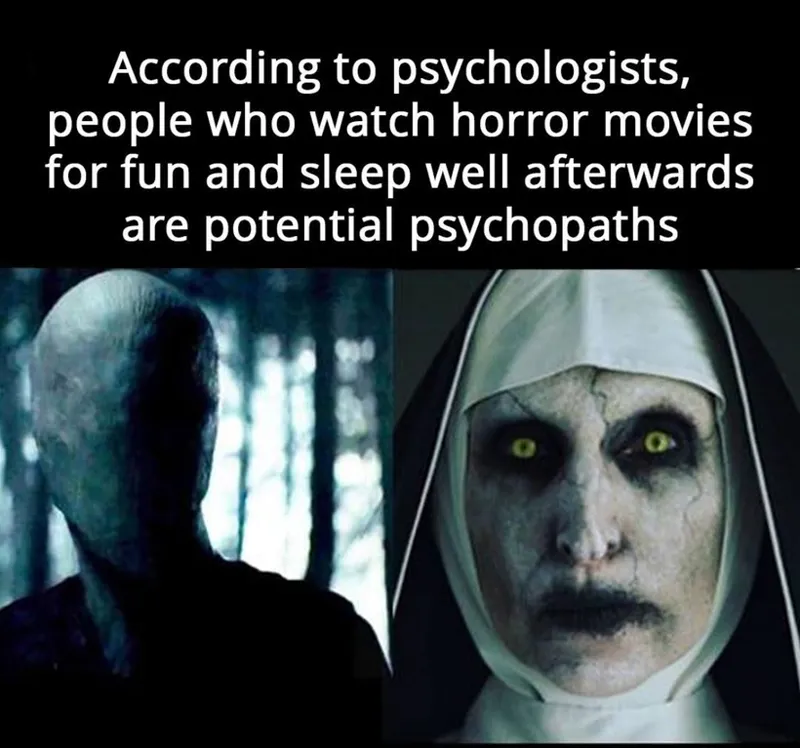
No small portion of the horror crowd (as Phil Nobile, editor of Fangoria magazine, aptly described us) who experienced this adopted a kind of ironic self protection. There is a kind of pride in referring to ourselves as weirdos, freaks and psychos essentially. It’s functioned simultaneously as a kind of in-group identification, an in joke, and a sneering middle finger at the absurdity of the assumption there has to be something “off” or “wrong' with someone horror has significant appeal, allure and meaning to. You can see a typical expression of this below.
This narrative feedback loop related to horror may be older than that, but Satanic Panic certainly helped extend and solidify it further. Another similar feedback loop was established related to heavy metal, that is instructive. During the Satanic Panic, even more than horror, heavy metal came under ridiculous suspicion and accusation of being part of some larger conspiratorial plot to spread Satanic worship and encouraging every form of anti-social behavior the human imagination can conjure. A combination of record companies and artists recognizing the marketing opportunity of controversy, and heavy metal fans adopting a sneering middle finger attitude toward accusers of their preferred genre, resulted in heavy metal artists and fans adopting the language and symbology commonly associated with Satanism. It’s a mirror of horror fans adopting an in group identification as weirdos, freaks and psychos, and horror creators instilling their work with an evermore graphic gore, from stomach churning realism to comically operatic camp, when the attempts to open to put a secular mask on the Satanic Panic turned to feverish squalling about “violence in media.”
As people among the horror crowd, it would behoove us to look deeper than the surface level absurdity of the Satanic Panic’s attacks on heavy metal. As deserving of mockery as it is, it’s naive not to take into account that it had real costs, caused real harms. There were the many false prosecutions and convictions of people in education and the daycare industry by the thousands, but there were also false prosecutions and convictions of heavy metal artists and fans. Both Ozzy Osbourne and Judas Priest were dragged into court over accusations they inserted “subliminal messaging” into their music that encouraged teen fans to commit suicide. There is also the well publicized case of The West Memphis Three, convicted and jailed for murders they didn’t commit, which by default, meant someone who did kill three eight year old boys was never found and prosecuted.
These are the most obvious, easily recognizable costs, but the lawsuits against Ozzy and Judas Priest reveal something else. Young people died by suicide, and instead of reckoning with this, their parents were able to evade it by lodging product liability lawsuits that were essentially delusional. In that light, considering how pervasive the belief in Satanic Panic was, and that it was enough to allow for these lawsuits to proceed into actual trials, it's impossible not to wonder how many kids needed support and help, but went without it because it was easier to say things like, “It’s that heavy metal. If they’d give that up, they’d be fine”?
Being an adolescent is difficult in almost any circumstance, and is going to come with hills and troughs, but that doesn’t mean these are the only difficulties adolescents, teens and young adults face. Withholding support, because of an affinity for a genre of music and being unwilling to investigate further is a kind of neglect isn’t it? This might seem hyperbolic to those who didn’t live through the Satanic Panic or those who’ve since been enthralled by the rose colored glasses of nostalgia, but you have to ask yourself how over the top it seems in conjunction with just how many false prosecutions and convictions went forward at the time. There is no shortage of people who were alive, and whose perspective isn’t so steeped in nostalgia, who understand the truth of this as well. It wasn’t just here in the US either. Once the grifters and charlatans who made Satanic Panic a national hysteria realized their constantly escalating claims were no longer finding purchase among the US population, they took their toxic show across international waters to the UK, AUS, Ireland, Italy and South America. We more or less exported this delusional hysteria, unfortunately.
We’re living in fearful times now. Here in the US, it’s easy to lay it all at the feet of Donald Trump and the Trump administration. Trumpism, with it’s roots in and connection to Christian white nationalism, has rather expertly manipulated the various fears of the whole population. They’ve of course been aided by those whose obsequiousness to power has no morals or integrity, including careerist politicians, journalists and other "media personalities," who believe they can wield it for their own ends, either by they trying to curry favor with Trump or somehow see it as a tool they can use to present themselves as the alternative to Trumpism. We’ve reached a point where in both traditional media and social media, it’s difficult to tell the difference between who is trying to describe conditions as they exist and who is trying to maintain or advance their position through this constant manipulation of our fears.
The perspectives we have on, and the way we talk about fear enables all of this, to different degrees. Even among those I’d consider myself allied with, there is no shortage of blindness to the part of fear plays in the life of the human animal, a drive to wipe it away with calls to courage and bravery, and to me, this seems ill advised. First, it’s worth it to understand that the existence of fear, the intrinsic nature of it, leaves us all open to it’s manipulation. Trying to be the ones to manipulate it isn't advancing anything, because we leave ourselves and each other as open to manipulation from grifters and charlatans as those who make up the movement that is Trumpism.
Second, to skip over our fear, to act like courage and bravery are simply to act despite the presence or existence of our fears, leaves us vulnerable because it is no different than what authoritarians offer and demand. It is to cut off or deny and suppress this most essential part of being human. If there is a solution to the ease with which our fears can be manipulated, it’s not a superficial facade of strength. It’s to know and understand out fears more intimately. We deny ourselves and each other the peace we deserve when we deny our humanity. The results are never positive.
This other path, highlighted in the research about the different ways the audiences for horror is accepting and approaching fear. Advocating for this is one small way those of us among “the horror crowd” can begin to participate in encouraging a positive change that isn't just superficial. It would also prevent us from participating in a narrative feedback loop that, like the one related to heavy metal during the Satanic Panic, is likely to have negative consequences for many among the “horror crowd,” and many who don’t count themselves among us. It's time we stop referring to ourselves as sickos, weirdos and psychos for this reason, and more.
It is to say getting cozy and friendly with our fear is good, and to understand and explore it, to treat fear as something that will be with us so long as we are conscious, something that has done plenty good for us, and will likely do good things for us in the future. This is, according to what the research says, what horror is and what it does for us, within the greater scope of storytelling as a whole. A more shorthand way to say this is that horror is the exploration of the realms of our fears in a desire to know fear, and as a result, ourselves more intimately.
There's another reason we should take into account as well. The self identification as sicko’s, weirdo’s and psycho’s is counter productive and verges on dangerous to those among the horror crowd who have a history with mental illness and/or neurodivergence. The way we see people in power positioning these things and what they are proposing is a warning and should be alarming. Combined with the embrace of an ethic of censorship, unlike anything we’ve seen since the Satanic Panic, the opportunity for the kind of negative feedback loop that lead to many, many people being denied the support and help they needed because of their association with heavy metal should be plainly apparent. Worse, the way RFK Jr. is talking about mental illness, autism, neurodivergence broadly and things like developmental disorders, is what precedes eugenics programs attempting to remove people from the population and gene pool. Many different mental illnesses and developmental disorders have genetic components. Autism and neurodivergence are naturally occurring genetic variations. The only way to "cure" these is to remove the people who carry those genes from the gene pool, which will require either forced sterilization or extermination. There is no more polite way to put it.
In hearing this suggestion, I'm sure there are some who will say, “They’re already targeting books and other forms of media made by and/or for marginalized people and minorities, so why try and make it about horror?”
This is true, and I’m in no way suggesting those of us within the horror crowd retreat from our efforts to resist and prevent the efforts to censor those works more broadly. Unlike what so many people in power often say, I think we are all capable not only of walking and chewing gum at the same time, but are also capable of understanding the broader patterns at work here, and being more effective in how we respond to them. I'm not trying to make this about horror, but to clarify the particulars of vulnerabilities for horror as a genre, and for the horror crowd as fans.
Horror has yet to come under a direct, concentrated attack, but it’s naive to think the combined box office success and broader cultural phenomenon that was Get Out, with Jordan Peele’s body of work following it, wasn't a significant factor in the birth of the “Woke Hollywood must be stopped,” narrative. All of Peele’s work has dealt relatively directly with with some aspect of race and racism in US culture, and all of his films have been extremely successful. Peele isn’t the only one whose work sits and the near perfect nexus of sociopolitical commentary, technical excellence and sheer, undeniable entertainment value. If you think the right hasn’t noticed Ryan Coogler, and the runaway success of his films, including this year’s stellar Sinners, I have a bridge to sell you. The single biggest reason Coogler and Peele haven’t come under direct attack by the more popular and/or powerful members of that far right movement, is just how plainly entertaining their work is. Coralie Fargeat's The Substance, made a huge splash for a horror film, especially for a fiercely feminist independent film, chock full of eye popping body horror too. It didn't win many of the Oscars it was nominated for, but being nominated at all was a minor coup, signaling a voting body more open to, and therefore more willing to give attention to horror.
This also speaks to the fact that horror’s audience is among, if not the most divers audience of any genre right now. That diversity is also reflected in who is currently able to attract the audiences attention. There’s still a long way to go in there being equity in whose work is given production financing and promotion, in film and publishing, but it is also clear identity isn’t a barrier to finding an audience within horror, who don’t share the creators identity. Websites and podcasts targeted to the audience for horror are embracing and shouting accolades for films and books from marginalized creators, whether they come from studies and major publishers or from the worlds of independent film and publishing.
It’s also a well established fact that authoritarians and the movements that support them, always use manipulation of fear as part of their efforts to gain and maintain control of the population. While it’s true they target the arts in a broad and general sense, it’s true this tends to have the most deeply felt impact on horror and comedy. Comedy is dangerous to that control because it has the capacity to reveal the absurdity of those efforts to create and maintain control.
Horror, by its very nature encourages a more complex relationship with fear, threatening one of the authoritarianism’s most useful tools. Consider that the modern horror film is said to have entered a Golden Age in the 1970s. With the Motion Picture Production Code (often referred to as the Hays Code) coming to an end in 1968, it gave horror more leeway to explore all that is uncomfortable and taboo in life in the United States. It also meant a boom in exhibitors (theaters and drive ins) willing to show unrated films. Filmmakers still ran into censorship issues with the newly established MPAA, but this meant a process of arguing or negotiating after a film was finished, where the Hays Code was an essential part of the decision about whether a film could get made in the first place. Seminal films like The Texas Chain Saw Massacre and Night of the Living Dead may have been made prior to the change to the MPAA, but they would have struggled to find an audience, without exhibitioners willing to show them. A film like Rosemary's Baby never would have been made at a major studio if it weren't clear the Production Code was about to be tossed in the trash. The end of the Production Code profoundly changed horror. The profundity of that change, and the attitude toward this in conservative perspectives is reflected in the Satanic Panic in the US, its secular cousin in the "violence in media" hysteria, and mirrored across the Atlantic in the UK passing its "Video Nasties" legislation, banning both the exhibition or ownership of a list of films, almost exclusively from the genre.
Today, the utility of a distant, vague, incurious relationship to fear should be clear in the current administration’s drive to deploy federal law enforcement and the National Guard in cities where the opposing party is in the majority in elected governance. They have plainly stated Washington D.C. is in just a test run. In reality, crime has continued to drop as we, the populace, have continued to make our way toward a more equitable view of the world and each other, however halting, fraught, and full of conflict that process has been.
For all of these reasons, it’s naive to believe horror won’t come under attack by a more direct campaign of censorship. The likelihood is high, and those of us with some interest in the health of the genre, and conducting ourselves as decent human beings, whether we are creators, journalists (be that writers, podcasters, streamers or whatever form it takes), academics or devoted fans, can begin talking about horror as a vehicle for, a part of developing a healthier relationship with fear, individually and collectively. Inherent in this is a rejection of the bigoted concepts that have been used to Other so many different people, all of whom are among us in the horror crowd. We can embrace specificity, Black horror and queer horror as more recognizable examples, while embracing they contribute to the universality of horror, by exploring this universal human experience in a more specific context. Part of what horror can do, is to communicate to the broader audience, the fears resulting from living in a society that has Othered marginalized people. Horror is currently demonstrating that, more than any other commercial genre, and it behooves fans, creators, the genre and society itself for this to continue. It also helps to protect many among us from the threat already rising.
It’s time we set down the idea that being a horror enthusiast makes us or anyone somehow off, broken or mentally it. Instead, we call it what it is, plainly, without regret, shame, guilt or aggression. It's time we embrace that horror is the art of fear, and we collectively need to develop a better relationship to it as part of the effort to protect ourselves and each other.