
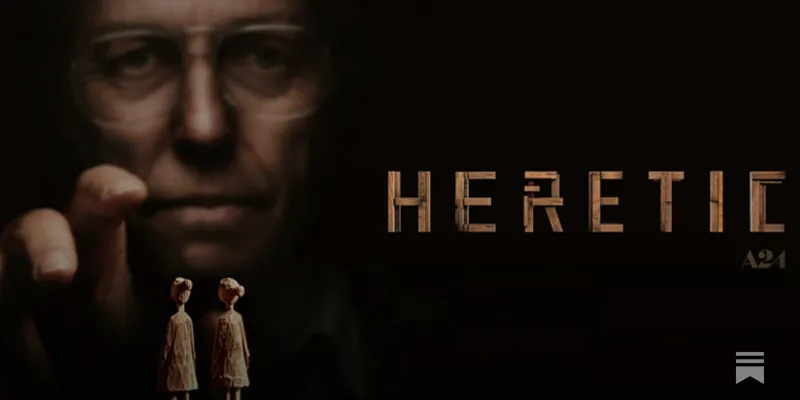
Heretic (2024, Scott Beck and Bryan Woods)
Heretic gets an unusual place in the record of my experiences with film. I can't remember the last time I came out of a film with such a negative response, on first viewing, only to have it completely turned around in a second viewing. When the credits rolled the first time, I thought it had committed what is one of the few genuine sins in storytelling, by what I acknowledge are personal standards. It struck me as a film which took up a few hot button or controversial topics, then attempted to not just have it both ways, and then tried to avoid saying anything about them, through the excuse of "giving the audience the entertainment they want."
It was indeed entertaining. Within the first ten minutes or so, I was fully engrossed and invested. In that first viewing, it lost me in the last ten minutes, when I felt it dropped it's central themes in order to not have to make a definitive comment on them.
There are films that do this. Joker was probably the last film I so thoroughly disliked, for this reason. They are rare though, and even more rare are films as well executed as Heretic in crafting an experience. There is a bit of violence, a bit of blood at the end of the film, but these aren't the genre materials Heretic is interested in crafting it's sense of horror from. It excels in a different variety of discomfort, a different variety of unsettling and disgusting, and it so well executes these, I thought there was a good possibility I was missing something. I couldn't piece together how this writing and directing team of Scott Beck and Bryan Woods could understand how to navigate and calculate the tension, the audience experience, the unrolling of scenes and information, and simultaneously believe they could get away with saying nothing.
My experience with Joker was that I initially thought it quite a good film, but within twenty-four hours I'd had a complete turnaround in my feelings toward it. I realized the film was a con, which is bad enough, but worse a con that played on both the public sympathies for people with mental illness, and can't function without one of the most harmful public misconceptions about the experiences of people with mental illness. It was attempting to have its cake and eat it too, doing so by founding its success on the harmful belief that there is a large portion of the population who claim to have mental illness to use it for sympathy, for attention, and so on. It's a film that essentially calls the audience fools for empathizing and identifying with Arthur Fleck, when it doesn't allow them the option of a perspective that isn't Fleck's. It stinks of the sneering edgelord quality of 4chan, as if its foolish to allow oneself empathy, and only serves to invite manipulation, being conned. It uses the unreliable narrator convention as a weapon for justifying an existing stigma. Being putting an actor with Joaquin Pheonix's level of talent and charisma at the center, and generally being technically well made, it's a well executed scam, but it's a scam all the same.
I don't bring up Joker because it's a film I had such a visceral distaste for, but also because that same edgelord quality has been regularly invoked in so much of the response to Heretic. It's not untrue, but I think this contributed to my initial misreading of the Heretic, along with the more broad state of storytelling on film.
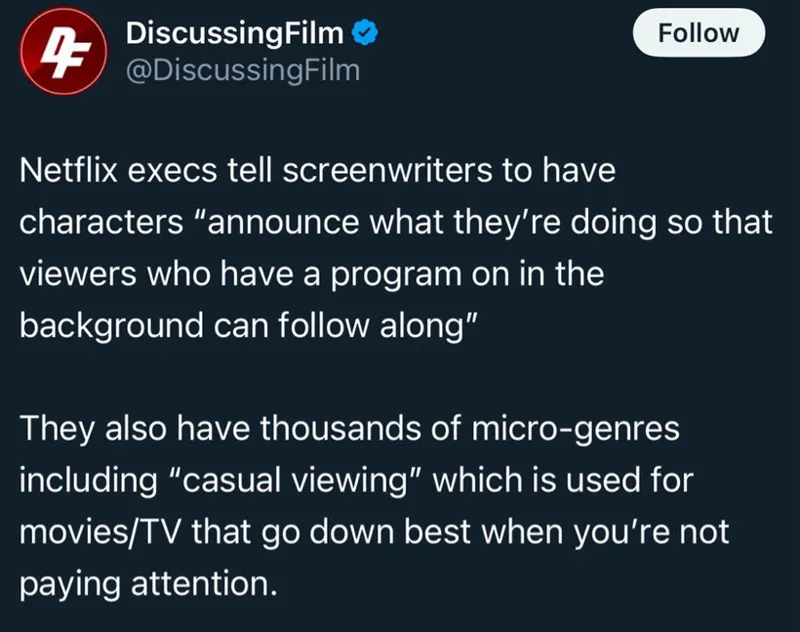
Every storyteller has a set of choices to make in how they convey what they're trying to do, what they want to evoke from the audience, with a story. The more conventional way, the way most films approach this, is for the film to tell the audience what's happening, even if it's in the form of showing it to them. This isn't an inherently bad way to tell a story, but the bad version of this kind of storytelling is so widespread, it leads to things like this:
Another way to tell a story is to use the structure and conventions of genre to immerse the viewer in the experience of the characters, essentially recreating that experience. One of the my favorite films of last year, Blink Twice is structured to recreate the experience of being re-exposed to something which has been traumatic in the past, along with the inherent psychological need to avoid it, and the social expectations to forget it. I'm fairly certain it wasn't more well received and more talked about, because audiences didn't grasp this intent. It was talking about all of those things by using it's story to put the audience through that experience, not simply presenting them and commenting on them. Audiences, I think apparently including myself, are getting used to the variety of storytelling that is much more "show and tell" and less recreating an experience from firmly within a character's point of view.
Heretic is, in it's way, using both of these and is about the way people with ill intent, in this case a sadistic misogynist, use the space between the two kinds of storytelling experience to disorient, confuse, distract, disempower and rob the targeted individual (or audience) of their sense of dignity and self determination. The "show and tell" aspect of the storytelling has a sinister intent, as distraction from what is actually happening.
Hugh Grant's character, Mr. Reed, is monologuing constantly about religion, in various ways. He makes claims about his own atheism. His claims about the dogma and texts of various religions, his historical analysis, all of these are factually accurate, and technically correct. In the same way that cults like Nxivm use the language of self help or extremists like white supremacists use the language of the political and social, it is about breaking Sister Barnes and Sister Paxton (Sophie Thatcher and Chloe East) sense of self and reality until they are willing to submit. It's not coincidental Mr. Reed is doing so through this language of religion and atheism either. It is a model religion perfected and religion gives us the greatest number of concrete examples, but it is not a model exclusive to religion.
Reed is also relying on social convention in a number of ways. To my mind, the arguments about religion are both distractions and signpost. It's part of how he's arrogantly telling Barnes and Paxton his intent, in an arrogant, sadistic trickster sense, but also as distraction from the degree to which their holding to social conventions is allowing him to continue this exercise. Through this Heretic is commenting on the degree to which the behavioral expectations of gender require women to be polite to the point of passivity, the degree to which we've allowed violence against women to become so normalized that it shapes behavior, and by religion's role in the foundation those norms. Crucially though, it's not really a film about faith. Heretic is using it's structure to highlight what is true in discussions about sexism, that faith is used as a way to veil how much it comes down to being all about control.
In this way, Heretic is right on time, and I don't think that's a coincidence. We're watching a group of men come into power whose only real expertise, only real competence, is the ability to generate enough bullshit tangentially related to what they're doing and what their intent is, as a method of acquiring power and control. They are, like Mr. Reed, sadistic conmen, who've identified how social conventions about things like civility and decorum can be manipulated, and are exploiting it to satisfy the insecurities that create their sadistic urges.
It makes for a engrossing watch, and a smart film, but not one that can be fully appreciated while you're doing something else.