

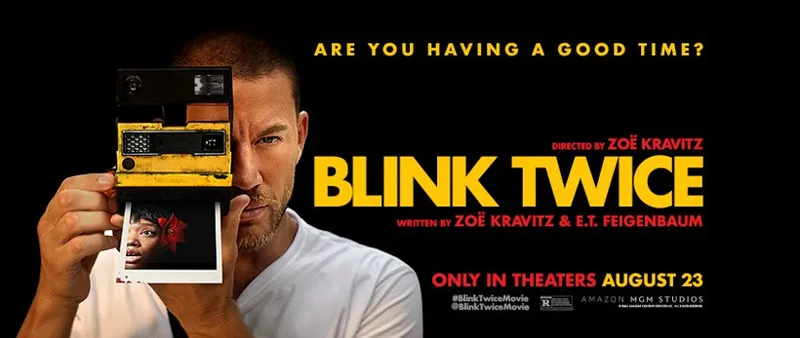
Blink Twice (Zoe Kravitz, 2024)
This is spoiler free in that it does not contain plot details, though I will discuss some of the themes.
Zoe Kravitz isn't unknown to movie fans or celebrity gossip hounds. She is the daughter of Lisa Bonet and Lenny Kravitz, stepdaughter of Jason Momoa, with a handful of impressive acting credits under her belt. It would be easy to dislike or feel envious toward her. She comes from a family of successful celebrity artists. She's had her own success as an actress, both critically and commercially, made appearances as a musician on Janelle Monae's breakthrough album and the Big Little Lies soundtrack, and on top of everything else, possesses stunning beauty. It would be easy to think maybe, there's just a little too much working in her favor already, and she needs to step aside to let someone else try their hand at directing. It's a sentiment that says, "Haven't you had enough good fortune already? Have you earned the spot you're standing in?"
To add some more fuel to that fire, Kravitz has now proven she is a gifted storyteller. What she crafts in Blink Twice is both dizzying seaside escapism and an adrenaline rush of a film, wise in both its use of time and its understanding of crafting a story on screen as an experience.
Among the many other praise worthy elements, is it's visual style. Like The Substance and Strange Darling, Blink Twice embraces the beauty of deep, vibrant, full color, something that's been relatively rare in horror since roughly the nineties. There has been a slowly rising tide of micro-budget films embracing it, and it seems now to be making it's way into these higher profile indies. This isn't to say I don't love the dark beauty of films like Se7en, and some of the excellent work that can be done in more monochromatic styles, but it is great to have some variety seeping into the horror landscape. A good deal of Blink Twice takes place in a sun drenched tropical setting. And it is sun drenched, not sun bleached, which would have been the instinct of many other directors for a film dealing with this content and themes. In that same vein, the costume, set design and choice of location help add to the story and characterization. Kravitz has either thoroughly thought all of this through or knows how to hire people who understand how their role contributes most effectively to the overall themes and visual style of the film. They can both be signs of great directors.
There is also some great cinematography here. There are only a few locations, and yet, because of the dynamic nature in choices of frame and movement, it never feels visually stale, dull or boring. There's also a liberal employment of something I personally appreciate, the extreme close up. There are many shots with one characters face filling the frame to the point that we as an audience could count their pores if we paused the image. It contributes to creating a combination of intimacy and isolation. The composition is inventive, but not so showy or intrusive to break the illusion either. It helps create the overall atmosphere of the film, and even matches certain character and thematic elements.
It's clear that being the child and stepchild of three well liked celebrities, and an actress with her own positive reputation, hasn't hurt Zoe Kravitz rolodex. This is a surprising cast for a first feature and a budget of $20 million. Her producing partner, and romantic partner, Channing Tatum takes the male lead, with Naomi Ackie in the female lead. Both of them are very good. Tatum is getting a chance to flex some muscles he hasn't so far, and is all too believable as tech billionaire Slater King. It is, from a certain perspective, a courageous role for Tatum, given his public persona and the perception of him. For Ackie, this could be a breakout role, as she handily embodies some pretty complicated material and layered scenes. There's a point in the film where she is playing layers of performance, with her character playing an emotion and experience we as the audience know isn't authentic, and it's outstanding work.
The other standouts here are Adria Arjona, playing one of the other members of this group who've jetted away to King's private island, and the legendary Geena Davis, playing very much against her public persona. Arjona gets enough material in her supporting role to craft another complicated, layered performance, and she nails it. Geena Davis is as good as she has ever been, in a smaller, but thematically important role. Rounding out this band of party goers is Alia Shawkat, Christian Slater (who gets a few very good comedic moments), Haley Joel Osment, Simon Rex, Liz Caribel and Trew Mullen, with a role just above a cameo for Kyle McLachlan.
As impressive as the rest of this is, none of it would amount to much if the script wasn't so sharp. Kravitz co-wrote with E.T. Feigenbaum, and this feels like a film directed and written by someone who was considering all of its pieces, as an experience, from its inception. There is a sharp understanding of immersive storytelling on screen here. The script and the storytelling are extremely confident in their understanding, and that confidence is in no way misplaced.
What's clear in her directorial debut, is that Zoe Kravitz knows how the public sees her. She knows what everyone in any room she's in thinks of her. There is, in the zeitgeist currently, only a few degrees of difference between the tech billionaire and what's being referred to as the nepo baby, the progeny of famous artists whose gone to turn their inherited name recognition and presumed network of contacts into a career. Kravitz understanding obviously includes the rooms where she has been the divinely fortunate progeny of wealthy celebrities, both of whom were sex symbols in their own right, and when she's been in rooms where she is another stunning young beauty powerful men believe needs their acceptance, and possibly even for them to like her, for her career and her hopes of artistic fulfillment to advance. There is a maturity and perception behind Blink Twice, which is instrumental in making it as effective as it is and it's hard not see the parallels to Kravitz own life.
This knowledge of these many different dynamics and the clarity of understanding she brings to it all, make Blink Twice a unique film, and a confident directorial debut. The question of whether or not she earned the opportunity becomes moot, because she has made better of that opportunity than most who get it. What she delivers in Blink Twice is the evidence that she indeed belongs where she is. What's she's proven is that people who've been in many of those rooms underestimated her, and continue to do so at their peril. As a movie going audience, we get the reward of witnessing this revelation. This is the announcement that she is a great storyteller with a keen understanding of film, and from now on, she is the Zoe Kravitz who made Blink Twice, no matter what else we may think of her, and whether or not she cares.
Blink Twice is in many ways about perspective, the perspective that memory, experience and trauma afford. There is a built in capacity to forget pain and trauma. There is also a natural capacity for the experience of pain and trauma to shape behavior. One of the pervasive, unrecognized social narratives about trauma is that it must be forgotten. It must not shape someone's behavior too thoroughly, no matter how catastrophic the experience. "Get passed it, and go one with everyday life," isn't something we have a choice about, whether or not the "getting passed it" and having a fulfilling life are possible in the parameters of everyday life. One of the things we collectively run from, sideline, attempt not to take into consideration, is the perspective that may come from those experiences, because of how often those traumas have some foundation in the way we organize "everyday life." What happens when the lesson is that the way we organize "everyday life" is the foundation of why the traumatic event occurred? We have to forget. When this is the logical, rational conclusion, it's too heavy a burden for any human psyche to carry, day in and day out, and get on with getting on, going along to get along.
Blink Twice manages to be thought provoking, timely, timeless, entertaining, satisfying and impactful. It's the great combination of film which plays as effectively as commercial entertainment and more considered, deliberate artistic creation. It deals thoughtfully with themes of gender, power, economic inequality, and trauma, without ever feeling like its either preaching or being a slog. Kravitz expertly manages the mix of comedy, tension, suspense and some disturbing thematic elements, without ever coming off as exploitative. She has an almost uncanny understanding of how to use pacing, humor and misdirection, telling the audience only what they need to know from one moment to the next, and then paying off what we didn't see/ask later, all without it feeling as if she ever took the cheap, dishonest way out to achieve a satisfying, and still thought provoking ending. It's a kind of filmmaking which if the thematic and story elements were different would be referred to as muscular. What we do get from moment to moment, is intriguing and interesting to the point we don't get time to stop and consider the previous scene, and instead of this being a simple trick to use pacing to cover flaws, it both foreshadows without tipping its hand and doubles back to make this a genuine strength produced from good writing.
All of the tools of filmmaking are put to use in keeping the viewer in a close perspective with Naomi Ackie as Frida. By keeping us this close, and understanding how to use everything from the cinematography, sound design, the charisma and comic capabilities of its cast, as well as the editing, to immerse the audience in Frida's experience, it gives Kratvitz confidence in her own understanding of how we as an audience are going to see all of the characters around Frida, and how she interacts with them, the room to be the brilliance at the foundation of the film. She knows how we see them, and through putting us so thoroughly in lock step with Frida's experience, manages to put us in the uneasy position of being unsure of our own reaction to them.
What we end up with is an experience that is fun, disquieting and disconcerting. The fun of it, the pacing and the visual style are all creating an experience that ends up hiding just how intricately it's designed, and how well crafted it is. It feels like fun, escapist thrillers often do, while hiding underneath just how incisively it's interrogating horrific sociopolitical realities.
Due to horror's comfortable relationship with low budget filmmaking, each year tends to produce at least one (often more) directorial debuts that signal the arrival of a talented new voice in horror or filmmaking more generally. This year, of the film's I've seen, only two qualify for being to compete for best feature debut. One of those is Blink Twice and the other is The First Omen. That both have come from female directors shouldn't be treated as trivia or checking boxes related to representation. These are audacious new voices in filmmaking, and it's impossible to watch either film and believe they don't benefit from a women being among their most core creators behind the camera. Zoe Kravitz is also a woman of color, and that she casts Naomi Ackie, a Black woman as the lead, is something which further adds to the richness of the film.
I'm of the belief that one of the reasons there is opposition to equity in who gets to be in front of and behind the camera is that those in opposition to it know that it helps to foster some sense of shared humanity.
For my money, Blink Twice is the best debut feature of the year, at least in horror, and I will be waiting with anticipation to find out what Zoe Kravitz next project behind the camera will be.