
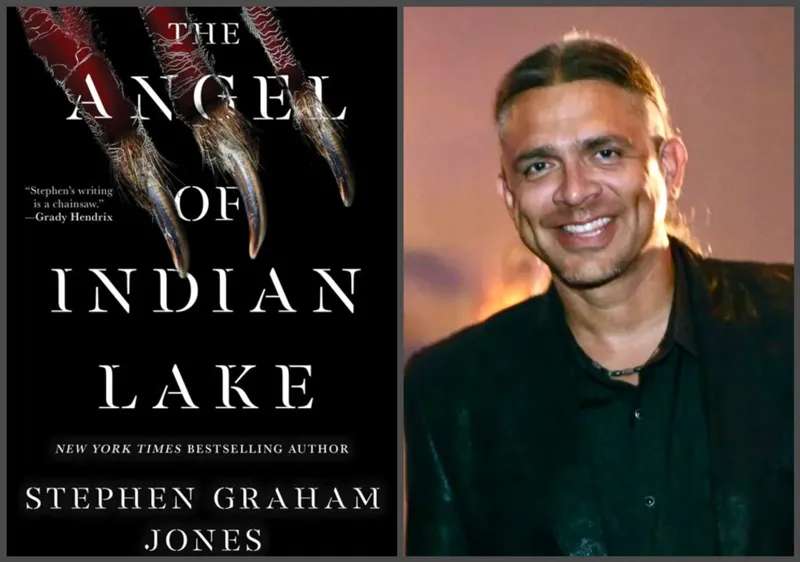
An Ode to The Angel of Indian Lake and Stephen Graham Jones
I'm not going to pretend to be able to write an "objective" review of Stephen Graham Jones latest novel, The Angel of Indian Lake or the Indian Lake Trilogy as a whole. I'm far too in love with both to pull off even the most superficial appearance of objectivity. If you're looking for someone whose going to go looking for criticisms of this novel, and the trilogy, it's not here. I probably could find something to criticize, but I already know that no novel or work of art is objectively perfect. I finished reading The Angel of Indian Lake on March 28, and as of today, April 2, this final novel and The Indian Lake Trilogy as a whole, have been impossible for me to stop thinking about. To put it plainly in simple terms, I'm awestruck by what Stephen Graham Jones (SGJ) accomplishes with the trilogy, and particularly with the way he wraps it up. There will be some slight spoilers, though I avoid directly saying what happens, I do refer vaguely to some things in all three books.
My most succinct review is... GO READ THESE FUCKING BOOKS NOW!
I rarely pre-order books before they're released. I avoid it, because it can very quickly become an expensive habit I can't afford. I didn't read the first two books, My Heart is a Chainsaw and Don't Fear the Reaper at the time of their initial release. This is partially due to the fact that when they were released, I had a whole lot of other stuff going on, and keeping up with the hot new horror novels wasn't something I had much time to pay attention to. I started reading My Heart is a Chainsaw when I saw the gushing praise for Don't Fear the Reaper not long after it's release. I blew through both books and was eagerly awaiting The Angel of Indian Lake.
Both of those books reward in depth consideration. Giving them some thought, reading or listening to others interpretations/reactions after you've finished them adds to the experience, in part because they read with ferocious momentum. SGJ is not slowing down to point to thematically important elements or plot points that are going to effect the narrative. He's not bothering to give you indications of why those themes or the elements he uses to lay them out are important. When an Indian Lake book starts building momentum, it takes no time at all for them to reach speed. These novels feel very much like Jade Daniels has grabbed you by the collar, and is sprinting through all their mad events, heart wrenching and heart warming turns.
They read like the best pulp, and reveal themselves to be in the best of the literary tradition upon further consideration. One of the things I am most struck by, inspired by, and honestly grateful for is that in not seeming to care much about or having any interest in whether he or his books are recognized as "literary" works, as opposed to what canon and a certain population of the book reading public, journalists and academics consider lesser, like pulp and horror, SGJ has created a near perfect example of why great writing is great writing, and great storytelling is great storytelling, no matter the genre or the pretensions, trappings or tropes it dabbles in. There are books that are flatly entertaining in the vein of the slasher sub genre, playing and toying with all the tropes, traps and conventions inherent to it. Yet they are also deeply interested in the humanity of the characters, and by extension, reaching out to the humanity of the reader. What they end up demonstrating, is that it's up to the reader to bring their humanity to the books, and the most significant barrier to that is their preconceived notions about things like genre, and what is great writing and storytelling prevent them from doing so.
Jade Daniels, the protagonist captured my heart, well before the end of the first novel. Stephen's ability to write this unconventional character with such humanity was the hook, and the story, with it's inventive turns, meta-horror narrative, the town of Proofrock with its cast of interesting characters and relationships were deliciously sweet bait. Chainsaw as a whole, is a great read, and Jade is a great character, an unconventional protagonist, that in almost no way fits the archetypes of the hero. She spends more of the time in that novel acting towards other characters in ways usually be reserved for the supporting character the protagonist eventually wins over, but by doing the right and necessary thing that's in front of her, in ways and for reasons that are unconventional but in no way hard to believe, Jade ends up being in the position the hero normally occupies. She's not a hero. She's not an anti-hero in the classic sense either, but she is willing to act. Whether her reasoning is always particularly sound or her assumptions correct, that willingness to be proactive puts her ahead of the other characters in the novel when the bodies start piling up. Jade was the hook, and I wasn't hooked through the lip. I swallowed it whole, and it secured itself deep in my guts.
SGJ pulls off taking this character who is not at all the model of what we have come to expect a hero to be, and makes her your hero by the end of the book. She's only seen as a hero by a few other characters by the end of the novel, and wouldn't be in any conventional novel in any genre. All of which is clear as the novel comes to a close, and yet, that makes her even more the readers hero. Jade is a broken character from the very beginning of the first novel in the trilogy, and the events of the first two novels aren't a process of fixing her. She learns and progresses, but she's also being subjected to these incredibly traumatic and destabilizing events not because she's broken, but because of the best parts of who she is and the shit luck of the lottery of birth that is being born and raised in Proofrock. It's an honest, realistic, empathetic approach to her character and her experiences. By the end of Chainsaw, he's had some resolution for some conflicts/issues she began the book with, but this isn't happily ever after either. It's good enough. It's survival, with all of the scars and new perspective it brings. It is a triumph for Jade, because of who she is, while simultaneously undercutting the sense of triumphalism which plagues lesser novels and films attempting to use the themes SGJ does in Chainsaw.
I've never read another novel that as accurately describes the experience of being in a crowded public place when something shockingly violent suddenly happens. I kept rereading different parts of a particular sequence, just to make sure I was getting the pieces that were there. The thing is, not all the pieces are there, but we do get them once that sequence concludes, because that's what it's like to experience something that terrifying and chaotic in a crowded place. It's confusing, frightening, overwhelming and you can only act on what you see in front of you. The full story of what happened, even when it's a few short minutes, comes into focus after the screaming has stopped, the panic has subsided, the danger is no longer urgently present, the injuries and dead are counted.
Don't Fear the Reaper advances Jade, as a character, with the same depth of humanity, by being more complex, necessarily acknowledging, but also mining the changes wrought by the events in Chainsaw, while also being one hell of a ride. It also gives us Dark Mill South (for my money one of the best names for a slasher in the history of the sub genre). Whether Dark Mill South is the most dangerous thing in Proofrock this time around though, is a matter of reader perspective and interpretation. As was true in Chainsaw, the dangers around Jade are many, and the way SGJ advances the themes they represent is brilliant.
If it's not clear, I was a big fan of Chainsaw, and Reaper added more depth and scope to my appreciation and respect for Jade Daniels as a character and Stephen Graham Jones as an author.
The Angel of Indian Lake is the coup de grace. Both of the previous novels are excellent, together and separately. The Angel of Indian Lake lifts those novels further, into the realm of being truly exceptional, in the way only the best series finale can be. Taken in total, the saga of the Indian Lake trilogy, the Jade Daniels saga, is a jaw dropping achievement.
I haven't been this emotionally and personally affected by a novel in quite some time. As someone whose life has been altered by living with PTSD, the only thing I can really say to express it is that the respect, compassion, honesty and love Stephen Graham Jones treats Jade Daniels with was not something I was really prepared for going into this book. I wasn't prepared for it, because I don't think I've ever seen it done this well. She can't be understood without it, but it is in no way the full extent of what makes her interesting or worth following, being invested in, as a protagonist or character. She is worth caring about simultaneously because of and in spite of all the things her brokenness brings into the world around her. She has all these symptoms of someone dealing with mental illness as the result of terrible trauma, but they are symptoms. He never treats them as who she is. She is someone, experiencing those things and lives with them, and they effect how other people might see her or how she processes the world, but they are not who she is, they are happening to her.
Maybe that seems like semantics, but that subtle difference in perspective from so many novels that try to tackle material likes this hit me deep in my core. I've never seen anyone depict it with so much respect and honesty. There's no excusing her faults, her shortcomings, the things which cause other people hardship or inconvenience that stem from it (or stem from other parts of Jade that might make her antagonistic toward them), but there's no sense of Jade being less valuable because of them. Jade is worth it, because of the whole of who she is as a character.
If Jade was cracked when Chainsaw began, she is shattered, parts of her pulverized (literally and figuratively), when The Angel of Indian Lake begins. She was an outsider, content with that status at the beginning of and through most of Chainsaw. As Angel begins, she is investing every bit of herself into trying to hold onto being able to even be an accepted outlier. That idea, that some people are not necessarily trusted or wanted, but are individuals allowed to live on the fringes as opposed to being completely exiled, is of central importance in The Angel of Indian Lake, and as a result, the entire trilogy.
SGJ doesn't shy from depicting the uglier parts of Jade or as being the things which force force her to the fringe (some of which maybe more of us should adopt, some of which he positions as being inescapable for people of Native American descent), but the backbone of his perspective on her is that as real as even the ugliest parts of her are, she still deserves love, respect, care, honesty and compassion with or without them. They effect how she moves through the world and the decisions she makes, are part of her, but they are not the sum total of who she is or why she deserves our time and attention or the attention and love of other characters in Proofrock. We need to know what this all means for her, to understand her experience as she's traversing this story. She also comes into this story with more than that, maybe more than she's had in either of the previous novels. In the great tradition of those previous Indian Lake novels, it's not much, but it is enough.
The way he concludes this saga for Jade Daniels, with all of that, in context of this novel and the broader story of that includes previous two novels, crushed me. It is grand and poetic in its way, and yet it's also simple, honest and hits right in the heart. Jade simultaneously becomes who she was meant to be from the beginning, but it's also what she has been through the trilogy, both of which are informed by and part of how broken she is, and yet she wouldn't be able to be that without the rest of who she is either, the things that brought her what she comes into this novel with that she didn't have in the first two.
Part of achieving this is moving fully into Jade's perspective in a first person point of view as the majority of the novel. The first two novels use a third person omniscient point of view following Jade or other characters (depending on the chapter). They also have interceding chapters that are different devices like extra credit assignments Jade has turned in to her history teacher in Chainsaw (those papers titled Slasher 101, Slasher 102, etc.). Angel puts us firmly in Jade's POV, the benefit of which is unfiltered access to her interior life. It is a hectic point of view. It can seem disjointed at first, and if some readers need to get through a few chapters to get comfortable with it, to fully get a handle on following it, it wouldn't be surprising. At the same time, if they've read the two previous novels, the frenetic nature of Jade's point of view isn't going to be shocking, and neither should the change to first person be. As is true of the Angel as a whole, the changes to Jade's first person point of view feels like this is what we've been progressing toward through those first two books.
Beyond his stellar portrayal and perspective toward a character with symptoms of trauma induced mental illness, The Angel of Indian Lake finds ways to re-contextualize events from the previous two novels. It does so without resorting to short cuts or cheap tricks either. Instead, it adds perspective, creating new ones or expanding the perspective, based on those events and their context in the overall story. It takes masterful storytelling to take excellent two excellent novels, and make them better, within the context of the whole story. SGJ executes on what it is that makes the best trilogies the best.
A check on my Goodreads accounts says I finished reading The Angel of Indian Lake on March 28. I was probably a teenager the last time I finished a book and went right back to re-read it or an entire series it was part of within a few weeks. It's April 2, and yesterday I started re-reading My Heart is a Chainsaw, with the intent to re-read the trilogy, not only because I want to go through them with the new perspectives Angel gives, but because they're just damn great books that are so rewarding to read. I want to be devastated in this beautiful way, all over again.
Now, with the well of inspiration Stephen Graham Jones has provided, I'm going to get back to working on my own fiction. Trying, hoping and accepting I probably can't even dip a toe into the degree of excellence that is The Angel of Indian Lake and The Indian Lake Trilogy.