
6G, Unstickable Glue, & Blinking Masterminds
Move Over 5G, 6G is Arriving Soon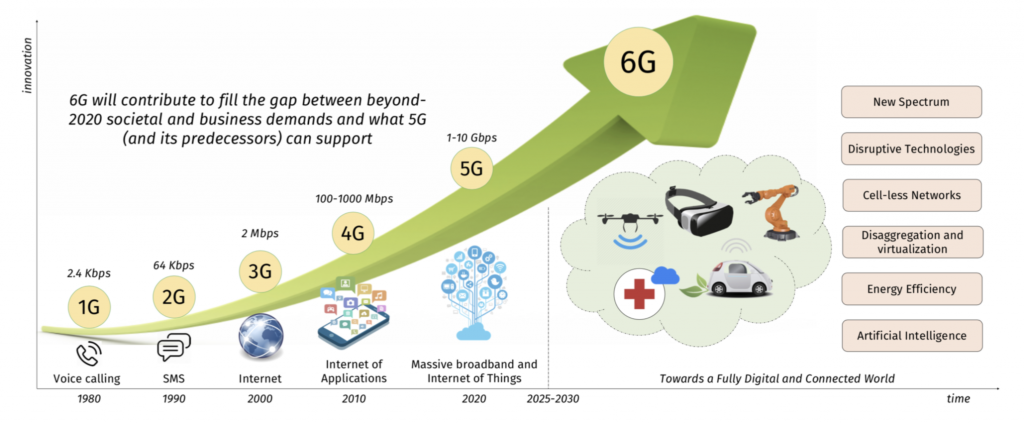
Image: Department of Defense
The U.S. government is already planning the transition to the 6th generation of mobile networks, 6G. Its predecessor, 5G, is currently being rolled out all over the world. 6G is supposed to bring us even higher bandwidth. While the best 5G network might allow you to download a 36 Terabyte folder in an hour (at 10 Gigabytes per second), a 6G network might allow you to download the same file in seconds.
5G already uses very high frequencies. They’re in the range of a few GHz, which is similar to the frequency of your microwave oven or wifi router. 6G is supposed to use even higher frequencies. The U.S. government is now looking at making the range of 7.2 to 8.4 GHz commercially available, and is also considering the range of 37 to 37.6 GHz.
Scientists and various industry sectors, notably aviation, are concerned about these new mobile networks interfering with their operations. The U.S. Department of Defense says they will listen to the concerns, but I guess it remains to be seen whether it’ll make any difference.
Read an article about recent proposals here, an explanation of 6G with video here, and the Biden administration’s recent National Spectrum Strategy here.
Unstickable Glue Allows Easier Recycling
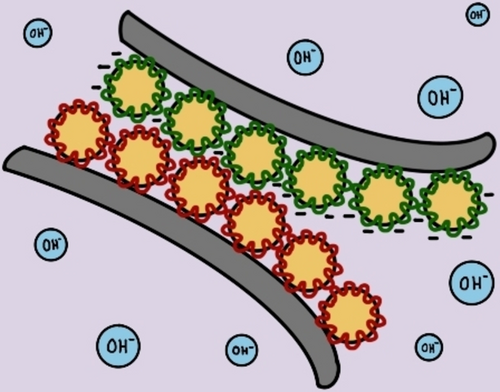
Image: Electrostatic glue held together by positive and negative ion bonds comes unstuck in alkaline water. Sierra-Romero et al., Angewandte Chemie (2023).
Engineers at Newcastle University in the U.K. have invented a new reversible (“unstickable”) glue that they say will make recycling much easier. The water-based glue holds together via electrostatic adhesion and comes apart when exposed to non-neutral pH solutions, i.e. acids or bases. The reversible glue could make it much easier to cleanly remove labels from recyclable waste products such as plastic bottles. Press release here, paper here.
People Under Stress Blink More

Do you hate game shows? So do I, but scientists have finally found real value in them. A team of over 60 scientists at the University of Arizona recently analysed footage of 100 participants of the British game show “Mastermind”. Their goal? Study human behaviour and physiology under stress. They found that contestants on the show blinked about 40 times per minute, almost double the average blinks per minute of a relaxed person. Press release here, paper here, and if you want to count your own blinks, you can find a recent episode of “Mastermind” here.
Comments (6)
I currently have to cut apart cardboard cans to remove the metal ring and base and then soak the cardboard in water to remove the unrecyclable liner, so the unstickable glue appears to be a good idea. But what needs to be done is mandate that all loops from waste back to manufacture be closed and not allow any new materials to be made. If new materials are needed, then we can mine the landfills first.
And for those who might be interested, here is some reading material on the allocation of he radio spectrum (a generic name that includes the signals used with radio sets, TV, cellphones, Wi-fI, GPS-GNSS receivers and anything that deals with radio signals, i.e below the infrared). Further, the article describes the division of this spectrum into bands, with relevance to the 120 GHz of, for example, G6: https://www.fcc.gov/engineering-technology/policy-and-rules-division/general/radio-spectrum-allocation Excerpt: "Currently only frequency bands between 9 kHz and 275 GHz have been allocated (i.e., designated for use by one or more terrestrial or space radiocommunication services or the radio astronomy service under specified conditions)"
6G plans to go to higher frequencies even, around 120 GHz. https://youtu.be/8jYX19oW-zg?si=7qqJFhTiQzkFJWtR
Will count my blinks, when I go through quizwithit the next time
About G6: So this is a moment with a new serious reason to worry: The G6 frequencies are not defined yet in detail. In the past, there have been recurrent problems when a commercial company called "Light Squared", reborn after bankruptcy as "Ligado", tried to establish (and they are still trying) to install a terrestrial network of radio stations transmitting in the L2-Band (1 GHz - 2 GHz) to send nationwide, in the USA, positioning corrections to its users, to the ones these users obtained with their GPS receivers. Although their signal carriers were not at the same frequencies as GPS, they had harmonics and subharmonics (radio transmitters being inevitably nonlinear) that were strong enough they could interfere. Ligado was transmitting from much closer to GPS receivers than the far away satellites of GPS, so Ligado's were much stronger. This was approved twice by the then Federal Communications Commission (FCC), first during George W. Bush's and then again during Trump's presidency, against very strong opposition, because of the likelihood of radio-interference with GPS that seriously bothered the US military and the makers of GPS equipment, groups of concerned users, including people that used GPS as a very important part of what is needed for defining, for example, something as fundamental as the International Terrestrial Reference Frame, so that is how I came to be aware of this. See, for example: https://www.reuters.com/world/us/pentagon-warns-gps-interference-ligado-broadband-network-2022-09-09/ Later, with the changes of government and of the composition of the FCC, this also changed and the permission for Ligado to go ahead was revoked by the current government -- for a second time. The first one was when Obama was president, after Bush ad before Trump, and the then newly composed FCC decided it was not worth the trouble of GPS interference. Then "Light Squared", now renamed "Ligado", went into its first bankruptcy Why should it matter to anyone not in the USA? Because GPS, along with newer systems of the same type and operating principles, such as the EU's GALILEO, that have come out since the 1980's, all collectively known as GNSS( Global Navigation Satellite Systems), operate in the same frequency band that is affected by Ligados' project and are a vitally important and no longer replaceable part of the infrastructure of the world. And because big Telecoms have been trying for decades to grab parts of the spectrum used for navigation, such as that reserved for GNSS, as well as the reserved frequencies used for transmitting data from Earth Observing spacecraft on things relevant, for example, with the monitoring of sources of Global Warming, as well as for increasing our scientific knowledge of the Earth. But Ah! The relentless search after those millisecond transmissions! That can benefit who, exactly?
Looks like Ligado is headed for Ch 22. Creditors didn’t get their principal payment on Nov 1st and their bonds are at 18 cents. It’s forbearance time. https://www.wsj.com/articles/ligado-networks-seeks-to-restructure-debt-again-to-ease-satellite-deal-ef35fbd1 I wouldn’t hold my breath for 6G. The study period alone for this initiative is two years. It’ll be at least a decade to develop. None of the wireless companies can afford to bid on spectrum at the moment anyway. They have yet to get paid for the $80+ bn they shelled out in the C-band auction. Returns for the industry have been awful.