
Peak Oil, Augmented Forests, & Energy from Feathers
Peak Oil is Here Again
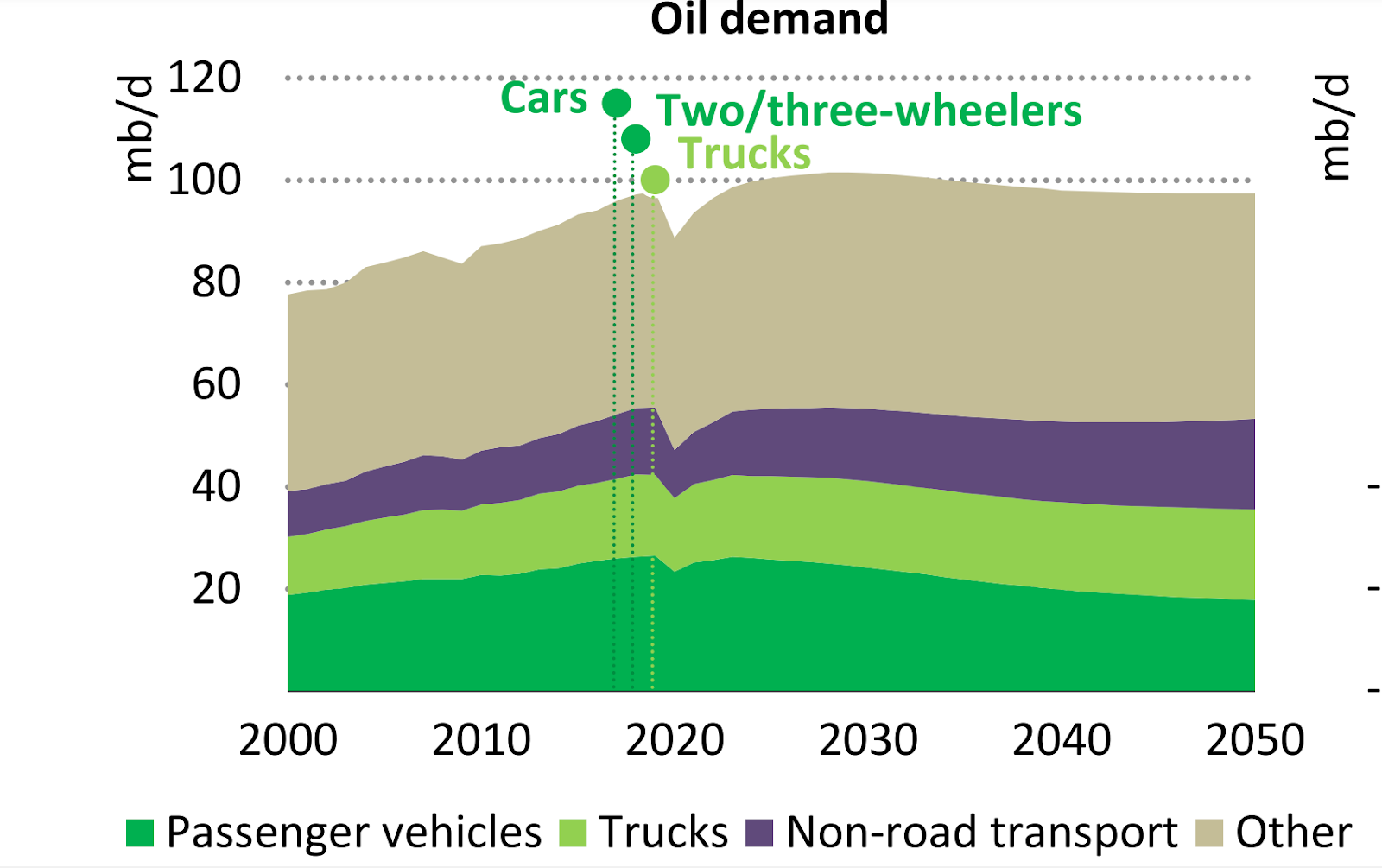
IEA 2023 projection for global oil demand in million barrels per day
According to the International Energy Agency, we are on track to see fossil fuel use peak before 2030. In their recent World Energy Outlook, they say that clean energy supply is now sufficient for global demand for fossil fuels to falter and enter a terminal decline. While the share of coal, oil, and natural gas in the global energy supply has been stuck around 80% for decades, they say that by 2030 it’ll go down to about 73%. Then again, peak oil has been predicted several times before and it didn’t come to pass, so don’t hold your breath. Full report here.
Researchers Scan Forest with Augmented Reality

Ecologists at Rice University used augmented reality to capture and analyse what’s going on in Tanzania's tropical forests. The Microsoft HoloLens 2 headset allowed them to control environmental scanners and then digitally construct the forest and its animals in a 3D model. Their project logged 19 species in their natural habitat and revealed that larger surface areas were associated with greater species diversity. Press release here, paper here.
Green Energy from Chicken Feathers

Image Source: Soon et al., Applied Materials & Interfaces (2023)
Ever wonder what happens to the feathers that once adorned the chicken you just roasted? Most of them get burned. But researchers at ETH Zurich and Nanyang Technological University Singapore had a better idea: build hydrogen fuel cells with them. They removed keratin – the material that makes up nails, hair, and you guessed it, feathers – from the chicken down, and used it for the membrane in hydrogen fuel cells, where water and oxygen react to form water and release energy. It’s an eco-friendly and cheap solution that along the way also solves a waste problem – smart!. Press release here, paper here.
Comments (6)
The definition of peak oil (https://peakoil.com/geology/what-is-peak-oil-have-we-reached-it): "Peak oil is the theoretical timeline for when domestic or global oil production will hit its maximum rate and begin to decline. It’s the idea that—at some point—the world’s finite quality and quantity of oil will decline to such low numbers that it would no longer be economic to produce." So, we may have already passed peak oil as in we have already had to rely on technologies, such as fracking and water injection and exploit far more difficult reserves, to continue to produce oil. The days of overburden pressure pushing oil out of the ground are over. What has hidden this recently was the drop in demand due to Covid-19 and the slow recovery in demand. It really is time to develop the IFR derivatives, such as PRISM (chrome-extension://efaidnbmnnnibpcajpcglclefindmkaj/https://nuclear.gepower.com/content/dam/gepower-nuclear/global/en_US/documents/PRISM%20Technical%20Paper.pdf) to provide enough safe, green energy to end the need for all fossil fuels.
Hi Jeffery, I meanwhile understand you better about IFR, but what about wind and solar (if we're busy to dust the panels, of course)? Haven't these meanwhile cheap resources not their portion to reach "peak oil"? IFR might be a brilliant technology, but in Germany, I see no political social chance to build one, after the first and last was closed in the 80s, without ever working (cost: seven billion at that time!). What about the mood in the US?
Sometimes good news in the science news, the application of Feather-ceratin for membranes sounds good.
The thing that worries me is the "we are on track" for peak oil part of the cited comment, becase it means that we are burning enough to get there in a decade at most, which is not necessarily great news. And, as predicted according to the plot, oil consumption is not dropping like a stone after it happens, but it's more like almost levels off, in a very slight descent from the 2030's on. With a compensating uptick in the 2040's on for "Non-road transport", that probably means train, ships and airplanes. And flying cars? And, when oil and gas may not suffice anymore to keep the fires burning, there shall be still all that coal, black and brown, to go through, waiting to be burned. And plenty of powerful people well-positioned politically and very interested in increasing their fortunes even more by doing their best to slow down as much as possible the switch over to non-carbon emitting means of producing energy. As extracting and selling fossil fuels happens to be their main line of business and they are quite happy with being part of it. But there are things happening where developments move in an interestingly different direction -- as long as the Sun is shining: https://www.renewableinstitute.org/solar-powered-vehicle-completes-first-off-road-journey-across-the-sahara/# Excerpt: "A radical, new solar-powered vehicle, claimed to be the world’s first capable of off-road driving over extensive distances without the need for recharging, has successfully completed a 620-mile (1,000km) test drive through Morocco and the Sahara. The two-seater, known as Stella Terra, was conceived by students from Eindhoven University of Technology, based in the Netherlands."
Hydrogen fuel cells are just a distraction in the fight against Global Warming. Getting and storing hydrogen are extremely inefficient processes. So using hydrogen can only be "green" if there are huge surpluses of electrical power to produce it.
Well, one can always drop some Lithium on water and step back quickly ...