
An Einstein Ring, Supernovae, and Bioprinted Nerves
Webb Telescope Spots Full Einstein Ring
Einstein Ring, JWST-ER1, original and magnified. Image: NASA/JWST
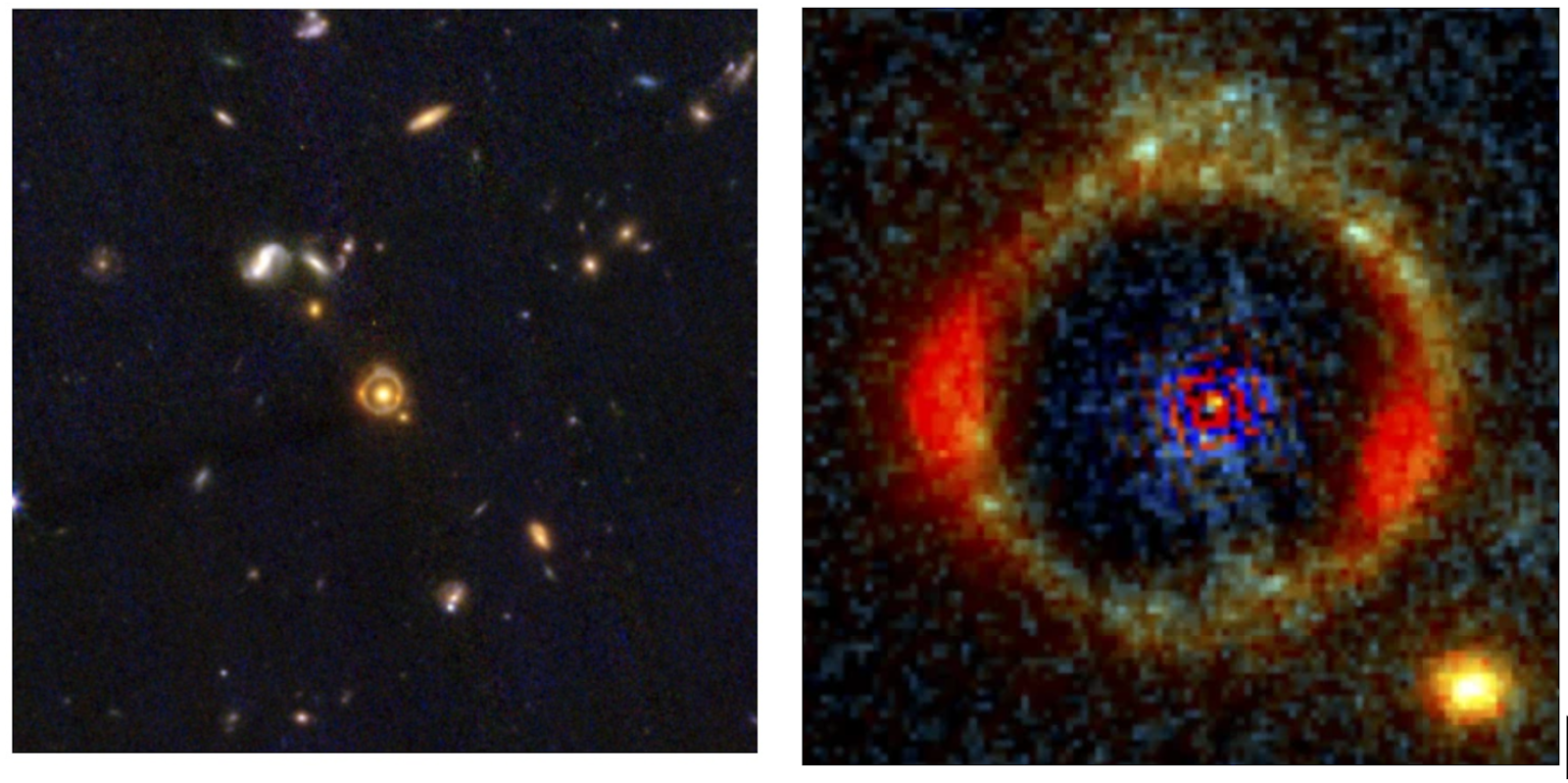
NASA’s James Webb telescope has found the most beautiful Einstein Ring ever. An Einstein Ring is a phenomenon produced by gravitational lensing, when light from one object is bent around another one. Usually the two objects are different galaxies and most of the time we don’t see a full ring but rather several dots or arcs. But if the configuration coincidentally happens to be particularly symmetric – as in this case – we see a ring. The galaxy in the center of the new Einstein Ring that’s causing the lensing is an elliptic galaxy about 10 billion light years away and about 650 billion times as massive as our Sun.
Besides looking spectacular, gravitational lenses are also useful because they allow astrophysicists to infer the mass of the bending object, including its dark mass. Paper here.
New 3D Simulation of Supernova

Image: Ke-Jung Chen et al, ApJ (2023).
An international team of astrophysicists has recently created a high-resolution 3D simulation of supernovae that uses the most sophisticated fluid and gas dynamics to date. They looked at the collapse and following explosions of supermassive stars over a hundred times bigger than our sun with a new code called “CASTRO”.
Supernovae simulations are incredibly computationally intensive because of their chaotic nature and the sheer size of the system. Even using the Minnesota Supercomputing Institute, the simulation took over 50,000 computer hours to complete. The new simulation provides unprecedented information into the gas turbulence and energetics in supernovae, as well as the mixing of elements and creation of new elements in the supernova process. While the simulation is visually stunning and scientifically interesting, it is certainly not the first 3D supernova simulation, as some outlets claimed. Paper here.
3D-Printed Nerve Cells Create Brain-Like Networks
Image Credit: Yao et al., Advanced Healthcare Materials (2023)

Bio-engineers at Monash University have successfully used “bio-ink” to 3D-print nerve networks that mimic the human brain. The bio-ink is a gel that contains living cells (from rat brains) as well as non-cellular materials. The researchers printed the inks in an arrangement mimicking patterns of grey and white matter typically seen in the brain’s cortical structure. The printed networks displayed spontaneous neuron signals and responded to electrical stimulation. Press release here, paper here.
Comments (11)
Here is a video with Feynman arguing for the often useful practice of thinking about somehing that really matters from "another point of view": https://www.youtube.com/watch?v=GNhlNSLQAFE The "quarks" part is out of date, as are two or three other things, because this is an old video, but the basic message is right forever.
Tracey, Betelgeuse, it has been reported, is considered a serious candidate now for going supernova if, sadly, not soon enough for any of us to live to see this, based on recent observations: https://www.scientificamerican.com/article/betelgueses-brightening-raises-hopes-for-a-supernova-spectacle/ I do appreciate your explanation about one detail of (I think) how the computer-implemented procedure mentioned by Sabine is used. But, while recently this star got darker because, it is thought, of a big belch of dust, this is not about that darkening, but about its recent 50% brightening after that darkening.
Hi Oscar, grumpy stars are so difficult to predict. We've been waiting for Eta Carinae and a few others just like it (e.g. P Cygni) to go boom for a while. These guys are all burning elements heavier than helium in their core and are much further along in their evolution than Betelgeuse, which is currently burning helium in its core. Having said that, no one expected SN1987A because its progenitor star didn't show significant signs of the farting/belching that evolved stars do -- see Eta Car's giant eruption of 1837, which dwarfs whatever Betelgeuse has been up to of late. It's a bit of a crap shoot as to predicting when stars will blow up. The timescale for subsequent rounds of fusion from helium up to iron in the cores of massive stars is quite variable but we do know that the more massive a star is, the faster it burns through its fuel. The most massive stars don't even progress all the way to iron in their cores, they have so much gravitational potential energy that, when carbon burning ends, for example, the core collapses rather than starts a new round of fusion of the next higher elements. Who knows, maybe Betelgeuse will pop its cork before Eta Car, but my money is on Eta Car first just because it is far more massive and has already progressed beyond helium burning. Grumpy stars all have their own unique personalities which make them so much fun to observe! Betelgeuse deserves its time in the spotlight, but it is a bit of hype to say that it has moved near the front of the line for expected supernovae. Eta Car deserves some love too -- it was the 2nd brightest star in the sky (after Sirius) for a while after its great eruption.
For much of my life, time after time, someone has found confirmation of something predicted by General Relativity, such as these "Einstein Rings." (Yes, that guy.) By people who actually dared solve the six independent differential equations of the tensor field equation for some particular case they were interested in. When working on a related project with a group at Stanford who were developing the main sensor for Gravity Probe-B (GP-B), a NASA satellite mission meant to test two of General Relativity predictions very difficult to observe, about the behavior of a gyroscope in orbit around a massive body, such as the Earth (and it was a struggle analyzing the data, but the GP-B people did confirm both!), I met a man who had recently come up with a closed expression for the relatively weak gravitational field of something like the terrestrial homogeneous oblate spheroid, the geodetic "reference" one that is the best ellipsoidal fit to our planet. His name was Ronald J. Adler (*). Unfortunately he was dying of cancer and it was difficult to strike the appropriate note in casual conversation so as not to discourage him even more. As I remember being told, Prof. Francis Everett gave a moving eulogy when it was all over for Ronald; I was back in Maryland at the time. (*) "Metric for an Oblate Earth", Ronald J. Adler, in "General Relativity and Gravitation", Vol. 31, No. 12, 1999. Requiescat in Pace, R.J.A.
Those people who developed a procedure to see what happens when a giant star goes supernova maybe should look into what Betelgeuse is up to.
Alas, different physics -- supernova modelers look at fluid flow and shock structures in a magnetized plasma starting from core instability. The phenomena that are observed around evolved red giant/asymptotic giant stars are tied to fusion rates in the star driving mass outflow mitigated by opacity. Dust formation is common in both environments, but even the most complete code in each case just models dust as a regulating knob in the code -- a quashing parameter that they set at various values for each run of the code. Other than dust, there are no real overlaps in the physics modeled by each code. If you're real interested in Betelgeuse, check out Eta Carinae, which has experienced massive eruptive outflows in the past and may be closer to going supernova.
"That mimics the human brain." More like the rat brain, I would think. Although there are some people that, quite frankly ...
In many cases rata are a better bet. They're unfairly maligned. I've met some lovely pet rats.
Pair-instability-supernova = hypernova?
Oh, a mention of dark mass with no "if it exists" right after it? You're slacking off.
:o)