
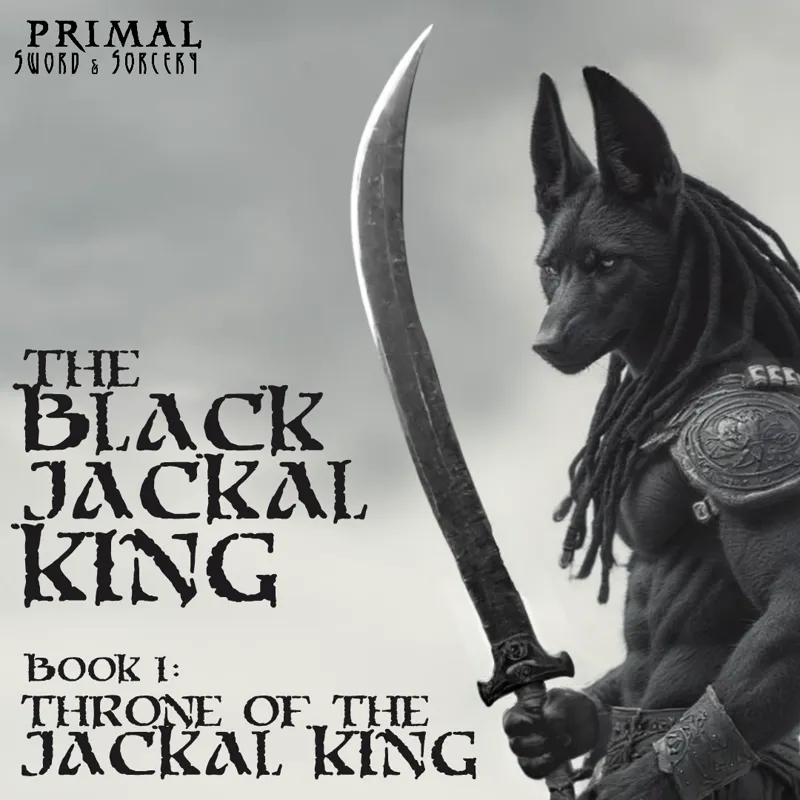
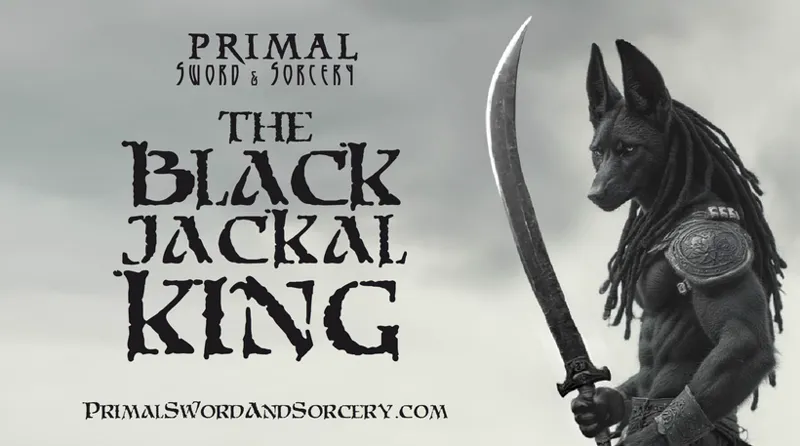
Throne of the Jackal King
"Once, the northern expanse between the Doglands and the wastes of Kartonga belonged to the jackals. They ruled it with thin hands and sharper minds, cunning traders, sly governors, and merciless raiders who mistook fear for dominion. Their reign ended in fire. The dogs rose against them—unified, enraged, and far more industrious than the jackals had ever imagined—and in a single generation, the old dominion collapsed. What remains today is not a kingdom but a scar: a corridor of dry plains and salt-ruined valleys known collectively as the Jackalands.
The jackals themselves speak of the past in low tones. They once possessed a realm twice the size of what now lies beneath their feet, its southern half fertile and rich with pasture. But they built nothing that endured. Their towns were camps, their strongholds carved from rock and sand, their wealth stored in caravans that never stopped moving. When the war came, there were no walls to hold, no fields to feed them, no foundries to arm their sons. The dogs came with iron, timber, and a will to settle. The jackals had only teeth and pride.
Their defeat was absolute. The southern half of their world—the heart of their domain—became the Doglands, the single greatest territorial loss of any people in Zhuru’s postwar age. It was not simply a shift of borders; it was a replacement of civilizations. Every city that stands there now was raised by dogfolk, brick upon brick, on jackal graves. The canals that run from the highlands bear Doglord names. The shrines, the market towers, even the roads—none are of jackal make. If the jackals were to reclaim what was theirs, they would inherit only the monuments of their conquerors. To restore their own culture, they would have to destroy everything the dogs have built.
This is the curse of the Jackalands: a land they cannot reclaim without erasing the only structures that could sustain them. They lack the numbers, the beasts of burden, the ironworks, and the sheer labor power to rebuild what war and time erased. A full generation has grown since their last serious campaign. Those born now know no homeland beyond the sand. They dwell in ruins that predate them, carving out a thin existence along the northern marches where the soil begins to fail and the wind carries the dust of Kartonga."
—The Vandyrian Codex
Prologue
Out on the borders of the Jackalands, there was nothing but the wind and the dust, the bare rocks jutting up from a plain so stripped of life that the very memory of grass had gone brittle and blown away. The sun at dusk was a copper bruise leaking down over bones—bones of cattle, bones of wanderers, bones of jackals themselves. In that wasted border, hunger was the only law and theft the only craft that mattered. There were no clans left, no hearths, no mothers to teach a pup her name. Only the packs, lean and black as shadows, drifting like the last smoke of some forgotten fire. The old pride of the jackals was gone, given over to the dogs in a war lost before it began. Now, only strays dared to scavenge here.
On one such evening, when the wind stank of iron and the crows picked meat from the old stone pillars, a ragged young female, ribs sharp as scythes beneath her pelt, darted from the gloom. She was nothing—a thief born of nothing, living on the edge of the ruins, barely more than a shade herself. Still, she was quick. Her jaws closed around a rack of ribs, still wet, still red with the day’s kill, and she ran laughing, joy in her mouth, even as her heart hammered fear into her chest. Behind her came the pack—six males, hulking and black as midnight, their eyes yellow coins in the gloom. They gave chase, long legs swallowing the ground, hunger turning to violence with every stride.
She ran hard, desperate, the bones clattering in her jaws, but the land was broken and the rocks cruel. Her paws struck a loose stone and she pitched forward, ribs scattering on the dust. The pack was on her before the sound of her laughter faded. Teeth and claws closed in, and the old laws of kin and clan meant nothing. There was only darkness and the sound of her wailing—carried by the wind, swallowed by the night, never spoken of again. “This is why his lineage is unknown to us, other than that he came from the darkness,” the old ones would whisper, though none dared say it loud.
Of his mother, nothing was kept but a stain in memory. Of his father—if such a word means anything in the borderlands—there were many rumors and none were true, for a jackal born of night and violence has no need of ancestors. He was the cub that survived, the one with eyes like dried blood, leaner than the rest, hungrier, colder. He had no name, and so he took them from others. None remember the seasons that followed, for the Jackalands had grown thin and mean, and the old order crumbled in silence.
He rose, a shadow among the shadows, a young black jackal whose scars mapped the history of a land no longer worth fighting for. When the elders tried to tame him, he gutted them. When the strong tried to claim him, he snapped their spines on the black stones. When the desperate begged for mercy, he showed them only the back of his hand and the flash of his teeth. No one taught him the old stories. No one cared to name the songs. He carved his name in flesh and in fire, and those who knelt did so in terror or not at all.
Now he sits the throne, what passes for a throne in the Jackalands—a mound of old hides and bones atop the ruins of a hall, with the sun bleeding behind him and the land stretched out dead to every horizon. He is young still, but no one calls him a boy. He is king because there is nothing else left to call him. The jackals bow because there is nothing left to believe in but fear. His eyes burn in the dusk, and his claws are never clean. The others—the dogs, the lords, the so-called kings beyond the border—call him tyrant, butcher, bastard. But in the Jackalands, in the places where the wind still howls and the mothers weep in secret, there is only one name that matters.
He rules by the law of hunger and shadow. He is the king the Jackalands deserve. And in his silence, the land itself remembers what it is to be lost.
Book I: Throne of the Jackal King
I
The wind that howled across the Jackalands was not the voice of any god; it was the last breath of a murdered realm. Each dusk bled out over salt-ruined plains and black stones cracked by seasons too long and suns too hard, a land not only forgotten but actively despised by those who had claimed it as their own. The Jackalands had once been ruled by sly hands and sharper minds, but those hands were now bones scattered in dry gullies, and those minds lay cold beneath the burnt crust of the ruins of . Only memory lingered here, and even that was turning brittle, snapping away beneath the boots of the living.
Out of this graveyard limped the last, meanest son of the bloodline—if bloodlines could be said to exist for jackals born of rape, murder, and a famine of hope. The Black Jackal King was not a name he’d taken, nor one he cared to hear spoken. Names were for the weak, the sentimental, and the dead. In the ruined towns along the old trade road, mothers whispered his titles—bastard, butcher, king—but only after nightfall, and only when the wind was up to carry their words away. He was the black shadow in the dust, the reason daughters were hidden and sons armed early.
He ruled nothing, not at first. He had no tribe, no lineage, no claim except the right of the beast that survives when all others perish. His first throne had been a dung heap in a ruined cattle post, his first court the pack of lean, desperate males he had either cowed or butchered. They followed because he led, and he led because he never hesitated. In the world that remained, that was enough.
His face was handsome, in the cruel way of predators—long muzzle, sharp white fangs, eyes like dried blood, and ears torn from a dozen brawls. His body was lean, corded with muscle and the kind of hunger that never left a male who had slept in ditches and drunk the blood of fallen foes for warmth. He walked naked to the waist, the black fur of his chest streaked with sweat and the old wounds of desperate nights. A long sword, notched but lovingly honed, hung from a crude baldric, and his loins were barely covered by a strip of tattered hide—both for freedom and for the simple fact that nothing in this world frightened him, least of all the judgment of others.
His horde was small in those days. Ten jackals, all black-furred, all hard-eyed, some barely old enough to have known the old clans before they broke. They followed because he offered what none else could: certainty, violence, and the chance to take what could not be begged or bought. There was no philosophy to it. They were jackals—born to scavenge, raised to raid. The King gave them a reason to be wolves.
The sun was a copper bruise low over the horizon when the King’s horde descended upon the hamlet of Tash Kiri. It was not a city—nothing left in the Jackalands could rightly be called a city. Tash Kiri was three longhouses, a sheepfold, a crumbling watchtower, and the rusted memory of a wall. The folk who lived there were jackals, mostly—broken families, old males who’d lost their teeth, young females whose eyes had grown too wide and too watchful. They watched the road but did not guard it, for there was nothing left to guard.
The King came in hard, not even bothering with stealth. His horde swept down like a black wave, swords drawn, teeth bared, laughter cutting through the dusk. There was little fight—what could the wretched offer? An old male ran for the tower, and the King split his skull with a backhanded swing. A pair of younger males tried to form a line, but they died screaming, their bellies opened, their deaths an afterthought. The horde moved with method—if a hut was locked, they set it alight. If a female screamed, she was dragged out by the hair. If a child ran, it was left to cower. The King’s men were not savages—they were professionals, and he allowed them their fun only after order was established.
The plunder was meager—some dried fish, a skin of oil, two jugs of brackish wine, and a queen.
She was not old, not young, but still bore the sharpness of breeding. Her pelt was tawny, her eyes wide with hate, her body slim and strong, hips already heavy with the memory of carrying young. The King took her for himself. He did not waste words on comfort or promises. She fought, as they always did, and he let her. When she clawed his chest, he bit her neck; when she spat curses, he rolled her beneath him and claimed her, his growls drowning out the crackle of burning thatch and the howls of his pack. There was no romance, only dominance, only the raw necessity of the act—a marking, a warning, a promise to all who watched.
Afterward, she lay panting and shivering beside him in the ruin of the longhouse, her thighs wet, her spirit not yet broken but already shifting. He licked her sweat from his muzzle, looked at the fire outside, and called for food. She would not leave him now. Not because she loved him—she would never love him—but because she feared him, and in the Jackalands, fear was as close to loyalty as anything ever lasted.
The King was not idle. By dawn, Tash Kiri was his. Those who bent the knee were spared, put to work patching the roof, gathering the scattered herds, cooking the stolen food. Those who would not bow were staked out for the crows. The King understood the power of spectacle. In the morning, the blood was washed away, the burnt bones buried, and the horde moved on. The queen rode behind him, naked beneath a torn black cloak, arms wrapped tight around his waist.
II
The campaign continued. Each night, another village. Sometimes they fought; sometimes they simply opened their doors and offered tribute, hoping to appease the inevitable. The King took what he wanted. If a male challenged him, he was cut down, his head spiked on the gatepost. If a female caught his eye, she was taken, sometimes by force, sometimes by the slow, insidious seduction of power. The Black Jackal King did not bother with pretense. When he wanted, he reached for it; when he finished, he left his mark.
He grew restless quickly. Lust gnawed at him, deeper than hunger, deeper than the ache of old wounds. The more he claimed, the more he craved—the act itself not just pleasure, but proof that he lived, that he ruled, that his will could bend even the proudest female. Some called it weakness, but none said so twice. Those who watched saw only the growing number of pregnant females in his wake, nursing bruises, swollen with the king’s seed, eager for the attention and protection his shadow brought.
The king’s horde swelled as word spread. From the edges of the ruined trade roads, desperate males came, drawn by the promise of meat, shelter, and the chance to serve under a banner that did not quiver at the wind. They pledged themselves at swordpoint, and the king gave them three days: prove your worth or feed the Vultures at the border and writhe. The weak fell quickly. The strong learned his rules: loyalty was fear, discipline was survival, pleasure was permitted only after victory.
The Black Jackal King slept surrounded by his queens, bodies tangled and glistening in the heat, the air thick with musk and sweat. He rose before dawn, rutting hard and fast with whatever female was closest, never gentle, never asking. His need was constant, punishing, a fire in his blood that would not be quenched. Yet in this, as in all things, he was careful: no favorites, no soft words. Affection was a luxury he could not afford, and he made certain none mistook his attentions for love.
One night, as the king’s horde camped by a dried-out riverbed, the sky thick with storm clouds, a scout returned with news. There was a city—if such a word meant anything—two days to the east, a place with walls and water, ruled by a cousin of the last rival he had butchered. The king listened, ate raw meat from the bone, and sent out his orders. There would be no siege, no negotiation. They would strike at dawn, kill the guards, and take the city before the sun was high.
The horde moved fast, traveling by night, living off what they stole or took by force. As they neared the city, the king scouted ahead alone, moving like a shadow between the dead trees and salt marshes. He watched the walls, counting sentries, noting the way the torches burned, the number of dogs at the gate. He saw the rival’s queen—tall, sleek, with the gold rings of royalty in her ears—walking the parapet with a look of boredom and barely hidden dread. He marked her for his own.
Dawn broke like a blade. The king’s horde struck with savage precision. Arrows blackened the sky, the first wave of jackals scaling the walls with hooks and ropes, silent as thieves. The king himself cut down the gate guard, split a second with a thrust through the spine, then strode into the chaos with sword and snarl. There was nothing pretty about the fight. The king did not duel—he butchered. He hacked, stabbed, mauled, using every trick, every dirty blow, every cruel angle the streets allowed.
By midmorning, the city was his. The rival—a fat, aging male with more pride than skill—was dragged before the king, begging, bleeding from a dozen cuts. The king let the horde watch as he drove his blade through the male’s groin, leaving him to die slowly. The queen, silent, eyes burning with hate and something darker, knelt at the king’s feet when he offered her the choice: serve or die. She spat at him, so he slapped her to the stones, tore her robe, and took her there, her cries ringing out over the city like a broken hymn.
When it was done, she crawled to him, bloody and weeping, and he lifted her chin, baring his teeth. “This is your kingdom now,” he told her, voice low and cold. “Bear my sons or feed the rats.”
So the horde grew—ten became thirty, thirty became a hundred, and the Black Jackal King moved from ruin to ruin, leaving behind a trail of bones, swollen bellies, and the black banners of his making. The Jackalands had become a place where the old rules no longer mattered, where only violence, lust, and cunning could make a king.
By the time the sun set on his latest conquest, the king lay sprawled on a bed of hides, two queens entwined at his flanks, a third straddling his hips, her belly already round, her eyes closed in exhausted ecstasy. The city outside was silent, broken. The old lords were dead, their names forgotten, their wives taken, their sons kneeling in fear or sharpening blades for the next campaign.
The king did not sleep. He stared at the cracked ceiling, the scent of sex and blood thick around him, his mind racing ahead. He was not satisfied—could never be satisfied. The hunger in him was a living thing, never sated, never still. Each victory only deepened the void, each conquest only fueled the need for more.
He was the Black Jackal King. He had come from nothing, ruled by nothing, and would make the world nothing in his image.
The Jackalands trembled, and the night wind carried his name.
III
By the time word of the Black Jackal King’s conquests reached the edges of the Jackalands, myth had already started to ferment around his name. Some whispered that his horde rode only on moonless nights, their laughter drowning out the wind, and that every city on their path had been stripped of pride, wealth, and queens. Among the broken, some spat curses, but none spoke openly of rising against him. None but the desperate, and the doomed.
One remained: a male whose name still carried weight among the few who remembered his brother’s reign. He had not died in defense of the council hall, nor bled for the treasury or the old gods. When his world fell, he had hidden and watched as all he knew was torn down, city by city, mate by mate. Yet there comes a point when even a coward will stake everything on one final throw.
He arrived at the battered gate at dusk, a cloak of dust and sweat on his shoulders, trailed by a handful of gaunt survivors. There were no banners, no steel in their eyes—only a ragged hope that something of the old world could still be saved, or at least avenged. His challenge was shouted into the blood-warm air, echoing against the stone and summoning the city’s ghosts: “Black Jackal! Bastard king! Face me!”
The city froze. Doors slammed. Children were swept inside. The challenge—public, final—meant everything, or nothing at all, depending on who survived the dawn.
The king did not answer with words. He finished bathing in the ruined pools of what had once been a palace, letting the water run pink off his fur, then nodded once to Marbanji, his hulking captain. The word spread: the king would meet the challenger. The law of the Jackalands—such as it was—would be written in blood, not treaty.
Night fell with an uneasy weight. Torches spat yellow flame along the city walls, but the real heat came from the crowd: jackals, dogs, the conquered, the curious, all crammed onto balconies and roofs, murmuring as the rival stood alone in the sand. He wore battered armor that no longer fit, his chest heaving, a sword trembling in his grip. Beside the king’s throne, two queens waited—one round with the promise of a new litter, the other with the hard eyes of a survivor, her body still bearing faint scars from a life now gone. She did not look at her former mate. When she laughed, it was cold, joining the king’s horde in their anticipation.
The king rose, bare-chested, scarred, and silent. His only ornaments were the notched sword at his hip and the slick gleam of oil on his pelt. He walked into the firelight with slow certainty, not looking at the crowd or the rival, but at the queens—at what he’d taken, and what no one would ever reclaim.
He did not waste breath. At a signal from Marbanji, the duel began.
The rival lunged, desperate. The king stepped aside, letting steel slice empty air, and struck back—not with a flourish, but with flat, brutal economy. The first blow shattered the rival’s jaw, teeth scattering in the dust. Another sliced clean through the wrist, sending a hand spinning to the sand. The king moved with method, each step calculated, each strike a lesson. When the rival tried to rally, the king took his other hand with a sweep of the blade. The crowd flinched. The queens watched, one biting her lip, the other smiling.
Blood poured from the rival’s stumps, but he would not kneel. He charged, mouth open in a silent howl. The king tripped him, kicked him flat, and pressed a foot to his chest. With one cold motion, he drew his dagger and gelded the rival, tossing the ruined flesh aside for the crowd to see. The rival convulsed, agony shuddering through him, blood soaking the sand. The king crouched, meeting his eyes just once. There was no mercy, no judgment, only indifference.
Finally, gripping the rival’s hair, the king forced his head back and brought his sword down in a clean, diagonal stroke—splitting skull and neck, ending the last of the old blood in front of everyone who mattered. The two halves of the head slumped apart, steam rising in the torchlight.
The city was silent, horror and awe blending in every breath. Some wept; others stared as if a new world had just split open before them. The horde roared. The queens approached, their bodies painted in light and shadow, black silks slipping away. One—the rival’s former mate, now swollen with the king’s young—stepped over the corpse, knelt, and pressed her lips to the king’s claws, her eyes never leaving the crowd. The other joined her, laughter hard as iron.
Before all the city, the king claimed them both, driving the last memory of the old world into the sand. There was no tenderness, only dominance and display. The queens gave themselves eagerly, mocking the dead and the living alike. Children watched, mothers covered faces but not eyes, and every witness knew: this was law now. Power, not tradition. Fear, not honor. Loyalty to the strong, not to the blood.
When it was finished, the king rose, both queens clinging to him, their bodies marked by violence and pleasure. The horde chanted his name, the crowd bent the knee. The old order had not simply ended—it had been erased, shamed, and remade.
From that day, no one called him upstart. He was the King—not by right, but by will. He ruled from a throne of bones and old betrayals, beneath a blood-red sky. The horde swelled, the harems grew, and the only stories left to tell were those written in scars and sired in conquest.
Wherever the wind carried his name, the weak remembered what it meant to be afraid. The Law of the Jackal was no longer a rumor; it was the only law left standing.
---
EPILOGUE
Though legend, always muddied by rumor and pride, has oft mistaken myth for record, the true histories of this land were once again set down in a mixture of ink, gold, and blood. This conquest did not restore the lost realms of Jantara—those lands remained a memory, a scar none could reclaim. Yet in the span of a single campaign, the Black Jackal King seized no less than six petty kingdoms south of the ancestral border. Here, on ground salted with the bones of the old world, began the rise of the dynasty that would harry and haunt Bantos, Bruwa, and all greater Zhuru for generations to come. The jackal nations’ long war on the world began at this grave of tradition, at the throne of the Black Jackal King, at the Black Blade of Anu-Ra, first of his name.