
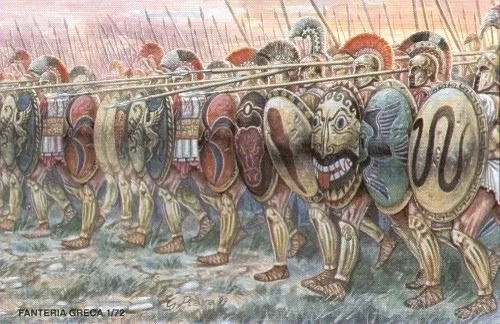
Radio War Nerd EP #210 — Xenophon & March of the Ten Thousand
Guest: Philip Matyszak, author & historian
Recorded: December 13, 2019
The War Nerd talks to historian Philip Matyszak about Xenophon's Anabasis — the story of the March of the Ten Thousand, when Greek mercenaries, stuck deep inside the Persian Empire, were forced to fight their way out through strange and hostile lands and tribes. Maty was previously a guest on RWN #151 (Athens' disastrous Sicily expedition) and RWN #162 (Rise & Fall of Sparta).
At 1:53:00 Ames and the Nerd discuss Xenophon and the American Right, and the UK elections
Buy Philip Matyszak's books, including "Expedition to Disaster: The Athenian Mission to Sicily 415 BC", "Sparta: Rise of a Warrior Nation" and "Sparta: Fall of a Warrior Nation". Read Matyszak's blog.
Total time: 2:20:04
Direct link to this episode's mp3 here
Comments (23)
The allusions to Sulla's civil war in this episode make me wonder — speaking of historical epochs wildly misconstrued by the contemporary right — when you might have occasion to take a look at Roman history? Particularly the late republican era — the Gracchi, Marius, Sulla, obvs Caesar, &c.The collapse of the republic remains, to my mind, the ur-example of how seemingly stable, rich societies fall into tyranny, and would I think be something worth exploring in depth.
You seem to be confusing slings with slingshots.
I assume this is the Sri Lanka book Mark was referencing, but just in case, or if someone else wants it... https://www.worldcat.org/title/kandy-at-war-indigenous-military-resistance-to-european-expansion-in-sri-lanka-1594-1818/oclc/470319020&referer=brief_results
Sorry for the double post.On a positive note, Nigel Dodds lost his seat to Sinn Fein!! John finucane won carson's old seat. Strange times
On a positive note, Nigel Dodds lost his seat to Sinn Fein!!
very off topic but thank you very much to the war nerd collective. Wishing you and yours a very good new year from Scotland.
On a positive note, Nigel Dodds lost his seat to Sinn Fein!!
Apologies if I am over-posting here, but I figured I should contribute wherever my narrow field of expertise allows. Here are some further books that may be of interest. If you want to learn more about Xenophon and contemporary Greek society, Xenophon And The History Of His Times by John Dillery. For numerous aspects of ancient Greek warfare, the multivolume The Greek State at War by W. K. Pritchett. For an excellent collection of essays on hoplite warfare, Men of Bronze: Hoplite Warfare in Ancient Greece edited by D. Kagan and G. F. Viggiano. For a major reevaluation of hoplite warfare (as well as a thorough debunking of Hansen), Greek Warfare: Myth and Realities by H. van Wees. For a history of all the non-soldiers in a Greek army who played vital roles: Slaves, Warfare, and Ideology in the Greek Historians by P. Hunt. For a more academic treatment of Xenophon, The Cambridge Companion to Xenophon edited by M. A. Flower. Happy to help if there any other ancient history questions!
For a slightly more romantic telling of the story of the 10,000 I would also recommend the History on Fire podcast miniseries on it, it has some good background on Persia as well as some good old fashioned nonsense heroism in the latter part.
Philip rules! You gotta have him on for some Alexander/Hellenistic Era episodes!!
Incredible episode, as usual, love Philip as a guest! You guys keep me sane in this crazy world
Is there an Anabasis translation that people recommend?
I mentioned the Loeb translation above: You can buy it here for $28 (https://www.indiebound.org/book/9780674991019). You can read it for free here, chapter by chapter (http://www.perseus.tufts.edu/hopper/text?doc=Perseus%3atext%3a1999.01.0202). Xenophon's Greek is is not complicated, so most published translations should suffice.
It was mentioned in the discussion that Anatolia at the time was composed of many different peoples and languages. Ther was a trib of Celts there among the mix - the Galatians. I've seen depictions of Celts with wicker shields. Maybe that is where the description in the book comes from? Anatolia was attracting different peoples even into the 19th century. Ther was a regiment of Polish cavalry in the service of the Sultan who got caught up in the proto-Turkish nationalism of the time. Half left for America but the other half adopted Islam and stayed in the Ottoman empire. As an aside, there are people of Polish descent in Haiti who went there to suppress the revolt at the behest of Napoleon but switched sides and stayed. Also, the Ottoman representative at the Congress of Berlin was a Prussian (Karl Detroit) though he had adopted a Turkish name. I had the dubious pleasure of watching the BBC coverage of the election results. One would have to strain mightily to believe the coverage was impartial. Their barely suppressed glee was particularly hard to stomach.
I believe the Celts got there later in 279-278 BC (https://en.wikipedia.org/wiki/Celtic_settlement_of_Southeast_Europe). I don’t know about the wicker shields that they encounter later in the story, but the soldiers with wicker shields at Cunaxa may actually be the Egyptian contingent. In the Cyropaedia, Xenohpon describes the Egyptians as fighting with tall wicker shields (Book 6)
I second the recommendation of Xenophon's Anabasis. It's a quick and captivating read, far easier to get through than most ancient literature. If you don't identify with the narrator like a brain-dead neoliberal hack, there's a ton of fascinating insight on the ancient world on offer. I recommend a version with both the original greek and the english translation page for page. Reading this short book basically taught me how to deal with the greek alphabet.
The loeb series is good for the English and Greek side-by-side. The Loeb Anabasis has been updated recently by John Dillery. You can buy it here for $28 (https://www.indiebound.org/book/9780674991019). It has some good commentary as well. If you want to read Xenophon's other major history, the Hellenica, I'd recommend the Landmark series version. While only in English, it is packed with maps, commentary, and essays. And only $20! (https://www.amazon.com/Landmark-Xenophons-Hellenika-Xenophon/dp/1400034760/ref=sr_1_1?keywords=hellenica+landmark&qid=1577067353&sr=8-1)
Who is the Egyptian historian that they mention around 1:40? I can't quite figure out how to spell it. Oxirinkas? Oxyrinkis? I want to read more about this
I think it’s Oxyrhynchus, not a person, a town where a lot of papyrii were discovered
Everything I know about Xenophon I learned watching The Warriors. Can you dig it? CAN YOU DIG IT!?
The takedown of Hansen is no longer available on Facebook, alas. At least not to me.
On the Corbyn mural matter, the mural (Freedom for Humanity) was anti-capitalist and had several caricatures of bankers, one of whom was a Rothschild, i.e. Jewish, and several who were not, Rockerfeller for example. It clearly shows mega-rich bankers living of the backs of enslaved 3rd world people. It was interpreted as Jews enslaving humanity, which an indictment either of the intellectual capacity or the outright disingenuous maliciousness of the individuals doing so.
A pic of the mural can be seen at https://www.bloomberg.com/news/articles/2018-03-23/u-k-labour-leader-says-he-was-wrong-to-back-anti-semitic-mural.