
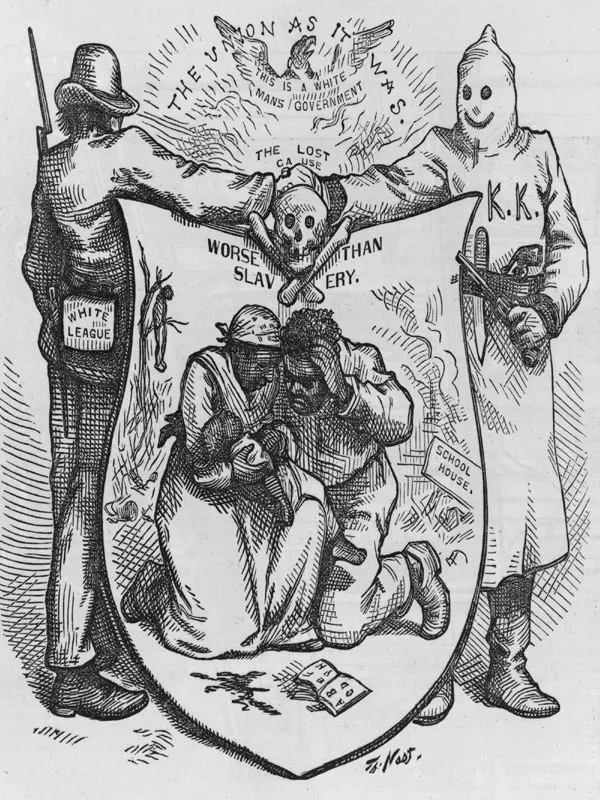
Radio War Nerd EP #204 — The Reconstruction As Dirty War
Recorded: October 28, 2019
The War Nerd looks back at the period after the US Civil War known as "Reconstruction" as a form of warfare — a dirty war, with all the ingredients. Why is there so little historical grasp of the Reconstruction as another form of warfare? Why don't we even know the casualty figures — almost entirely freed African-Americans, killed by the South's dominant whites? A big shout-out to Michael Harriot for his thread on Reconstruction-as-warfare.
Books cited:
Henry Louis Gates, Stony the Road
Eric Foner, Reconstruction
Gen. John Beatty, The Citizen-Soldier
* * *
Don't forget the new audiobook by the War Nerd's alter-ego John Dolan: "Pleasant Hell", the comic memoir read by the author himself. Buy it here!
Total time: 2:22:24
Comments (33)
Another great epsiode on this sort of thing would be the Red Summer of 1919. Basically a bunch of African Americans came back from WWI and said fuck this shit and starting fighting back. Turned Chicago into a war zone and brought about the Elaine, Ark Massacre of over 100 African Americans (some sources say up to 800). And the Bisbee "riot" between Buffalo soldiers and local police in Arizona. https://www.amazon.com/Red-Summer-Awakening-Black-America/dp/1250009065/ref=sr_1_1?keywords=red+summer&qid=1574616313&s=books&sr=1-1
Did you hear that Turkish security recently snatched some ridiculous number of Baghdadi's family on their side of the border, something like 25? Can't find the story right now.
https://www.aa.com.tr/en/turkey/4-relatives-of-dead-daesh-isis-leader-remanded/1646999
Thanks for the great episode. I too had the experience in high school of this being gotten through as quickly as possible. The term "Reconstruction" does indeed evoke a queasy feeling. Re impeachment: I'm with you that Democrats seem afraid to wield power and will not fight, no matter how badly their base wants them to. Trump could have been impeached on day 1 under the emoluments clause. Him keeping his businesses while in office is a fairly straightforward violation of the Constitution, even if most people find it a big yawn. As others have said, I don't think this phone call enough to make 22 Republicans (23 if you count Joe Manchin) come to Jesus. The political pressure isn't there because most people don't understand or even care what the charge is. Worse yet, if he's impeached this year, McConnell, knowing the result in advance, will have a trial early next year. A "fair" trail is important for propaganda purposes, to echo William Hogeland. The trial will be in late January/early Feb, right when the Dem. primary is beginning. Four candidates - including 2 most exciting candidates, Sanders and Warren - will be spirited away to the Senate 6 days a week (per Senate rules, trials go 6 days a week). They are giving the Republicans the chance to throw a wrench in the works and it would not surprise me at all if, out of this chaos, we get the return of Hillary. Then we go into the convention with a mess on our hands and the superdelegates pick the nom, and it's not gonna be Bernie. I would love to see Trump ousted, but *this* impeachment process seems very irresponsible. I think it will have the effect of depressing the Democratic vote if Sanders and Warren are kneecapped in at the outset.
Thanks for this great episode. The New York Times Magazine did an amazing series on slavery this year. It's called the 1619 project and can be downloaded for free here. https://pulitzercenter.org/builder/lesson/reading-guide-quotes-key-terms-and-questions-26504 I'm more of a social science history nerd than a war nerd, and the best economic history of slavery I've read is American Taxation, American Slavery by Robin Einhorn. I wrote a review of it here. https://www.metafarce.com/5-american-taxation-american-slavery.html
Just fyi, I will definitely buy a War Nerd Civil War primer
OK! Now THAT I might write, since I've spent decades reading up for it.
I know you weren't trying to make a comprehensive list of all the massacres of the Reconstruction, but add the Hamburg Massacre that happened near North Augusta, SC to your mental list in case you write that book. It's complete with a "Wade Hampton's Veterans Park" and a monument to one of the perpretrators of the massacre.
Wow! Good tip. I really think Wade Hampton is worth a major unauthorized biography. I'm too old to do it, but somebody should.
Lincoln's general obsession with border states is a bit inexplicable. In the specific case of Kentucky, however, I think I remember Lincoln prioritized keeping it Union for it's military benefits, namely the waterways and rivers that could allow Unions armies access to the Mississippi River, and into Tennessee. Lincoln's views on abolition were also initially driven by the military situation. Slavery allowed the South to send more manpower to the front lines while slaves could be devoted to the logistical matters. Lincoln's thinking on the issuance of the Emancipation Proclamation was that freeing the slaves (only in Southern states currently in rebellion; another act of tip toeing around border states to ensure they remained pro-Union or at least "neutral") would deprive the South of logistical manpower, thus forcing them to reallocate front line troops to crop harvests and munitions factories. But I think as John mentioned, as the war marched on Lincoln's views on abolition evolved to be more motivated by morality and justice than strictly its military benefits.
If you want to know what the Union army would have done to an enemy population they had less qualms about killing you can just look at the ongoing genocide on the western frontier in this period, including Sherman's postwar career.
Yeah, that's very true. The one honorable exception I know of is Benjamin Grierson.
I completely agree that the democrats are allergic to using power effectively. But, I also understand them (at least this one time) being skeptical of impeaching trump over the Ukraine controversy. I know it's a different scenario, but I think Mark talked about how if trump was theoretically impeached over Russia gate nonsense, the wound it would leave in our politics would allow a politician even worse then trump to win indefinitely. Personally, I think the democrats would be smarter if they put all their eggs into actually winning in 2020, rather then hoping for an impeachment.
0% chance 20 Republican Senators vote to impeach him for anything short of shooting a guy on 5th Ave, the whole impeachment thing is a sideshow
Please make this episode available for free. I'd love to share this link everywhere.
Good idea.
Another book which makes this argument is Douglas Egerton's "The Wars of Reconstruction," whose title rather gives that away. Foner reviewed it here: https://www.nytimes.com/2014/02/02/books/review/douglas-r-egertons-wars-of-reconstruction.html
Thanks. I have a lot of remedial reading to do.
Please write this book
I was thinking the same thing, Brent! A comprehensive military history of Reconstruction. I know Dr. Mark Grimsley at Ohio State was working on this topic at some point, but I don't know if he ever got to publish anything.
The Republicans were not "abolitionist." They were antislavery. Big difference. They wanted to stop the spread of slavery to areas where it did not already exist, but were okay with letting alone where it existed. They were founded in 1854 in opposition to the Slave Power's encroachment on the territories taken from Mexico and on the rights of Northern states to defend themselves from legal encroachments like the Fugitive Slave Law. "Abolitionists" were a hated and despised minority. Mostly African American in fact. More postwar revisionism to give the whiff of abolition to those who were complacent about slavery and hostile to blacks
It might also be worth mentioning that plenty of people who were opposed to slavery were so for racist reasons. The impetus for projects "returning" slaves to Africa was a fear of black people seizing any amount of power, and a lot of elite "abolitionism" grew out of the same kind of fears that made Jefferson fantasize about getting rid of the majority of the slave population by genocide if necessary.
after the last episode it'll be nice to listen to something that isn't about horrible betrayals, wasted opportunities, and the possibility of a better future being violently snuffed out
... are you listening to the right show then?
Eric Foner is brilliant, you guys could probably get him on. He's a lefty, but not the annoying kind.
Great episode! We love all of our wonderful guests but John and Mark solo episodes are always gonna be my favorites. I actually spent quite a lot of time on this in high school, but only because my teacher was this bitter old brilliant Irish Catholic who grew up in Pittsboro and held a grudge against a certain kind of white southerners for the rest of his life. I’m sure Dr. Dolan could understand.
Oh yeah.
Yes! I've been thinking for a while now that the Reconstruction period was defined by a large-scale insurgency. There's a decent book that I read, "White Terror: The Ku Klux Klan Conspiracy and Southern Reconstruction," that covered this, albeit without the explicit thinking of the "conspiracy" as an insurgency. The echoes of the Iraq insurgency were striking, from the insurgent minority group foolishly boycotting an election to the insurgency groups getting taken over by politlcally-nihilistic psychopaths.
Great comment! I'll read that.
This episode mentions blacks who tried to flee their plantations being rounded up by white supremacist terror groups and forced to return to sharecropping, and murdered if they refused. This system actually continued into the 1960s and one of my college classmates had a grandfather who was enslaved in this way. On the plantation the slavery system continued as before and sharecroppers were regularly beaten and raped. https://www.vice.com/en_us/article/437573/blacks-were-enslaved-well-into-the-1960s
Blacks were prevented from escaping, often at gunpoint, until the mechanization of cotton agriculture during after WW2 when the great migration began in earnest. Until then most black people in the USA lived in the South and were effectively disenfranchised. Incidentally, a wonderful book, John M. Barry's Rising Tide (1998) , locates the precise moment when the black population switched its loyalties from the Republican to the Democratic party in the wake of the disastrous Mississippi flood of 1927, when Republican Herbert Hoover was put in charge of flood relief. The white population was evacuated by river boats to the tune of the band playing "Bye-bye Blackb Bird"; and the black population of Greenville, Mississippi, which had a considerable educated middle class, was made to remain on the levy and do forced labor at gun point for months, ostensibly to "repay" the cost of their rescue. This was reported in the Chicago Defender, a black newspaper which circulated underground (because forbidden) in Mississippi where it was read aloud in back rooms, and above ground in the progressive circles in the North. I am simplifying, for the full story Barry's book is riveting. Another great book about the sequel, the great migration north (one of the greatest movements of populations in history) and specifically to Chicago, is Nicholas Lemann's The Promised Land, also a heartbreaking tale of missed opportunities.
All my high school history courses explicitly skipped Reconstruction because we “didn’t have the time”. Once I learned the first taxpayer funded public schools were built during Reconstruction it was like the end of The Usual Suspects; “oh THATS why we denigrate public schools here”.
[US history grad student] Colleges do this too. Well, we don't so much skip it, as pivot around it. We all know its importance, yet it gets tagged at the very beginning or very end of semesters--before students are really engaged or after they're ready to tap out.