


Radio War Nerd EP #152 — Franco-Prussian War, 1870-1
Recorded October 8, 2018
SYRACUSE, SICILY—The War Nerd picked up a copy of one of the great defeat-in-war novels — Zola's La Debacle — and was inspired to do a whole episode on the Franco-Prussian War that Zola wrote about. After the break, Ames and the War Nerd discuss the much-romanticized, highly infuriating Paris Commune that briefly appeared in the political vacuum of defeated France. Turns out there's not much to romanticize—just a gruesome turkey shoot by an extremely vengeful French ruling class and defeated officer corps.
Maps:
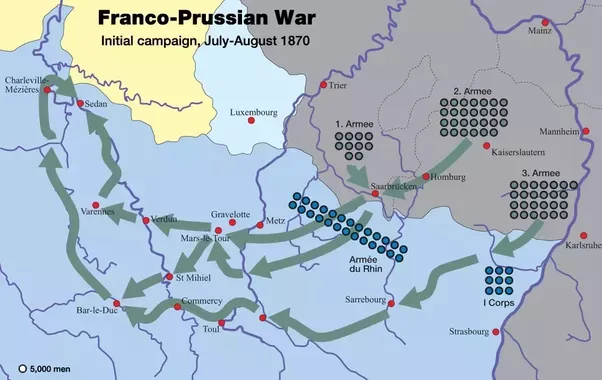
* Initial campaign, July-August 1870
* Franco-Prussian War map
Total time: 2:18:57
Direct link to this week's episode here
Comments (12)
Fun fact: The norwegian playwright Nordal Grieg, who got shot down over Berlin, wrote a play about the commune wich got plagiarized by Bertold Brecht.
to what extent can you NOT draw a straight line from Napoleon to the Franco-Prussian War to WWI?
I was wondering if you'd mention Robert W. Chambers, as one of the stories in The King in Yellow is set in Paris during the Prussian siege. I wondered if he was there at that time?
Cheers Gabriel, this is all realy good stuff. The stuff about the divisions between Pre-Sedan officers Corps and those who had risen under the Government of National Defence is interesting. Particularly because while the Royalists miss their chance (because Henri d'Artois was fucking idiot so they had to wait for him to die) and get stomped in 1876 that old reactionary officer class basically haunts France for the next 90 years, it’s kinda shocking how clearly the memory of the Commune is haunting Pétain and Weygand in 1940.
Not sure if Robert Tombs''s "The War Against Paris" on the Versailles army will appeal to people not as obsessed with questions of repression and personnel policy as I am, but I thought I'd anyway copy some passages on the origins and motivations of the officers and men. On the officers: ' The National Defence officers [i.e., those who gained rank after most of the pre-war regulars lost at Sedan and Metz]--with so many ex-rankers, semi-civilians and republicans among them, all of whom stood to lose from the reaction in the army that would accompany reaction in the state--were reluctant to become involved in civil war. The military authorities, generally of the old army, held them all in suspicion.... [They] therefore tried to solve the problem of unreliability among the officers by replacing where possible those of wartime creation by regulars returning from captivity in Germany. Nevertheless, large numbers of the former remainedin most of the Versailles regiments, and in the end remained loyal to the government. The changed situation provides much of the explanation for their more or less grudging fidelity [as it] became clear that the Parisian movement was more than a purely patriotic upsurge, and that it was not led by the kind of men to whom a moderate republican officer might be expected to rally. ... There were also personal considerations. In one way, to remain neutral would have been easy [but] to heed such advice would probably mean the end of a career, and there was therefore a scramble for employment by officers of all ranks trying to prove that they would merit special consideration when the reduced peacetime army was re-established. ... As many National Defence officers serving in the Army of Versailles shared the background, and to some extent the opinions, of the few who rebelled more openly, it was inevitable and not unreasonable that the senior commanders should be mistrustful. Their solution to the problem was to give command of the troops to regular officers returning from captivity in Germany.... During April, regular officers returning from Germany took control of the higher echelons of the army, though still a minority at company level. It may be assumed that their loyalty to versailles, in spite of occasional grumbles, was unquestionable: unlike many of the National Defence officers, they had little knowledge or understanding of the wounded patriotism of Parisians that had helped produce the insurrection, and were largely ignorant of their other grievances. In addition, personal interest attached them to a conservative regime that would return to the pre-war military system. This change in the composition of the Versailles officer corps was among the most important factors that made the army an instrument usable against Paris. Encouraged by the rivalry with the National Defence officers, their determination had a noticeable effect on the performance of the army: " One felt that they were defending their salaries. . . their personal future"; each was fighting "for his own life. . . for self preservation." ' <a href="https://www.amazon.com/War-Against-Paris-1871/dp/0521287847" rel="nofollow noopener" target="_blank">https://www.amazon.com/War-Against-Paris-1871/dp/0521287847</a>
On the rank and file: ' The authorities hoped to transform the rank and file too with released regular soldiers--a hope that had been nourished since the beginning of the crisis. Thiers had not been entirely sure of the loyalty of the "old army": "Several months of captivity might have altered it, physically and morally." Only about half the 310,000 prisoners were long-service regulars, the rest being reservists and those near the beginning of their military service... The prisoner returned in a state of disorganization, and so the original plan, to send each detachment back to its depot to reform the regiments of the pre-war army, had to be abandoned. It was found necessary to form regiments provisoires from the mixed detachment as they arrived. It was hoped that companies could be formed from men of the same unit, no doubt with the intention of minimizing the danger of indiscipline arising from the lack of acquaintance of officers, NCOs and men that was blamed for the breakdown of the army in March. Even this method was slow, for the returning prisoners contained a high proportion of reservists due for demobilization -- about half, according to Thiers. There was no question of keeping them: "they would have been grumblers, not fighters." Of the 13,452 who had arrived at Cherbourg by 11 April... onnly 3,800 had been assigned to regiments.... As a result of these difficulties, the prisoners of war took part in the campaign only in its later stages, when the superiority of the Versailles forces was already established.... While on the one hand a battalion of zouaves, the elite French infantry, had to be sent to Algeria after numerous reports of its indiscipline and sympathy for Paris, other prisoners of war were "furious with the Parisians". In short, the returning prisoners were of an uncertain and changeable disposition, and like the rest of the army, they needed careful handling. ... Disaffection continued to show itself throughout May, even after the entry of the army into Paris. Soldiers from many different units were involved, from all sections of the army: the provincial National Defence regiments, the old Army of Paris, and the former prisoners of war. Clearly, being of rural origin or having served in the Imperial Army and passed through the prison camps of Germany did not guarantee hostility towards Paris, and still less enthusiasm for versailles. Yet the broad view of the conflict as being between ruraux and townsmen is not without some validity. [Evidence from] court martials for desertion or complicity in the insurrection shows that many [of the accused] shared an urban origin and a non-agricutural, often artisan, occupation. On the other hand, in the most important court-martials, those bearing witness against their comrades were of rural origin and, as important perhaps, very young. ... Certain definite, though limited, conclusions can nevertheless be reached on the "spirit" of the troops and its consequences. The army did not suddenly change from a mutinous rabble eager to fraternize with the people, into a hardened instrument of repression. In spite of the measures taken by the government, notably the purging of all those thought to favour the insurgents, there remained to the end soldiers who sympathized with Paris, and a much larger number who were strongly opposed to involvement in the civil war... The authorities had to ensure, therefore, that the troops should never again be severely tested, hence the prudence with which the campaign was conducted. Loyalty to Versailles demanded no more than acquiescence in what seemed to be the inevitable. The widespread reluctance to fight, though it reduced the army's efficiency, was prevented from disrupting its functioning. It may even have added to the ferocity of the final stages of the campaign, when resentment at being forced to fight seems to have turned against the stubbornly resisting Federes: "It is the Parisians' fault that we are still not back home." ' <a href="https://www.amazon.com/War-Against-Paris-1871/dp/0521287847" rel="nofollow noopener" target="_blank">https://www.amazon.com/War-Against-Paris-1871/dp/0521287847</a>
The Bonapartism aspect of peasant support for Louis Napoleon doesn't seem to differ much from modern day strongmen and their support among the provincial poor. The Right to Strike is a strange one though. Not exactly the priority among rural peasantry.
My ears were bleeding. The Commune was NOT a nationalist movement but a patriotic one. Patriotism ran very deep among the French, especially within the mid to lower classes, while the second empire aristocracy owned France but only belonged to their class. French nationalism as such only appeared a couple of decades later with revenge politics and around the Dreyfus affair. I've never heard of the Front National claiming the Commune as it would have caused an uproar. The Commune is still the holiest of the holy from the jacobin left to the anarchists. Today, the treason of the elites rhetoric is mutual to left and right movements with an anti-EU/anti-NATO bent that consider national sovereignty as an essential condition for change. In France, the FN did try to appropriate it from an nationalist angle, and so did Melenchon from a populist marxist perspective. There's a very good example of that sentiment in Italy right now.
"NOT a nationalist movement but a patriotic one" - how do you distinguish?
There is “power” and there is chain of command, no?
You guys made an interesting point regarding rural voters, who apparently had garnered quite a reputation for conservative tendencies by 1871. Some of the communards were aware of the irony of violently resisting democracy: <a href="https://journals.openedition.org/mots/19617" rel="nofollow noopener" target="_blank">https://journals.openedition.org/mots/19617</a> Marx didn't call this "false consciousness" -- that phrase was coined after him and used by Lukács especially. Marx claimed that that class interests of peasants are inherently conservative, which, like many of Marx's statements about class, is a pretty dubious generalization in its own right. <a href="https://understandingsociety.blogspot.com/2015/09/marx-on-peasant-consciousness.html" rel="nofollow noopener" target="_blank">https://understandingsociety.blogspot.com/2015/09/marx-on-peasant-consciousness.html</a>
I mean to be fair to old Karl, in the next passage after he lays out his theisis on the Peasants in the 18th Brumaire he starts complicating the picture.