
The Gospel of John - Chapter 1 - Verses 1-14 - The Word
In the beginning was the Word, and the Word was with God, and the Word was God. 2 The same was in the beginning with God. 3 All things were made by him; and without him was not any thing made that was made. 4 In him was life; and the life was the light of men. 5 And the light shineth in darkness; and the darkness comprehended it not.
6 There was a man sent from God, whose name was John. 7 The same came for a witness, to bear witness of the Light, that all men through him might believe. 8 He was not that Light, but was sent to bear witness of that Light. 9 That was the true Light, which lighteth every man that cometh into the world. 10 He was in the world, and the world was made by him, and the world knew him not. 11 He came unto his own, and his own received him not. 12 But as many as received him, to them gave he power to become the sons of God, even to them that believe on his name: 13 which were born, not of blood, nor of the will of the flesh, nor of the will of man, but of God. 14 And the Word was made flesh, and dwelt among us, (and we beheld his glory, the glory as of the only begotten of the Father,) full of grace and truth.
Comments (30)
I feel a little ghoulish sliding another comment in, knowing the reason for the episode timing 😬 but if I am forgiven that trespass, I finally sat down to read the Jewish Annotated New Testament's intro to John, which has a lot of interesting stuff to say! Two things stood out to me (both of which may well have been covered already in the episode by our recovered host!): First, that the idea of "the Word" is not a Johanine innovation; apparently a lot of Jewish thinking in the first two centuries CE incorporated the Word/Logos/Memra (in Aramaic) as God's chief actor and instrument. The intro cites the Jewish philosopher Philo, a contemporary of Jesus: "To His Word (Logos), His chief messenger, highest in age and honor, the Father of all has given the special prerogative, to stand on the border and separate the creature from the Creator", in "Who is the Heir of Divine Things" 205-6). It also quotes some of the interpretative translations of the Scriptures (targumim), for instance "And the Memra [Word] of God said 'Let there be light' and there was light by his Memra.", Gen 1.3). It sounds so much like John! Which is to say, John sounds a lot like other Jewish texts -- which is appropriate, as I think it's come up earlier that John is both really Jewish and really anti-Jewish, and that one way to read that dichotomy is that it encodes the Johanine community being expelled from the synagogue. The intro points out, though, that first-century Judea was wildly theologically diverse (which we saw some of in Mark). Even proclaiming a Messiah wouldn't necessarily be beyond the pale: "in the period of 132-135 similar claims were apparently made for Simeon Bar Kosiba to be a messiah, by the prominent Rabbi Akiva, whose status and stature within early rabbinic Judaism did not suffer as a result" (JANT 153). All together, this makes me wonder: what if John wasn't _encoding_ division but _creating_ it? If John's theology was in bounds, if proclaiming a Messiah didn't push them out of the synagogue, if the authors needed a way to bind their own community together and define it against the broader Jewish society around them, what if they wove a thread of persecution and division into their central text to do that? To be clear, this is just off-the-cuff speculation! It could well be that John's steps of identifying the Word as God and Jesus the human Messiah as the Word and then worshipping in Jesus' name crossed a real line for the Jewish community around John. (So much of this turns on the cultural sensitivities of a time and place that is just unimaginably distant today!)
The text of the New Testament that I'm using has an extended prologue on translating the prologue of the Gospel of John and it too mentions Philo. I'm just going to block quote rather than interpret, "For one thing, the term logos really had, by the time the Gospel was written, acquired a metaphysical significance that "Word" cannot possibly convey; and in places like Alexandria it had acquired a very particular religious significance as well. For the Hellenistic Jewish philosopher Philo, for instance, it referred to a kind of 'secondary divinity,' a mediating principle standing between God the Most High and creation. In late antiquity it was assumed widely, in pagan, Jewish, and Christian circles that God in his full transcendence did not come into direct contact with the world of limited and mutable things, and so had expressed himself in a subordinate and economically "reduced" form "through whom" he created and governed the world. It was this Logos that many Jews and Christians believed to be the subject of all the divine theophanies of Hebrew Scripture."
Hi friends - I have run smack into the worst fever of my life. It keeps breaking and reforming and it’s a little scary! I am sure I will be okay but it has ground my work to a halt. I hope you will forgive me if I take a day or two extra with this...in some ways a delirious fever feels appropriate for John but i don't think we should experiment with the form THAT much for the first episode! if i live it'll be up soon! here's hoping!
Take care of yourself and get well soon!
What an epic beginning. I can almost hear a John Williams theme (maybe the Krypton theme?) playing grandly in the background. First thing that struck me about this is how similar it is to Mark's beginning in structure. Mark and John don't mess around with significant births or work on establishing mortal lineages. They state the divinity of the gospel's subject (although John hasn't identified him yet) and then they each move right on to John the Baptist. John's author is way more interested in setting the stage and placing all these figures in the proper context, whereas Mark doesn't worry about defining terms like "Son of God." Mark likes keeping symbols and complex ideas opaque and undigested, while John seems to use all this symbolism in order to better get the point across. That difference in approaches gives John a lot of freedom to "explain" Jesus in directions Mark likely never imagined. I recall that it's fairly controversial whether John's author had Mark's gospel in front of him or her while they were writing the gospel of John. This intro certainly makes me think so.
Yom Kippur is an entirely appropriate time for thinking about the Gospel of John 😝 • Mark and Luke start out with a mission statement, whereas Matthew and John both launch right into it, assuming we know why we're here. Comparing Matthew's and John's openings feels representative of the scope of the two testaments: Matthew starts with the lineage of the human Jesus, John with God's creation of the universe. • We got almost no hint in Mark that the author function saw the itself or the latter community of the Jesus movement as participants in its story (which makes sense, if Mark saw its task as primarily historical). So it's quite a moment when John switches into the first person, inviting both the author and the reader into the text: "and dwelt among us, and we beheld his glory". • "we beheld" is pretty interesting also since we understand the Gospel to be written after everyone who knew Jesus personally had died (absent supernatural intervention, at least). • Is the parentheses in line 14 suggesting a latter addition? • "the glory _as of_ the only begotten of the Father"? "As of"?! Is there some doubt there? Why the hedge against this identification? Is that just a translation artifact? • John's starts out with a stark binary worldview, light and darkness, good and evil, which is so different from Mark. In Mark we had sin and temptation and even punishment, but those all ultimately related to humanity rather than freestanding cosmic forces, right? • (Tenuously on topic: my rabbi gave a Yom Kippur sermon about living in Megido in 1999, watching US evangelicals tailgate for the expected battle on the plain where John proclaimed his apocalypse would take place. She took this into a discussion of the armageddon that is the flattening down of humanity's and the world's complexities into the kind of simple binary that John presents here, and what it means to not despair in the face of unimaginable, complete catastrophe like we face today. It was pretty good.) • What's up with "sons of God"? And the fact that believers are made "sons of God" not by being adopted, but by given power? It has an unexpected adoptionist ring to it, especially if the parenthetical in verse 14 is removed (in which case John introduces no concept of there being an "only" "begotten" from the Father).
I've never been sure how how to classify John. It's one of the Four Gospels, of course, but there's always a voice in the back of my head that says "this is totally fanfic". Mark feels like a history. It's a story, of course (all histories are stories), but I got the sense that the author function told its story within the constraints of what they knew of Jesus' life. (Maybe that's too generous?) Whereas with John, from what I understand/what's been discussed before, it feels like the author freely rearranged everything in order to tell a particular theological story. (Does that distinction makes sense?) If that's the case, though, are we as individuals constructing our own understanding of Jesus obligated to take John more seriously than any other stories about Jesus? What makes John more "genuine" or "canonical" than Paradise Regained, or the Last Temptation of Christ, or Dayspring? One obvious answer is that John _is_ canon for billions of Christians across thousands of years 🤣 and another is that John, writing only 80ish years after Jesus' death, would have had access to so many stories and saying of the actual Jesus that we just don't have anymore. Perhaps the real answer is that "understanding Jesus" is a very poorly defined objective. Whether we're looking for a communal understanding or a personal one, how much we weigh basing it on history or a common or specific theology or in our own personal search for meaning or for support outside ourselves, each of those will lead us in different directions with regard to the Gospel of John (and any other story). I certainly don't have an answer, but would be glad for anyone's thoughts.
Oh, the Gospel of John is definitely fan fiction. Slash fiction at that! I can’t wait until we get to chapter 21 where the author’s self-insert character is all but promised eternal life...
Love this recap of all of existence! I know this is backwards, but it reminded me of the opening sequence on Buffy.
“3 All things were made by him; and without him was not any thing made that was made.” I have apparently been reading enough of N.K. Jemisin’s Inheritance Trilogy and watching Dark Souls playthroughs that this verse sticks in my mind. Okay, god made everything that was made. But what about anything that was unmade? My familiarity with the Marvel and DC multiverses means I have to wonder about the inverse of this verse, about what was unmade in the making of “all.”
I was wondering that same thing about "the darkness". The Light is associated with God and the Word, so the Darkness could be read as being not of God and the Word. Yet the Darkness is capable of comprehension (otherwise it's not meaningful to observe that it doesn't comprehend!), so fundamentally it must have some kind of existence. Makes me think of Milton's Chaos and Uncreated Night, who are primordial and (as the name says) uncreated, yet also have existence and will and intelligence, as shown by Chaos talking to Satan and getting annoyed about God carving up his territory.
So, Anthony. I was just reading “Shout Out” again and noticed that a quote in the last page of your story “Sunlight” was familiar. And then I remembered listening to this reading and how you slipped some Gospel of John into a gay super hero comic. No question here, just commenting on your strong brand and how we love you, being you, in all you write.
Cue the Ed Sullivan joke: "And now for something completely different." I was late to the episodes about the Gospel of Mark, so this is my first time commenting. I grew up Catholic in the very Protestant southern U.S. and this gospel always seemed like a first among equals, whether I was at the cathedral or slumming at friends’ mega-churches after sleepovers. While there are some beautiful turns of phrase and the certainty of salvation, this is also the most anti-Semitic and supersessionistic of the gospels. I wonder how much of its popularity has been fueled by that same anti-Semitism. Both Mark and John lack a birth narrative but their respective depictions of Jesus couldn’t be more different, from the language itself, to the pacing of his ministry (one year to three), and especially Jesus’ awareness of and control over himself. Mark’s is often called the wartime gospel, either leading up to or shortly after the destruction of the Second Temple, but John has always read like a gospel waging a war between Christianity and Judaism at a time when their separation was final and both were being attacked by Rome. (How much of this gospel’s pivot was shaped by Paul’s mission to the gentiles?) Getting to the language itself, Stephen Butts’ description of it as a “metaphysical mobius strip” is perfect, because this theology is retconning Genesis to sow the seeds of trinitarianism. I can easily imagine it being a proto-doctrinal statement of faith, one that rehabilitates Jesus from his ignominious execution. If Mark’s Jesus was the suffering servant, Matthew’s (somehow) the heir of David and a new Moses, and Luke’s a savior for all the nations, then John’s surpasses them by making Christ the preexistent Logos from whom all of Creation unfurls like a run-on sentence. Last, as someone who’s still Christian(ish), the development of the Trinity has always been fascinating to me. I’m sure you’ll discuss it at various points in the podcast, but do you buy John’s balancing act, the tightrope of which seems to be identity as action or purpose, in maintaining the singularity of God?
"Retcon" is the word I went for too! John reshapes both creation and the identity of Jesus in this opening section. I've always wondered how John gets away with this retcon--why did people accept as canonical such a dramatic departure from previous scripture? Of all things, it's actually been the X-Men that have helped me understand this. In one episode of the X-Men podcast Cerebrocast (on which our host has appeared), they talked about how a good retcon doesn't negate or explicitly change previous stories, but rather reposition them to reveal something new. Early Christians would (I think*) not have seen John as a contradiction of Mark or Genesis, but a step to a new vantage point from which you can see truths previously out of the frame. Sure, there might be contradictions here and there (just as there are in the various histories of, say, Magneto), but those would be understood as minor continuity errors, not as a crisis. Relatedly, I am curious which retcon our host thinks is more ambitious: the Gospel of John or 2019's Moira X 🙃 * well, maybe not all early Christians would have seen John as being in accord with Mark -- the adoptionist/high Christology debate was a whole thing. If it hasn't been convered, do we know much about how easily John was adopted as Gospel among early Christians?
This is so different! And so cool! What I like most about the Gospel of John's introduction is how clearly we can see both the author's personality and what the Christian community was wrestling with at the time. After Mark's silence, it's kinda dazzling. I say "the author" because John much more feels like the work of one person. (What does the scholarship say?) The text is dense, as people noticed, because the author is precise and detail-oriented and complete. This is someone who clearly feels that each detail matters to the picture the text paints. And the text paints a picture of the Christian community of its time: To me, John's emphasis on the specifics of the Word's relationship to God suggests that each of those aspects (was the Word created? Is it divine? Can it be distinguished from God?) must have been a topics of discussion and uncertainty. (This isn't even supposition, really—those topics continued to be argued into the era of the councils.) Similarly, there'd be no reason to list out all the things "sons of God" did *not* come from (or whatever the subject is in 12-13, it's unclear), unless it was at least imaginable to the author that someone might argue for blood or the will of the flesh or the will of man. Finally, why would the author introduce, by contradicting, the idea that some John is himself the divine main attraction, unless it was a known idea people believed? It's for that reason I join with those who jam with John as the Baptist here. We know there were followers of John long after his death (still are, in fact: Mandaeism), and it seems more likely the Christian community was struggling with the Baptist's followers than with whether one of Jesus' disciples and transcribers was actually the light. (Maybe this is reading too much into the first 14 verses, but in choosing John as the only figure worth noting, as well as the cosmic scope, I really read a distinct perspective that feels _Christian_, as opposed to Mark's ambiguous position inside a multipolar Jewish world.) All of this to say the author's style really resonates with me 😄 I find it hard enough to leave out details on things I just find interesting; how much more pressure to be thorough and thoughtful when you're dealing with salvation! If the whole text is like this, it's going to be quite a trip.
My trusty old NAB Study Bible states this is a "product of a developed theological reflection" and remarks on how the prologue is "like an overture for a musical work" in introducing the important themes of the gospel. The page with verses 1 through 17 is literally half footnotes, because we're in for a RIDE. A literal translation of 1:14 would have "pitched his tent/tabernacle" instead of dwelt (KJV) or "made his dwelling" (NAB), calls back to Exodus and the tabernacle, and forward to John 7 and Jesus teaching around Sukkot.
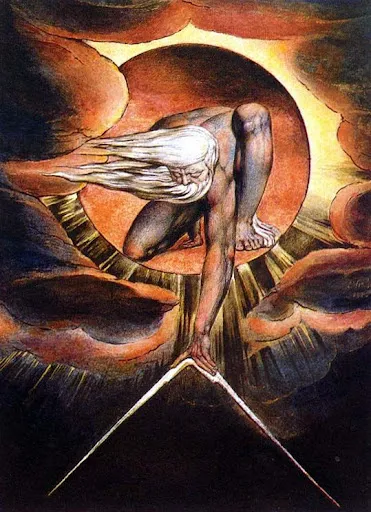
Love the use of the Ancient of Days as the cover for the reading, one of the few paintings my rudimentary art history knowledge can actually recognize. Definitely a very strange start to the gospel. We get a mini recap of the start of Genesis, the creation and separation of all existence through an act of will, the Word (at least that's always how I interpreted it, the Word being God's divine creation, the ability to will things into existence through speech or intent). And then we get a summary of John the writer, and in a weird way this strikes me almost as the inverse of the invocation of the muse like we see in epic poetry. In the traditional invocation, the speaker, as themselves, call out to and request insight, inspiration, etc. Here, we start with that divine other and it creates and illuminates this person (who we know to be the author but who is not identified by first person or addressed as such in the text). Definitely a more theological and abstract start to the gospel than Mark.
So interesting how far the understanding of who Jesus was has developed in the 30-50 years between Mark and John being set in their final forms. Where Mark refers to Jesus as Son of God and we're unclear what that meant to the Markan community, John comes right out of the gate claiming Jesus, as the Logos, is part of God and has been in God since the dawn of creation. Jesus is now most definitely divine. I guess we're seeing the seeds of trinitarian thinking starting to emerge. To me this Jesus feels similarly formulated to Milton's Jesus in Paradise Lost - of God, but secondary to the Father. On a more personal note, as someone who grew up in a Christian family, and *kind of* still has some form of Christian faith, this passage is very familiar and still feels wonderfully poetic. I'm also hoping we'll dive into what Logos might mean - I've always got the impression it's a very important concept in theology but have never quite grasped why.
The Word reminds me somehow of Adam naming all the animals. Is the Word here possibly that true name of God that shouldn't be taken in vain, because it gives the the power of creation? As in, if you know the true name of objects you have power over them, and if you have the true name of god, you can conjure up, well, whatever you want? I know this is a jumble of ideas, I hope you can make some sense of my question. If it doesn't make sense, just skip it.
I read through John for the first time last year, and coming back to it now, this opening reads like a mission statement. Where does this story begin? Not with John the Baptist, not with Mary and Joseph, not with Isaiah or David or Abraham. It starts with creation itself, calling back to Genesis 1. Who's John? Not a follower of Jesus, but an envoy sent by God, to testify about what he witnessed and spread the word. And then we get some proto-trinitarianism: Jesus was not the Son of God, but Jesus was God, now among their creation. Where the synoptic gospels read like biography, my feeling was that John is more interested in theology, of making Jesus fit within a broader religious tradition. Coming back to it now, with the benefit of being able to contrast it against a deeper reading of Mark (thanks!), I'm just like: Oh, that wasn't some accident or quirk of John that I was picking up on. That's the whole point of the project. It's pretty clear about that right here, up front. Maybe this is going a little too far, but I get the sense that John isn't interested in telling us the story of Jesus per se. John wants to tell us Act III of the Story of God, the story that began with the Word and now will end with it.
I like how you see John as the third and final part of the story of God. Biography is thus beside the point because God _is_. Or as some versions translate the Hebrew of the first theophany to Moses: “I will be who I will be.” If Genesis was recasting pre-existing myths (Utnapishtim and the flood) through a henotheistic/monotheistic lens, it seems like John is expanding a still young Christian theology through the lenses of Greco-Roman philosophy, which for an interesting contrast.
What a dizzying sequence of relationship and identifications in this prologue: to be, to be with, to be in, to come into. To make, to be made by, to witness, to illuminate, to know, to receive, to give. (Maybe I should try diagramming it.)
I said I'd do it and then I went and did! (turns out I can't put images in a comment box, probably for good reasons, but here's a diagram of how everything in this passage relates to everything else: https://imgur.com/a/CYf6dar)
I'm sure on the podcast we'll be getting into the various nuances of "logos" - the Word - and what that means when applied to God and to Jesus, but I want to shout out my absolute favorite one of its constellation of meanings. In addition to "word", "reason", "speech", "argument", etc., "logos" is also the word for the mathematical concept of <i>ratio</i> - a sort of relation between magnitudes. A is to B as C to D and so on. And while I doubt Euclid was uppermost in John's mind, the idea of Jesus as being a sort of relation between things is very evocative to me.
It’s already so much different than Mark which comes across as a rapidly written account of the man who led a movement that was loud enough to bring about his doom. The Johannine community had time to open with poetry that sounds much more familiar to my Catholic ear. “And the light shineth in darkness; and the darkness comprehended it not” blows my mind. I’m very excited to get into John’s theology and discover what’s here and what’s not.
This reads so much more like the false endings to Mark than anything else out of that gospel, I think--it has an element of exclusivity that seemed to lack in the rest of Mark, and verse 12 especially brings to mind the stuff from Mark about serpents and poisons and faith healings. Also, verse 12's promise that believing "in [Jesus's] name" will give people the power to become the sons of God suggests that John is working with a very different conception of what the phrase "son of God" means compared to Mark.
Thinking about the Word and the Adam and Eve stories wherein God breathes life into them and how breath/life/word all get interconnected in the language of the Bible. Which is very interesting and cool. I find the intro to John to be extremely dramatic and Extra. It's SO SO SO different from the style of Mark! And at first was thinking he was referencing John the Baptist but then realized he was talking about himself in a "call me Ishmael" sort of way. Or even in a bit of a Chuck Tingle way ( because Chuck Tingle always refers to himself in the 3rd person as "man name of Chuck.")
I could be wrong about this but I think the writer is talking about JtB here.
This is quite the dense prologue. John writes like a student trying to boost the word count in their paper the night before it's due. Monty Python really got it spot on with the Holy Hand Grenade bit. I'd like to try to dissect what the meaning of "The Word" is supposed to be here. I'm getting echoes of the concept of The Trinity, separate things also being one thing. The Word was in the beginning, with God, was God, was made flesh, and dwelt amongst humans. It sounds like John is implying that Jesus existed in some form since the beginning of time. Which kind of tracks if you consider Jesus to also be God. Why did they have to write this metaphysical mobius strip? My other guesses as to what The Word could mean would be knowledge, the scriptures, or the concept of salvation. The connection my brain made to salvation is with the idea of the gospels being the good news. In this interpretation John would be saying the secret to salvation has always been around and he can tell you what it is. Classic pyramid scheme tactics. I'm only slightly joking with that. The second paragraph seems like largely a summary of some of the earlier parts of Jesus's story with a troubling note that believers will be given power. Pretty vague on what power being Sons of God would imbue but troubling nonetheless.
"Skip a bit, brother..."