
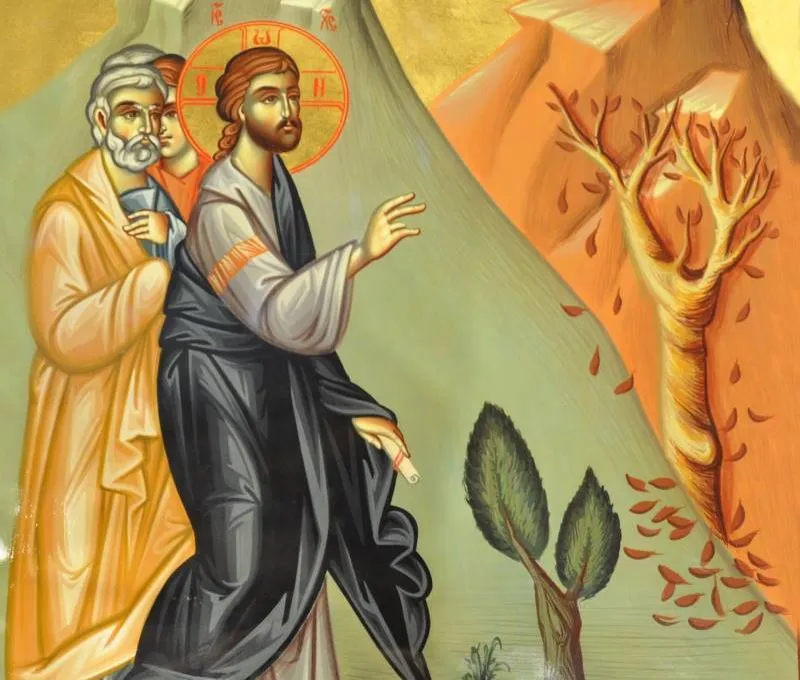
The Gospel of Mark - Chapter 11 - Verses 1-14 - The Fig Tree
And when they came nigh to Jerusalem, unto Bethphage and Bethany, at the mount of Olives, he sendeth forth two of his disciples, 2 and saith unto them, Go your way into the village over against you: and as soon as ye be entered into it, ye shall find a colt tied, whereon never man sat; loose him, and bring him. 3 And if any man say unto you, Why do ye this? say ye that the Lord hath need of him; and straightway he will send him hither. 4 And they went their way, and found the colt tied by the door without in a place where two ways met; and they loose him. 5 And certain of them that stood there said unto them, What do ye, loosing the colt? 6 And they said unto them even as Jesus had commanded: and they let them go. 7 And they brought the colt to Jesus, and cast their garments on him; and he sat upon him. 8 And many spread their garments in the way: and others cut down branches off the trees, and strawed them in the way. 9 And they that went before, and they that followed, cried, saying, Hosanna; Blessed is he that cometh in the name of the Lord: 10 Blessed be the kingdom of our father David, that cometh in the name of the Lord: Hosanna in the highest. 11 And Jesus entered into Jerusalem, and into the temple: and when he had looked round about upon all things, and now the eventide was come, he went out unto Bethany with the twelve.
12 And on the morrow, when they were come from Bethany, he was hungry: 13 and seeing a fig tree afar off having leaves, he came, if haply he might find any thing thereon: and when he came to it, he found nothing but leaves; for the time of figs was not yet. 14 And Jesus answered and said unto it, No man eat fruit of thee hereafter for ever. And his disciples heard it.
Comments (15)
I want to try to put the fig tree episode in the context of the symbolism of fig trees in the Hebrew Bible. So, in the Exodus narratives, one of the selling points of Israel as the Promised Land was the fertility of the land—often referenced in terms of an abundance of wine, (olive) oil, and figs. The Torah (specifically Deuteronomy 28) relates that, when the descendants of Abraham came to Israel, God told them they would be blessed if they remained faithful to God’s covenant with them but would experience covenant punishments (i.e., breach of contract penalties) if they were not. These penalties included exile from the land, blindness, “madness,” death, rule by foreign kings, and crops not bearing fruit. The book of Jeremiah records a lament for perceived moral decay in the southern kingdom of Judah, including the passage: “When I wanted to gather them, says the Lord, there are no grapes on the vine, nor figs on the fig tree; even the leaves are withered, and what I gave them has passed away from them.” One way to interpret many—probably, most—of Jesus’ miracles is to see him as undoing the effects of the covenant punishments: he takes away blindness, mental illness, even death. One of the punishments listed in Deuteronomy is even that someone will take away your donkey and not bring it back. Jesus makes sure it gets brought back. So, I think one of the things going on in the fig tree passage is that Jesus is mad at the fruitless fig tree as a symbol of the incompleteness of his own mission. In the main, people have not signed on to the moral reforms he was trying to make. Religious leaders who should be on his side are trying to kill him, people come to him for free food or healing or even entertainment but don’t become disciples, and those who do follow him so often don’t really seem to get it. He could even be feeling frustrated at himself, knowing that he doesn’t have much more time left and having wanted to do so much more good.
As a person who is queer and a Christian and who has been kicked out of three churches (so far!), I resonate strongly with feeling frustrated and hurt that people who should accept you instead reject you. With feeling angry that, when you suggest to your co-religionists that we should be on the side of the marginalized and oppressed, that they say, "We don't want to, and you should stop causing trouble, or else." With crying furious tears over the way Black people, women, and trans people are treated in your country, while the people who claim to speak for your religion are among those actively oppressing them and us.
I just remembered a fun historical fact potentially relating to the donkey in this week's episode. There's an ancient piece of graffiti on plaster preserved in the Palatine museum. It's called the Alexamenos Graffito and it depicts somebody worshipping a crucified figure. The crucified figure is a man with a donkey's head and there's text beneath that reads "Alexamenos worships his God" or something to that effect. Scholars aren't in 100% agreement on the exact interpretation but one theory is that it's meant to be mocking a Christian named Alexamenos and if that's the case then one of the oldest depictions of the crucifixion of Jesus was made as a joke. It may not be as fun of a fact to some but I enjoy it.
There's something almost majestic about the anti-climax of Jesus' arrival in Jerusalem. He enters the Holy City riding the prophesied animal, surrounded by signs of biblical prophecy and kingship...only for it to be so late that all he has time for is sightseeing before heading back to his hotel. It reminds me of Tolkien's observation that Jesus would be the smelly donkey and not the noble lion -- today Jesus is the disorganized tourist and not the triumphant hero. ---- I find myself wondering about editing and preservation at this point. The story would be more impressive if the story merged the two days and had Jesus arrive in triumph and set straight to work; similarly, the fig tree seems less like support for the Christian narrative than like something you have to explain away. Given those and other unexpected moments in the upcoming days (like the naked youth), I wonder if the last week of Jesus' life was simply so widely witnessed and remembered that the Gospel authors had very little room to make changes, at least when Mark was being composed. ---- Jesus knows without seeing that there is a colt the next town over, but he's surprised by the fig tree's lack of fruit. He has special knowledge when he needs it for his mission, but Jesus is as in the dark as the rest of us when it comes to his own needs. I wonder if that was frustrating.
What was it that Jesus did when he came into the temple? "... when he had looked round about upon all things..." makes it feel to me as if just wanted to be in the presence of it, like a pilgrim coming to the end of their pilgrimage.
I really, really enjoy that in a passage focused almost entirely on the triumphal entry, you're laser focused on the fig tree. I also really like that part of dayspring. I think about it at least once a week.
With all of the other motifs in Mark about Jesus running late, being interrupted, always in a rush, I could see the fig tree incident as a last poignant example of Jesus Versus Linear Time. That defining characteristic of mortality - that some things are possible only at certain times, that things take time to accomplish - has been a recurring feature of Jesus's preaching. Still, this simple instance of seasonality comes as a surprise - or at least as a frustration. Also, considering all the times that Jesus fed others in situations of equal difficulty, there's something really sad about him looking for food and finding nothing. (He fed others, he cannot feed himself?)
A wizard may arrive precisely when he means to, but it's not fair for him to expect dinner to be ready when he arrives a month early.
It is unreasonably distressing to me that I am to just imagine this door at a crossroads, with no associated structure. Just some door standing alone, with a donkey tied to it. I have to wonder if this signifies in any way, or if it's just a weird quirk of the text that there's no mention of the structure attached to the door here. What would the door have to be like, structurally, to admit something being tied to it and still function, I wonder? And this is to be read as a donkey by the way, in spite of modern English using colt more frequently to refer to horses, right? Other translations go with 'young donkey,' and almost all the Children's Bible-flavored illustrations I remember have it as clearly a donkey. And again with the loosing of garments! I have to think that these folks are laying down cloaks and scarves, but it's a very jarring juxtaposition coming right off the heels of Secret Mark and Bartimaeus, where we are apparently meant to read the loss of garments as nudity or something near it. I can't help but amuse myself by imagining Jesus as a rock star with groupies throwing their clothes at him at this point. Lastly regarding the fig tree, I really want to read this in a less absurd way than it's typically presented, but also humanizing enough to border on blasphemous. Prophecy or no, he surely knows the authorities have it out for him by now and that his time is short, right? I want to read this as a man despairing that he won't get another chance to enjoy one of his favorite treats. As someone who is stoic when talking to his friends about his impending doom, but blows up at this one little thing. It really feels like how, after something deeply traumatic that's just been welling up inside you for days, it's finally that stupid jar that you can't open that breaks you down into a sobbing fit on the floor. A good "screw you, you damned tree, I didn't want any figs anyway, it's not like I'm going to die soon or anything" before he has to go back to being composed with his posse, with later versions turning this into a literal curse on the tree.
I think "door" here is just an archaic usage for "gate"--that's what the Russian version I'm using has. It seems important here that it's the Russian form voróta and not the Church Slavonic doublet vratá, which would suggest a fancier/more elaborate thing. I don't get the sense that it's just a crossroads in the middle of nowhere. Jesus says to go over to a village, and I suspect the donkey (definitely a young donkey in the Russian, btw) is probably supposed to be a gate attached to a palisade or some fences or something on the border of the village. I'm also not sure about the crossroads aspect of things, either. My Russian version just has "on the street" (which in modern Russian also is an idiom for "outside", but here probably does mean on a literal street).
I swear there's already been some lengthy discussion of this episode, but Patreon's search function isn't bringing anything up--am I imagining this or does anyone know when that might have been?
This feels tonally inconsistent with the rest of Mark. Just a few verses ago Jesus was saying he's here to serve not to be a king and now he has a whole entrance ceremony glorifying him. Though given how people have acted around him in the past, maybe this could have been happening the entire time and he's been stopping people from doing so. The difference now being that maybe he wants to experience a little pomp and circumstance before he dies. The narrative structure reminds me of a few stories from the Jewish Bible where a servant would be sent to retrieve something, they are told they'll be asked a question, and told how to respond. Moving on to the fig tree, I had forgotten it says it's not even the right season for figs. Like Jesus going to a pumpkin patch in July and cursing it for not having any pumpkins ready. If I recall correctly, some of the other gospels have the tree wither away but here Jesus is just yelling at an out of season fruit tree. "And his disciples heard it" and they probably wondered "is Jesus okay?"
It also (and I have done no work on this idea so take it with a grain of salt) may be a joke? Like an actual satirical prophetic gesture simultaneously sincerely declaring his identity and ironically mocking Roman Triumphs.
I just caught up with y’all on Mark in the past two weeks. It’s so interesting but I had a question: why can’t Jesus just, like, make a fig grow?
There's not alot of hard rules about what Jesus could and couldn't do so he probably could have. As to why he didn't? I dunno hopefully somebody smarter than me can figure that one out.