
The Gospel of Mark - Chapter 1 - Verses 1-15 - The Son of God
1 The beginning of the gospel of Jesus Christ, the Son of God; 2 as it is written in the prophets, Behold, I send my messenger before thy face, which shall prepare thy way before thee. 3 The voice of one crying in the wilderness, Prepare ye the way of the Lord, make his paths straight.
4 John did baptize in the wilderness, and preach the baptism of repentance for the remission of sins. 5 And there went out unto him all the land of Judæa, and they of Jerusalem, and were all baptized of him in the river of Jordan, confessing their sins. 6 And John was clothed with camel’s hair, and with a girdle of a skin about his loins; and he did eat locusts and wild honey; 7 and preached, saying, There cometh one mightier than I after me, the latchet of whose shoes I am not worthy to stoop down and unloose. 8 I indeed have baptized you with water: but he shall baptize you with the Holy Ghost.
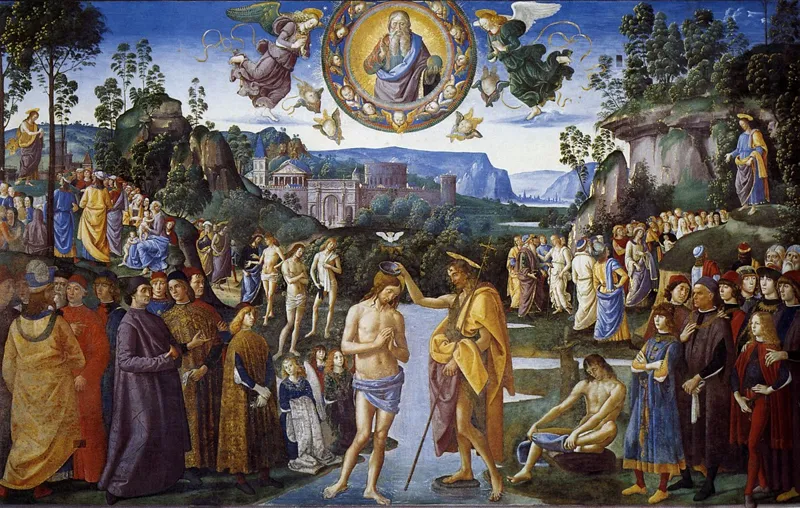
9 And it came to pass in those days, that Jesus came from Nazareth of Galilee, and was baptized of John in Jordan. 10 And straightway coming up out of the water, he saw the heavens opened, and the Spirit like a dove descending upon him: 11 and there came a voice from heaven, saying, Thou art my beloved Son, in whom I am well pleased.
12 And immediately the Spirit driveth him into the wilderness. 13 And he was there in the wilderness forty days, tempted of Satan; and was with the wild beasts; and the angels ministered unto him.
14 Now after that John was put in prison, Jesus came into Galilee, preaching the gospel of the kingdom of God, 15 and saying, The time is fulfilled, and the kingdom of God is at hand: repent ye, and believe the gospel.
Comments (22)
I'm following the Norwegian translations (2011, 1978/85, 1930/38) in bokmål and nynorsk (we have two written languages). All of them seems very close to the King James version, including making it clear that Jesus sees the Spirit descend and hears the voice from heaven. A difference is that the Norwegian versions specify that it was written by the prophet Isaiah. In the 2011 translation, I think they focused on being as true to the original texts as possible, and it seems more terse than the older translations.
I'm using an edition in the Koine Greek and was little thrown off by the way "Holy Ghost" is described as "πνεῦμα." I don't know if the range of that word had shifted by this time but I think one of its central notions is breath from another entity, in this case God. I wonder if 1) this is the language used to refer to what we now call the Holy Ghost throughout the Gospels, and 2) how does this idea of it stemming from another figure (God the Father?) work into a Trinitarian view.
In Norwegian, the word for spirit is 'ånd', but this word can also mean breathing. According to the dictionary, it originally only meant breath, and by extension life, but changed under the influence of Christianity to mean spirit.
Having never read the Gospels before, I picked up a children’s bible (the Airship Genesis Kids Study Bible, which overlays the NKJV text with section headings, sidebars, and a space travel metaphor that I don’t quite get yet). They introduce Mark by pointing out that “He wrote as if in a hurry. He often used the word ‘immediately’ to describe the action. See if you can find that word eight times just in chapter one.” I get the sense of a tumble of action here — once Jesus happened to be baptized, suddenly this set of events began unfolding. Not being Christian, I don’t understand what baptism is? Does it mean the same thing today as it did when John went a-baptisin’ in the wilderness?
Some thoughts on things the original audience of Mark probably would have known that are more obscure to us: 1. Mark is written at least thirty years after the events in question are supposed to have happened. Oral and written traditions surrounding Jesus have circulated for those thirty years, and churches have already been established that believe Jesus is the Messiah who was prophesied, and these churches are likely the primary audience of Mark. Nobody (or almost nobody) would be reading Mark “cold,” without knowledge of Jesus, John the Baptist, etc. It’s like how audiences of “Oedipus Rex” would have already been familiar with the story; it’s a new telling of already-familiar material. 2. “Gospel/good news” (Greek “euangelion”) would likely have been understood as a reference to the proclamation of a new emperor. When there was a new Caesar, messengers were sent throughout the empire to proclaim the “euangelion” of the advent of his reign. This is partly how John the Baptist functions, as the proclaimer of the new king. 3. Re: John the Baptist, it would’ve been clear that he was doing cosplay of the prophet Elijah. Wearing a leather belt was weird enough back then that you could use it to describe a person to a third party. The language here is also almost word-for-word from a description of Elijah in the contemporary-to-them Greek translation of 2 Kings 1:8. John the Baptist identifying himself and/or being identified with Elijah is significant, because it was believed that Elijah was to be the forerunner of the Messiah (cf. Mark 9:11; Malachi 4:5-6). So Jesus gets Messiah cred from this. One helpful way to look at the gospels is to view them as narratives designed to demonstrate that Jesus is the Messiah prophesied in the Hebrew Scriptures. 4. “Messiah” was a political figure, the king of Israel, who was expected to deliver Israel from Roman oppression. He was also expected to be able to perform miracles. References to “Son of David” and “Son of God” were Messianic titles; the latter was not originally understood as a claim to divinity in any kind of Trinitarian sense.
That last point is very helpful in understanding Jesus as a figure in other religions (which always confused me when I was younger). Islam sees him as the messiah in a political sense and as a messenger of God but without him being one and the same as God.
Some disconnected thoughts (they will be more connected in the future when I’m not typing on the phone): We appear to get Jesus’ point of view after baptism - does that ever happen again? How would Mark know what he saw? It sort of implies that Jesus didn’t know he was Jesus until the moment of baptism. Do priests wear camels hair sometimes because of John? The honey seems to call back to Samson. That and the hair. I like that John knows about shoe “latchets “ but is also running around foraging in skins. How did John start baptizing in the first place? The spirit driving Jesus to the wilderness (the spirit that was well pleased a moment ago) has echoes for me of god hardening his heart against the Egyptians, in the sense that he’s doing something cruel for no good reason. Also this echoes later in exodus when the Jews wander in the desert. I find it interesting that Mark _begins_ with those references, if indeed they are references. Why did John go to prison? I agree with other posters that the in medias res aspect of this is totally novelistic in the sense that it creates a desire in the reader to know what’s going on, but it could also be that Mark’s text references other earlier texts that are lost?
We'll get more on John's backstory in Luke, and there's more info on the arrest at Mark 6:17 and on. This story got put into a WILD opera by Richard Strauss called Salome. The wilderness wandering is indeed echoes and references. The wandering at the end of Exodus through Deuteronomy are 40 years - Jesus wanders in the wilderness for 40 days and nights. Moses was on top of Sinai for 40 days. There's an Ezekiel parallel as well. Jesus's POV is interesting at the baptism - as others have noted, the pronouns are pretty unclear about who's observing what, and in my very brief googling, I haven't found a consensus. I have no idea if it holds up, but I read the Anne Rice first-person Jesus books when they came out, and I remember enjoying how she wrote Jesus 'discovering himself' at his baptism.
A curious thing i took notice of reading a German Lutheran version from 1912 was a slight difference in wording (which doesn't have to mean much, though I find it quite interesting): When, in verse 3, John says "make his paths straight.", the German word used instead of "path" is "Steige". I don't know the english equivalent of that word, but it basically stands for a steep path towards a place that is higher up or, in some cases, a ladder or staircase. It also derives from the verb "steigen" which can be translated into "to rise". Also, the word used instead of "straight" is "richtig", which means "right". Like I said, I don't know if this is relevant in any way, but the foreshadowing and allusion to the end of Jesus' path is kind of cool.
Like others have mentioned, I was struck by the abrupt beginning of this. I’m so used to the story of an immaculate conception and the wee baby Jesus starting off the story. This was like Jesus kicking in the door and being like “let’s do this!” One thing that struck me as odd as someone not particularly well versed in the Bible was why an entire verse was spent on describing the clothing and food of John the Baptist. Internet research has now told me that it was because he was wearing clothes more befitting older prophets (specifically Elijah) than what his contemporaries would be wearing and that his food was indicative of living off of only what God was providing (aka not farming, but just living off the land). I have fallen down a bit of a rabbit hole on the food thing, finding that whole books have been written about a locust and wild honey diet. Also there is an Israeli protein company that sells a locusts+honey protein bar so y’all can get those biblical gains. (No, seriously, it's called Biblical Protein)
Re: Gospel and good news, both the New Revised Standard Version and Today's English Version use 'good news instead of gospel. Interestingly the TEV (also known as the Good News Bible) capitalizes Good News, but the NRSV does not.
What do we know about the authorship of the Gospels? We (now) know the Hebrew scriptures are a synthesis of different authors working in different traditions over time. Is it similar for the Gospels, or do we believe them to be the work of singular individuals (whether or not those individuals are the evangelists named as authors)? ---- Like Ryan I was wondering about the vision of the heavens opening. The text [in the translation we're using] says "And straightway coming up out of the water, he saw the heavens opened", which suggests it's *Jesus* who saw the heavens opened (unless I'm wrong about how baptism works, totally possible!). There's no suggestion that anyone else saw this vision. Personally, I like the reading of this as a private revelation. It fits with the rest of the text (where Jesus has to contend with a disbelief that would be surprising if much of Judea heard God's declaration). It also has a nice narrative vibe, of Jesus being able to (and having to) sustain himself and his motivation and his faith from what he alone saw and no one else knows. This also makes me think of Milton's retelling of this episode. Milton allows Satan to hear the divine message, but it's not clear if it's John or Jesus or both who hear God's words -- "nor was long / His witness unconfirm'd" (1:28-29) has the same pronoun ambiguity that marked the very end of the poem. (Does "his" refer to John's witness or to Jesus being witnessed?) ---- Is the existence of John the Baptist attested separately? If I remember right, during Paradise Lost you once mentioned that early Christians may have adopted John the Baptist into their stories to coopt John's own religious movement into early Christianity. How much do we know about John (and perhaps by extension, all the other Jewish religious movements going on in the region at the time)? ---- Gospel means "good news", right? I wonder how much it changes our response to the text to use that highly specific word in English, rather than the equivalent to what early listeners would have heard.
Just noticed something that the English translations tend to obscure. When the author says the Spirit “casts [ekballei] him out into the wilderness,” he’s using exorcism language (cf. Mark 1:39, same word). Jesus is cast out as if he were an unclean spirit, to go to the place of unclean spirits (the desert/wilderness; cf. Luke 11:24). I had previously thought that Jesus went into the wilderness to fast and that Satan took advantage of what he supposed would be an opportunity (and that could still be going on from Satan’s perspective), but this language makes it seem like there’s intentionality on the other side, as well. Jesus isn’t ambushed but went into the wilderness to pick a fight and/or God sends Jesus forth as a champion to do battle for him (like Saul sends David to fight Goliath). If this is right, it would be in line with Christus Victor theology, the notion that one of the works of Christ is to destroy the power of death and the devils.
Right, so I have available to me three versions of the Bible translated into Bulgarian: one was printed in 1871 when Bulgaria was still part of the Ottoman Empire; one was printed in 1940, in the last years of the last Bulgarian kingdom; one was printed in 1982, when the communist regime in Bulgaria was still going strong. I was curious how the texts compare, so I read each verse side by side in all four texts. And in 15 short verses three things caught my attention as significant enough differences. However they may be insignificant – my ignorance is profound and the best I can hope for is not to waste anyone’s time. In the second verse the two older Bulgarian texts use the Bulgarian word for “messenger”. The newest text however uses in stead the word for “angel”. In the same verse, the oldest and the newest texts use the Bulgarian word for “prepare”. The text from 1940 uses in stead the word for “arrange”. In verse 14, where in the English text it says that John was put in prison, all Bulgarian texts use a phrase, which shifts the focus a little. The oldest and the newest texts say that John was “betrayed” and the 1940 text says he was “handed over to the authorities”. Interestingly, the word for “betray” and “hand over” in Bulgarian is the same. The meaning in the 1940 text was changed only by adding the phrase “to the authorities”. So these are my silly little observations. Please, feel free to ignore them. I’m just so happy to be along for this new part of the journey and looking forward to holding your book in my hands!
Fascinating! I'm reading with the Russian Synodal Bible (the first translation into Russian, started in 1813, NT published in 1820 and OT not until 1870), the Central Asian Russian Scriptures (CARS, designed to "highlight the text's oriental roots", published 2003), and the New Russian Translation (published 2006, revised 2014). On these notes, RSB has "angel" while the newer texts have "messenger". The RSB also describes John as betrayed/handed over, while CARS describes him as detained and NRT as arrested.
Not sure how this is gonna go so I’ll just start off with an observation and a question: 1. Jesus comes to us fully formed and without question the Son of God. We don’t have any details about his parents or that he was a carpenter before. He’s just some rando who shows up, gets tested by Satan, and starts healing folk. 2. Jesus says “repent and believe the Gospel” but the Gospels are being written about his teachings. Is there some sort of theological explanation for this self-referencing of the Gospels? Or is there a more general meaning to the Gospels that Christ’s audience would have understood?
As Alex notes below, gospel just means "good news". So I think Jesus is referring to his previous phrase "The time has come / the Kingdom of God is near" as being the good news in question.
Marks starts super abruptly! None of that Matthew/Luke preamble where Jesus was a child and there were angels and Magi and stars, just: the desert. And men who appear from and/or are driven into it.
It really does! We're just supposed to know who John is (through general cultural knowledge?), and what he's doing, and to share a common understanding of sins that requires baptism (which IIRC is not a concept in the Hebrew scriptures). And know who Satan is, and where Judea is, and who what Holy Ghost is, and who the prophets were. All these things are pretty obvious to us who grew up in heavily Christian societies (and would presumably have been obvious to Jews of that era, whose culture was in many ways quite different from modern Judaism), but it seems like so much of this would be alien to the early Greek audiences to whom the early Christians proselytized. Could this whole "jumping right in with no context" quality actually be a deliberate decision with regard to that audience? That it would leave them curious and uncertain and dependent on others to explain the whole context, as a way to draw potential converts deeper into the discussion and the mystery?
We sure didn't stay away from Satan for very long!
well paradise regained sure was extra
I don't know what's happening, but I like it!