







Milton and Paradise Lost's Composition - the Puckering Manuscript
Hey friends! Hope you are all well! I am back from Japan (what a trip!) and back at my laptop again and have awoken today to alerts from friends of a wonderful treasure - the Trinity College at Cambridge's digitization of the Puckering manuscript, a key document in John Milton's own hand full of his poems and notes! Check it out here!
This thing is so cool that I thought I'd spend some time with it and point out some salient and interesting features of it.
MANUSCRIPT HISTORY
The Puckering manuscript has been at Trinity for a very long while (noted scholar and horror writer MR James worked with it!). It comes from the library of Sir Henry Puckering (1618-1701), the son of Sir Adam Newton - a man whose careful cultivation of friends and occasional cheerful frauds (including passing himself off as a priest) led him in his life to quickly climb from baker to tutor to Prince Henry to a Baronet, which his son inherited. Henry took his father's title but quietly dropped the name, changing "Newton" for "Puckering" (his mother's maiden name, and the more serious/respected side of his family) perhaps partly as a rebranding project to negotiate his way through his changing allegiances during the English Civil War (flip-flopping sides TWICE) and his own unpopular fondness for Catholics after the Restoration.
Dying without an heir, his baronetcy (so hard-won by his father!) went extinct, and the Milton notes (hereafter the "Puckering manuscript") arrived at Cambridge as part of a bulk donation of Puckering's library to the school (his alma mater) at his death.
Like so much of Milton's legacy, then, the Puckering manuscript represents another common refrain of Paradise Lost's afterlife as a rigorously republican text handled, digested, and interpreted by the Royalist society, poets, and scholars that inherited it. Puckering, in the generation after Milton, was neither a scholar nor a man of much political conviction (though he once fought a duel for his sister-in-law's honor, wounding his hand), and it's unlikely he gave the work much thought as it decayed in his library. It sat in Puckering's collection (and, as MR James notes, Cambridge's own) largely ignored for some time, until its massively important contents were noticed. In 1881 the New York Times preserves the following scrap about its lineage from Notes & Queries, noting the importance of one Charles Mason in rescuing the work from the obscurity of the archive:
Now that it's digitized, let's take a look (again, you can see the whole thing here)!
CONTENTS
The Puckering, noted by a later editor/collator at its front as "Milton's Juvenile Poems," represents an anthology of several of Milton's key early works, written largely in his own beautiful hand (some amanuensis is visible), many in a state of high finish but with considerable editorial intervention (cancellations, insertions, notes), with none of Milton's later material (ending with only preliminary notes towards PL - more on this in a moment) and little care about presentation. It thus probably represents a mid-career assemblage of what Milton probably considered his major poetic output, made perhaps during the fervour of his political career before both his sight and social position were lost - a kind of notebook at his left elbow while his right hand carried on the business of career, another testament to Milton's ubiquitous anxiety that he owed the world his poetry even as it seemed to call him to other tasks.
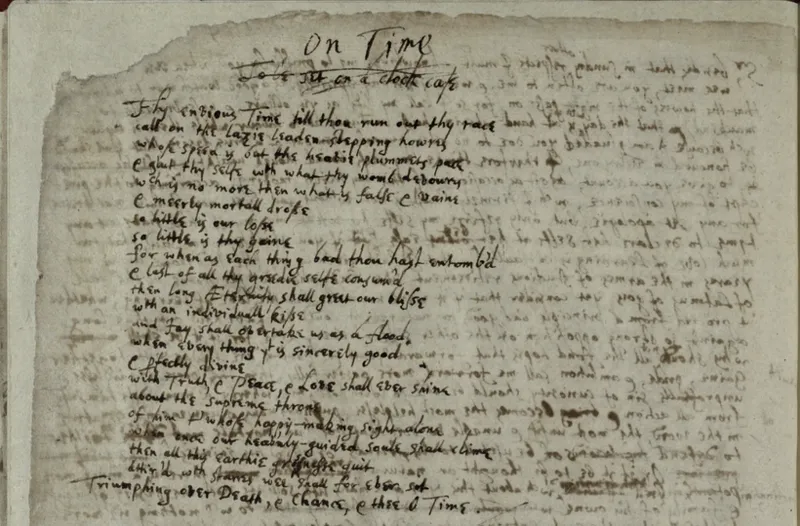
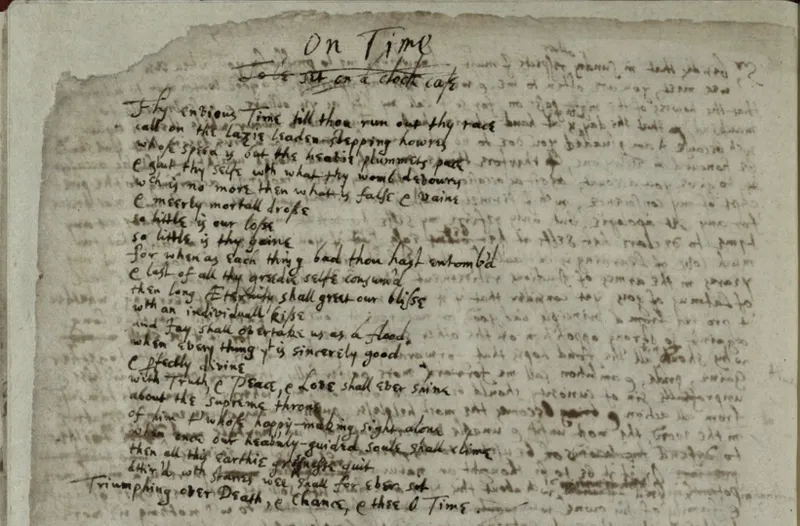
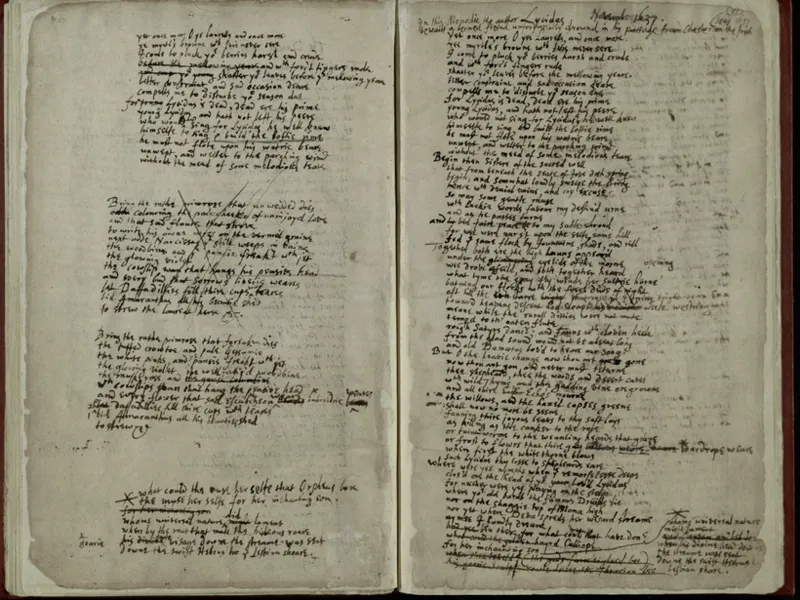
Indeed, the volume contains one of the key expressions of Milton's anxieties about the racing clock - the poem "On Time" appears in its pages, here notably with a subtitle that says it is "To Be Set On A Clock-Case" which Milton has furiously crossed out, thinking better of the somewhat tacky souvenir gesture.
Fly, envious Time, till thou run out thy race;
Call on the lazy leaden-stepping hours,
Whose speed is but the heavy plummet’s pace;
And glut thyself with what thy womb devours,
Which is no more than what is false and vain,
And merely human dross;
So little is our loss,
So little is thy gain!
For when as each thing bad thou hast entomb’d,
And last of all thy greedy self consumed,
Then long Eternity shall greet our bliss
With an individual kiss;
And Joy shall overtake us as a flood,
When everything that is sincerely good
And perfectly divine,
With Truth, and Peace, and Love, shall ever shine
About the supreme throne
Of Him, to whose happy-making sight alone
When once our heavenly-guided soul shall climb;
Then, all this earthly grossness quit,
Attired with stars we shall for ever sit
Triumphing over Death, and Chance, and thee,
O Time.
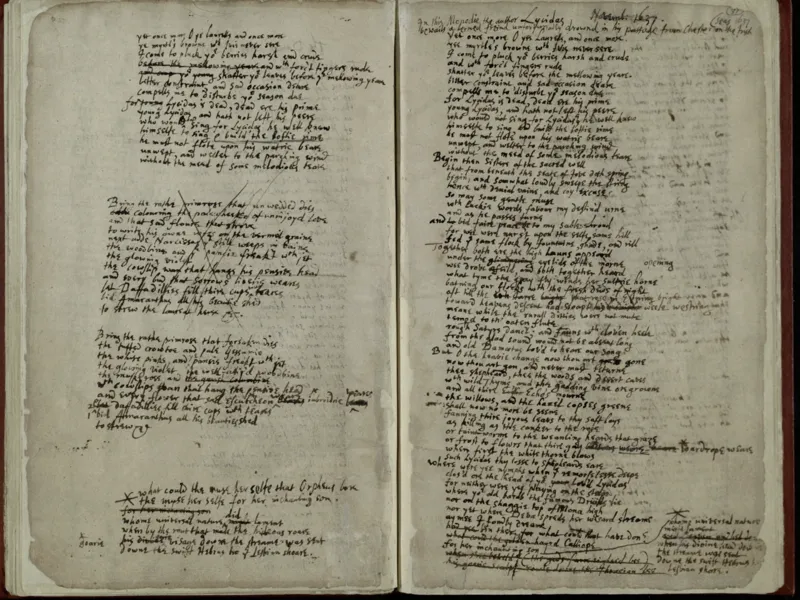
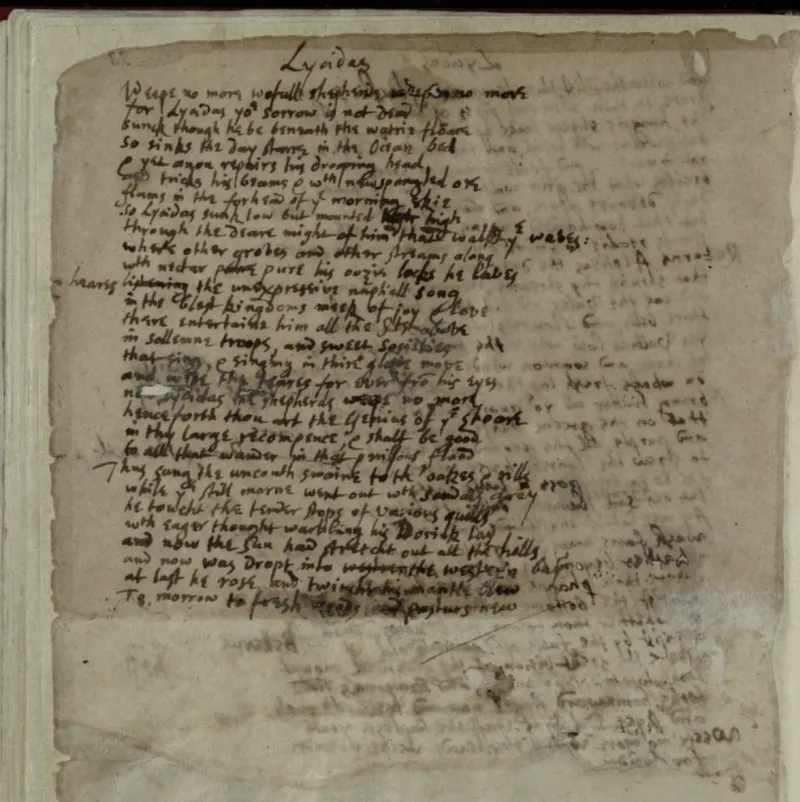
The Puckering includes several key Milton works from this early and middle period along with this, including "Upon the Circumcision" and the text of Comus, Milton's masque composed for Ludlow Castle. Here's how Milton preserves "Lycidas" - the poem of lament for drowned schoolmate Edward King, part of an anthology project among his schoolchums, that announced Milton's literary career and showed off his talent. You can see both his own rework of the opening here, cancellations, as well as some damage to the pages towards the end. Here too, in text and form, we encounter Milton's obsession with legacy, preservation, and obliteration, meticulously copying and still editing his material output even as he self-consciously mourns a poet rendered mute by obliviating death.
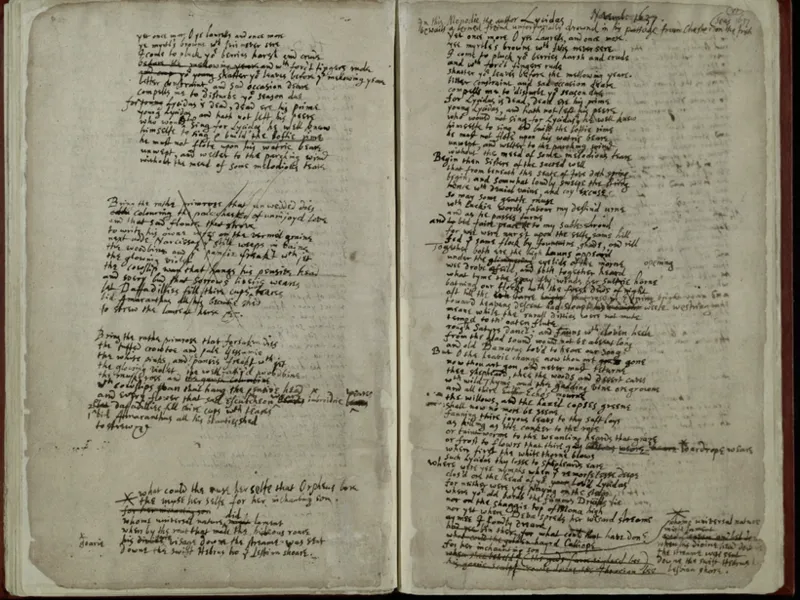
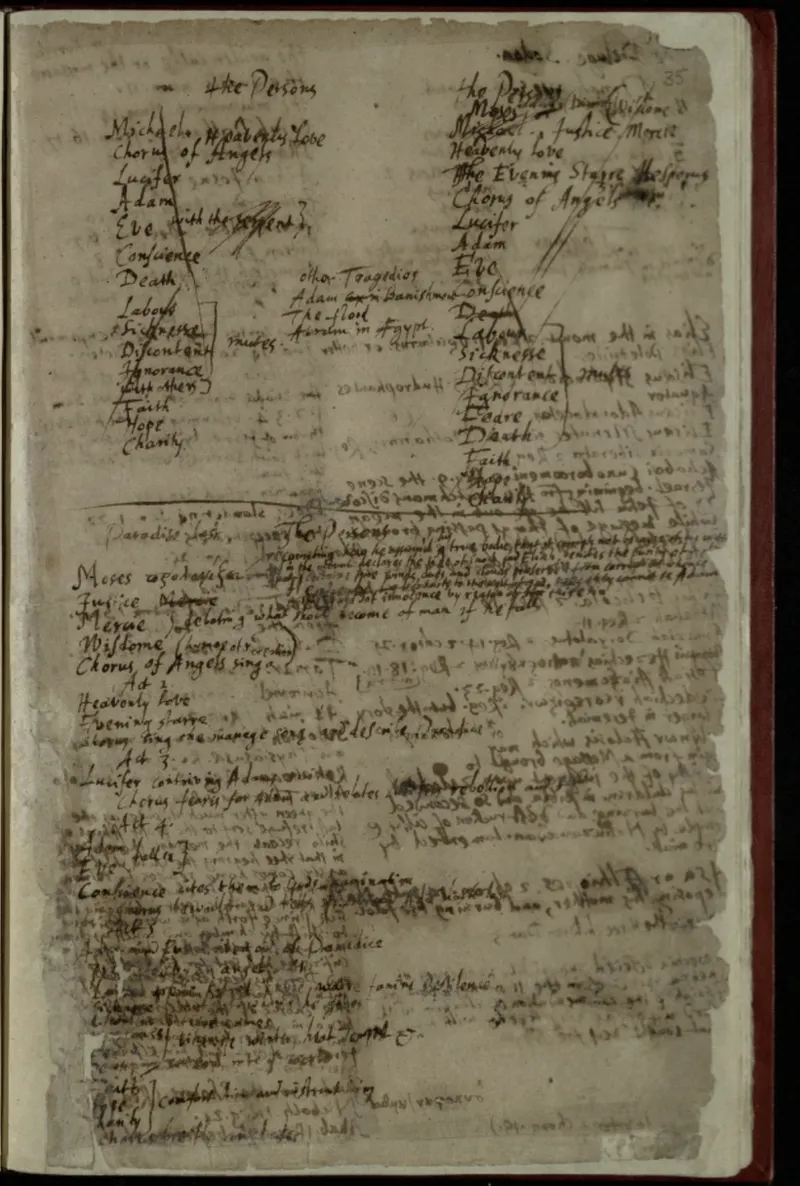
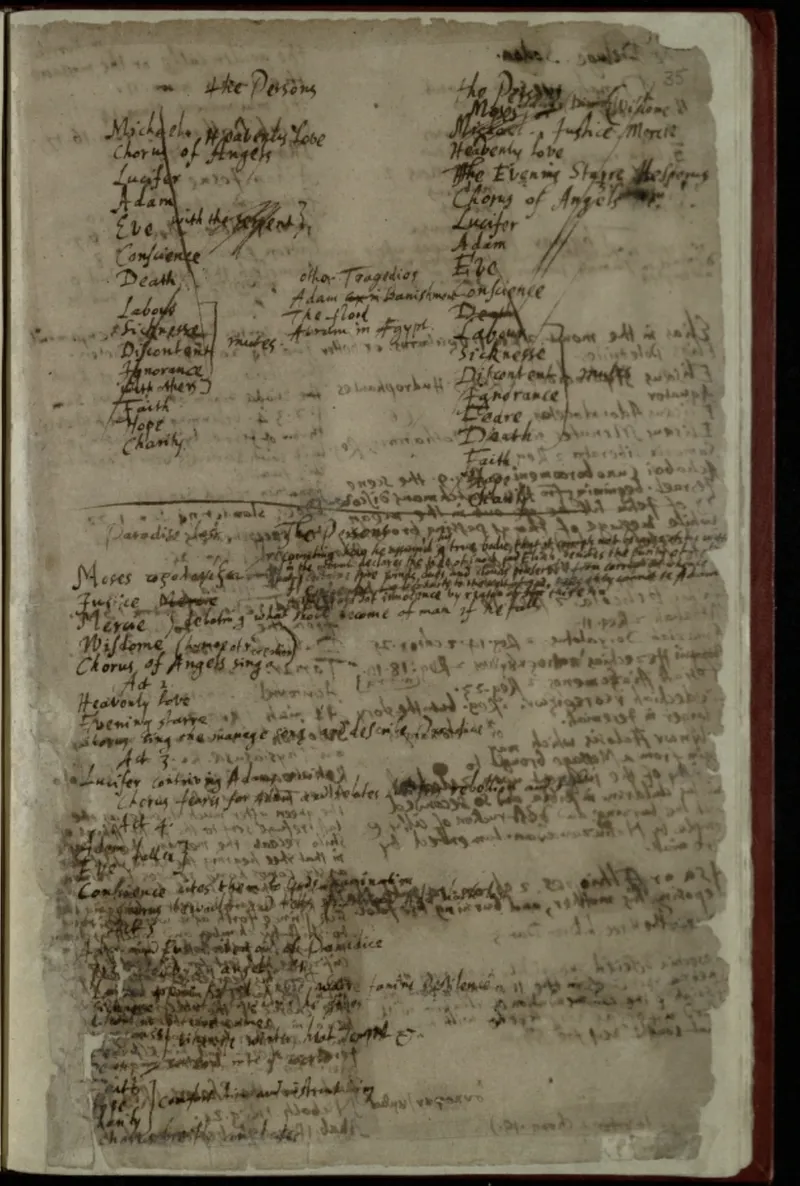
But perhaps most wonderfully, in the manuscript we encounter notes for Milton's earliest concept work for PARADISE LOST - here still conceived as a drama rather than an epic poem, with a robust cast of characters including Michael, Lucifer (a name he doesn't use for Satan in the finished work), Adam & Eve, Death, Faith, Hope, & Charity. This sense of Paradise Lost's history beginning as a kind of passion play carry into several of its features, including Satan's very stage-y Vice-like monologues in Book 4, and its more allegorical characters like Sin & Death, a tendency which falls away in the later books (the personified virtues similarly never appear, nor do "Conscience" and "Ignorance" etc).
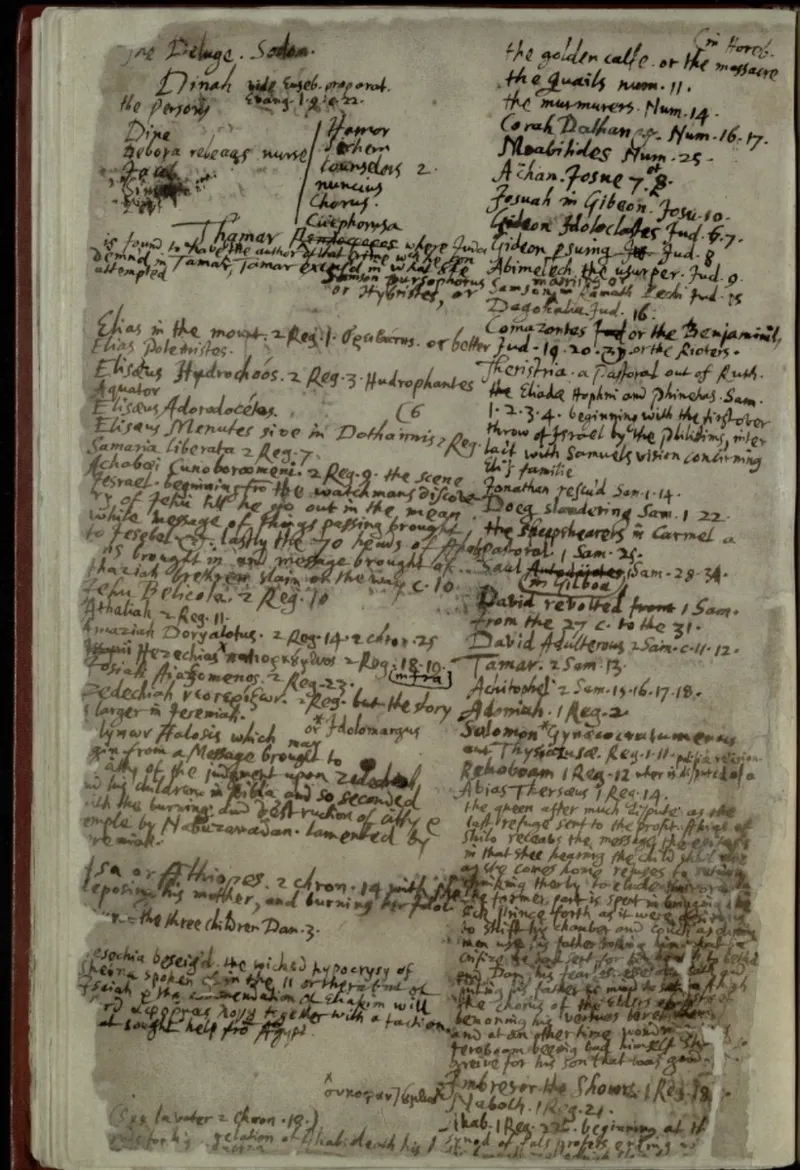
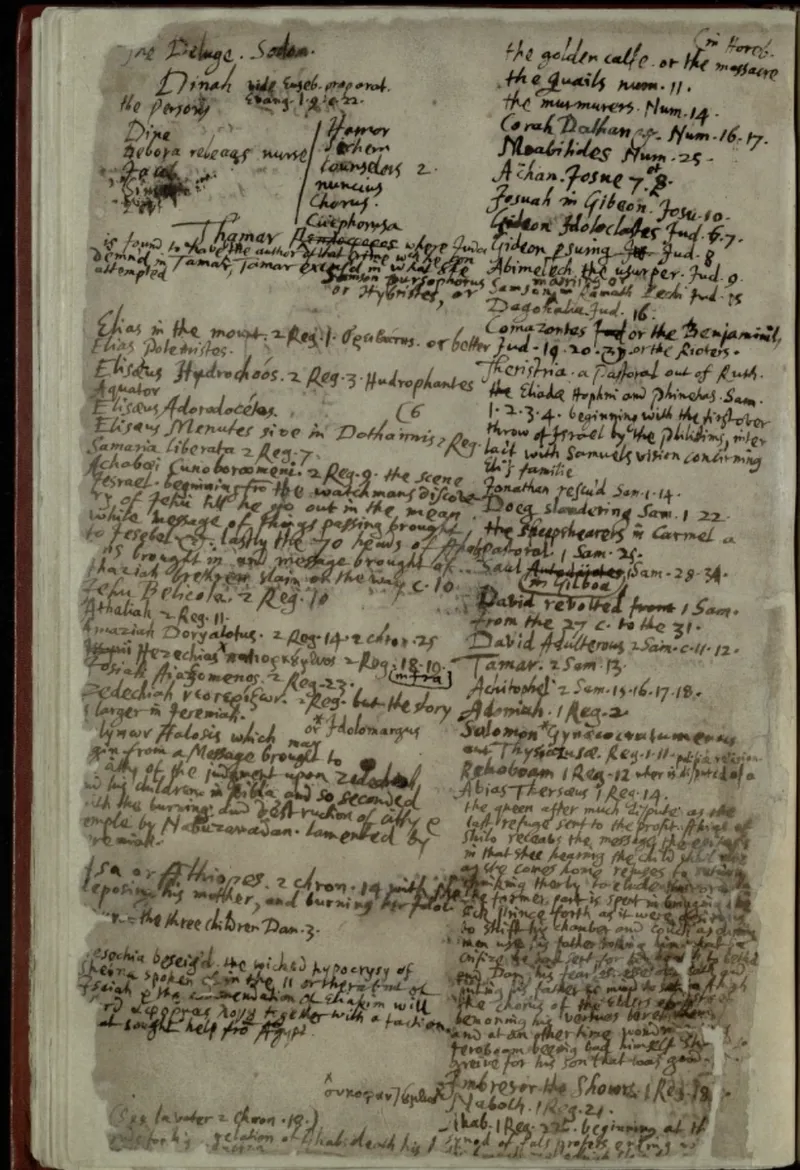
Milton was clearly toying with later biblical stories he might focus on - a concept he abandons, instead truncating them into a rapid montage presented to Adam by Michael in Books 11 & 12. But here we can see his larger scope, as he considers David, Moses, etc as subjects worthy of longer treatment:
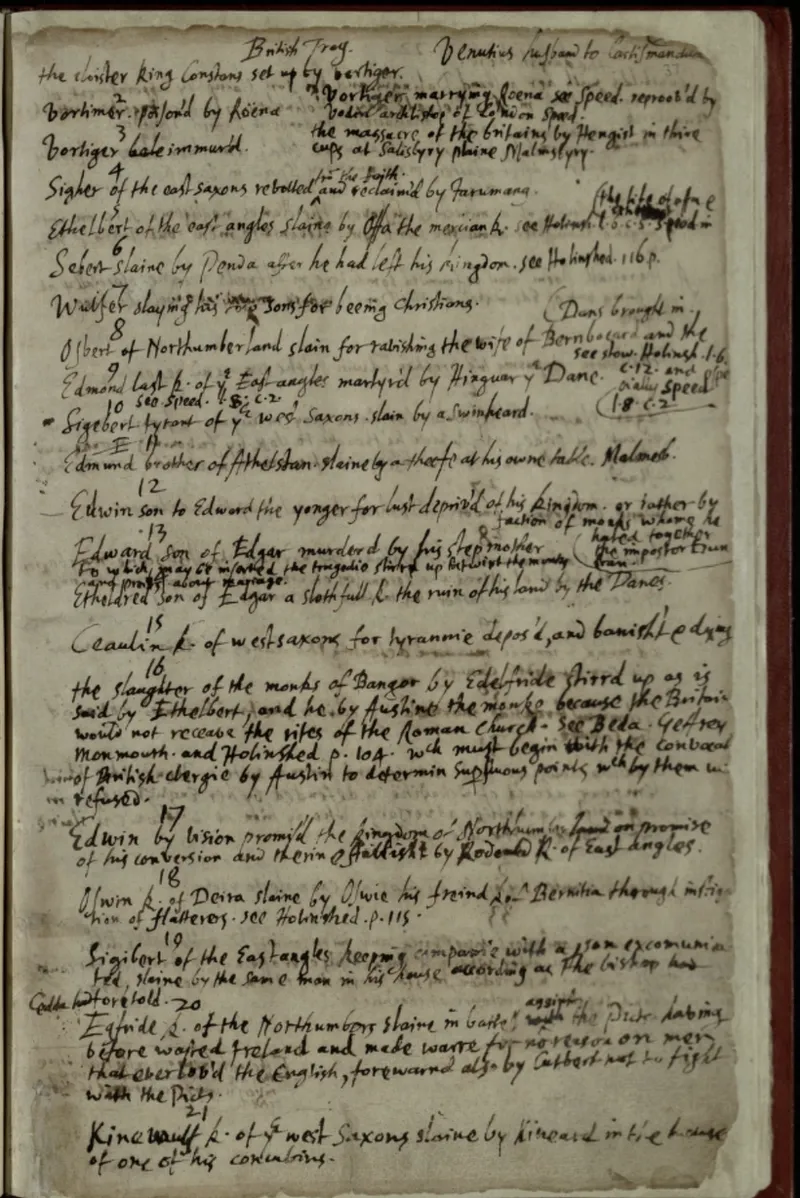
And finally, we can see Milton's OTHER great considered epic project, sketches on the subject of the King Arthur cycle, giving England the national epic he thought it needed (Milton thought often of Spenser's incomplete Faerie Queene, and its ghost haunts him closely here). He here tries to imagine a "British Troy", conceiving of subjects from Aethelred to Edward the Confessor as possible hooks to hang his hat on.
Paradise Lost ultimately both rejects and claims to surpass such a need for a celebration of British martial prowess, in the final text referring to the idea contemptuously as "tilting furniture" as he expresses his own anxiety at the beginning of Book 9 about his high poetic project, and while invoking his muse talks about the tacky jingoist trash of writing epics about homelands, and his disinterest in projects that celebrate and incite war:
If answerable style I can obtaine
Of my Celestial Patroness, who deignes
Her nightly visitation unimplor'd,
And dictates to me slumb'ring, or inspires
Easie my unpremeditated Verse:
Since first this Subject for Heroic Song
Pleas'd me long choosing, and beginning late;
Not sedulous by Nature to indite
Warrs, hitherto the onely Argument
Heroic deem'd, chief maistrie to dissect
With long and tedious havoc fabl'd Knights
In Battels feign'd; the better fortitude
Of Patience and Heroic Martyrdom
Unsung; or to describe Races and Games,
Or tilting Furniture, emblazon'd Shields,
Impreses quaint, Caparisons and Steeds;
Bases and tinsel Trappings, gorgious Knights
At Joust and Torneament; then marshal'd Feast
Serv'd up in Hall with Sewers, and Seneshals;
The skill of Artifice or Office mean,
Not that which justly gives Heroic name
To Person or to Poem. Mee of these
Nor skilld nor studious, higher Argument
Remaines, sufficient of it self to raise
That name, unless an age too late, or cold
Climat, or Years damp my intended wing
Deprest, and much they may, if all be mine,
Not Hers who brings it nightly to my Ear.
The Puckering manuscript gives very real proof to Milton's claim that Paradise Lost's theme was long in choosing and late-begun - giving us some fascinating insights into his process and the road which led to its final composition, and the anxieties of insufficiency and imperfection which plagued its compotion. Thanks to everyone who sent this release my way!
(If you're interested in PARADISE LOST but new to my Patreon, we actually began this whole project by going through the entire poem! Check out the Paradise Lost podcast episodes in full here!).
Comments (1)
Fascinating!