


Oliveira - Thoughts on Michelangelo
In advance of our night at GLAD DAY BOOKSHOP on March 12th (come join us, Toronto!), I wrote a guest post for the Brockton Writer's blog.
It is about Michelangelo, and the posture before God for the queer Christian artist. I hope you like it. It's reproduced below:
I have been thinking lately about Michelangelo.
If you look up at the roof of the Sistine chapel (as so many centuries of tourists have done, hushed and chided first by the Vatican’s colourful Swiss guards and then their less-imaginatively-costumed rent-a-cop security), you will see the outstretched finger of God reaching out for an indolent Adam. The father of generations seems to just stir from a dream, beautiful and noble – in form and moving, as Shakespeare put it, how express and admirable; in action how like an angel; in apprehension how like a god. The ceiling is in many ways the apotheosis of the Renaissance’s celebration of humanity, of man as the measure of all things (as the recovered Protagoras proclaimed and as DaVinci made iconic, inscribed in the neat mathematical circles of his “Vitruvian Man”).
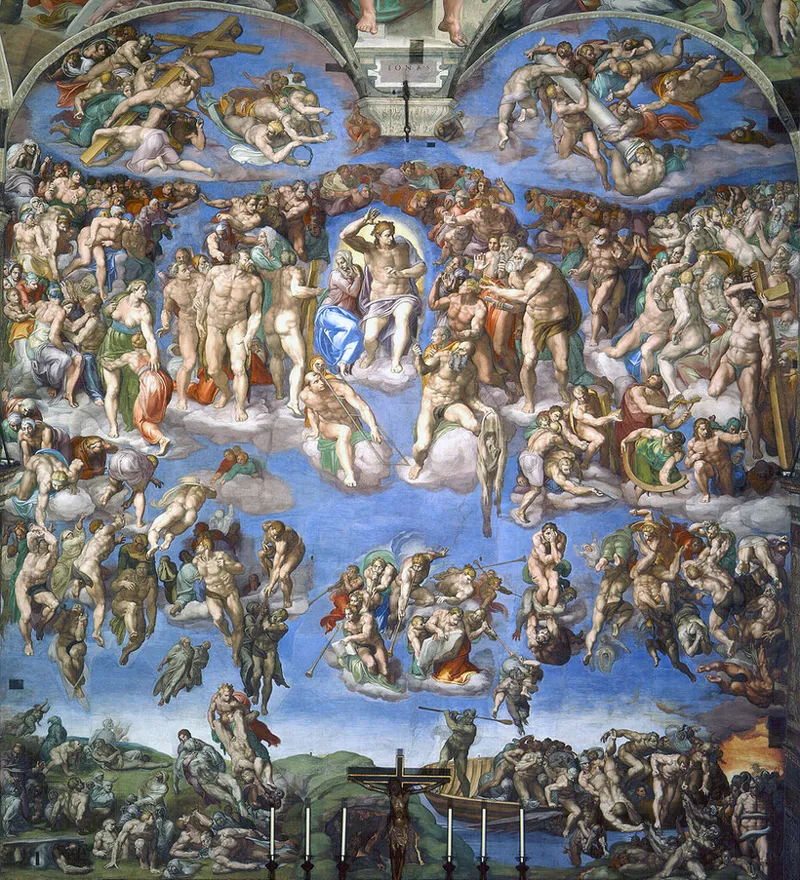
Then look down from the famous ceiling, past its tidy geometries and pleasant pastels, to the altar wall – to find Michelangelo’s “Last Judgment,” and watch it all come undone.
At the close of time, clawing from their opened graves and whirling in a widening gyre, a riot of naked flesh twists and writhes airborne as all the souls of humankind ascend or descend to their eternal rest or torture. The quintessence of dust made horrifyingly manifest, as all that is human comes to its great dissolution.
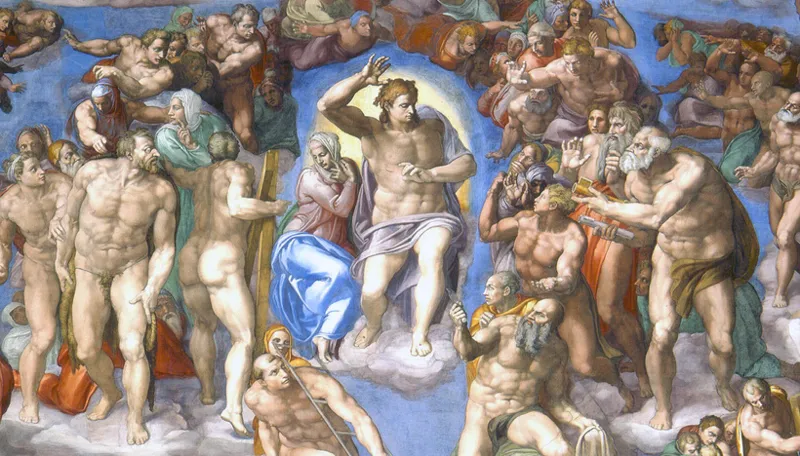
At the centre of this turbulent Baroque maelstrom is Christ, resplendent and terrifying. Michelangelo courted controversy thrice over by depicting him without his throne, without his beard, and without a stitch of clothing. Naked and beautiful, he raises his hand in judgment – and stops. Something has caught his eye.
Below him, at his left hand is an old man: bald, with a scraggly beard. In his hand is his own skin, collected in a mottled, wrinkled sheet – torn from his flesh at his martyrdom. It is a depiction of St Bartholomew, skinned for love of Christ, left a red raw nerve like the faun Marsyas before the radiant divine. He is frowning uneasily. And in his other hand, shockingly, he brandishes a small tanner’s knife at his God.
It is also a last self-portrait of Michelangelo himself – the vital, virile queer artist who had scandalized and renovated the cities and art of the Renaissance to the confusion and consternation of colleagues and cardinals alike. No longer the youth of La Pieta, the David, or the Sistine roof, he now regards the beautiful, masculine ideal and Christian sublime that had been his greatest inspiration and greatest gift, for one last time. What do the god and his creation think of one another, here at the end? What judgment does each render of the other?
Even before Michelangelo’s death, the work of censorship began; Daniele de Volterra was commissioned by the Vatican to painstakingly cover up the work’s nudity (for which he earned the nickname “Il Braghettone” – “the breeches-maker”). Tourism and pop culture have almost completed the work the Vatican started, and a masterpiece that once shocked a pope with its frank, erotic gay male desire and anger has become, over the censorious centuries, illegible and domesticated.
My new book Dayspring debuted last year. It is the story of Christ: a gospel, as told from the point of view of his beloved disciple. It is also a queer memoir, insistent (to the strenuous objections of the occasional consternated GoodReads reviewer) on its carnality and sensuality, I think because it is trying with some desperation to come to grips with a movement and a messiah that seems to have found no place for us.
In this, it is a project that is certainly not alone. It participates in its minor way in the same projects as Da Vinci, Gentileschi, Marlowe, Shakespeare, Sor Juana Inés de la Cruz, Wilde, Tchaikovsky, and so many others. Christian history is populated by authors who sought to enrich and deepen the artistic canon even as that same edifice worked furiously to efface their lives and vandalize the record. My book indeed not only tells its own story, however haltingly, but also seeks to be an (always incomplete) archive of the countless queer voices that fill the flock and choir of Christian history: visionaries like John of the Cross and Rupert of Dietz, saints like Francis de Sales and Teresa of Avila, even evangelists like the authors of the Johannine corpus and the Mar Saba fragment. Queer stories and queer mystics and queer artists have peopled Christianity since, and at the very heart of, its foundation.
I think we recognize the uncertain swirl of Michelangelo’s Last Judgment: as humanity breaks down around us, called to an account that seems incoherent, even as the text of history and our flesh itself seems to undergo a brutal editorial intervention and censorious police action from forces around us – as the carnal reality of the body is ripped away be God and ripped away again by a flurry of vandalizing fig-leaves and bolts of artless cloth by inferior hands and scolding footnotes insisting we must, above all, not believe our senses.
And I think we recognize, too, the posture of Michelangelo before Christ at the end: skinned alive, standing before something beautiful and terrible, holding uncertainly and with wild desperation the knife that flayed us.
Brockton Writers Series 12.03.25: Anthony Oliveira (Brockton Writers Series)