



THIS WEEK IN VIOLENCE: Domino
2026, Week 43
Over the past few weeks, tensions have been rapidly mounting between the governments of Ethiopia and Eritrea, owing to a multitude of factors.
If you don’t know much about Ethiopian-Eritrean relations, that’s okay. Put it this way: You might not know much now, but if things boil over, you’ll learn. So for this week’s newsletter, we’ve put together a brief overview of the history of the region and the present conflict, where things stand today, and why recent developments should worry us all.
Ethiopia says it must defend itself against Eritrea's 'all-out invasion'
Reuters – Oct 09, 2026
Reporting by Dawit Endeshaw
ADDIS ABABA, Oct 9 (Reuters) - Ethiopia said an "all-out invasion" by Eritrean forces had left it with no option but to defend itself, in a letter to the UN shared with Reuters on Friday, as blasts continued near the border between the two countries.
In response, Eritrea's information minister said his country had shown restraint since Ethiopia had declared a war of aggression against Eritrea by stating in 2023 it would acquire sovereign access to the sea.
The countries traded accusations after a reported incursion by Eritrean troops this week raised fears of outright war in the region, where the two nations have fought previous conflicts. The stakes have been raised this time around by conflicts in the Horn of Africa region and tensions across the Red Sea.
[...]
"The Ethiopian regime has been pursuing, in effect, an unprovoked war of aggression against Eritrea for more than three years," Yemane Gebremeskel, Eritrea’s information minister, said in a statement posted on X on Friday.
Citing statements made by Ethiopian officials, Yemane accused Addis Ababa of using the current conflict to take Assab, an Eritrean port, in order to restore access to the Red Sea.
Ethiopian Prime Minister Abiy Ahmed’s spokesperson did not immediately respond to a request for comment.
Eritrean soldiers were seen in northern Ethiopia this week, witnesses told Reuters, days after the neighbours severed diplomatic ties.
Yemane's statement did not address the issue of Eritrean troops deploying in Ethiopia. On Wednesday, he called reports of an Eritrean incursion part of an Ethiopian plan to justify a war of aggression against his country.
Eritrea asks UN to intervene in standoff with Ethiopia
Reuters – Oct 10, 2026
Reporting by Reuters
Oct 10 (Reuters) - Eritrea asked the UN Security Council on Saturday to take deterrent measures against Ethiopia, according to a letter seen by Reuters, saying Addis Ababa's accusations of an invasion by Eritrean forces amounted to a "declaration of war".
The incursion by Eritrean troops, which Asmara has denied and Reuters could not independently verify, has raised fears of a return to all-out war along Ethiopia's northern border where the two Horn of Africa neighbours have clashed before.
Conflicts elsewhere in the region and tensions across the Red Sea have further raised the stakes.
Eritrean Foreign Minister Osman Saleh said in the letter that the incursion claims were part of an Ethiopian plan to justify a war of aggression. He urged the UN to intervene.
"Eritrea requests the UN Security Council to forcefully condemn Ethiopia's deplorable declaration of war against Eritrea ... and take the requisite deterrent measures against it in accordance with Chapter VII of the UN Charter," he wrote.
Chapter VII allows for measures ranging from sanctions to military action, though Osman did not specify what measures Eritrea was calling for.
Ethiopia itself wrote to Security Council members on Friday, stating that Eritrean troops had advanced up to 60 km (37 miles) inside the northern region of Tigray in recent days. It warned that the presence of foreign troops left Addis Ababa with no option but to defend itself.
Ethiopian Prime Minister Abiy Ahmed's spokesperson did not immediately respond to a request for comment on Saturday.
[...]
Earlier in the day, Ethiopian government forces and their militia allies entered the Tigrayan city of Adigrat, near the border with Eritrea, three residents said, days after Eritrean troops were pushed back from the strategic city.
A video shared on social media and verified by Reuters showed members of a militia allied with the Ethiopian government walking in the streets of Adigrat, which is located 30 km (19 miles) from the border with Eritrea.
Three Adigrat residents also told Reuters they had seen the Ethiopian army and an allied militia in the city on Saturday morning, with one of the residents saying they saw soldiers on patrol along with military vehicles.
Strap yourselves in, it’s time for another classic episode of Gregk Attempts to Neatly Summarise Longstanding and Complex Conflict.
The root of modern tensions between Ethiopia and Eritrea and related conflicts in the region can be traced back to the colonial era, during the ‘Scramble for Africa’ period of the late-19th century.
In the late 1870s, a number of uprisings in the Balkans had caused severe disruption to the Ottoman Empire. The Russian Empire had exploited the instability, fomenting unrest in attempts to extend its own imperial holdings.
In April, 1877, Russia formally declared war against the Ottoman Empire. Less than a year later, in March of 1878, Russia had decisively defeated the Ottomans, liberating numerous Balkan states from Ottoman control and effectively confirming the Ottoman Empire’s status as the ‘sick man of Europe’. Keep that in mind.
In 1869, the opening of the Suez Canal connecting the Mediterranean Sea to the Red Sea, negating the laborious task of circumnavigating Africa via the southern cape, had massively increased the strategic importance of territories along that waterway.
That same year, an Italian missionary named Giusseppe Sapeto struck a deal with two Sultans to purchase the port town of Assab, situated right on the Bab al-Mandab Strait directly opposite the Yemeni port city of Mokha, in Eritrea.
Over the decade that followed, Sapeto and others sought to expand Italy’s footprint in the eastern horn, but struggled to find sufficient political or financial support among the Italian elite.
But developments in the 1870s and 80s began to alter the calculus. Conflicts on the African continent exacerbated potential in the region for territorial realignment (not to mention those ailing Ottomans). In 1881, France invaded and occupied Tunisia, the country on the north coast which Italy had been eyeing up for itself. And then a war between Britain-aligned Ethiopia and Egypt, which was then a tributary of the Ottomans and controlled much of the Red Sea coastline, threatened to thoroughly disrupt the mosaic of power in East Africa.
In 1884, the Berlin Conference was held, the meeting of the colonial states of Europe which formalised the high period of colonialism on the African continent, known as the Scramble for Africa.
Italy, a relative latecomer to European colonialism, was eager to increase its foothold in the Red Sea. By this point Britain had already thoroughly established its presence in the region. The Yemeni port city of Aden, located roughly 100 kilometres east of Mokha along the coastline, was a key hub for trade between Britain and its colonial operations in India.
Britain was anxious about France or Germany expanding their footholds in the region at their expense, but its forces were already heavily stretched maintaining its extant holdings. So it struck a compromise, acceding to Italy’s desire to turn Assab from mere private property into an official Italian holding. In 1882, Eritrea formally came under Italian control, and eight years later, in 1890, the Colony of Eritrea or Italian Eritrea, was founded.
So it went for the next few decades. As you’ll remember from our episode on the Toyota Hilux, the First World War and collapse of the Ottoman Empire had led to sweeping transfers of territorial holdings between the victorious empires, and Italy, though a beneficiary of these transfers, was comparatively short-changed. In 1936, Benito Mussolini used Italian Eritrea as a staging ground for Italy’s invasion and annexation of Ethiopia, eventually establishing Italian East Africa across Eritrea, Ethiopia and Somalia.
Following Italy’s defeat in World War II, Eritrea fell under British military administration alongside neighbouring Ethiopia. Following a 1950 UN vote, it was decided that Eritrea and Ethiopia would enter a formal federation. Eritrea would become an autonomous region within Ethiopia with its own government and authority, while Ethiopia retained control over matters like the military, diplomatic concerns and monetary policy.
The ten-year arrangement did not fare well, primarily due to Ethiopian-aligned factions in Eritrea’s government gaining power and then using it to undermine Eritrea’s autonomy and draw the region closer to Addis Ababa. In 1961, an armed separatist group called the Eritrean Liberation Front escalated to armed struggle for independence, and shortly after the Ethiopian Empire formally annexed Eritrea.
The Eritrean War of Independence then raged for nearly three decades. It was a bloody conflict, marred by brutal counterinsurgency warfare tactics against civilian populations by the Ethiopian government, Cold War horse trading, as well as internal unrest in both Ethiopia and Eritrea.
In 1991, a coalition named the Eritrean People’s Revolutionary Democratic Front succeeded in ousting Ethiopia’s leader and capturing Addis Ababa, ending the war. In 1993, a referendum was held to determine Eritrea’s relationship with Ethiopia. The results were almost unanimously in favour of independence, and so in May of 1993 Eritrea was established, by law, as an independent, sovereign state.
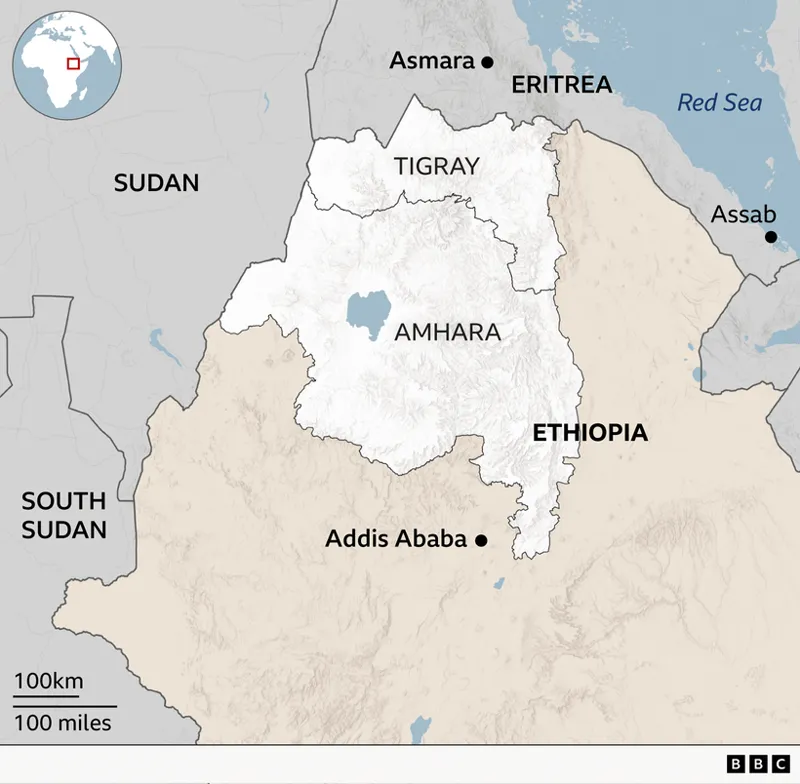
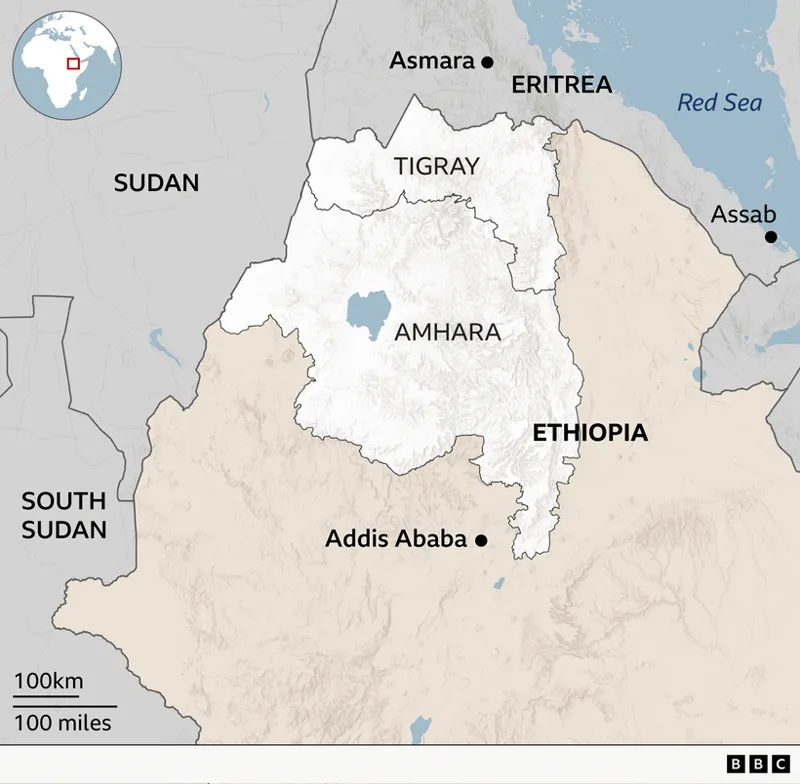
This might have been all well and good in theory, but one need only take a brief look at a map to see a huge practical hurdle this created. Eritrea was the sole region of Ethiopia with access to the Red Sea coastline—or any coastline at all, for that matter.
With Eritrea’s independence, Ethiopia was now a landlocked state, and would be dependent on good relations with independent Eritrea to maintain shipping and trade. Unfortunately, relations were not good. Shortly after gaining independence, Eritrea’s government commenced large drives to forcibly expel Ethiopians from its territory.
Economic issues also emerged. Naturally, the economies of the two formerly-united territories were closely intertwined. It was alleged that Eritrea was exploiting this for economic advantage, facilitating goods produced in Ethiopia to be smuggled across Eritrea’s border to be sold and exported on more favourable terms for the vendors and, more importantly, Eritrea. Eritrea became a major exporter of coffee, for example, despite the fact that it did not produce coffee domestically.
During the Eritrean War for Independence, which eventually expanded into an Ethiopian Civil War, Eritrean separatist groups had aligned with Ethiopian militias against their common enemy, Ethiopia’s governing military junta, known colloquially as the Derg. Following Eritrea’s independence, the new Ethiopian government was dominated by people from one of these factions: the TPLF.
Originally founded in the 1970s, Tigray People’s Liberation Front (TPLF) was nominally a Marxist-Leninist organisation seeking the liberation of Ethiopia’s minority ethnic groups, such as the Tigray, from domination by the country’s ethnic majorities, the Amhara and Oromo.
Tigray is also the name of one of Ethiopia’s northernmost regions, directly on the border with Eritrea. It is also the home of many of the TPLF leadership, who were now forming Ethiopia’s new government.
The TPLF was happy to align with Eritrean separatists against the Derg, but now it was in government, and there were concerns. The Eritrean-Ethiopian border had been derived from previous treaties and agreements inked between Italy and Ethiopia’s various powers. Now, there were disputes over certain areas, particularly a triangular piece of land in the west which looks a little bit like a bottle opener, and which contains the contested town of Badme.
Following Eritrean independence, periodic skirmishes over Badme provoked reprisals between Eritrean and Ethiopian forces, as well as Tigray militias in the surrounding area. In 1998, this erupted into a full-scale war between the two countries. It concluded two years later with Eritrea claiming a diplomatic victory, being awarded most of its territorial claims in subsequent negotiations.
Ethiopia, meanwhile, achieved the military victory. Though it stated it would accept the findings of these diplomatic efforts, when Badme was awarded to Eritrea, Ethiopia continued to occupy the town militarily for years. This created a delicate balancing act as Ethiopia’s government strived to avoid alienating Tigrayans, while both Ethiopia and Eritrea continued to squabble over the border regions, and while both were under international arms embargoes pertaining to their border war.
From 1991 onwards, Ethiopia was governed by Prime Minister Meles Zenawi, a former commander of the TPLF who remained in power until his death in 2012. He was succeeded by his deputy, Hailemariam Desalegn, who hailed from a different group. Six years later, Desalegn resigned due to ongoing public unrest.
An election by the Ethiopian government selected Desalegn’s successor, Abiy Ahmed. Ahmed’s party is the Oromo Democratic Party, representing the interests of Oromo people, one of Ethiopia’s majority ethnic groups. It emerged out of the Oromo People's Democratic Organization, one of the armed groups which had joined the Ethiopian People’s Revolutionary Democratic Front during the civil war, alongside the TPLF, the Tigray.
So, over the course of the 2010s, after dominating Ethiopian politics for almost two decades, the TPLF experienced a precipitous decline in standing. When Abiy Ahmed took office as Ethiopia’s new Prime Minister in 2018, he led an effort to reduce tensions with Eritrea.
This effort was largely well-received, but was criticised by Tigrayans, who had borne the brunt of the bloodshed during the border wars of the late ‘90s. When Prime Minister Ahmed formed a new cross-factional party, the Prosperity Party, in an attempt to weaken the ethnic federalism which had dominated Ethiopian politics, the TPLF refused to join. Instead, the TPLF retreated to Tigray, where it continued to operate as a de facto regional government or administrative power.
Amidst allegations that the TPLF was seeking to reassert its control over the country, both the Ethiopian and Eritrean governments became embroiled in a war against a newly-formed Tigray Defence Forces (TDF). The TDLP, a one-time ally of Eritrea and then governing power in Ethiopia, was now at war with both at the same time.
The Tigray war lasted two years, from November 3, 2020, to the same day in 2022. It was another brutal and bloody conflict, in which all sides were accused of carrying out massacres, crimes against humanity and acts of genocide including mass rapes and ethnic cleansing. The war was halted by a peace agreement between Tigrayan and Ethiopian forces. Eritrea, however, was not party to the agreement, and continued to occupy areas of Tigray.
The TPLF are far from the only groups to have had grievances with the Ethiopian government in Addis Ababa, however. The TPLF’s downfall and Ahmed’s efforts to reorganise Ethiopia’s politics reignited historical disputes, and created conditions ripe for other factions to try to exploit.
In late 2025, a new coalition was formed with the aim of overthrowing Ahmed’s government, the Ethiopian Peoples’ Forces Alliance for Survival (EPFAS). The new group saw the TPLF aligning with armed groups and liberation movements formed along ethnic and territorial lines, including some whom only years before had been allied with the government against the TPLF.
Given the recalcitrant TPLF, which had been vanquished by Ethiopia and Eritrea only years before, was now mounting a new offensive from Tigray, along the Eritrean border, it was bound to raise questions about who was supporting them.
Which is not to say that Ahmed and Ethiopia are without fault in this matter. Alongside establishing friendlier relations with Eritrea, Ahmed has also prioritised another political objective that is important to Ethiopian political-economy, but which was likely to work against those friendly relations: reestablishing maritime access.
As stated, following Eritrean independence, Ethiopia became a landlocked state. Reestablishing sea access for the country has been a priority ever since, but successive governments have insisted such aims would be achieved peacefully and diplomatically. But with the TPLF now reconstituting as an anti-government force, fingers began pointing the blame northward.
Are these Ethiopian militias receiving outside support, from Eritrea or elsewhere? Almost certainly. Eritrea has been widely alleged to be providing support to both the TPLF and an Amhara faction called the Fano, though it repeatedly denies this. Addis Ababa has lobbed similar accusations against the governments of Egypt and Sudan. None of this is particularly clear, but if Sudan was supporting the anti-government coalition, one might be forgiven for thinking this was just payback, given Ethiopia has been providing support to the Rapid Support Forces in Sudan’s own civil war.
This is a long history going back decades, but the most recent developments have unfolded rapidly over just a few weeks. Late last month, the EPFAS coalition formally declared its establishment and its opposition to the Ethiopian government. Concurrently, Ethiopia and Eritrea have both begun accusing the other of acts of war and declaring their right to retaliate in self-defence.
Which brings us back to Assab. If you look at a map of Ethiopia and Eritrea, you will notice that that historic and strategically important port town is situated in the southeasternmost corner of Eritrea. In October of 2023, during a parliamentary address, Abiy Ahmed declared Ethiopia’s intention to reestablish its “sovereign access to the sea by any means necessary.” Two years later, a major general in Ethiopia’s National Defence Forces put a finer point on it, declaring, “the Red Sea belongs to Ethiopia. We will take it back at any cost! Assab is Ethiopia’s Red Sea province.”
Recognising the implicit threat in Ahmed’s 2023 address, Eritrea interpreted it as a declaration of war and has been petitioning the UN to take action to rein Ethiopia in. Reports now abound of Eritrean troops being observed operating as deep as 60km across the Ethiopian border, in Tigray.
Eritrea claims it is trying to create a buffer zone and keep Ethiopia’s conflict on the Ethiopian side of the border. Ethiopia, however, is declaring that such actions are, themselves, a declaration of war, and seeking approval from the international community to defend itself. Eritrea, in turn, claims that this is part of a three-year-long endeavour by Ethiopia to provoke a war which would then serve as a pretext for retaking Assab.
If that picture wasn’t complicated enough for you, we’ll add one further detail for good measure. Eritrea is not Ethiopia’s only path to the sea. It also shares an extensive land border with Somalia, and those two countries have territorial disputes going back centuries which, in the modern era, have a tendency to trail contemporary conflicts.
Somalia is also experiencing its own internal instability and civil war-like conditions concerning the breakaway state of Somaliland. In 2024, Ahmed inked a memorandum of understanding, in which Ethiopia would formally recognise Somaliland as an independent sovereign state, in exchange for a lease of a small parcel of land on the Somaliland coast for the establishment of a naval and commercial shipping base.
Needless to say, the announcement drew strong condemnation from the government of Somalia, as well as the governments of Eritrea and Egypt. The deal was also set upon by the Somali Salafist militant group al-Shabaab, which has reportedly enjoyed a surge in recruitment numbers by painting the move as the opening gambit in Ethiopia’s dismantling of Somali sovereignty.
And this, all of this, is why the rapid resurgence of tensions between Ethiopia and Eritrea right now are worth keeping an eye on. At the heart is an ethno-territorial conflict which has been going, in different intensities, for half a century or more. But aside from that, it is one which involves and connects to multiple actors on both sides, operating here, there, or elsewhere, according to their own interests.
A border dispute between two countries localised primarily around the border region of Tigray and the port city of Assab is surrounded by lines of dominos snaking across eastern Africa into Egypt, Sudan, Chad, Libya, Somalia and Somaliland, not to mention further afield to countries like the ever-helpful UAE. And for every line of dominos leading out of the country, many more snake back. And this is before you confront this dispute’s inexorable connection to the Red Sea, Bab al-Mandab Strait and broader Middle East conflict, and the question of how other, larger powers will address, exacerbate or exploit the fighting.
It is still too soon to say what will happen next. Hopefully, cooler heads will prevail and both Ethiopia and Eritrea can be convinced to climb down and return to peaceful negotiations. If not, this has the potential to become not just a hot war, but one laden with decades of grievances and desire for reprisals, drawing in the attention and ‘helpful assistance’ of all of their regional neighbours.
We are now halfway through the decade, and in a few short years have witnessed some of the most horrific armed violence in modern history. But if someone or something lights this powderkeg, it has the potential to make everything we’ve already seen look trivial in comparison. And with the global community’s diplomatic energies likely to be focused elsewhere for the foreseeable future, it is not clear who, or what, will intervene to end it.
We live in bad times. This is an unavoidable fact. But we should never lose sight of the truth that things can always get worse.
Comments (2)
People (like me) tend to forget, or not know, how huge and populous these countries are. And of course how strategically located they are. Meanwhile the Arabian peninsula next door is burning in warfare.
Absolute gut punch of a final sentence.