





THIS WEEK IN VIOLENCE: The Road Not Taken
2026, Week 37
This week, some thoughts on Ansar Allah’s rapid advance down Yemen’s western coast as they prepare to exact further costs on the US for its war of choice against Iran, followed by some brief meditations on September 11th and its consequences.
Houthis seize key Yemeni port of Mocha in drive to take control of Red Sea coast
Iran and its proxies move closer to full control of two shipping chokepoints as regional conflict widens
The Guardian – Sep 10, 2026
Reporting by Patrick Wintour
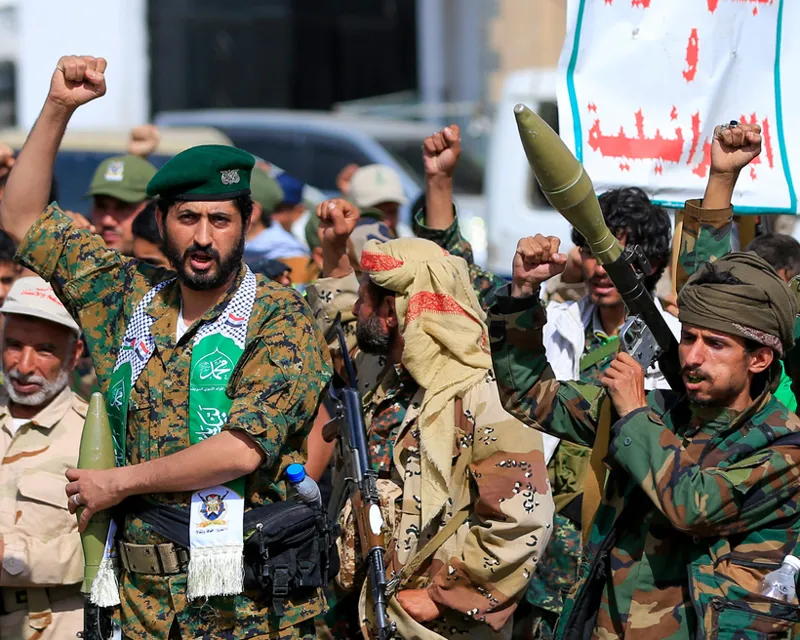
Houthi forces in Yemen are making a concerted drive to take over the country’s Red Sea coast fully, claiming control of the key port of Mocha in the most serious wave of fighting with the Saudi-backed government in years, bringing the Iran-aligned group closer to full control of a key shipping route.
Seizure of the coast and some of the islands in the sea would be a strategic disaster for Saudi Arabia and the US, taking Iran and its proxies closer to full control of two choke points for western shipping on opposite sides of the Arabian peninsula: the Bab al-Mandab at the southern end of the Red Sea and the strait of Hormuz in the Gulf.
Observers have said a reduction in hostilities – the most intense since the UN-sponsored ceasefire of April 2022 put an end to major military exchanges – now seems unlikely in what is seen as an attempt by the Houthis to open a second front in the Iran-US war, alongside the battle for control of Hormuz.
Baraa Shiban, the Royal United Services Institute’s (Rusi) Yemen specialist, a London-based security thinktank, said the situation in the country was spiralling out of control, adding that the UN-recognised Yemeni government was opening new fronts against the Houthis in the hope of putting more pressure on their forces than they could withstand. But in the past 48 hours the Houthis had [made] major advances south, down Yemen’s west coast, taking them closer to the high ground overlooking the narrow Bab al-Mandab strait.
[...]
By taking control of more of the Red Sea coast south of the port of Hodeidah, the Houthis’ aim is to use a new lever to put pressure on Saudi Arabia and the US to agree a deal that lifts the US blockade on Iranian oil tankers in the Gulf. Donald Trump on Wednesday acknowledged he did not expect the war with Iran to end before the US midterm elections at the start of November.
The latest phase in the escalation began when Houthis attacked energy installations and southern cities in Saudi Arabia using drones and ballistic missiles. In response, the kingdom’s military forces launched at least 15 strikes between 3 and 7 September.
[...]
The clashes have raged across Yemen, including Ad Dali, al-Bayda, Marib, Shabwah, al-Jawf, Hodeidah, and Taiz. In the initial days of the renewed conflict the Houthis were forced back in some areas as battles on multiple fronts overstretched their resources and fighter numbers.
The Houthis will be hoping political divisions inside the Yemeni government, reflected in a lack of an integrated military, will slowly give them the upper hand. The United Arab Emirates, previously a powerful player in southern Yemen where it backed the separatist forces of the Southern Transitional Council, withdrew its financial and military support at the turn of the year. The southern forces have refused to fight outside their own region.
[...]
The escalation to this week’s all-out violence has been a slow process. It began after a senior delegation of the Houthi group, which has long been in a complex alliance with Iran, flew to Tehran for the funeral of the Iranian supreme leader Ali Khamenei in July, returning in an Iranian plane that the Saudis refused to land in rebel-controlled Sana’a.
The Saudis instead bombed the runway, leading the Houthis to announce a Red Sea naval blockade of Saudi Arabia in what the Yemeni group described as a blockade for a blockade. The 20 July announcement of the blockade was followed by a strike on Saudi Arabia’s Jazan refinery on 25 July and on a tanker off Yanbu on 24 August.
Saudi Arabia has become reliant on the Red Sea route for trade after Iran throttled shipping through the strait of Hormuz as a result of US-Israeli attacks.
The other day I saw somebody refer to Yemen as one of the forgotten political divides of the twentieth century. Anyone with a casual understanding of Cold War geopolitics will be familiar with, for example, North and South Korea; the Deutsche Demokratische Republik and the Federal Republic of Germany, East and West; North and South Vietnam.
Fewer will be aware that the nation of Yemen, situated on the southern tip of the Arabian Peninsula facing Eritrea, Djibouti and Somaliland, was also once divided by struggle between two visions of order—as it is today.
Not that anyone should be blamed for this. Of all those political-geographic schisms, the Yemeni one might be the most perplexing, all of its conceptual underpinnings criss-crossing and bearing so many asterisks one might think they were observing the sky rather than a terrestrial dispute.
Perhaps the easiest way to illustrate this dynamic is the fact that Yemen’s division is categorised as one between North and South, but when observed on a map the relation looks more like one between East and West, with some of the southern Yemeni regions being situated further North than the western North’s regions. Are you still with me?
To explain the long history of this division would take too long and do damage to my precious hairline. Suffice to say that for centuries Yemen’s two axes have harboured disputes of political, territorial, educational, cultural, economic, confessional, colonial and imperial origins, and that the polarities of these disputes have switched on numerous occasions in ways that only confound further.
During the mid-1960s, an insurgency against British presence in the country resulted in Britain’s exit from southern Yemen and the formation of the People’s Democratic Republic of Yemen, opposed to the Yemen Arab Republic in the north.
The Marxist government in the south, which allied with the Soviet Union, was localised primarily around the port city of Aden, which had been heavily developed by the British owing to its utility as a stopoff on the long shipping journey from Britain, down through the Suez Canal and on to India.
The north, following a Nasserist military coup a few years later, became a more conservative Arab republic with a market economy, and hewed close to its Arab neighbours.
Each side, however, remained riven with contradictions. The south had the strategically and economically valuable Aden, but was otherwise limited in resources. The north hosted the majority of the country’s population, but they remained oriented around traditional tribal customs and patronage networks. There was also a religious divide between Zaydi Shia groups in the northern highlands and Shafi'i Sunni groups in the south.
Again, none of these divides were neat, nor did any singular issue encapsulate the political split. What matters is that while both countries trudged along with outside support, neither was entirely viable without the other, a fact which became more salient with the end of the Cold War, leading to their unification shortly thereafter.
Forward to the modern context, Yemen’s present civil war emerged following an uprising against the government in 2011 as part of the wider Arab Spring movement. Several years of interventions from various Gulf states, as well as deployments by the US military and CIA, both overt and unacknowledged, culminated in the eruption of a new phase of civil war in 2015.
This time, the divide was between Ansar Allah, a Zaydi Shia group in the north known also by the surname of their founder, Hussein al-Houthi and his brother Abdul-Malik, who succeeded him; and Yemeni government forces, backed by an array of international partners, but most prominently Saudi Arabia and the UAE.
From that point on began successive waves of horrific, brutal violence in the country, most notably that inflicted from without. Enjoying full backing and support from the United States, Saudi Arabia prosecuted a siege campaign against the Houthis, blockading Yemen and carrying out a murderous and ultimately fruitless campaign of aerial bombardment on the country, striking water treatment facilities and other vital civilian infrastructure leading to rife famine and deprivation in the country.
All told, it’s estimated Saudi Arabia’s campaign in Yemen led to the deaths of hundreds of thousands of civilians, and has been classed as a genocide. What it did not succeed in achieving, however, was dislodging the Houthis. In 2022, after over a half-decade of killing, the violence largely subsided with the signing of a ceasefire.
In recent years, the Houthis have gained a reputation for being, depending on your perspective, a thorn in the side of the rules-based international order, or an imperfect voice of moral reason amidst the Israeli genocide.
Since Israel began its campaign of extermination of the Palestinians following October 7th, Ansar Allah has used its positioning on the Bab al-Mandab Strait to disrupt shipping through the Red Sea up to the Suez, inflicting economic consequences on Israel, the US, Saudi Arabia and their allies for their complicity in the mass murder of Palestinians.
Despite repeated attempts by the Biden administration to cease the Houthis’ activities through military strikes, they were incapable of ending the threat entirely. Their activities largely subsided with the signing of the largely symbolic Gaza Ceasefire in early 2025.
With the US and Israel’s attacks on Iran, the Houthis’ primary backer and ally in the region, the Trump administration kicked the hornet’s nest once more. In recent weeks, the Houthis have sought to exacerbate the economic pain inflicted by Iran’s closure of the Straits of Hormuz by closing the door on Bab al-Mandab.
In continuity with Yemen’s tendency for conflicting characteristics, Ansar Allah’s sudden surge across Yemen’s west coast over the past week is simultaneously out of nowhere and also a culmination. Pundits and commentators who are currently expressing shock that the group would be able to run the table like this are overlooking the fact that since 2015, the group has stood toe-to-toe with multiple adversaries and emerged, if not victorious, then able to fight another day.
In the context of both the Israeli genocide of the Palestinians and the American blunder against Iran, Ansar Allah has proven a remarkable degree of strategic nous, knowing when to press its advantage, and how. With the group having declared its intention to turn the screws on Red Sea shipping, rapidly mobilising to seize key port cities down the western coast, and even apparently executing an amphibious landing to seize the strategically valuable island of Mayyun, their military capabilities are also being put on display for all to see.
Detractors can fairly dismiss these circumstances, and argue that Ansar Allah have only achieved so much because the US has never deemed the group worthy of full attention; and that Yemen remains a comparatively marginal and limited conflict in the context of the broader regional unrest.
But as the saying goes, that and a quarter will get you a phone call. It cannot fully account for why and how the group has repeatedly confounded and vanquished much larger foes, and is now effectively executing and securing military objectives that would make those foes blush. (How long has the much larger and more powerful US been talking about seizing Kharg Island?)
One reason I have a personal aversion to the term ‘proxy’ is that it falls into the lexicon of words western pundits and commentators only use when talking about governments with whom the US has adversarial relations. The west has governments; their enemies have regimes. The west has allies and coalitions; their enemies axes and proxies; the west has populist conservatives; the enemies have hardliners.
Certainly, Ansar Allah has benefited from strong relations with Iran and its government over the years. One might ask why this is any more or less moral than the US relationship with Saudi Arabia or UAE, who appear incapable of using their western-supported militaries for anything other than war crimes and massacres.
But to call an entity a proxy is to deny its own motives, ideological priors, and operational independence. Over the past few years, and particularly these recent weeks, Ansar Allah has demonstrated it is more than a product simply manufactured from without. It might be time for the US and its proxies to begin reckoning with them on that basis.
Otherwise, we can expect the Houthis to take what has been an economically costly and painful summer for Europe and the West, and turn it into a hellish winter. They’ve proven their capability and their determination. To test their will at this point would be foolish.
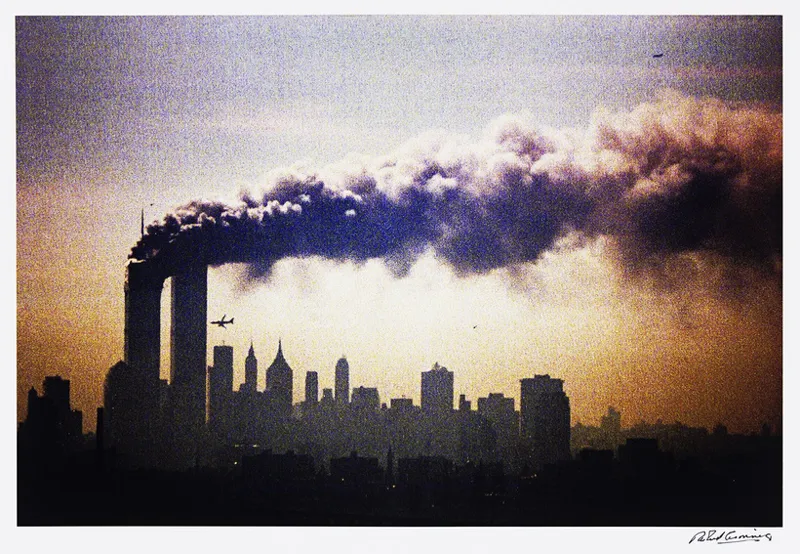
This past Friday marked the 25th anniversary of the attacks of September 11th, 2001, in which a group of al Qaeda militants crashed a number of commercial passenger jets into the World Trade Center buildings in Manhattan, New York City, the Pentagon in Washington, D.C., and a field in Pennsylvania.
Someone on Bluesky the other day said that most ‘Where were you on 9/11?’ stories have one thing in common; namely, that they are boring. Mine is no exception. I was nine years old, my mother had just picked me up from school. I remember it was a bright and sunny day.
As we drove down a winding country road past the hedgerows of fields, I heard the mumbling of the radio and asked her what had happened. She replied, “Some people have crashed planes into a building in New York.” I don’t remember much else. I simply remember how sunny it was, the green of the leaves in the hedgerows, and how they blurred to my vision in the passing car.
As such, for all the impact 9/11 and its aftermath has had on myself and my politics, this show, and the world in which this all takes place, I feel neither positioned nor qualified to talk about the event itself.
Former guest and NYC resident Spencer Ackerman is currently rolling out a series of pieces about September 11th and its aftermath over at Forever Wars. His piece published on the day is both brief and poignant, with the feel of dejected retrospection that can only come from a career of writing in this space which I imagine often bears an echoing sentiment of how it should have been unnecessary.
The Guardian also published a collection of comments from different Americans on the ways they feel the events of that day transformed their country and themselves. Here are two which stuck with me in particular:
Ashley, a 30-year-old based in Washington DC, who celebrated her fifth birthday on 11 September 2001, said: “People who are older than me say ‘it united the whole country’. But growing up alongside its passing anniversary, I feel it completely unraveled the US, and we are still wrestling with its legacy.”
She added: “To me, 9/11 has become representative of in America, paranoia, death, destruction, revenge, greed. Even our younger generations laugh at it, because they are desensitized not just to the violence of that day, but the overwhelming violence America committed abroad in its wake.”
[...]
Dan J, a 42-year-old based in Vermont, said: “From day one, the attacks on 9/11 have been used to demonize and dehumanize an entire region of the world.
“We allowed 9/11 to bring our nation together, not in grieving or resilience, but in group hatred. I was ashamed of us then, and as we have allowed this country to become more absorbed in hatred, xenophobia and isolation now, the shame is stronger.”
Tom Usher, a former guest of the show and a good friend of myself and Thomas, has just launched a new show, Tangible Vibe Shift, in which he hopes to explore events and moments in history in which we experience that palpable feeling that something in our world is irreversibly changing.
For Tom, September 11th was that event, and continues to be one which he fixates upon and chews over, and so it was that which he selected as his inaugural episode, which dropped, serendipitously, on September 11th. If you know Tom from his time writing for VICE and elsewhere, his posting on social media, or his many appearances across the digital space, you’ll know he’s both a very funny and irreverent individual, but with a marked capacity for empathy, introspection and profundity that is frankly inappropriate for a hard geezer such as himself.
In any case, if you’d like to reminisce in a more light-hearted manner about the time them slags smashed into the Twin Towers, I’d highly recommend checking out his show and hitting the ‘Subscribe’ button on YouTube.
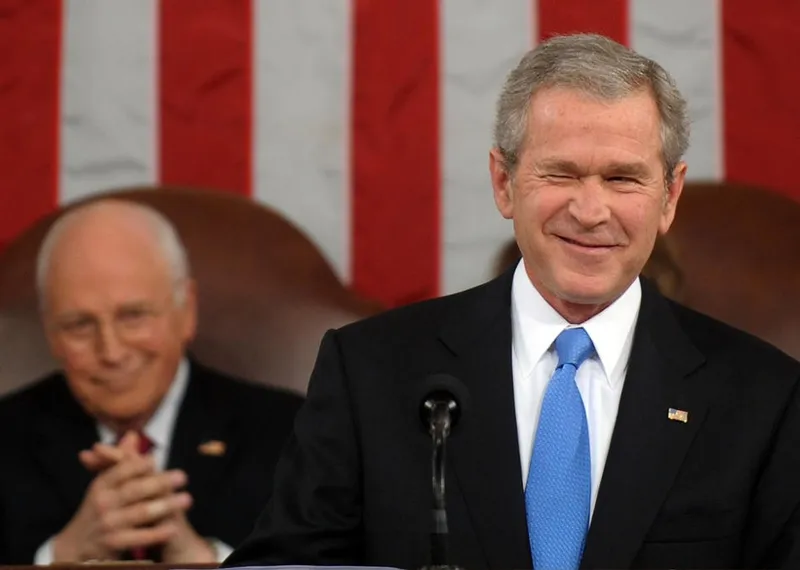
Lastly, I’d like to share a piece written by the American essayist Elaine Scarry, published in September, 2008, in Boston Review. Written on the eve of that year’s Presidential elections, which would see George W. Bush’s Republican Party ejected from power, replaced with Barack Obama, the essay, entitled ‘Presidential Crimes’, is a forceful argument for the need to criminally prosecute Bush and his allies for the criminality inflicted on the world while in office, and the moral and political hazard of not doing so. Which is what was not done.
The essay is long, rigorous and weighty, and so difficult to summarise succinctly. If you want a Sunday long-read, consider giving it your time.
Here is one passage which has sat with me:
“[...] Let us suppose what is fair to suppose, that Barack Obama and John McCain continue in good health, are as wedded to the law as they appear, that one of the two is elected fairly and honestly, and that the country begins its mighty pivot back to its gravitational center in the rule of law. It will be almost like a miracle cure, an overnight release from our eight-year-long affliction.
Or will it? What will this shift over to the rule of law mean? It will mean that when we are led by a person who does not believe in the rule of law, we will not as a country follow the rule of law; and when we are led by a person who does believe in the rule of law, we will follow the rule of law. If that is the case, the United States will continue to be what it has been during the last eight years: a country governed by the rule of men (their beliefs, their preferences, their choices), not by the rule of law (where beliefs, preferences, and choices are constrained by invariable and nonnegotiable prohibitions on cruelty and fraud). Just as one might in the past have said, “this president was short whereas the next president was tall” or “this president was isolationist whereas as the next president was internationalist,” so now one might shrug and say, “this president believed it was his prerogative to torture whereas the next president believed it was not.” The incalculable damage left by Bush and Cheney’s day-in-and-day-out contempt for national and international law includes the power to sweep forward in time and trivialize into a matter of personal preference any future president’s adherence to the law. Will we become a country in which the rule of law is just another policy preference? Do we really think that the rule of law is to be left in the hands of our leaders?”
Here’s a poem by Robert Frost.
Two roads diverged in a yellow wood,
And sorry I could not travel both
And be one traveler, long I stood
And looked down one as far as I could
To where it bent in the undergrowth;
Then took the other, as just as fair,
And having perhaps the better claim,
Because it was grassy and wanted wear;
Though as for that the passing there
Had worn them really about the same,
And both that morning equally lay
In leaves no step had trodden black.
Oh, I kept the first for another day!
Yet knowing how way leads on to way,
I doubted if I should ever come back.
I shall be telling this with a sigh
Somewhere ages and ages hence:
Two roads diverged in a wood, and I—
I took the one less traveled by,
And that has made all the difference.